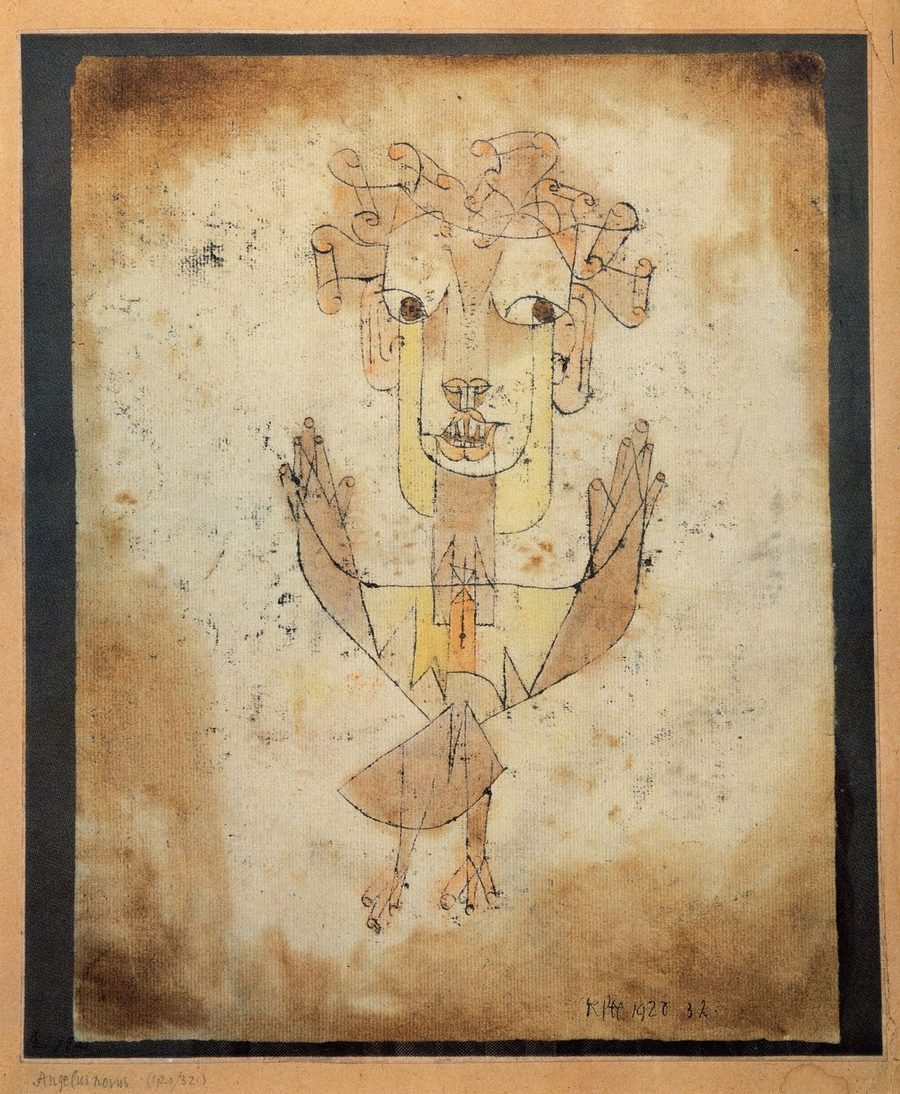
Paul Klee, Angelus Novus, 1920
In late May, I flew to New York City in the hopes of not seeing Paul Klee’s Angelus Novus. The 1920 print is perhaps best known for inspiring a mournful meditation from the German Jewish writer Walter Benjamin, who associated Klee’s uneven, delicate stick figure—what a petroglyph would look like if made by a tentative kabbalist—with “the angel of history.” Now owned by the Israel Museum, the piece was supposed to be included in an exhibition of Klee’s art at the Jewish Museum, but it was delayed in Jerusalem after Israel and the United States bombed Iran. When the exhibit opened in March without the famous work, the joke wrote itself, and indeed was circulated among the sort of nerds who make quips about critical theory: The Angel of History is stuck in Jerusalem. Although I laughed, I felt some misgivings over the un-Benjaminian sleight of hand at work in the conflation of the angel of history—an imaginative concept—with the Angelus Novus—a singular, physical object. After all, Benjamin had subjected individual art-objects to withering, iconoclastic critique. Wary of the icon’s claim to instantiate spiritual truth physically, Benjamin celebrated Klee’s image instead for its suggestive absences, for what was not there. When I booked my trip, I felt that not seeing the Angelus Novus would be as close as one could get to not seeing the face of God in the ancient Temple. But by the time I had arrived, so had Klee’s original, replacing a reproduction hung in its place. Seeing it, I felt I was rewatching the scene in which Dorothy discovers, with the curtain removed, that the Wizard is a humbug.
Despite my qualms about this simplifying substitution, in the weeks after I gazed upon Klee’s angel, I found myself thinking of Benjamin’s. In his “Theses on the Philosophy of History,” Benjamin wrote that Klee’s angel “looks as though he were about to distance himself from something which he is staring at.” It reminds him of the angel of history, who he imagines gazing at “one single catastrophe which keeps piling wreckage.” Helpless to intervene, this angel is perpetually thrust backward into the future by “the storm . . . we call progress.” Benjamin wrote these lines in 1940, shortly before he fled Vichy France to a Catalonian border town. Informed that the Franco regime had canceled transit visas and would deport Benjamin, alongside other Jewish refugees, back to France, he killed himself. In describing the angel, it is as if Benjamin were composing his own eulogy. But he was also burying the Enlightenment’s confidence. Its just-so story of continuous historical progress born of human rationality was among the innumerable casualties of rampant fascism.
As Benjamin saw it, a repressed theology lay hidden beneath modern mechanistic notions of inevitable evolution. The essay opens with a critique of always-victorious “historical materialism,” by which Benjamin evidently means the smug certainties of German social democrats, so certain of history’s inevitably progressive evolution that they had discounted the threat of Nazism. He compares such an unflappable belief in progress to a chess-playing automaton, which conceals within it “a hunchbacked dwarf who was a master chess-player”; the latter figure represents “theology, which as everyone knows is small and ugly and must be kept out of sight.” Against such secularized faith, Benjamin counterposes religious doubt, using Klee’s angel to imagine an uncanny myth; by explicitly embracing religious motifs, he drains them of their capacity to reassure and employs them instead to discomfit. Benjamin’s imagining of the angel of history encompasses creation through eschaton: from the storm “blowing in from Paradise” to the angel’s desire to “awaken the dead.” But the angel, of course, cannot do it. These theological horizons are, well, horizons—always slipping out of reach. And who ever heard of an “angel of history,” anyway? Jews have long worshipped the God of history; angels, by contrast, perform discrete tasks or supervise specific nations. Benjamin quietly overturns this traditional division of labor by outsourcing universal providence to a mere angel, and an impotent one at that. Like an unqualified caryatid, the “new angel” assumes the old God’s burden but is crushed under the weight. History is overseen by this flimsy assemblage of lines and shades of beige, who is paradoxically subject to the violence he is supposed to remedy.
Even more paradoxically, by pointing to what the angel observes, Benjamin suggests that you cannot really understand Klee’s image by looking at it. The one single catastrophe: not pictured. In 1940 Europe, the “piling wreckage” hardly needed to be depicted; the angel, same as anyone, was staring at bombed cities, bread lines, and concentration camps. Like the photographic negative of the Baroque chiaroscuro technique, in which intense contrasts between light and dark direct our attention to a posited source of illumination beyond the canvas, Benjamin’s interpretation subordinates the work of art to an overwhelming, contextual darkness. Which is also to say that Benjamin takes no interest in the concrete, unchanging object that Klee created in 1920. His concern was rather with the juxtaposition of that image with his own transitory situation: with art in a specific political situation.
Accordingly, Benjamin carefully refrains from equating his angel with Klee’s; instead, after naming and describing Klee’s print, he writes, “This is how one pictures the angel of history.” Klee’s image does not represent Benjamin’s myth, but merely reminds us of it. By shifting from image to imagination, Benjamin echoes his earlier, famous argument that capitalism’s capacity to mechanically reproduce artworks strips individual masterpieces of their “aura.” By that term, he means the deictic luminosity of a fetish object, the mysterious property that draws crowds to the Mona Lisa and dictates that we reverently whisper our wonder. Benjamin associates the modern cultivation of “aura” with the fascist dictator and his cult of personality, to which he counterposes the hope that the ubiquity of cheap, industrial replication might allow publics to critique, rather than worship, art. Benjamin’s reading insists that we not linger on Klee’s piece. The angel cannot turn, but we can and must. We reorient ourselves, pivoting from mythic image to critical thought. Klee himself tended to sketch incomplete outlines, aiming not at self-contained monuments but fragmentary, provisional drafts, which ask the viewer to imagine the details. He also loved monoprint, the technique used to create Angelus Novus, in which a flat, inked plate transfers a drawing onto the final medium, resulting in a unique piece that is both handcrafted and mechanically reproduced. In monoprint, as in much of Klee’s work, the artist’s immediate draftsmanship is oddly estranged from itself, rendered tentative and indirect.
Ironically, the reception of Benjamin’s “Theses” made Klee’s Angelus Novus into one of the secular cult objects the philosopher so mistrusted. Through Benjamin’s martyrdom, Klee’s print became a relic, the occasion not for critique but for hagiography. Its legend only grew as it acquired its own involved saga of provenance. Having bought the print in 1921, Benjamin entrusted it, before fleeing Paris, to the French surrealist Georges Bataille; Bataille delivered the angel (in Frankfurt) to the Marxist critic Theodor Adorno; in New York, Adorno handed it over, as per Benjamin’s will, to the scholar of Jewish mysticism Gershom Scholem; Scholem bequeathed it to the Israel Museum. This convoluted sequence of intellectual celebrities suggests itself as heroic genealogy, a chain of tradition miraculously connecting us to the lost world of German Jewish thought. As a curator at the Jewish Museum puts it in the exhibit’s audio guide, “That lineage of extraordinary philosophers and intellectuals caring for it posthumously . . . makes the whole story one of rescue and preservation of another order.” Conveniently, the spoils of the diaspora found their way to the homeland. Because of Scholem’s gift, the State of Israel here, as elsewhere, claims both to correct the exilic impotence of Jews like Benjamin and to inherit their legacy, first to negate the diaspora and then to take possession of its riches.
Benjamin would have understood all too well his text’s appropriation as a nationalist trophy. He writes terrifyingly of present victors’ power over the past: “Even the dead will not be safe from the enemy if he wins.” Here again, Benjamin rejects the illusion of a fixed, monumental past; historical legacies are battlegrounds, to be won or lost in today’s struggles. One sees an intimation of this idea in the Jewish Museum’s laudable choice to devote a full exhibit to Klee. For Paul Klee was notably not a Jew, though he was accused of being one by the Nazis, who attacked his art as “degenerate.” He responded by gamely incorporating Stars of David and legendary “Red Jews” into his sketches and paintings. In honoring Klee (including his earlier, pre-Nazi work), the Jewish Museum acknowledges an anti-essentialist account of its own organizing identity category: art, and even artists, can be made Jewish, even retrospectively, by the assault of history. Because the fight against fascism furnishes the rationale for the exhibition, the museum might have easily gone further, connecting the ultra-nationalism and genocide of Klee’s moment to our own.
Instead, in the awkward interval between the exhibition’s opening and the piece’s arrival, the museum attempted to smooth over the present crisis, posting a staggeringly euphemistic note alongside the facsimile Angelus Novus: “Due to current conditions affecting international transport, the shipment of the original artwork has been temporarily delayed.” In other words, Israel and the United States had launched a war of aggression against Iran, which included murdering 120 schoolchildren in a single attack and (to compare great things with small) obliterating an Iranian synagogue containing centuries-old Torah scrolls in another, and which created a public health emergency across the region. Such are the “conditions,” as they put it, “affecting international transport.” By papering over this brutal reality, the museum helps attendees fail to ask: What are the ethics of borrowing and exhibiting this prize piece from Israel, a country presently ruled by a man his death-dealing predecessor, Yitzhak Shamir, called “the angel of destruction”? The angel did not fly, to put it bluntly, because Israeli bombers did. Celebrating Israel’s role in the “rescue and preservation” of this Klee with only the vaguest acknowledgment of “current conditions,” perversely evacuates the piece of the political, circumstantial significance Benjamin accorded it.
By the time I saw the exhibit in late May, the original Klee had materialized, and all reference to what the museum apparently sees as a regrettable hiccup had correspondingly vanished. The Angelus Novus plays no conceptual role in the exhibit, which after establishing Klee’s Bauhaus phase, focuses on his late, anti-Nazi work. (The broader exhibit, which Mitch Abidor wrote about for Currents, is simply marvelous.) The piece is displayed on its own, placed in an alcove in an awkward connecting room with an arched doorway, reminiscent of a cathedral. This angel has become a star, to be gawked at, or perhaps venerated: what Catholics call an icon, and Jews refer to as an idol.
Passing through the Jewish Museum’s metal detector, under the watchful eye of an armed police officer, I was reminded of the prayer of the crusader king Richard the Lionheart as he approached Jerusalem. According to the chronicle histories, he threw his cloak over his eyes and said, “Blessed Lord God, I pray thee not to let me see thy Holy City that I could not deliver from the hands of thy enemies.” The Jewish Museum is not my enemy—and, of course, any Jew would have been rooting for Saladin. Nonetheless, I appreciate Richard’s refusal to be a pilgrim, his subordination of the Holy of Holies to the relevant political context. Richard recognized the deadening effect of unthinking piety and the impropriety of according absolute respect to what has value only in proper relation to its conditions. Such respect and its corollary, the studiously depoliticizing canonization of figures who insisted on their works’ urgent dialogue with a moment of danger, are the idols of the mind. It is no blessing to see Klee’s art in their grasp. Klee’s art, especially as interpreted by Benjamin, does not ask of us deference or mute wonder: It demands to be thought about.

I’m Arielle Angel, editor-at-large of Jewish Currents. Before you go, there’s something I need to ask.
We’ve seen over and over how the mainstream media falters in telling stories on our beats—whether it’s antisemitism, Israel/Palestine in American politics, Jewish identity, or the American left. At Jewish Currents we’re committed to uncompromising analysis and longform reporting on these issues and more—stories you won’t find anywhere else. In a media landscape that obscures injustice and flattens discussion, we’re changing the conversation. But we need you.
If you believe in this work, please consider making a donation—or even better, a recurring one—to ensure that we are able to keep publishing stories like this one. We can’t do it without you.

Raphael Magarik is an assistant professor of English at the University of Illinois Chicago; his book, Fictions of God, is out now.