The Dream Logic of Fascism
In Charlotte Beradt’s study of nightmares under Nazism, the analysis often seems inadequate to the material.
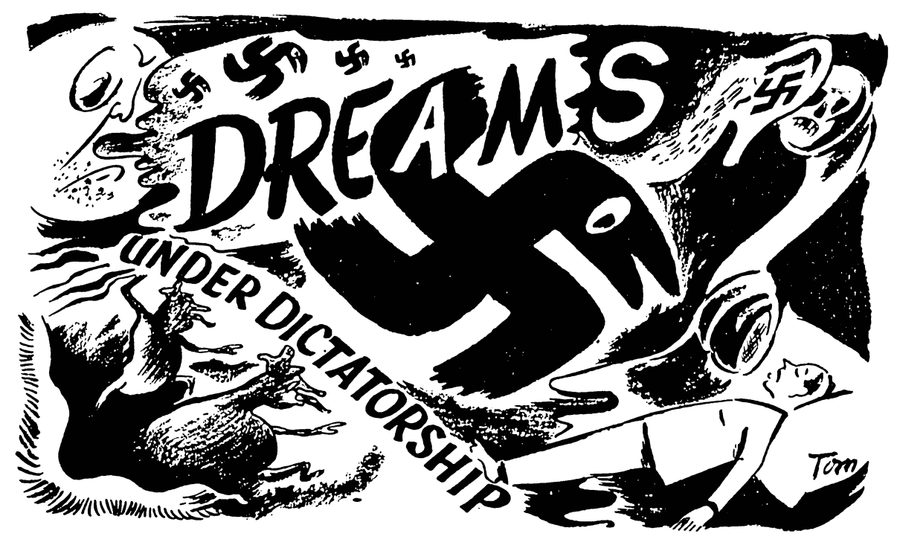
Image from a 1943 Charlotte Beradt essay in Free World that became the basis for The Third Reich of Dreams

Discussed in this essay: The Third Reich of Dreams: The Nightmares of a Nation, by Charlotte Beradt, translated by Damion Searls. Princeton University Press, 2025. 152 pages.
Several weeks after Trump’s inauguration, I dreamed that my wife and I wanted to have our infant daughter’s room painted but could not afford to at today’s rates. Fortunately, we had access to a time machine; a house painter from the past would be much cheaper. Concerned about our workman interfering with history upon his return, we knew we would have to keep him absolutely insulated from current events. I suggested that we hire a young Adolf Hitler, whom we would have every incentive to hide from the world. He did good work, and we happily sent him back to the 1920s, but I soon noticed that we had somehow slipped up and made the Holocaust even worse. We agreed that if we did this again, we would have to be more careful.
By enlisting the past-future führer (and mediocre painter) in our home-improvement project, my mind seemed to express absurdly what, in those days, I found myself constantly remarking upon to friends: namely, the absolute incongruity between the unfolding catastrophes of the world at large and my nuclear family’s tiny Eden. The ominous tendril to creep in under the nursery door was, appropriately, a rise in prices—a proximate cause of Trump’s victory and thus our current authoritarian woes. The dream also evoked an uncomfortable truth: Much as my imaginary Hitler was serving rather than threatening our domestic tranquility, in the increasingly nightmarish real world, fascism was purporting to protect my family. A week before the dream, Mahmoud Khalil, a US permanent resident, had been kidnapped, detained, and threatened with deportation under the pretense that he, and the pro-Palestine protests he helped lead at Columbia, represented a threat to young Jews, which is to say that our daughter was, in a sense, the rationale for storm trooper thuggery. Indeed, my fantasy of a Hitlerian TaskRabbit resembles the mainstream Jewish institutions’ delusion of collaborating safely with Trumpists to quash criticism of Israel.
At the time, I had Nazi dreams on the brain; I was reading the new edition of The Third Reich of Dreams: The Nightmares of a Nation, a remarkable book by German journalist Charlotte Beradt, originally published in 1966 and now freshly translated by Damion Searls and reissued by Princeton University Press. Inspired by her own terrible nightmares, Beradt began collecting them from friends and acquaintances in 1933. She eventually assembled more than 300 dreams, which she anonymized, rendering certain key terms in code—Hitler became “Uncle Hans,” an arrest was “the flu”—and hid in the spines of her books. Before she and her husband, both Jews and Communists, fled to London in 1939, Beradt mailed some to friends abroad for safekeeping. In 1943, living in New York, she wrote a short article for the left-liberal magazine Free World about the material she had amassed, before finally releasing the collection of several dozen dreams with her commentary. (An English edition, translated by Adriane Gottwald, followed in 1968.)
The Third Reich of Dreams makes a powerful impression; I found it literally breathtaking. Some of the dreams are terrifying, as when a girl imagines that the angelic figurines hanging above her bed were surveilling rather than shielding her. Others are more subtly ominous. Many people reported dreaming: “It’s forbidden to dream but I’m dreaming anyway”; one hatmaker imagined that “to be safe” from government persecution, she was “speaking Russian . . . so that I wouldn’t understand myself.” As Beradt exposes the fears and desires of ordinary Germans, one feels oneself encountering an unmediated underbelly, as if the Holocaust had been made to lie on an analyst’s couch.
As Beradt exposes the fears and desires of ordinary Germans, one feels oneself encountering an unmediated underbelly, as if the Holocaust had been made to lie on an analyst’s couch.
The marketing of the new edition suggests that Beradt’s book offers not just historical insight but lessons for our frightening present. A front-cover blurb by novelist Zadie Smith describes it as “essential reading for anyone who has known what it is like to live within a totalitarian state—or is worried they’re about to find out,” and a new preface by poet Dunya Mikhail calls the text “strikingly relevant” and “incredibly timely.” Some of the reception has been even more direct: Mark Dery wrote in The Washington Post that “this travelogue through the German unconscious will look chillingly familiar to anyone living in Trump’s America.” Smith says much the same in her own essay about the edition for The New York Review of Books.
Right-wing authoritarianism is at its worst globally since the 1930s; some analogy between the two moments is unavoidable and even useful. But comparison can easily lead to analytic imprecision. For instance, despite conceding that there are significant differences between Nazism and Trumpism, Smith’s review nonetheless describes both as “totalitarianism,” with the ideologies sharing a common “propaganda machine.” (Now it’s the “algorithm,” instead of the “megaphone, the radio, and the printing press,” that is “imposing mandatory conformity.”) Thus the relevance of Beradt’s “straightforward picture of the psychological effects of propaganda and manipulation upon a populace.” However authoritarian and fascist our contemporary regime is, it is generally not described as “totalitarian”—and for good reason. Far from subsuming private life into the public state, Trump is aiming at something like the reverse: the federal bureaucracy dismantled, health care regulated by innumerable quack influencers, more “school choice” and church charters. Even his assertion of federal authority hinges on the preservation of the private sphere, like state repression to secure the private rights of Zionist students to their “safe spaces.” (And whatever social media’s baneful contributions to Trumpism, ten minutes on X will confirm that it enforces not “conformity” but abrasive, partisan disagreement.) Careless analogizing produces not just platitudes but actual obfuscation.
One can hardly blame an author for her posthumous reception, but Beradt’s text itself offers the kind of too-tidy conception of Nazi totalitarianism that facilitates facile analogies to the present and impedes a knottier mode of historical comparison. Reading the dreams she collected as invested with a pristine clarity and oracular foresight, Beradt posits a single shared psychology of life in the totalitarian state. In so doing, she oversimplifies the past, leveling the social contradictions out of which Nazism arose and treating 1930s German society as if it were already the uniform singularity toward which the state aspired. The Third Reich of Dreams is thus easily assimilable into straightforward tales of authoritarian power and valiant resistance, and satisfying to those seeking the consolation such stories can offer. Those binaries comfortingly cast us as heroes or victims. But dreams can do much more interesting work. As my own surreal reflection of my family’s role as authoritarian pretext suggests, they can instead reveal the web of complex conflicts, both psychological and political, in which we are caught. Ultimately, Beradt’s dreams thus have most to teach us if we attend to the ways they exceed her interpretations—to their stubborn hints of the entanglements from which fascism emerges.
Beradt was fascinated by her dream archive’s apparent prescience; she repeatedly calls attention to moments and images that anticipate later events. Although their visions are “not prophetic,” she writes in the first chapter, “these dreamers, with sensitivity sharpened by fear and repulsion, perceive almost imperceptible symptoms in the profusion of daily events.” The hatmaker’s dream about speaking a language she did not understand “in case [she] said anything about the government,” Beradt writes, “has since become reality in Auschwitz, where the impossible became possible”; at the 1947 Auschwitz trial, a camp prisoner who had worked as a secretary testified to her fear of having revealed state secrets in her sleep. Elsewhere, a young woman dreams of hiding beneath a pile of corpses. “What comes to mind,” Beradt writes, “is that ten years after this dream, during the mass exterminations of ‘the Final Solution,’ people without the right papers really did have to hide beneath piles of corpses.”
But the uncanny portrait of a nation glimpsing its inevitable fate depends on Beradt’s editing and commentary. Sometimes, in its commitment to predictive reading, the exegesis discards or obscures the past and present. In the case of the dream about the pile of corpses, the dreamer herself connects the gruesome scene to “a description of the pile of corpses left outside of Khartoum after the Mahdist revolt,” a brutal struggle in which Sudanese rebels fought first the Egyptian army and then the British Empire. Beradt’s emphasis on the dream’s anticipatory quality requires turning away from the Holocaust’s precedents in the colonial violence that anticipated Auschwitz. Later in the book, Beradt writes that a Jewish woman’s dream of a “Vermin Keep Out” sign at a restaurant in proves the dreamer’s ability to “predict in detail the upcoming campaigns,” because such signs “had not yet started showing up in restaurants”—except the dream occurred in “the winter of 1936-’37,” when they certainly had. In such cases, Beradt’s book contains what biblical scholars describe as prophecies “ex eventu,” that is, ones written after, and with consequent knowledge of, the events they purportedly predict. More often, though, Beradt extends early symptoms of Nazism’s ultimate catastrophe into premonitions of a more general concept of 20th-century oppression. After an account of a dream involving surveillance, Beradt remarks, “It is important to realize that this dream . . . dates from 1933. What today are political facts, everyday realities, were not yet described in novels: Orwell’s ever-present Big Brother did not yet exist.”
Beradt’s tendencies toward consolidation and abstraction were part of a broader contemporary trend that elevated the Holocaust above the contingencies of ordinary history and into the realm of indelible myth. The sociologist Jeffrey Alexander describes the 1950s and ’60s as pivotal decades for the “removal of the Holocaust from particulars of time, place, and person” and its transformation into a “moral universal.” What early observers often understood as various specific war crimes were reinterpreted as a single, unified event and given the name we now take for granted—a conceptual shift that made the Nazi genocide newly available for abstract analogizing. In her 1951 classic The Origins of Totalitarianism, Hannah Arendt interpreted Nazism and Stalinism as twin instances of the same phenomenon; this analysis not only gave intellectual heft to a common-sense, liberal anti-communism by casting the USSR as absolutely villainous but also helped fashion from the Holocaust an explanatory paradigm to be applied elsewhere. A decade later, the Milgram experiments proffered universal, social-psychological theories of human susceptibility to authoritarianism (one participant reported that his wife told him, “You can call yourself Eichmann”). Gradually, the Holocaust came to be seen as potentially relevant to everyone, the global paradigm for genocidal evil.
Beradt’s tendencies toward consolidation and abstraction were part of a broader contemporary trend that elevated the Holocaust above the contingencies of ordinary history and into the realm of indelible myth.
As in this emerging myth, the details of history are less important in The Third Reich of Dreams than the clash of moral forces, from which Beradt derives an analytic typology concerned with the degeneration of the individual personality under totalitarianism: The majority, who submitted to the regime, lost their very personhood, whereas the few who resisted were rewarded with continued psychological coherence. She describes a woman who dreams of hiding her copy of the possibly subversive Schiller play Don Carlos under her maid’s bed; when the storm troopers find it, she realizes the book she hid was actually a harmless atlas but nonetheless “stood there feeling horribly guilty and let them throw it on the truck.” Here, Beradt identifies “the new kind of individual created by totalitarianism.” Even though innocent, she is ashamed—it hardly matters whether for her subversive intentions or her failure to speak up, since in either case the point is that totalitarianism has induced an absurd self-alienation. Similarly, a construction worker dreams that a post office refuses to sell stamps to the regime’s critics; he stands meekly waiting his turn until, eventually, an Englishman cuts the line and tells off the postal clerk. The construction worker sees clearly the moral of the dream: “I made myself a ridiculous man.” Beradt explicitly outlines this near-universal template in her sustained analysis of the dream that opens the book:
Goebbels came to my factory. He had all the employees line up in two rows, left and right, and I had to stand between the rows and give a Nazi salute. It took me half an hour to get my arm raised, millimeter by millimeter. Goebbels watched my efforts like a play, without any sign of appreciation or displeasure, but when I finally had my arm up, he spoke five words: “I don’t want your salute.” Then he turned around and walked to the door. So there I was in my own factory, among my own people, pilloried with my arm raised. The only way I was physically able to keep standing there was by fixing my eyes on his clubfoot as he limped out. I stood like that until I woke up.
The dream, she writes, reveals a paradigmatic devolution into “a non-person”; it “depicts not so much an individual’s fate as a typical event in the process of transformation,” exhibiting “the nature and effects of totalitarian domination as numerous studies by political scientists, sociologists, and doctors would later define them.”
According to Beradt, only dissidents’ dreams—which involved “decisive action” and lacked the absurd, paradoxical distortions that characterized others’—show them holding fast to their agency and individuality. In one 1934 dream from a “resistance fighter’s wife,” she explains, the dreamer “defends herself and is neither a non-hero nor a non-person.” Another finds an underground journalist being discovered and cunningly evading capture, all while knocking down Nazi flags and ripping a picture of Hitler from a café wall; in this “action-packed” narrative, Beradt notes, “every blow is followed by a counterattack.” The strict binary strains credulity—and, indeed, it is absent from the original 1943 article. There, she views resisters’ dreams as less distinctive: Although they notably included struggle against Nazism, they finally “shifted back from the realm of action into that of suffering” that characterizes the other dreams.
The book’s more rigid division, conceived and retrofitted sometime in the ensuing decades, suggests a misunderstanding of the moment from which many of these dreams emerged. In the early 1930s, after all, the distinctions in Germany were not yet between a singularly obsessive and murderous state, on the one hand, and resisting heroes, on the other; totalitarianism, like everything else, develops historically, congealing from a complex stew of political antagonisms. Beradt’s key binary leads her to downplay more salient differences: those between social groups variously affected by the rising Reich. This tendency is perhaps most strikingly illustrated in her treatment of Jews. Though they are accorded their own chapter in the book, she insists that their dreams “occupied the same realm of fear and oppression as the dreams of all the other groups” and thus exhibited exactly the same themes “we have seen so much of, but to an extreme.” (When the British rabbi Lionel Blue quipped, “The Jews are just like everyone else, only more so,” I do not think he had the Holocaust in mind.)
Beradt’s neat buckets of moral abstraction prove too small for her dreams, which repeatedly overflow with details, offering not straightforward dichotomies but a messy hermeneutic surfeit. At stake in the factory owner’s dream, for instance, is not just his “humiliation” before his workers but also his transformation into one. Thus, the unnaturally slow arm, reminiscent of Charlie Chaplin’s Modern Times, depicts the thoroughly material alienation of the factory, in which the employee’s body acquires its own mechanical, inhuman rhythm to complement the assembly line’s. (It is not Mr. S’s soul that is deformed but his body, as accentuated by his final gaze at Goebbels’s “clubfoot.”) To generalize the experiences of a factory owner into a universal paradigm implies a theory of Nazism to which labor exploitation is irrelevant: She pointedly notes that Mr. S was a “Social Democrat” who “had employed many of his old Party comrades,” as if to forestall any thought of class conflict. For Beradt, the mortification lies in the inversion of traditional hierarchies, the unmanning of a solid, upstanding bourgeois. But to me, the bracing force of this dream is rather the continuity between the authoritarianisms of the factory floor and of fascism—the anticipation, partial yet undeniable, of Nazi dehumanization in the objectification of capitalism itself.
Beradt’s neat buckets of moral abstraction prove too small for her dreams, which repeatedly overflow with details, offering not straightforward dichotomies but a messy hermeneutic surfeit.
The thorny particularity of dreams is, of course, one of the great themes of psychoanalysis. Nowhere is the de-particularizing spirit of Beradt’s book more explicit than in the contrast she draws between her own approach and the therapeutic one, which she declares inadequate to the circumstances of totalitarianism. While for Sigmund Freud, dreams are coded expressions of private neuroses, Beradt asserts in the first chapter that those she collected refer to a public, overwhelming reality, and communicate unambiguously: “They have no façade concealing personal contexts and association, and there is no need for anyone else to interpret how events in the dream are related to events in waking life.” In other words, the dream is not the object to be interpreted but rather itself the interpretation of political life. Later, considering a dream in which a child of a “mixed marriage” dreams of fleeing with her Jewish mother on her back, only to experience “a horrific sense of relief” when she realizes her mother is dead, Beradt absolutely rejects speaking of any “latent, repressed hatred of the mother . . . waiting for an outlet,” and quotes the philosopher Karl Jaspers on the “existential nonsense of dream interpretation,” part of a “trend of degrading the individual person,” presumably by postulating that our psychic lives are determined by shared subterranean desires. Her suggestion that psychoanalysis collaborates with the Nazi debasement of the individual is dubious as well as ironic: Here, Beradt is the one insisting on the absolute priority of a single shared public situation over private history.
By contrast, Jewish psychoanalysts and cultural theorists on the left claimed from the beginning of Nazism that its pathologies interacted complexly with specific histories and social contradictions, especially of class—and were therefore experienced psychologically in radically different ways by different sectors of German society. Already in 1933, Wilhelm Reich, an Austrian student of Freud and one-time communist, was arguing that fascism grows from the “reactionary germ cell” of the nuclear family, so that the sexual repression of the proletariat funnels erotic energy toward authoritarianism. In his 1941 Escape from Freedom, the German analyst and socialist Erich Fromm tried to profile Nazism psychologically; placing Freud’s ideas in dialogue with the longue durée development of capitalism, he theorized that the material precarity of the middle classes encouraged certain ego insecurities, which in turn rendered them prone to fascism. Theodor Adorno’s analysis of the Los Angeles Times astrology column from the early 1950s mixed Marxist and psychoanalytic insights, rooting fascist tendencies in the banal humiliations and commodity consumerism of middle-class life. The particulars of such interpretations have aged variously, but they all share virtues that Beradt’s analysis lacks: a sense of Nazism as the product of concrete histories and social dilemmas, and the understanding of individual psyches as differing not just through their moral choices but because of their places in social hierarchies.
Yet, as the stray allusion to Khartoum or the questions raised by the factory owner’s class suggest, Beradt’s dreams are often fraught with luminous wrinkles, ironed out by her readings. Take that half-Jewish woman who dreamed of bearing her dying mother on her back. (She thus resembles not Freud’s Oedipus but Virgil’s Aeneas, who similarly schleps his father Anchises out of a burning Troy, and who must prize himself free from the old man’s death grip before he can sire Rome, his new fatherland.) Beradt’s dichotomy between the psychoanalytic and the political ignores how Nazism grew from, reinforced, and remade all manner of nasty familial structures, through its hypermasculinity, fascination with racial genealogy, and invocations of the Vaterland. In 1936–37, this unfortunate young woman was classified by the Nuremberg Laws as a “mischling,” situated in an agonizing ambiguity and tantalized by the possibility—almost invariably elusive—of admission into a new fatherland. Thus she also dreamed she “had a child with an Aryan man and the man’s mother wanted to take the child away from me because I wasn’t pure Aryan. I screamed, ‘Now that my mother is dead none of you can hold anything against me!’” This fantasy of simultaneously spurning and replicating her mixed lineage, of disowning and becoming her mother, shows she experienced the rise of the Third Reich and the personal fixations of her own nuclear family as tightly, excruciatingly knotted.
We owe Beradt a tremendous debt for preserving such dreams, even if, or in fact because, her analysis often seems inadequate to them. They incite us to the torturous, particularized, and necessarily speculative interpretations of the innumerable hidden and contested pathways between public and private; it is this invitation, not a general exhortation to resist, that we could use now. (We lack, after all, not political will but a winning strategy, which will require a richer understanding of our conditions.) Indeed, such a mode of analysis may even serve as an alternative model for historical thinking. Today, one most commonly reaches for a Holocaust analogy desiring clarity or moral authority. But at its best, dream interpretation involves a sequence of tentative symbolic identifications, proposed and revised in a fraught dialogue. We’d likewise be best served by looking to history not as an anthology of nightmares reminding us what we already know but as a shifting storm of social forces whose meaning never settles. For there are in fact no universal morals, any more than there are universal dreams.

I’m Peter Beinart, editor-at-large of Jewish Currents. Before you go, I need to ask something of you.
In recent years, I’ve watched as mainstream Jewish institutions and media have chosen ethnonationalism over liberal democracy and mass slaughter over the pursuit of a just peace. Jewish Currents offers something different. It’s a magazine built on intellectual curiosity and respect for the dignity of all people.
But a project like this doesn’t sustain itself, and we can’t do it without your help. If you share my belief in the importance of this mission, please consider making a donation—or even better, a recurring one. We need you with us.

Raphael Magarik is an assistant professor of English at the University of Illinois Chicago; his book, Fictions of God, is out now.