Kansionario Sosialista
Selections from a 1919 Ladino Socialist songbook

The Sephardic Branch of the Socialist Party of America was established in 1918 on Rivington Street on the Lower East Side, with about 150 initial members. The group soon began to produce publications in Ladino—first its newspaper, El Proletario, and then, starting in 1919, a series of pamphlets under the title “Communist Library.” The inaugural release is also the only surviving text: Kansionario Sosialista (Socialist Songbook). This booklet features the lyrics of more than a dozen radical songs translated into Ladino, including the classic anthem “The Internationale”—written in 1871 after a major international leftist congress and later adopted by movements across the world—as well as others that praise workers and socialism or condemn war and capitalism. The source languages for these renderings are unknown; perhaps they were translated from Spanish, French, Italian, Yiddish, Greek, or any of the other tongues familiar to the Ladino-speaking community. (According to the Bureau of Investigation, El Proletario’s co-editor, Abraham Cohen, knew ten languages.)
A foreword to the volume explains that while the Communist Library’s main aim was to provide Judeo-Spanish readers with “class education,” the series began with the kansionario out of popular demand. Presumably the Sephardic Branch’s sympathizers had requested Ladino versions of socialist songs to chant during marches or on the picket line, to make their voices heard in their own language. The editorial choices tell us something about how the Ladino Left understood itself. The inclusion of some words in Castilian Spanish (written in Hebrew characters and sometimes glossed in Ladino) is likely a sign of the community’s efforts to connect to other Spanish-speaking workers in New York City. And while the only existing copy of the booklet is missing the last page, the table of contents indicates that the collection ends with a Greek version of “The Internationale,” which suggests that these radicals also saw themselves as linked to their Greek counterparts.
Though unknown to most of us now, at one time some of these Ladino renditions appear to have been popular enough that their reach extended beyond the immediate circle of Ladino leftists. In the 1970s, when historian Louis Menashe asked his Salonican-born mother Bertha—who had never joined a radical organization—to write down the lyrics of Ladino songs she remembered, she included “Kante Sosialista” (“Socialist Song”), with only tiny variations in wording from the version published in the Kansionario Sosialista more than a half-century before. Indeed, despite their radical politics, certain leftist songs seamlessly entered the canon of Ladino popular music. When Albert Levy—who had advocated for the abolition of private property in El Proletario and served as the editor of La Vara before joining the Democratic Party and becoming director of Sephardic Talmud Torah, a Seattle religious school—transcribed the lyrics of a range of popular Ladino songs in a personal notebook long after his politics moderated, he included “Kante Sosialista” as well as “Marsh Ovradera” (“Workers’ March”), both of which are included in this excerpt.
Here you’ll find a selection of six songs from this volume—“La Internasional” (“The Internationale”), “El Imno Sosialista” (“The Socialist Hymn”), “La Marseyeza de la Pas” (“The Marseillaise of Peace”), “Marsh Ovradera” (“Workers’ March”), “Kante Sosialista” (“Socialist Song”), and “La Revolusion” (“The Revolution”). They are being published alongside English translations by Oya Aktaş, Joana Bürger, and Büşra Demirkol, with Devin E. Naar and Nesi Altaras. We’re also pleased to present new recordings of “La Internasional” and “El Imno Sosialista.” The former was performed and recorded in Brooklyn by a group led by Daniel Elias of the Elias Ladino Ensemble and Simone Salmon, an ethnomusicologist and multi-instrumentalist specializing in Jewish and Turkish music. The latter was performed and recorded in Los Angeles by multimedia artist, activist, and musician Lu Coy, who draws on their Ashkenazi Jewish and Mexican heritage to sing in both Ladino and Yiddish. Because this song, like many of those included in the Kansionario Sosialista, has no known tune, Coy also wrote an original melody and accompaniment with Michel Van Loh.
— Devin E. Naar
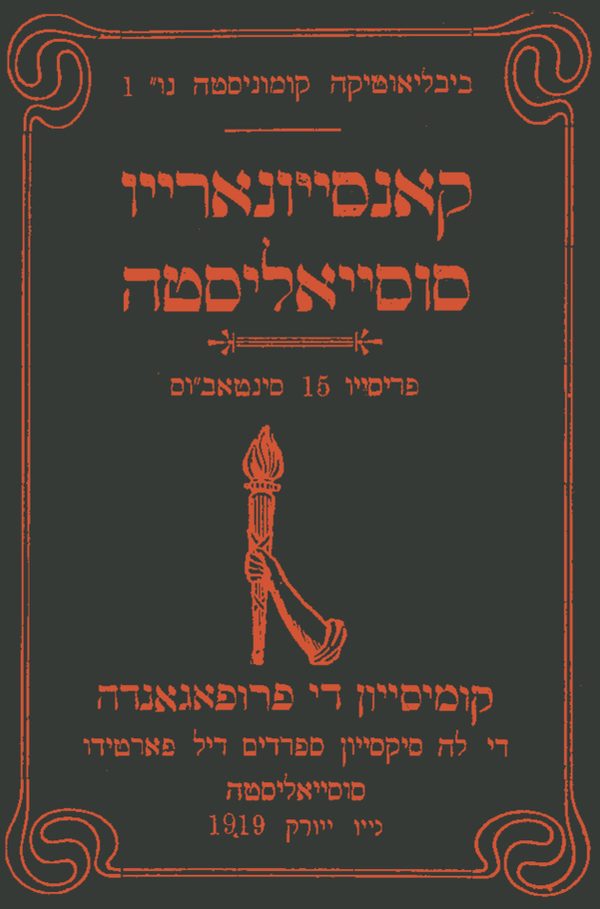
Cover of the Kansionario Sosialista, or Socialist Songbook, the first volume in the Communist Library series put out by the Propaganda Commission of the Sephardic Branch of the Socialist Party in New York, 1919.
La Internasional
“La Internasional” was recorded by Andrew Sheron at Conveyor in Brooklyn, New York. Singers: Arielle Angel, Rachel Angel, Daniel Elias, Aleeza Howitt, Yoni L., Akee S., Simone Salmon, and Zack Youcha. Piano: Andrew Sheron. Mixed by Darren Blackensee at Electric Garden in Brooklyn.
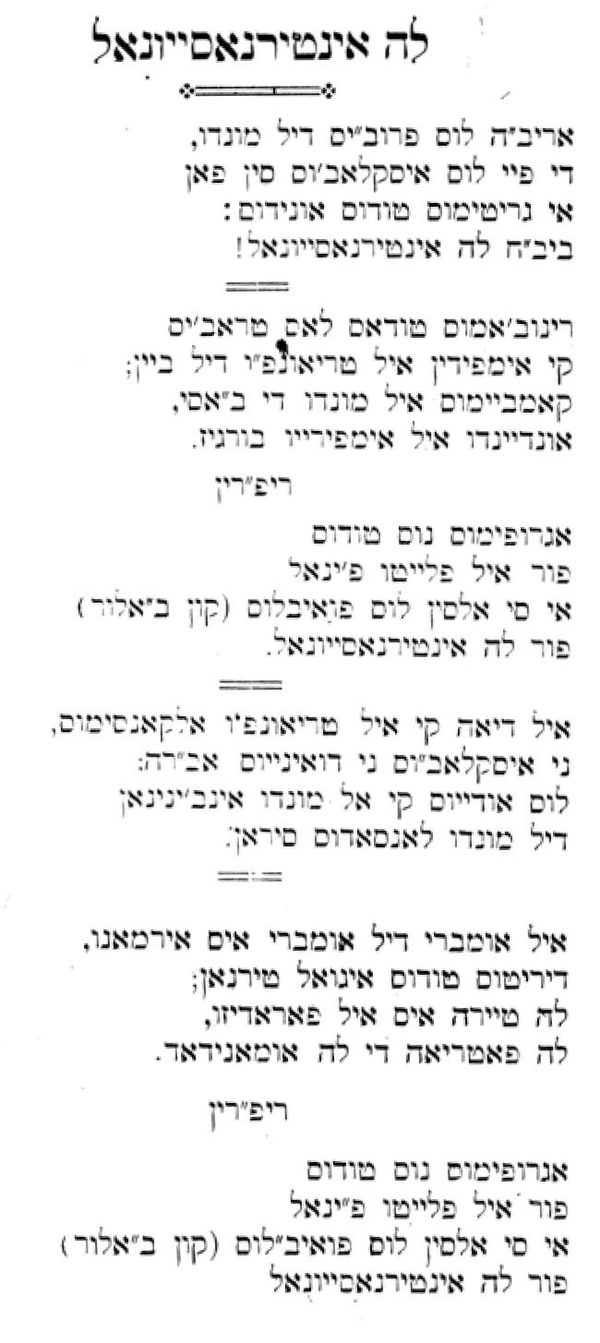
Ariva los proves del mundo
De pie los esklavos sin pan
i gritemos todos unidos
Biva la internasional
Renovamas todas las traves
ke empiden el triunfo del bien
Kambiyemos el mundo de vase[1]
Undiendo el imperio burgez
Agrupemos nos todos
Por el plyeto final
I se alsen los pueblos
Kon valor por la internasional
El dia ke el triunfo alkansemos
Ni esklavos ni duenyos avra
Los odios ke el mundo enveninan
Del mundo lansados seran
El ombre del ombre es ermano
Deritos todos egual ternan
La tiera es el paradizo
La patria de la umanidad
Agrupemos nos todos
Por el plyeto final
I se alsen los pueblos
Kon valor por la internasional
The International
Rise up poor of the world
On your feet slaves without bread
and may we cry out all together
Long live the international!
Let’s reimagine the rules
That impede the triumph of the good
Let’s change the empty world
Drowning the bourgeois empire
May we come together
For the final struggle
And may the peoples arise
With valor for the international
The day we achieve triumph
There will be neither slaves nor owners
The hatreds that poison the world
Will be cast off from the world
Every man is brother to the other
Everyone will have equal rights
The Earth is paradise
The homeland of humanity
May we come together
For the final struggle
And may the peoples arise
With valor for the international

El Imno Sosialista[2]
“El Imno Sosialista” was reimagined by Lu Coy with Michel Van Loh, and recorded in Los Angeles, California. Guitar and saz: Michel Van Loh. Vocals and flute: Lu Coy. Percussion: Kayhan Azadi. Engineered and mixed by Kayhan Azadi in Los Angeles. Mastered at Electric Garden in Brooklyn.
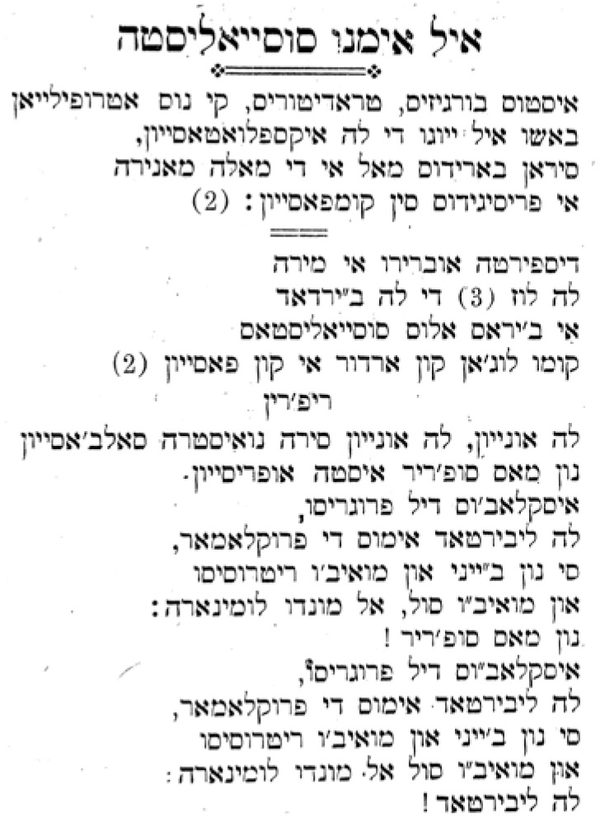
Estos burgezes, traditores, ke nos atropeyan
Basho el yugo de la eksploatasion,
Seran barridos mal i de mala manera
I presegidos sin kompasion.
Desperta obrero i mira[3]
La luz de la verdad
I veras alos sosialistas
Komo luchan kon ardor i kon pasion
La union, la union sera nuestra salvasion
Non mas sufrir esta opresion
Esklavos del progreso
La libertad emos de proklamar,
Si non viene un muevo de retroseso
Un muevo sol, al mundo luminara:
Non mas sufrir!
Esklavos del progreso
La libertad emos de proklamar,
Si non viene un muevo de retroseso
Un muevo sol, al mundo luminara:
La libertad!
The Socialist Hymn
These bourgeois, traitors, who trample us
Under the yolk of exploitation,
They will be swept away and badly so
And persecuted without compassion.
Wake up worker and look at
The light of truth
And you will see the socialists
How they fight with fervor and passion
The union, the union will be our salvation
No more suffering this oppression
Slaves of progress
Liberty we must proclaim,
If not a new regression comes
A new sun will illuminate the world:
No more suffering!
Slaves of progress
Liberty we must proclaim,
If not a new regression comes
A new sun will illuminate the world:
Liberty!
La Marseyeza de la Pas[4]
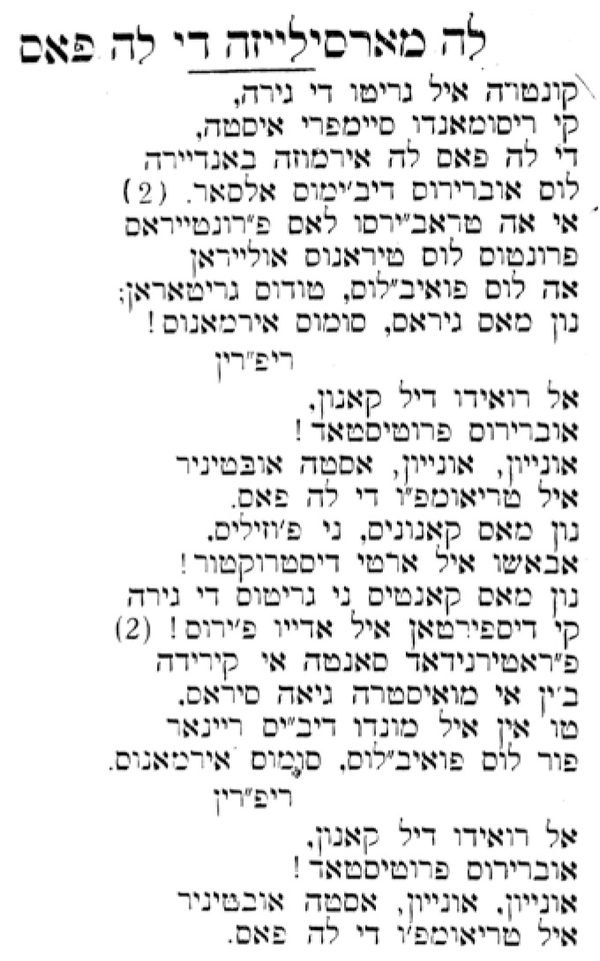
Kontra el grito de gera,
Ke resumando siempre esta,
De la pas la ermoza bandiera
Los ovreros devemos alsar. (2x)
I a traverso las frontieras
Prontos los tiranos oyiran
A los puevlos, todos gritaran;
Non mas geras, somos ermanos!
Al ruido del kanon,
Obreros protestad!
Union, union, asta obtener
Al triumfo de la pas.
Non mas kanones, ni fuziles.
Abasho el arte destruktor!
Non mas kantes ni gritos de gera
Ke despertan el adyo feros!
Fraternedad santa i kerida
Ven i muestra giya seras
Tu en el mundo deves reynar
Por los pueblos somos ermanos.
Al ruido del kanon,
Obreros protestad!
Union, union, asta obtener
Al triumfo de la pas.
The Marseillaise of Peace
Against the cry of war
Which is always resounding,
The beautiful flag of peace
We the workers should raise. (2x)
And across the borders
Soon the tyrants will hear
The peoples, all screaming;
No more wars, we are brothers!
Upon the noise of the cannon,
Workers protest!
Union, union, until we get
The triumph of peace.
No more cannons, nor bombs
Down with the art of destruction!
No more songs or cries of war
That provoke the wrath of God!
Sacred and beloved brotherhood
Come and you will be our guide
You must reign over the world
Because the peoples are brothers
Upon the noise of the cannon,
Workers protest!
Union, union, until we get
The triumph of peace.
Marsh Ovradera
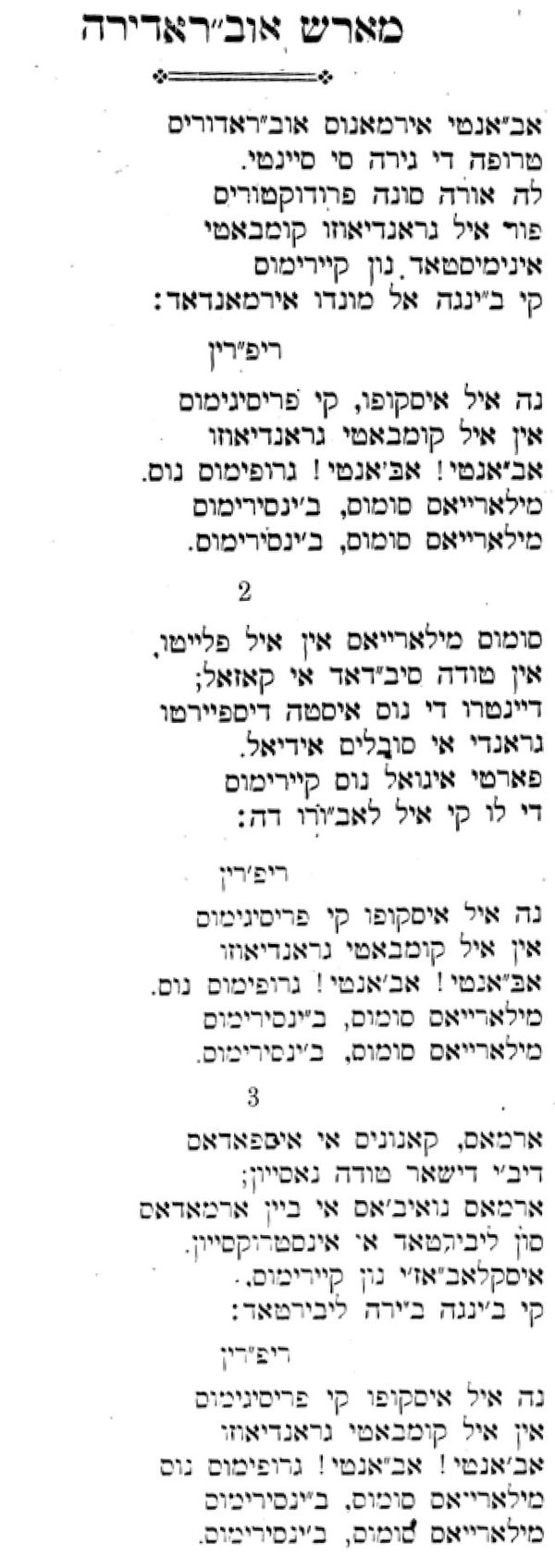
Avanti ermanos ovradores!
Trupa de gera se siente.
La ora sona produktores
Por el grandioza kombate
Enemistad non kieremos
Ke venga al mundo ermandad.
Na el eskopo, ke presegimos
En el kombate grandiozo
Avanti! Avanti! Grupemos nos
Milarias somos, venseremos
Milarias somos, venseremos
Somos milarias en el plieto,
En toda sivdad i kazal;
Dientro de nos esta despierto
Grande i sublim ideal.
Parte igual nos kieremos
De lo ke el lavoro da.
Na el eskopo, ke presegimos
En el kombate grandiozo
Avanti! Avanti! Grupemos nos
Milarias somos, venseremos
Milarias somos, venseremos
Armas, kanones i espadas
Deve deshar toda nasion.
Armas nuevas i bien armadas
Son libertad i instruksion.
Esklavaje non kieremos
Ke venga vida libertad.
Na el eskopo, ke presegimos
En el kombate grandiozo
Avanti! Avanti! Grupemos nos
Milarias somos, venseremos
Milarias somos, venseremos
Workers March
Onward fellow workers!
The troops of war are heard.
The time of the producers has come
For the grand battle
Enmity we do not want
May brotherhood come to the world.
Thus our goal, which we pursue
In the grand struggle
Onward! Onward! Let’s organize
We are thousands, we will triumph
We are thousands, we will triumph
We are thousands in the struggle,
In every city and countryside.
Within us has awoken
The grand and sublime ideal.
We want an equal part
Of what our labor gives.
Thus our goal, which we pursue
In the grand struggle
Onward! Onward! Let’s organize
We are thousands, we will triumph
We are thousands, we will triumph
Weapons, cannons and swords
Every nation must leave them behind.
New weapons, very powerful ones
Are liberty and education.
Servitude we do not want
May life and liberty arrive.
Thus our goal, which we pursue
In the grand struggle
Onward! Onward! Let’s organize
We are thousands, we will triumph
We are thousands, we will triumph
Kante Sosialista
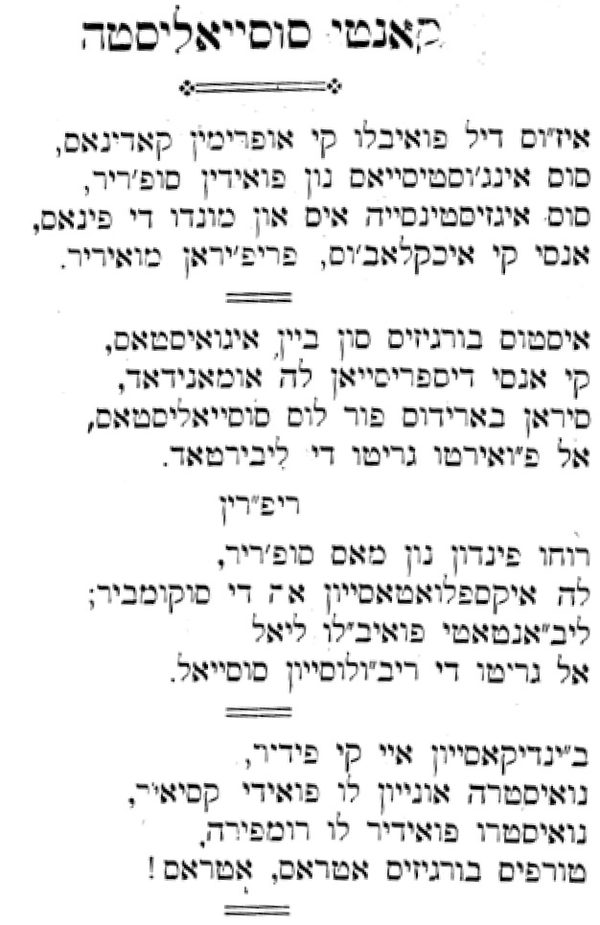
Ijos del pueblo ke oprimen kadenas
Sus indjustisias non pueden sufrir
Sus egzistensia es un mundo de penas
Ansi ke esklavos, preferan muerir
Estos burgezes son bien egoistas
Ke ansi despresian la umanidad
Seran baridos por los sosialistas
Al fuerto grito de libertad
Roho pendon, non mas sufrir
La eksploatasion a de sukomber
Levantate pueblo leal
Al grito de revolusion sosial
Vindikasion ay ke pedir
Nuestra union lo puede ke seer
Nuestro pueder lo rompera
Torpes burgezes
atras, atras!
Socialist Song
Children of the people oppressed by chains
They cannot bear the injustices
Their existence is a world of pain
Thus the slaves prefer to die
The bourgeois are selfish
And thus debase humanity
They will be erased by the socialists
Upon the fierce cry of liberty
Red flag, no more suffering
Exploitation is about to succumb
Rise up loyal people
Upon the cry of social revolution
Vindication must be demanded
Our union can manifest it
Our power will break it
Back, back
you bumbling bourgeoisie!
La Revolusion
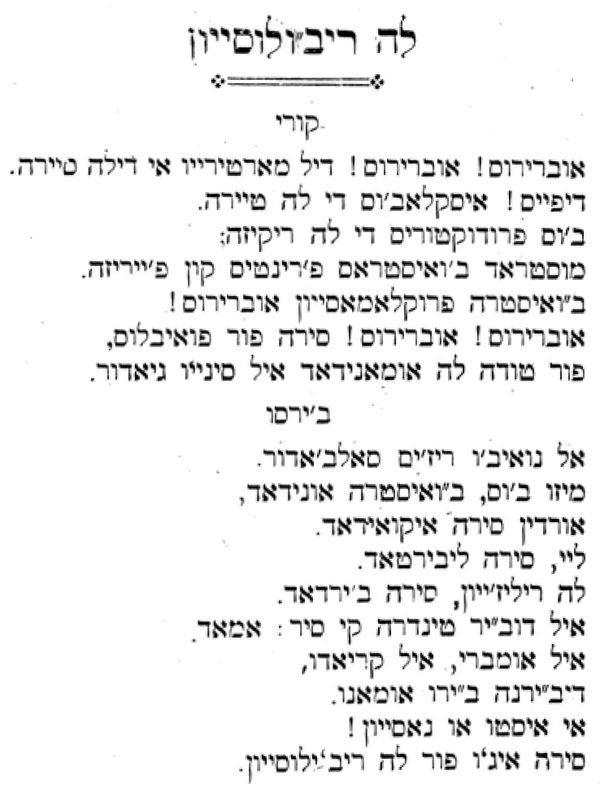
Obreros! Obreros! Del martirio idela siera.
Depies! Esklavos de la tiera.
Vos produktores de la rikeza;
Mostrar vuestras frentes kon fiereza.
Vuestra proklamasion obreros!
Obreros! Obreros!
Sera por pueblos,
Por toda la umanidad el sinyo giador.
El nuevo rejim salvador
Mezo vos, vuestra unidad,
Orden sera ekuidad.
Ley, sera libertad.
La relijion, sera verdad.
El dover tendra ke ser: amar.
El ombre, el kriado
Deverna vero umano.
I esto o nasion!
Sera echo por la revolusion.
The Revolution
Workers! Workers! With the hammer and the sickle.
On your feet! Wretched of the earth.
You, the producers of plenty;
Show your brows with pride.
Your proclamation, workers!
Workers! Workers!
You will be for the peoples,
For all humanity, the guiding light.
The new regime of redemption
Through you, your unity,
Order will be Equality.
Law will be Liberty.
Religion will be the Truth.
Duty will be to Love.
Each person, each child
Will become truly human.
And this, o nation!
Will be accomplished by the revolution.
The meaning of the term “vase” is unclear. It may be from French, “vase,” meaning mud, filth, sludge, or ooze, translating to something like, “Let’s change this putrid world.” It may also have been a typo, intended to be “base” or “foundation.” We have opted for the latter interpretation.
The song’s lyrics resonate with German revolutionary Rosa Luxemburg’s famous quote, “we must either move forward into socialism or fall back into barbarism.” “Progress” here might be read ironically, a reference to the proletariat’s alienation from industrialization, but we did not put it in quotes to maintain fidelity to the original.
Lu Coy's new rendition of this song picks up at the second verse.
Sung to the tune of “La Marseillaise.”

I’m Arielle Angel, editor-at-large of Jewish Currents. Before you go, there’s something I need to ask.
We’ve seen over and over how the mainstream media falters in telling stories on our beats—whether it’s antisemitism, Israel/Palestine in American politics, Jewish identity, or the American left. At Jewish Currents we’re committed to uncompromising analysis and longform reporting on these issues and more—stories you won’t find anywhere else. In a media landscape that obscures injustice and flattens discussion, we’re changing the conversation. But we need you.
If you believe in this work, please consider making a donation—or even better, a recurring one—to ensure that we are able to keep publishing stories like this one. We can’t do it without you.
Devin E. Naar is an associate professor of Jewish studies, Sephardic studies, history, and international studies at the University of Washington in Seattle and the author of Jewish Salonica: Between the Ottoman Empire and Modern Greece.
Lu Coy (they/them) is a Los Angeles-based queer multimedia artist, activist, and musician. Their work spans electroacoustic composition, song, theater, installation, and ceremony, drawing on the texts and traditions of their Ashkenazi Jewish and Mexican heritage. Coy has become a widely recognized emerging voice in the Yiddish and Ladino revival movements across the US and Europe.
Daniel Elias is a founding member of the Elias Ladino Ensemble. The grandson of Rabbi David Elias Cassorla, who served the Sephardic Congregation of Coney Island, and the son of Joe Elias, an early collector and performer of Ladino music, he has been performing Ladino music since the age of 15.
Simone Salmon is a PhD candidate in ethnomusicology at UCLA, working at the intersection of Jewish music, diaspora, and state power. Her work focuses on Jewish musical life in Turkey and its diasporas, situated within broader Sepharadi and Mizrahi musical worlds, and examines how authoritarian governance, minority silencing, and cultural resistance shape musical expression.