Ramadan’s Rhythm of Refusal
In Gaza, the holy month reminds us that loss is not time’s only path.
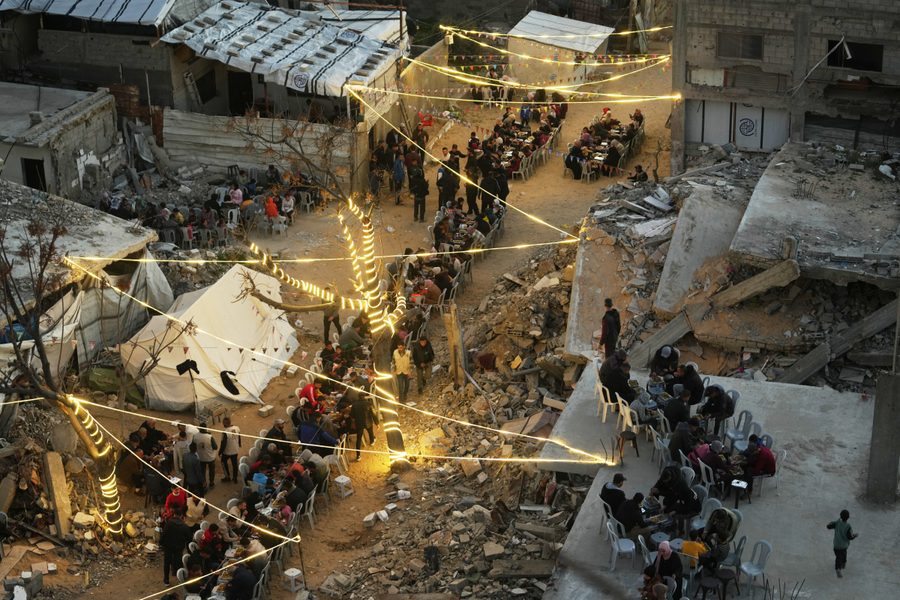
Palestinians gather for iftar in Gaza City, February 22nd, 2026.
There are months that pass unnoticed, dissolving into routine. These months reward speed. They move in a straight line—pressing forward and abandoning whatever cannot keep pace. What cannot be monetized, they dismiss as sentiment. What disrupts productivity, they scorn as weakness.
And then there is Ramadan.
Ramadan returns like a question we cannot avoid. It asks not what we achieve, but what we remember. It measures not what we build, but what we are able to withhold. It unsettles us, suspending time’s progressive rush.
During Ramadan, we move in circles. Ramadan repeats hunger so we do not forget fragility. It repeats sunset so we do not forget mercy. It repeats night so memory does not disintegrate in the ruckus of survival.
When I was a child, my family and I would greet each Ramadan by going to the sea to break the month’s first fast. We carried food in large containers, careful not to spill the soup on the sand shifting beneath us. We sat in plastic chairs, quietly facing the horizon as if the line between water and sky were a promise we could trust. In those last minutes before the call to prayer, the light thinned slowly, hunger sharpening our silence. When the adhan finally broke out, we passed dates from hand to hand. Then water, soup, conversation.
Before each dawn of the month, the musaharati would walk through our neighborhood calling our names, one by one. To be addressed in the dark was to be reminded that you existed within a community, that your hunger and your waking were shared.
Evenings, my family would sit together around the table. Awaiting nightfall, we were not impatient but suspended, as if time had agreed to pause with us. My mother, who cooked for us every day, moved between the kitchen and dining area, her face animated by a quiet pride. The act of feeding us: devotion made visible.
After evening prayer, the streets would swell with people. We drifted from the mosque onto a small nearby field. Football under dim lights. Bickering about the score, breathless laughter.
Year after year, dawn after dawn, night after night: the smell of salt and cumin in the seaside air, the voice calling your name in the hours before dawn, the family table, the field—its games and arguments—the tired walk home. Time felt endless, as if it did not pass but revolved, each ritual a portal opening at once onto that cherished month in years past and onto the promise of its future recurrence.
Now, in Gaza, we no longer live with the pretense of linear time. Plans collapse quickly, the illusion of a certain future has dissolved. When every hour folds in on itself, Ramadan no longer offers the clarity of simple repetition; it arrives fraught with absence.
Faces have thinned. Houses have been reduced to rubble. No amount of rearranging the furniture can distract from the chairs that remain empty.
Part of me threatens to accept this cruelty, to concede that what is lost cannot be retrieved, that history moves forward with or without our consent. Another part refuses to simply move on, to abandon what has been taken. Ramadan strengthens that refusal.
This holy month does not restore what is gone. It does something quieter: It turns us toward the sea, which unlike us, remains ever faithful to its rhythm. It turns us toward the mosque, which still calls. When Ramadan arrives, we wake before dawn, we wait for sunset. We measure the day in hunger and release—and we remember once again that loss is not time’s only path.

I’m Arielle Angel, editor-at-large of Jewish Currents. Before you go, there’s something I need to ask.
We’ve seen over and over how the mainstream media falters in telling stories on our beats—whether it’s antisemitism, Israel/Palestine in American politics, Jewish identity, or the American left. At Jewish Currents we’re committed to uncompromising analysis and longform reporting on these issues and more—stories you won’t find anywhere else. In a media landscape that obscures injustice and flattens discussion, we’re changing the conversation. But we need you.
If you believe in this work, please consider making a donation—or even better, a recurring one—to ensure that we are able to keep publishing stories like this one. We can’t do it without you.
Abdullah Hany Daher is a Palestinian writer and journalist from Gaza. He documents the human stories of war, aiming to preserve voices that the rubble cannot silence.