Newsletter
Jun
4
2026
Good afternoon from the Jewish Currents news desk. In today’s newsletter, we talk to A New Policy’s Josh Paul about the Israeli effort to swap out direct financial aid for deep technological and supply chain integration between the US and Israeli militaries. And we get a report from the “World Symposium Against Anti-Zionism,” a conclave of the biggest names in North American pro-Israel apologetics held last month near Toronto.
I’m Josh Nathan-Kazis, and here’s what we’re talking about today at the Jewish Currents news desk.

Haredi Jews blocked a road in Jerusalem on Sunday while protesting against military conscription. Violence over Israeli efforts to draft Haredim has been growing in recent weeks.
Ohad Zwigenberg/AP
TRAVEL BAN: An Israeli government minister boasted on social media on Wednesday that he had intervened to block prominent Palestinian American activist Linda Sarsour from entering Israel. Sarsour told Jewish Currents early Thursday that she had been planning a family trip to visit her 88-year-old mother-in-law. “I go there to hang out with my family, go to weddings, and shop,” she said.
Sarsour told us she received Israeli government clearance in late May to fly to Ben Gurion Airport in Tel Aviv, and then a week later got an email saying her approval had been revoked. “I’ve been able to go to Palestine many times. I’ve prayed at al-Aqsa,” she said. “I was going to move on. Next thing you know, they’re tweeting about it.” Israel’s Minister for Diaspora Affairs and Combating Antisemitism, Amichai Chikli, called Sarsour “one of the most prominent figures in the anti-Israel boycott movement in the US” in an X post, which included a picture of Sarsour overlaid with the word “BANNED.” Pro-Israel groups in the US have long been fixated on Sarsour, who has been active in Muslim and left-wing politics for years, and who rose to national prominence as a leader of the Women’s March in 2017. “They were, in their own way, saying because you fight for your people, because you are unapologetic about being Palestinian, and because your work is actually having impact in the US, you are now banned,” Sarsour said.
Sarsour’s parents are from Al-Bireh, a West Bank city just north of Jerusalem. “In the past when I went, I’d go from cousin’s house to cousin’s house to aunt’s house,” Sarsour said. “We stay up at night, we drink tea, we eat watermelon seeds.” Sarsour said that she has long understood that her activism put her at risk of being denied entry to Israel and the occupied West Bank. “In their own weird way, they’re reaffirming what we’re doing is working,” she said.
NEW POLITICS: The former US army doctor Adam Hamawy, whom Alex Kane wrote about for the Jewish Currents news desk last month, won his New Jersey Democratic Congressional primary on Tuesday night with nearly 30% of the vote in an extremely crowded field. Hamawy, who was supported by the anti-AIPAC super PAC American Priorities, ran on a platform of ending US aid and weapons sales to Israel. He’s now a shoo-in to win the general election in the fall in the heavily Democratic district. Alex says that Hamawy’s win is a sign of a new political reality. “In certain districts, candidates can center Palestine and win,” Alex tells me. “That did not used to happen.” Still, he warns against drawing too many broad conclusions from the race: “We should not overestimate what the win means. AIPAC stayed out of the race, Hamawy had his own super PAC supporting him, and there was no effort by his opponents to consolidate around one candidate. Had it been otherwise, it would have been a far tougher race to win.”
CHATTER: The news desk crashed “On the Nose,” the Jewish Currents podcast, to talk about our coverage of this past weekend’s pro-Israel parade in Manhattan. Alex Kane and I chatted with Arielle Angel, the host of “On the Nose” and the magazine’s editor-at-large, about how the parade devolved into a political debacle for the city’s Jewish establishment, and Alex and I made plans to meet up at a theoretical Jewish heritage parade in the New York City yet to come. Listen here, or download “On the Nose” wherever you listen to podcasts.
OOPS: In the latest Bamba news, the UJA-Federation of New York is really leaning into the bit it announced last week of buying lots of Bamba to spite the Park Slope Food Coop, which voted to boycott Israeli products. The New York Jewish Week reports that UJA took delivery of 20,000 bags of the puffed peanut butter snack last Friday at their midtown office, and distributed 4,000 of the bags at the pro-Israel parade on Sunday. That leaves 16,000 bags, which the Met Council, a Jewish anti-poverty group partially funded by the UJA, will distribute at food pantries. This raises questions! The original UJA press release last Thursday implied that all the bags would be distributed at the parade. What was the conversation like at the UJA headquarters when the truck full of Bamba pulled up on Friday and they realized that they had ordered nearly 900 pounds of Bamba?
“RADICALIZATION AND ANARCHY”: Haredi rioters on Wednesday night smashed up the home of an Israeli Supreme Court justice in a West Bank settlement near Bethlehem. It’s a new sign of the growing civil unrest over Haredi refusal to serve in the Israeli military. Press reports say it’s not entirely apparent why the crowd of Haredi men chose to target this justice’s home and family. The broader context, though, is clear: As national elections approach, and opposition politicians promise a crackdown on Haredi draft refusal, the issue is becoming increasingly combustible. Last month, Israeli police stepped up their efforts to arrest Haredi men who have not responded to military enlistment orders, leading to widespread protests. After the attack yesterday on the justice’s house, Israeli president Isaac Herzog implored protesters to “stop before there’s a disaster.” Haredi leaders, meanwhile, seem unwilling or unable to calm their constituents. “We have warned time and again that these measures would lead to radicalization and anarchy,” the Haredi parties Shas and Degel Hatorah said in a joint statement. “The blood of Torah scholars is not cheap.” Conflicts between the Haredi parties and their allies on the political right over this issue have long been a source of strife within Netanyahu’s government. Now, the fight appears to be entering a new phase, and the potential for escalating violence seems very real.
The Jewish Currents news desk is directed by Josh Nathan-Kazis, with reporting from Alex Kane and Maya Rosen, and editing by Mari Cohen. Want to get in touch? Email me at jnk@jewishcurrents.org, or message me on Signal @jnk.56. If you were forwarded this email, subscribe here so you don’t miss the next one.

An Israeli military vehicle on the streets of the West Bank town of Anabta in April. The US sends $3.8 billion in military aid to Israel every year.
Nasser Ishtayeh/Sipa via AP
Israel Wants to Replace US Military Aid With Something Worse
The Israeli government and its US allies this week rolled out a new strategy to maintain major US support for Israel’s military while at the same time backing off the increasingly unpopular system of direct aid. The idea is to make a show of stopping military aid, which nearly 60% of Americans now oppose, while at the same time instituting deep, hard-to-track technological and supply chain integrations between the US and Israeli militaries.
The first part of the plan burst into the open on Tuesday, when Marco Rubio, the Secretary of State, acknowledged at a House Appropriations Committee hearing that top-level officials are discussing a wind-down of US aid to Israel, echoing similar comments made earlier this year by Israeli Prime Minister Benjamin Netanyahu.
The second part is coming together elsewhere on the Hill, where on Thursday the House Armed Services Committee was marking up a major military spending bill. Buried in that bill is a provision, designated Section 224, that tasks US defense officials with “synchronizing cooperative efforts between the United States and Israel” on “defense technology research, development, testing, evaluation, integration, and industrial cooperation.” Technologies explicitly mentioned in the section include artificial intelligence, machine learning, cyber defense, network integration, and data fusion, among others. The nonprofit lobby group A New Policy says that Section 224 is “designed to implant Israel’s defense and intelligence establishments into the most sensitive and basic levels of America’s own defense technology ecosystem.” Rep. Thomas Massie, the isolationist Republican who recently lost his reelection bid in Kentucky, and the progressive Democrat Rep. Ro Khanna have both said they will oppose Section 224.
In the Senate, similar language is embedded in a spending bill now under consideration by the body’s intelligence committee, which would require expanded and enhanced sharing of intelligence with Israel. The Senate bill, which has received little public attention, was flagged on social media Thursday by Foundation for Middle East Peace president Lara Friedman. Meanwhile, Jewish Insider published a sketchy report Thursday afternoon on plans by a group of Republican and Democratic pro-Israel Senators to introduce another bill to coordinate the purchase of missile defense systems with Israel.
Israel’s hand here is not hidden: On Wednesday, Rep. Marlin Stutzman, a Republican from Indiana, introduced a resolution that broadly supported the framework laid out in Section 224. Stutzman also distributed a letter of support from Netanyahu himself, who referred to the resolution as an endorsement of “my plan.” Stutzman “introduced this resolution exactly one week after meeting with Prime Minister Netanyahu in Jerusalem and receiving his enthusiastic support for the legislation,” the representative’s office said in a statement.
Jewish Currents spoke to A New Policy co-founder Josh Paul, who resigned from the State Department in 2023 in protest of unfettered military aid to Israel, about the new Israeli framework and why opponents of material US support for the Israeli military should not be celebrating this pivot.
Josh Nathan-Kazis: Would this potential plan to phase out US military aid to Israel actually result in ending US subsidies of the Israeli military?
Josh Paul: The US currently provides Israel with $3.8 billion annually in grant military assistance. A proposal to “off-ramp” this funding over a ten-year period and replace it with deeper industrial cooperation would seem on the surface to provide a net savings to the US taxpayer and to shift the cost burden for [Israel’s] weapon procurements to Israel. But that’s not the full picture.
Imagine a world in which—as Section 224 proposes—Israeli technology is integrated into U.S. military systems. Last year alone, US Defense Department procurement topped $160 billion, with a further $140 billion spent on research and development. In that context, US foreign assistance is, despite all the hype it gets, relatively small beans. Integrating Israel as a key source into the Department of Defense supply chain, on the other hand, opens up prospects that could not only make up for, but over time dwarf, the billions in handouts Israel’s military currently gets. And unlike the current grant assistance, which mostly pays for US weapons systems, this would be money going directly into Israel’s economy. And that’s before accounting for the access to emerging US technology and intellectual property that Israel would have access to and be able to spin off for commercial purposes.
That’s why this is all a shell game. Foreign assistance is high profile, and requires annual approval by Congress. But the structures that underpin trade deficits are obscure, and, as even President Trump has learned, stubborn. What is being sold as a cost-saving measure could turn out to be far more expensive than the current approach. The answer shouldn’t be one or the other—it should be neither.
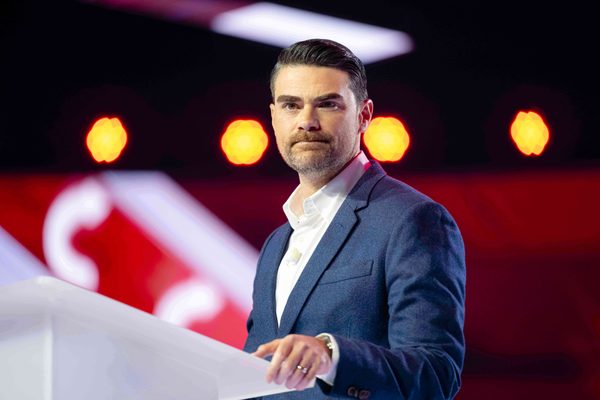
The conservative commentator Ben Shapiro, pictured in 2025, was keynote speaker at the “World Symposium Against Anti-Zionism.”
Jon Cherry/AP
Seven Scenes from an Anti-Anti-Zionist Symposium
At an event space just outside Toronto last month, the combative new Canadian pro-Israel group Tafsik hosted what it called the “World Symposium Against Anti-Zionism,” a daylong conference featuring all the biggest names in North American Zionist apologetics. Shiri Pasternak, a Toronto-based academic and writer, sat through the conference and shared her notes on the proceedings with Jewish Currents.
Pasternak said that the mood at the conference was embattled. “They really recognize that they’re in a kind of crisis,” Paternak said. “In the war of hearts and minds, it’s clear their grasp is slipping.”
Tafsik is one of a new wave of anti-anti-Zionist groups that has appeared in recent years as pro-Israel advocates look for new language and strategies to roll back the rapid shifts in North American public opinion on Israel. Among similar anti-anti-Zionist groups like Stop Antizionism, which co-sponsored the Toronto conference, and Movement Against Antizionism, Tafsik stands out for its particularly abrasive and crude approach. When Canada’s New Democratic Party elected the Jewish anti-Zionist Avi Lewis as its leader in March, Tafsik called Lewis a “weak, pathetic man,” a “groveling schmuck,” and a “contemptible failure.”
“Tafsik is positioning itself as a wartime organization that can pivot quickly, is grassroots, and is [ready] to fight,” said Pasternak. “They are positioning themselves as the attack dog.”
The May 17th Tafsik symposium in Woodbridge, Ontario drew more than 1,000 people. That’s a major Jewish event in Canada, a country with around 400,000 Jews, and its scale is a sign of an intensifying hard-right reaction to the growth on the Jewish left since October 7th. Panel discussions featured figures like Gad Saad, the marketing professor who has remade himself as an online anti-woke gadfly beloved by Elon Musk, and Eve Barlow, a music journalist and pro-Israel advocate. The conservative podcaster Ben Shapiro, a major figure on the online American right, delivered the keynote address.
The sessions were peppered with Islamaphobic and anti-immigrant rhetoric, as well as crass attacks on anti-Zionist Jews. With Pasternak, we picked out seven moments from the conference that give a picture of what the discourse is like right now on the anti-anti-Zionist right.
ANTI-ZIONIST JEWS ARE BUGS: At a panel on “anti-Zionism in education,” Gad Saad called Jewish anti-Zionists “the most execrable of all anti-Zionists,” to applause from the crowd, and launched into a tortured metaphor—a favorite of his—that situated Jewish anti-Zionists as suicidal insects hijacked by foreign bodies. “An actual wood cricket abhors water,” Saad said. “It wants nothing to do with water. But when it is parasitized by a hair worm, the hair worm needs the wood cricket to jump into water,” killing the wood cricket. Jewish anti-Zionists, Saad said, are “wood cricket Jews.”
HOLOCAUST SURVIVOR DENIAL: After establishing Jewish anti-Zionists as insects, Saad asked the audience to guess who he believed to be the “biggest of the degenerate wood crickets.” Someone in the crowd offered Jewish Currents editor-at-large Peter Beinart. “Peter Beinart is a good one, I despise him,” Saad said. “But no: Gabor Maté.” Maté, an author of popular psychology books who has been a leading public critic of Israeli violence against Palestinians, was born in Budapest in 1944, in the midst of the Holocaust. Saad ridiculed characterizations of Maté, who is Jewish, as a Holocaust survivor. “Six-month-old infants are not cognizant beings,” Saad said. “If he is a Holocaust survivor, then I too am a Holocaust survivor, because in the 1940s I was swimming in my dad’s testicles as a spermatozoa.”
DARK ENERGY: On a panel about “alternative media,” pro-Israel influencer Emily Austin asked Eve Barlow to talk about “how anti-Zionism has kind of destroyed the UK.” Barlow obliged, saying that “people are still afraid to talk about what’s really going on, which is this creeping Islamism. And anti-Zionism has been the Trojan horse by which it has entered our lives.” Later, Barlow said that she had moved out of the UK in 2014. “It was dark energy there in the UK,” she said. “I could feel the creep-in. It was just dark . . . It’s eating away at everything.”
“SUICIDAL EMPATHY”: Later in the same panel on “alternative media,” Austin borrowed one of Saad’s favorite terms as she opined on immigration policy. “It’s so interesting, you see it all the time,” she said. “People leave their third-world countries to come to a phenomenal, functional first-world country that suffers from suicidal empathy, that allows them in en masse. And then they bring the values that destroyed their country into this one. But it seems deliberate. So they know exactly what they’re doing.”
NOT A JEW: Ben Shapiro baits the left for a living, and he was on his game at the symposium. In the course of defending a claim that it is “inherently anti-Jewish to oppose Zionism,” Shapiro produced an argument meant to prove, through his customary rhetorical tactic of tilting at the flimsiest of straw men, that anti-Zionist Jews are not Jewish. “Remember the real definition of modern Zionism: The proposition that the Jewish state of Israel ought not be exterminated,” he said. “Any Jew who does not believe that is not a Jew in any real sense.”
INTERNECINE STRIFE: During a fireside chat-style session after his keynote, Shapiro was asked about anti-Zionism on the right. “’I can’t even be critical of Israel” is the get-out-of-jail-free card online,” Shapiro said, referring to what he said were efforts by right-wing figures to defuse charges of antisemitism. “This is a retarded idea.” Shapiro has been locked in an internecine conservative brawl with Tucker Carlson and others on the right who have dabbled in antisemitism while growing increasingly critical of Israel. “My annoyance has grown with the people who watch this trash and treat it as though it’s somehow worthy of respect,” Shapiro said.
PAY NO ATTENTION: The former Knesset member Einat Wilf, who leads a small new Israeli political party called Oz, joined virtually to make the case that “Gazans, Arabs, [and] Muslims can and should be Zionists.” While Wilf seemed allergic to using the term “Palestinian,” she essentially argued that they should stop resisting the state that explicitly excludes and displaces them. All they have to do is “let go of the obsessive anti-Zionism,” she said.
