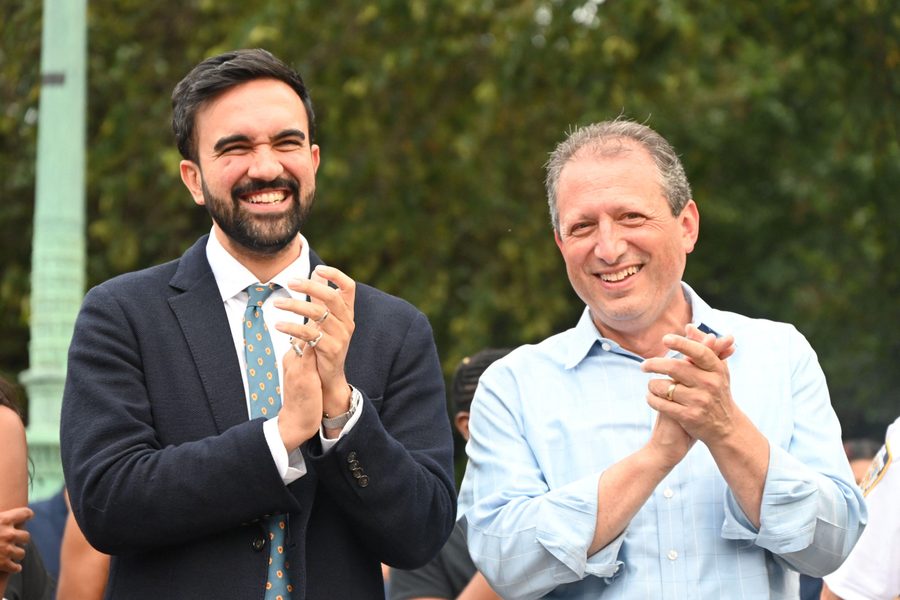
Zohran Mamdani and Brad Lander campaigning in Brooklyn on August 5, 2025
On the morning of December 18th, a group of community advocates and city and state legislators gathered in front of downtown Brooklyn’s municipal building to endorse City Comptroller Brad Lander’s primary challege to two-term Congressman Dan Goldman, a staunchly pro-Israel Democrat and heir to a fortune from the Levi Strauss clothing company. The gathering was a warning sign for Goldman: All eight politicians who took turns speaking were either current or former representatives of parts of Goldman’s Tenth Congressional District, which runs from lower Manhattan to west and south Brooklyn. Normally, elected officials support an incumbent from their own party, but here, they were denouncing Goldman as someone who, in the words of Assemblyman Bobby Carroll, “turned a cold shoulder” to constituents concerned with the suffering of Palestinians in Gaza. Carroll contrasted this with the attitude of Lander, a progressive who “co-endorsed” Zohran Mamdani last summer while running for mayor himself, and whose support was ultimately instrumental in building the left-liberal coalition that helped elect the democratic socialist in November.
The presence of one elected official was especially noteworthy: City Council member Alexa Avilés. Avilés had weighed her own run against Goldman, and had picked up the endorsement of the New York City chapter of the Democratic Socialists of America (NYC-DSA) in October. With the group’s field operation having powered Mamdani’s winning campaign, its endorsement was expected to carry more weight than ever in 2026. But things got complicated for Avilés when Lander, who’d been expected to take a spot in Mamdani’s administration, decided to jump into the NY-10 race. Thanks to his long-time advocacy for tenants, immigrants, and labor—and the big boost he’d given Mamdani—Lander would have substantial support on the left, especially in a district he’d partly represented on the city council for 12 years. Still, Lander, whose days of active DSA membership were long over, wasn’t going to win the NYC-DSA’s nod, not least because he’s a liberal Zionist—a strong critic of Israel’s bombardment of Gaza, but nonetheless a believer in Israel as a Jewish state and an opponent of the DSA-backed Boycott, Divestment, and Sanctions (BDS) movement.
With Lander in the fray, progressives began to fear a repeat of the 2022 election—when the left split the vote in a Democratic primary and Goldman ended up with a narrow victory. Consequently, some of DSA’s elected officials began coming out for Lander—none more important than Avilés herself. In a December 10th statement announcing she would not run, Avilés wrote that a “split field” runs the risk of allowing Goldman another “damaging term” in Congress. In a subsequent statement endorsing Lander on December 18th, she wrote that her district needed “a fighter in Congress who will put the needs of working-class people above the interests of corporations and AIPAC.” (The pro-Israel lobby is a supporter of Goldman, while Lander’s first campaign video featured a swipe at the organization.) Lander, Avilés wrote, “will fight for New Yorkers in a way that our current representative does not.” “I believe that I’m the candidate best suited to bring that coalition together and defeat Dan Goldman,” Lander told Jewish Currents in an interview the following day. The political moment, he said, calls for “a popular front if we are going to defeat Trump and build something better here, and make progress defending the human rights, dignity and self-determination of Palestinians.” With NYC-DSA’s candidate bowing out, Lander’s candidacy will be a test of whether the progressive alliance that came together in 2025 can do it again.
Challenging Goldman, who this month received backing from Governor Kathy Hochul and House Minority Leader Hakeem Jeffries, has become an increasingly urgent priority for New York progressives. The former assistant US attorney rose to prominence as a cable-news commentator and lead counsel for the first impeachment of Donald Trump in 2019. He ran for Congress in the progressive district in 2022, barely defeating state assembly member Yuh-Line Niou, who split the vote with other contenders on Goldman’s left. Progressive discontent with the congressman grew as Goldman vocally backed US support for Israel’s onslaught on Gaza following October 7th, 2023; pro-Palestine protests became a fixture outside his congressional office in Brooklyn. “Goldman has always been an ardent defender of the Israeli government,” said Grace Mausser, the co-chair of NYC-DSA. “He maintained his stance even as more and more Americans recognized the situation in Palestine for what it is: a genocide.”
In Avilés, the socialist group saw a credible threat to Goldman, and a chance to have another DSA leader join the small group of democratic socialists in Congress that includes Alexandria Ocasio-Cortez and Rashida Tlaib. “We believe a socialist with a strong history in movement politics and who has consistently taken a brave stance on Palestine is the best candidate for this district,” Mausser told Jewish Currents after NYC-DSA officially endorsed Avilés on October 25th. NYC-DSA had a steady base of 2,000 members in the Tenth district, its second-largest contingent in the city; it could also mobilize a citywide membership of over 13,000 behind its candidate. And these volunteers had a potent message to use against Goldman: He had refused to endorse Mamdani for mayor, despite the democratic socialist winning the district handily in the primary.
Multiple progressive challengers, however, could dilute that message. Avilés had been in conversation with NYC-DSA leaders about the race since the summer; during that time, according to reports in Gothamist and The New York Times, Lander had indicated that he wanted to be Mamdani’s deputy mayor. (Lander allies, however, told the Times he had never assumed he would get the job, and had been thinking about a potential congressional run since last spring). But according to the Times, Mamdani had informed Lander in late October that he would not be getting the deputy mayor job; instead, the mayor-elect wanted to support Lander in a run against Goldman. About six weeks later, on December 10th, Lander officially entered the race with a Mamdani endorsement—along with endorsements from Senators Bernie Sanders and Elizabeth Warren. This changed Avilés’s and DSA’s calculations. “DSA didn’t want to play spoiler when there’s clearly a much stronger candidate in Brad Lander, given he’s been in office for so long in Brooklyn,” said Ross Barkan, a writer who covers New York City politics for New York Magazine and the Times. “In the district’s vote-rich neighborhoods, he’s just much better known.”
Mausser told Jewish Currents that NYC-DSA left the ultimate decision up to Avilés, though the group’s leaders “talked and thought about strategy” with her after Lander indicated he was going to join the race. “Alexa was not hell-bent on running for Congress,” Mausser said. “She only wanted to do it if it made sense for the left, for her, and the political ecosystem that she operates in. In this case, she, like us, didn’t want to divide the left vote.” The Mamdani endorsement was another compelling reason for staying out. “The mayor was the agent of consolidation behind who he deemed to be the stronger candidate who is more connected to the district,” said Michael Lange, a NYC-DSA member, political strategist and author of “The Narrative Wars,” a Substack about New York City politics. “There was not a path for anybody else.”
Following Mamdani’s historic victory in November, the DSA was making strategic choices to spend its resources on winnable races in 2026—a mission that will determine whether the new mayor’s affordability agenda has enough allies in Albany and Washington, DC. In this vein, NYC-DSA has so far endorsed six state assembly and senate candidates, and is likely to endorse two congressional candidates—all of them in districts that Mamdani carried in the Democratic primary. “The New York City DSA branch has always been a pragmatic organization,” said Barkan. “If you’re taking volunteers to one part of the city, that’s less people for other parts. DSA is just not large enough to be a presence in more than a few congressional primaries while also backing a full state legislative slate.”
Besides, Barkan says, Lander was not someone democratic socialists had a compelling reason to run against. “He’s not a cadre DSA member and he’s not anti-Zionist, but he’s aligned on a majority of issues,” said Barkan. It is true that Lander’s positions on Israel are at odds with many of NYC-DSA’s members. “His perspective on Israel is something that many in the organization have trouble with,” said Michael Thomas Carter, a NYC-DSA member and former spokesperson for State Senator Julia Salazar, another NYC-DSA elected official. “Lander describes himself as a progressive Zionist, but there’s a lot of people within New York City DSA who believe that Zionism has an inherent ethnic-supremacy component that cannot be progressive.” These differences surfaced the day after the October 7th Hamas attacks on Israel, when NYC-DSA tweeted an encouragement for people to attend a pro-Palestinian rally that ended up featuring a speaker who referred to Israelis kidnapped by Hamas from the Nova festival as “hipsters” who were “doing very fine.” Lander criticized the rally as “abominable,” although he told Jewish Currents he understands in hindsight that NYC-DSA did not organize or sponsor the demonstration. But despite this history, democratic socialists were applauding Lander this past June, when he cross-endorsed Mamdani. The decision paved the way for liberal supporters of Lander to get behind the democratic socialist in the ranked-choice primary, and it ultimately helped fend off former Governor Andrew Cuomo’s independent bid in the general election. “Lander was a very valuable surrogate for Mamdani,” Lange said. “He earnestly combated the Islamophobic vitriol that attempted to paint Mamdani as an antisemite.”
It may also help, some progressive leaders say, that Lander’s views on Israel and Palestine tend to diverge sharply from Goldman’s. Joe Dinkin, the national deputy director of the Working Families Party (WFP)—Lander’s longtime political home, which has endorsed him in the race—called Lander “a clear voice against genocide and occupation,” adding: “That’s a stark difference from Dan Goldman, and is the kind of progressive Jewish leadership we deserve in Congress.” Along these lines, Lander told Jewish Currents that he would co-sponsor the Block the Bombs Act, which would halt the sale to Israel of tank ammunition and certain large bombs. “I support a block on offensive weapons as long as they’re conducting so many human rights violations over and over again,” Lander said.
Goldman has not joined the 61 sponsors of that House legislation, which was introduced last May, and his campaign did not respond when Jewish Currents asked whether he would support the measure if it came up for a vote. His voting record after October 7th has been supportive of arms for Israel. In April 2024, as Israel perpetrated what experts were calling a genocide in Gaza, Goldman voted to give the country an additional $14.5 billion in military assistance. The same month, Goldman voted to censure Rep. Rashida Tlaib over her use of the phrase “from the river to the sea,” a decision he recently told The New York Times he would likely not make again. Maddy Rosen, a spokesperson for Goldman, described him in an email statement as “an unwavering supporter of Israel’s right to exist securely and safely as a Jewish state and safe haven for the Jewish people.” But that support, she said, “does not extend to this Israeli government or Prime Minister Netanyahu, of whom he has been sharply critical for years.” But in January 2024, Goldman nevertheless voted with 205 Republicans and 42 Democrats to sanction the International Criminal Court after it issued an arrest warrant for Israeli Prime Minister Benjamin Netanyahu.
Many voters in the Tenth District, especially those on the left, will be sifting through these positions on Israel, and Lange is among the political observers who think most will break for Lander, even without a formal DSA ground game to help persuade them. “It’s not like the socialist voters in the district are going to sit it out,” Lange said. “The socialists in this district are still going to vote for Brad and probably give him money and volunteer.”
Lander has reasons to be positive about his chances. Three months before he declared his candidacy, a September poll of district voters found that Lander would beat Goldman handily in a hypothetical match-up. He’s especially popular and well-known in the district’s upper-middle class, voter-rich Brooklyn neighborhoods. Further, Lander has shown a talent for raising the kind of money needed to compete with an incumbent like Goldman—even in last year’s losing bid for mayor, where he reached New York City’s fundraising limit four weeks prior to the primary. And while he won’t have the DSA’s official nod, he will be backed by other progressive organizations that can supplement Lander’s own field operation, including the WFP and the United Auto Workers’ northeast chapter. “With WFP and other organizations Brad has been part of building, he’ll have plenty of willing and eager canvassers,” Dinkin said. Jews For Racial and Economic Justice, which boasts a membership of 6,300 people—1,000 of them in the Tenth District—is widely expected to get behind Lander as well; in the past, it has endorsed him both for mayor and for comptroller. Audrey Sasson, executive director, said the group is looking for a “candidate who’s ready to fight for Zohran’s vision, who sees the Jewish left as an asset rather than a liability, who will speak out on genocide and won’t be beholden to AIPAC.”
If these factors translate into a Lander victory in June, progressive leaders like Dinkin say it will be a positive sign for the future durability of a broad progressive coalition in New York. “We lost this seat in 2022 because of a fractured field,” he said, and learned a lesson from it. “Brad’s race shows there are a lot of people who are taking seriously the project of building a big-enough coalition to win and govern in the age of Zohran Mamdani.”

I’m Peter Beinart, editor-at-large of Jewish Currents. Before you go, I need to ask something of you.
In recent years, I’ve watched as mainstream Jewish institutions and media have chosen ethnonationalism over liberal democracy and mass slaughter over the pursuit of a just peace. Jewish Currents offers something different. It’s a magazine built on intellectual curiosity and respect for the dignity of all people.
But a project like this doesn’t sustain itself, and we can’t do it without your help. If you share my belief in the importance of this mission, please consider making a donation—or even better, a recurring one. We need you with us.