Left Electoralism After Mamdani: A Roundtable
A strategy discussion on the opportunities and risks created by the DSA candidate’s primary win in New York City.
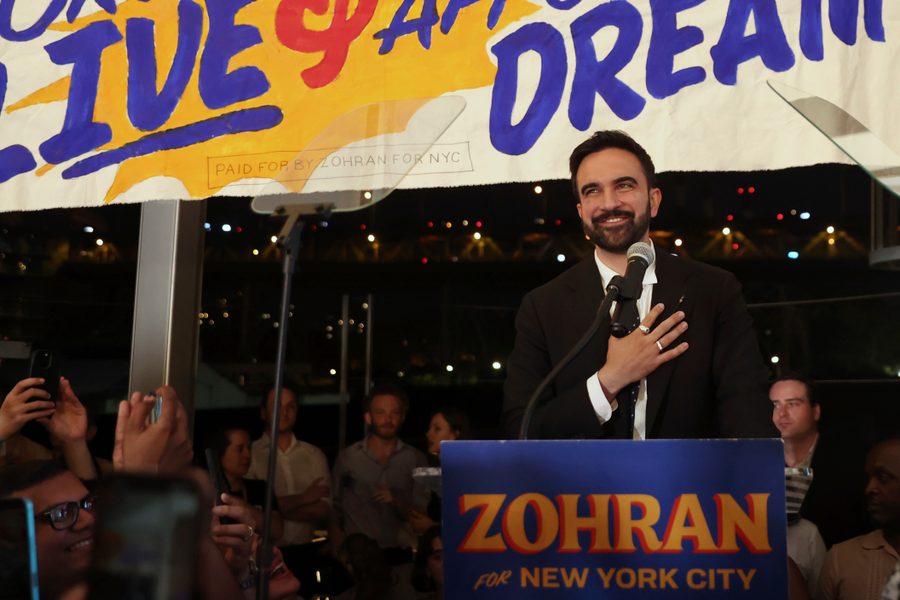
Zohran Mamdani speaks at his primary day election party.
On June 24th, Democratic Socialists of America (DSA) member Zohran Mamdani, an assemblyman from Queens, became the Democratic Party’s nominee for mayor of New York City. It is the biggest victory yet for DSA’s project of using the Democratic Party ballot line to dislodge centrist Democrats and advance pro-worker, pro-tenant, and pro-Palestinian policies.
But even if Mamdani wins the general election in November against incumbent Mayor Eric Adams, the new mayor will have to navigate the contradictions inherent in leading the richest city in the world as a democratic socialist. This is not a new problem: Since 2018, when DSA-backed candidate Julia Salazar won a state senate seat, the group’s New York chapter has had to navigate the difficulties inherent in socialist governance. For example, in 2022, Salazar backed legislation enabling the New York City Housing Authority to sell bonds to investors for public housing repairs; this led to criticism from some DSA members, who argued the legislation could lead to the privatization of public housing. At times, the relationship between DSA and the elected officials it backs has broken down over such challenges, such as when former Congressman Jamaal Bowman traveled to Israel with J Street, prompting a rebuke from DSA’s national body. Such questions are certain to recur if Mamdani wins the mayoralty in November. How can Mamdani hold together the diffuse and diverse coalition that powered his victory, and mobilize it to defeat the inevitable opposition to his agenda? How can he avoid the missteps that other progressive mayors have made? Is it possible for him to challenge the power of the billionaire class and govern the New York Police Department (NYPD)? And how will DSA react if Mamdani breaks with their program once in office?
To discuss these questions, Jewish Currents organized a roundtable discussion with Max Rivlin-Nadler, a reporter and co-founder of news website Hell Gate; the political strategist Emily Mayer; and NYC DSA steering committee member Batul Hassan. This conversation has been edited for length and clarity.
Alex Kane: What were the keys to Mamdani’s success—and what part did the electoral prowess of the NYC DSA play in the story?
Max Rivlin-Nadler: One thing that worked well for Mamdani is his incredibly effective social media campaign. He is a charismatic personality who put together straightforward, often funny, well-edited social media clips that have traveled extremely far. But that’s just one part of it. You can become famous, but you actually need to convince people to vote, and that part is the culmination of eight years of work that NYC DSA has been doing across the city to build out the city’s most powerful canvassing program. Residents in his core areas had their doors knocked four or five times—that was how tenacious DSA was.
In the past few city and state district races where DSA endorsed candidates, the endorsement just wasn’t enough. What was different here was that the group expanded its ground game citywide; all of a sudden there were new areas open to DSA, such as along the F line in Queens, where you saw a ton of South Asians being activated. DSA was building off of what it had done previously at the very local level. It was a huge refutation of the strategy of just flooding the airwaves.
Batul Hassan: We at DSA have taken the development of this electoral project very seriously. Since 2017 we’ve run 21 elections in New York, and we’ve won 11 of them. Over the course of this project we’ve developed a level of skill and organizing capacity that we were really able to flex in this campaign. And we’ve developed organizers themselves. A lot of Mamdani’s staff came from DSA. Mamdani himself developed his political organizing skills through DSA.
One pillar in all of our campaigns is having really clear socialist messaging that speaks directly to people’s material needs. We had a really robust field program that motivated about 60,000 people to give up their evenings and their weekends to share that message directly with people through one-on-one conversations. In a lot of my conversations, it was easy to connect the demands that Mamdani was making in his platform to what New Yorkers want to hear about: the rising cost of rent and childcare, the poorly managed bus system, and so forth. We were able to raise people’s expectations by speaking directly to them on these terms.
Emily Mayer: The only thing I would add is that the quality of the candidate really matters. The difference between a DSA loss or a DSA win in the last eight years of the electoral project has to do with the magnetism of actual candidates. It’s undeniable that Mamdani is a generational talent. New Yorkers, especially in a post-Trump moment, are craving authenticity and a sense that their elected officials are going to fight for them, and that’s not something that can be faked. Secondly, we’re in a very unique political moment. The Democratic base over the past year and a half has grown increasingly disillusioned with the leadership of the party. People are tired of a gerontocracy that feels set in its ways and unable to push back successfully on the authoritarianism that the right is riding. Mamdani’s leadership on everything from Gaza to the cost of living has demonstrated an authenticity that voters are deeply craving.
AK: What is the coalition that secured Mamdani’s win, and what lessons does the making of this coalition offer to the left regarding coalitional politics broadly?
EM: The coalition was largely organized by age—millennials turned out in record numbers—and by class. Mamdani brought together working-class immigrants and young progressives in the city, and that provided the numbers for a winning coalition, including a lot of people who had never voted or weren’t usual voters in Democratic primaries (and also may have voted for Trump in 2024).
The making of this coalition offers a really important lesson for progressives, which is that interests aren’t static. As an example: A lot of Asian neighborhoods that Mamdani won by big margins are some of the same neighborhoods that have held anti-asylum seeker rallies over the past four years. This might appear counterintuitive until we remember that a big reason for those rallies was elected leaders such as Adams spending significant time and energy ginning up anti-immigrant sentiment. These politicians framed the immigration debate as one of “good immigrants” who came here legally versus “bad immigrants” who skirted the system, which later led to these districts turning towards Trump in 2024. But then the Mamdani campaign came around, and it foregrounded the dignity of the immigrant experience overall. This created a sense of solidarity between the vastly different communities that make up New York. The campaign’s success with this strategy clarifies that our job as progressives is to use leadership and messaging to forge common interests and solidarity, rather than narrowly or transactionally navigating pre-existing and unchanging interests.
AK: In the long term, though, how do you keep a coalition that includes both people who are in favor of immigrants’ and asylum seekers’ rights, and people who were responsive to Trump’s anti-immigrant platform?
MRN: Ultimately I’m skeptical that the Colombian business owner on Roosevelt Avenue, who is angry over immigration and who voted for Trump in November, pulled the lever for Mamdani last Tuesday. I think that person is not voting in the primary. I think this was a different electorate than what we saw in 2024, and it was an electorate motivated by what happened in November and what’s happened since then, such as immigration raids across the city and people being disappeared in lower Manhattan. That clip of Mamdani reaching out aggressively towards Trump’s border czar Tom Homan—that is what people wanted to see, an avatar of themselves trying to do something that they themselves can’t do because they are incredibly vulnerable.
AK: The specter of Chicago Mayor Brandon Johnson—who was elected on a platform of raising taxes to fund housing and combat homelessness, but was unable to achieve these goals—has been wielded to try to warn New Yorkers against electing Mamdani. The Chicago Tribune published an editorial saying, essentially, “don’t elect Mamdani because we saw what happened when Johnson was elected.” How can Mamdani, assuming he wins the November general election against Adams, avoid the fate of Johnson in Chicago? What lessons from the Johnson mayoralty can Mamdani take?
EM: It’s important that we not buy into the narrative that has been generated by capitalists and then adopted by mainstream media deeming Johnson’s mayoralty a failure. There’s a learning curve for any executive, and a recent poll indicated he might be clawing his way back into popularity as he takes some of the boldest action against Trump, especially on immigration. He’s been a strident defender of the city’s sanctuary status, and he’s also won lots of victories for workers that we shouldn’t overlook, like ending the practice of paying tipped workers below the minimum wage, expanding paid time off for all city workers, and increasing the pay of childcare workers.
That being said, one of the major lessons is that we should expect lots of pushback on Mamdani’s agenda from the capitalist class. One of the first Johnson initiatives was a campaign called Bring Chicago Home, which hoped to progressively tax multimillion-dollar real estate sales to fund affordable housing. The real estate lobby spent millions against that effort, and ultimately, it was an early loss that made the new mayor look weak and put him on the defensive. Those early fights really matter. Choosing fights that you can win early on is an important strategy in any new administration. Capitalists have also tried to drive a big wedge between progressive aldermen and the mayor ahead of a future election, effectively telling aldermen that if you don’t vote no on the mayor’s budget, we’ll spend millions in your next election to defeat you. A Mamdani administration should work hard to preempt that kind of inevitable opposition, and do lots of relationship building with legislative partners inside government as well as with outside groups to figure out how to push back.
MRN: One big advantage Mamdani has coming into office is that there are so many laws that were passed by the city council four years ago that Adams has just ignored, such as the “streets master plan” to install 50 miles of protected bike lanes and 30 miles of protected bus lanes, Local Law 97 that limits how much carbon large buildings can emit, and the shutdown of the Rikers Island jail. Mamdani can pick these up and begin implementing them on day one. These are things that City Hall can do in the first 100 days. He doesn’t even have to expend much political capital to make these things happen, and these can provide the early wins Emily was talking about.
AK: What should we expect from police and real estate interests under a Mamdani mayoralty? How do you think things may play out there?
MRN: That’s obviously going to be the big question. Look at the Bill de Blasio administration. He appointed Bill Bratton to appease the NYPD, and he appointed Alicia Glenn to appease real estate. But both of those totally backfired, and neither of those two groups were happy with him. So I don’t think the Mamdani campaign should be losing too much sleep about making overtures to the real estate lobby, which in any case hasn’t gotten over the rent stabilization laws in 2019, one of the great DSA victories.
There are reasons to hope that Mamdani will be able to strike a balance. For instance, he has said that he wants to build massive amounts of social housing and do Mitchell-Lama 2.0, but he has also said we should have more market rate housing. So he’s acknowledging that the private market and social housing need to coexist, at least in the interim. When it comes to the police—I do believe there was a warm reception from rank-and-file cops to Mamdani’s idea that he doesn’t want the police to be pulling triple overtime shifts. He wants to focus on stopping violent crime and actually solving crimes at all because the clearance rate is ridiculously low, and he wants to get police out of mental health crisis situations that they’re not trained to be in and that have murderous consequences. As a journalist, I can say that the battle over that is going to be incredible to cover, because it does seem like Mamdani wants to envision a radical restructuring of the relationship between police and the urban geography, but one that I don’t think the rank-and-file are going to be that upset about, even if NYPD leadership and unions are going to be furious at any possible challenge to their authority.
AK: If Mamdani wins the general election, how can he and the DSA mobilize his army of door knockers to deal with these challenges? And more broadly, what do you think the role of DSA should be in a Mamdani mayoralty?
BH: This is a historic opportunity, maybe one that the left hasn’t had for 100 years in the US, to actually carry out a socialist agenda with support from the executive level. But having a socialist mayor is just one part of that process. If Mamdani is elected, we—DSA, workers and labor unions, tenant unions, and others—are responsible for creating the space that will be required for him to actually implement his platform. We need to be doing deep organizing in communities in order to build the political strength to pass what’s required. And it’s not just for things at the city level; there needs to be fundraising at the state level to do much of what we have set out to do. Part of our task is to show that it is actually possible to move these things.
EM: When I was progressive caucus director for the city council, I had a lot of experience trying to bridge the divide between organizing and governance. And I think it’s tricky. Legislators and the executive have a different role to play than organizations do, and it’s important to be clear about what that distinction is. In the same way that Bernie Sanders talked a lot about being organizer-in-chief, Mamdani can use the bully pulpit to push people to fight for certain things. But ultimately, being an executive and running a government is an exercise in making hard choices. The job of DSA isn’t to accommodate those choices, but rather to make the political space for electeds to be able to maneuver within the set of options that exist, and to say to capital, “I have to do this because union X is fighting for this”—in other words, to change the calculation such that there’s more space for an administration to make the right choices.
Further, I think it’s the job of DSA—and Mamdani working in partnership with DSA—to raise the visibility of some of the demands that have brought him into office at the state level, so that revenue can be secured for these policies. Here, the results of this election offer a seismic opportunity. If Democrats learn any lesson from this election, it should be that focusing on affordability and on mobilizing working class voters is in their self-interest. So if, say, Governor Kathy Hochul can see what’s good for her, she could be incentivized to move to the left in a primary election. And if she refuses to tax the rich, as she’s indicated, DSA should be able to credibly threaten her re-election. DSA has far surpassed the test of mobilizing on the scale of a mayoral election, so it’s a good next step to think about how to shoot big in the gubernatorial election in order to actually enable the mayor to have the space that he needs to deliver.
AK: What can DSA do if Mamdani breaks with the DSA line on specific issues?
EM: DSA as an advocacy organization and Mamdani as a potential mayor will have extremely different roles to play. The mayor’s job is to make sure his proposals can get over the finish line, which involves balancing a number of competing forces that are trying to influence what happens inside of City Hall. DSA’s job is to deliver the boldest version of the policy proposals that were at the center of the campaign. In order to do that, the group may need to push a potential mayor both privately and publicly to get those things done, and to get a version of them done that best serves working class people in the city. I think that DSA can do that through mobilizing their people to show up at every fight against opposing interests that seek to influence the mayor.
BH: Ultimately, we at DSA know that Mamdani becoming the Democratic nominee for mayor doesn’t mean that all of New York City has been transformed. This is still a capitalist society, and that means there will be tons of challenges in winning socialist policies. We know that the opposition that our project faces—from the landlord lobby to corporate Democrats, whether they’re in Albany or the city—is extremely powerful. In response, we’re not just fighting to win through the mayor’s office. We’re fighting to win in every place where the working class deserves to shift the existing balance of power.

I’m Arielle Angel, editor-at-large of Jewish Currents. Before you go, there’s something I need to ask.
We’ve seen over and over how the mainstream media falters in telling stories on our beats—whether it’s antisemitism, Israel/Palestine in American politics, Jewish identity, or the American left. At Jewish Currents we’re committed to uncompromising analysis and longform reporting on these issues and more—stories you won’t find anywhere else. In a media landscape that obscures injustice and flattens discussion, we’re changing the conversation. But we need you.
If you believe in this work, please consider making a donation—or even better, a recurring one—to ensure that we are able to keep publishing stories like this one. We can’t do it without you.