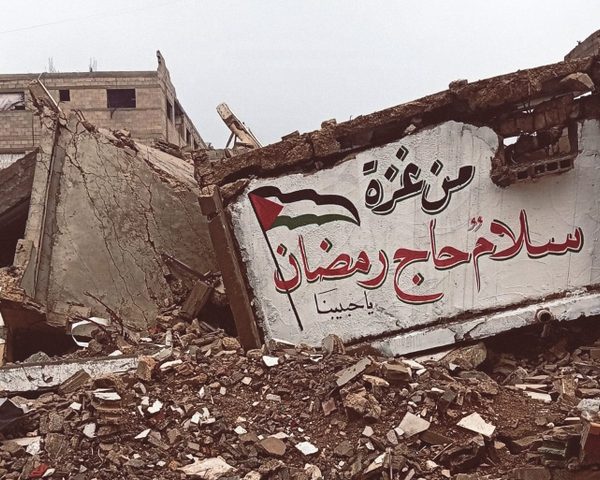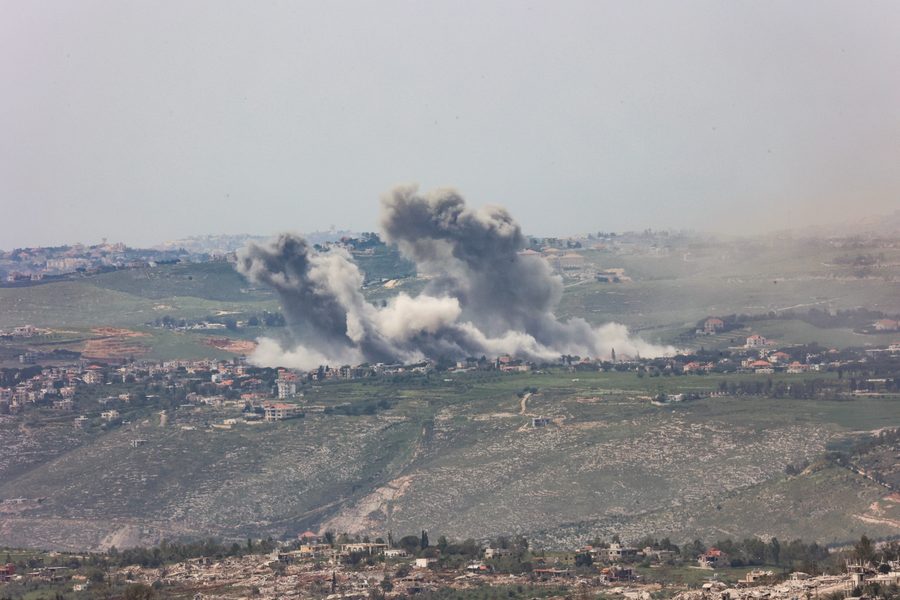
Smoke rises after an Israeli airstrike on a Lebanese village on Sunday. President Trump announced the continuation of a ceasefire on Thursday.
This article first appeared in the Jewish Currents news desk newsletter. Subscribe here.
On Sunday, Israeli airstrikes in Lebanon killed 14 people, while Hezbollah killed an Israeli soldier stationed in southern Lebanon. Three days earlier, President Donald Trump announced that Israel and Lebanon agreed to extend their so-called ceasefire for another three weeks.
The notional ceasefire is the latest effort to curb a war that broke out on March 2nd, when Hezbollah fired at Israel in retaliation for the Israeli-US war on Iran, the Lebanese militant group’s benefactor. But the fighting has continued, and the attacks on Sunday highlight the precarity of a deal that has lessened the intensity of the violence in Lebanon, but has not ended it. As direct negotiations between Israel and Lebanon continue, Israeli troops continue to occupy parts of southern Lebanon. Israeli forces have depopulated the area, forcing over 1.2 million people from their homes, and have demolished hundreds of buildings, destroying entire villages.
To understand the state of the war in Lebanon, Jewish Currents spoke to Thanassis Cambanis, the author of a book on Hezbollah and the director of the foreign policy center of the progressive think tank The Century Foundation. This conversation has been edited for length and clarity.
Alex Kane: What does the extension of the “ceasefire” mean?
Thanassis Cambanis: I don’t want to call it a ceasefire, because it isn’t fully one. The only promising element of this rapprochement between Israel and Lebanon is that it has enabled direct negotiations between the two governments, a necessary precursor to an actual ceasefire or peace agreement. But I’m profoundly skeptical that there is any possibility of a real political settlement right now because of two factors: Israel’s ongoing attacks on Lebanon throughout periods of negotiation and ceasefire, and the exclusion of Hezbollah from the political process.
Israel and Lebanon have been at war since 1948, before the Islamic Republic and Hezbollah existed. There has to be some kind of political settlement between these two states so that people on both sides of the border can live free of attack. That said, the war is not between the government of Lebanon and the government of Israel. It’s between Hezbollah and Israel, and the resolution has to involve direct negotiations between those two.
AK: How controversial are these talks within Lebanon?
TC: When the president of Lebanon publicly called last month for direct talks with Israel—a wise diplomatic move—he didn’t offer any concessions. He was immediately accused of betraying Lebanon, and specifically the “resistance,” the formulation used to describe Hezbollah and its allies who have fought against Israel. That is dangerous. I have heard people in Lebanon worry that the current president or prime minister might face the risk of assassination because of this diplomatic outreach to Israel and the United States and I think that’s unfortunately a plausible scenario. [Ed note: In 1982, a supporter of the Syrian government killed Lebanese President Bashir Gemayel, and in 2005, Hezbollah members assassinated Prime Minister Rafiq Hariri.]
AK: What are Israel’s main goals in Lebanon right now, and are they the same as the Trump administration’s goals?
TC: Israel’s goals are maximalist, detached from reality, and horrible for Lebanese society. Since October 8th, 2023, the policy goal of Israel has been to annihilate Hezbollah, to completely pacify Lebanon, and maybe extract something like a complete surrender from the country. In the last month and a half, those Israeli goals have grown to an overt project of ethnically cleansing the border zone of Lebanon, and there’s been an expressed desire to occupy some Lebanese territory.
Those goals are not the Trump administration’s goals, although his administration’s Lebanon policy has been, at best, unarticulated. The thing that would really contribute to a shift in the dynamic would be empowering the Lebanese state, and that’s something that neither the United States nor Israel has ever supported, because they don’t actually want a strong and coherent Lebanese government which could theoretically provide a counterweight to the Israeli military.
AK: Israel and the US are pushing for Lebanon to disarm Hezbollah, but they don’t want a stronger state?
TC: It’s an incoherent and contradictory policy. Everyone involved knows that the Lebanese government and the army aren’t strong enough to even hold their own territory from an outside or an internal challenge. They’re definitely not strong enough to disarm Hezbollah, a militia that has fought the Israeli military to a standstill multiple times in land wars.
Hezbollah’s transnational reach was eroded [by Israeli attacks on them after October 7th], and its ability to pose a threat beyond its borders shrank. However, it has retained its core competence, which is infantry power on Lebanese territory in communities that have been part of the Hezbollah-led project for nearly half a century. They are as strong as ever on their ability to defend Lebanese territory and fight against Israeli encroachment. They might be as weak as they were in their early years when it comes to projecting transnational power.
AK: Do you think the deal will hold?
TC: The regional picture has always been the main determinant of what happens in Lebanon. Right now we have an Israel that is running amok around the region, and a United States following suit, pursuing unachievable, open-ended military goals. Until that imbalance goes back into some kind of equilibrium, I don’t think there can be any kind of stable peace in Lebanon.
The type of settlement that is within reach is a tenuous and somewhat dissatisfactory type of non-aggression pact like what we saw from 2006 until 2023 between Israel and Lebanon. It certainly wasn’t anything like a political settlement, but there was a cross border calm that lasted for 17 years.
Right now Israel is not interested in that kind of agreement. Israel imagines that through the use of force, it can get something like total submission or military domination. We’re going to have to wait until those options are exhausted, until Israel and the United States find out that no matter how much they bomb Lebanon or bomb Iran, Lebanon and Iran are still going to be functional societies that contain elements that are going to oppose them. Peace, or at least non-war, will have to be made with those very actors that Israel and the United States hope to eliminate.

I’m Arielle Angel, editor-at-large of Jewish Currents. Before you go, there’s something I need to ask.
We’ve seen over and over how the mainstream media falters in telling stories on our beats—whether it’s antisemitism, Israel/Palestine in American politics, Jewish identity, or the American left. At Jewish Currents we’re committed to uncompromising analysis and longform reporting on these issues and more—stories you won’t find anywhere else. In a media landscape that obscures injustice and flattens discussion, we’re changing the conversation. But we need you.
If you believe in this work, please consider making a donation—or even better, a recurring one—to ensure that we are able to keep publishing stories like this one. We can’t do it without you.