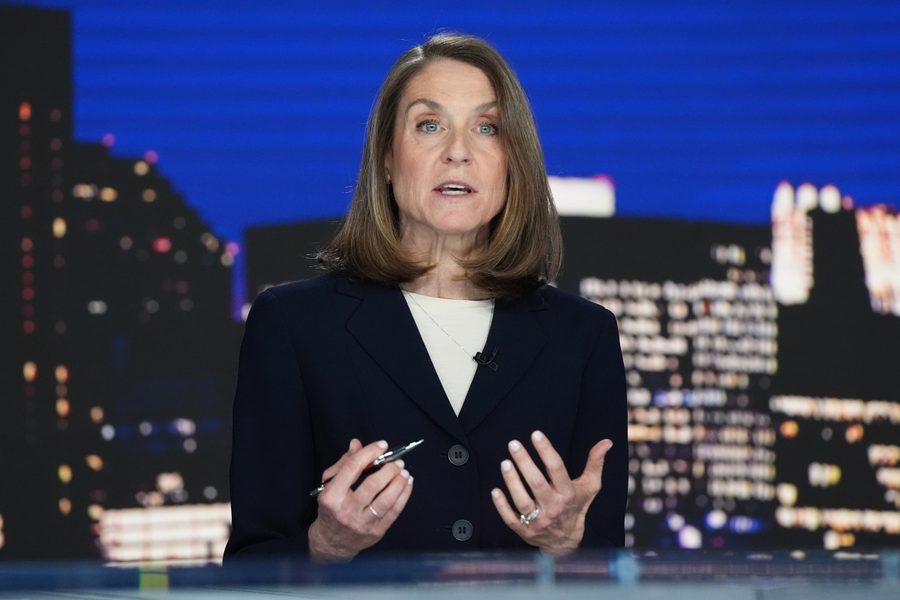
State Sen. Laura Fine, an AIPAC-backed House candidate who opposed the Iran war, appearing in a Democratic primary debate in February.
This article first appeared in the Jewish Currents news desk newsletter. Subscribe here.
Democratic House candidates backed by pro-Israel groups in Illinois—where AIPAC and its allies have spent nearly $14 million attacking progressives and supporting centrists in the ongoing primary races—split from the pro-Israel lobby this week on the US and Israeli war against Iran.
AIPAC, the lead pro-Israel lobbying group, which has long pushed for crippling economic sanctions on the Islamic Republic and opposed US diplomacy, commended President Trump’s “decisive action” in attacking Iran. The Democrats the group is backing in the March primaries in Illinois, however, have uniformly condemned US action against Iran, while stopping short of direct criticism of Israel’s role.
State Senator Laura Fine—who in June 2025 supported Israel’s bombing of Iran—said Trump could “send the Middle East into further chaos” and should be impeached. Former congresswoman Melissa Bean and Cook County Commissioner Donna Miller both said Trump’s actions were “dangerous and unconstitutional.” And city treasurer Melissa Conyears-Ervin denounced the “immoral” “war of choice.” (None of the AIPAC-backed candidates returned Jewish Currents’s request for comment.)
This tightrope act by the pro-Israel Democratic candidates in Illinois is a sign of the political predicament the unpopular war has created for AIPAC, which is supporting candidates in dozens of tight races across the country as it seeks to maintain Democratic support for Israel in the House. “They are aware that Democratic voters oppose this war pretty overwhelmingly,” said Matt Duss, executive vice president at the Center for International Policy and the former foreign policy adviser to Senator Bernie Sanders. A Washington Post poll published earlier this week found that 87% of Democrats oppose the war. In focusing their criticisms on Trump, the Illinois pro-Israel candidates are sidestepping Israel’s role in the bombings and staying out of direct conflict with AIPAC. “They have to be careful if they want to keep AIPAC support,” said Duss.
Similar dynamics are playing out in other primary races, and in Congress. In New York, the AIPAC-endorsed Rep. Dan Goldman, who is facing a challenge from progressive former city comptroller Brad Lander, criticized Trump for “defying our Constitution,” while making no mention of Israel. The Iran war was also a late issue in North Carolina’s Democratic primary on Tuesday, where the incumbent, Valerie Foushee, beat her progressive challenger Nida Allam by a tiny margin. Allam’s final TV ad focused on her opposition to the war on Iran, and criticized Foushee for taking money from weapons companies. Foushee—who also opposes the war on Iran—distanced herself from AIPAC during the campaign, and in her statement declaring victory, said that voters in her district demand “progressive change” like “passing legislation to block arms sales to Israel.”
Progressives scored an outright victory on Tuesday in Texas, where Rev. Frederick Haynes won the Democratic primary in the overwhelmingly Democratic 30th Congressional district, positioning hims as the next representative there. Haynes has referred to Israel as an apartheid state and called Israel’s actions in Gaza a genocide, and has more recently voiced opposition to the Iran war.
“These early results already demonstrate a massive shift in what is possible for the people that we elect to Congress,” said Beth Miller, political director of the anti-Zionist group JVP Action. “You could not imagine these folks being serious contenders a few years back in the same way and with the politics that they’re running on right now.”
Illinois is now the center of the next Democratic battle over Israel policy, and it is there that AIPAC is spending most heavily. AIPAC donors and AIPAC-tied super PACs have spent $13.7 million on Illinois primary races attacking progressives and boosting their preferred candidates, according to a recent investigative report from WBEZ, the local public radio station.
In interviews with Jewish Currents, two Chicago-area progressive candidates characterized their AIPAC-backed opponents’ tepid criticism of the Iran war as disingenuous. Nonprofit founder Junaid Ahmed, who is among the candidates running against Melissa Bean, said that Bean “knows that AIPAC money is toxic,” and that “if she doesn’t say anything against what’s happening in Iran, she’s got no chance.” Robert Peters, a state senator running against Donna Miller, said Miller has “made a lot of commitments around AIPAC money. So I don’t think it’s a coincidence that she left [AIPAC and Israel’s role] out.”
In a joint statement on Monday, four of the Chicago-area candidates backed by the Congressional Progressive Caucus PAC—Peters, Ahmed, Evanston Mayor Daniel Biss, and union organizer Anthony Driver—criticized Trump for dragging the US into “into an unnecessary and illegal regime change war fully backed by AIPAC,” and called for their opponents to “unequivocally reject AIPAC’s pro-war agenda.”
Progressive advocates said that the US-Israeli war on Iran was likely to boost those pushing an anti-war message in districts more favorable to progressives. Yousef Munayyer, head of the Palestine/Israel program at the Arab Center Washington DC, said the war on Iran “heightens the contrast in a lot of these races” and “helps make the case that a lot of these progressive candidates have made that US policy is far too pro-Israel, and that there is far too much pro-Israel influence around American policymaking and in American elections.”

I’m Peter Beinart, editor-at-large of Jewish Currents. Before you go, I need to ask something of you.
In recent years, I’ve watched as mainstream Jewish institutions and media have chosen ethnonationalism over liberal democracy and mass slaughter over the pursuit of a just peace. Jewish Currents offers something different. It’s a magazine built on intellectual curiosity and respect for the dignity of all people.
But a project like this doesn’t sustain itself, and we can’t do it without your help. If you share my belief in the importance of this mission, please consider making a donation—or even better, a recurring one. We need you with us.