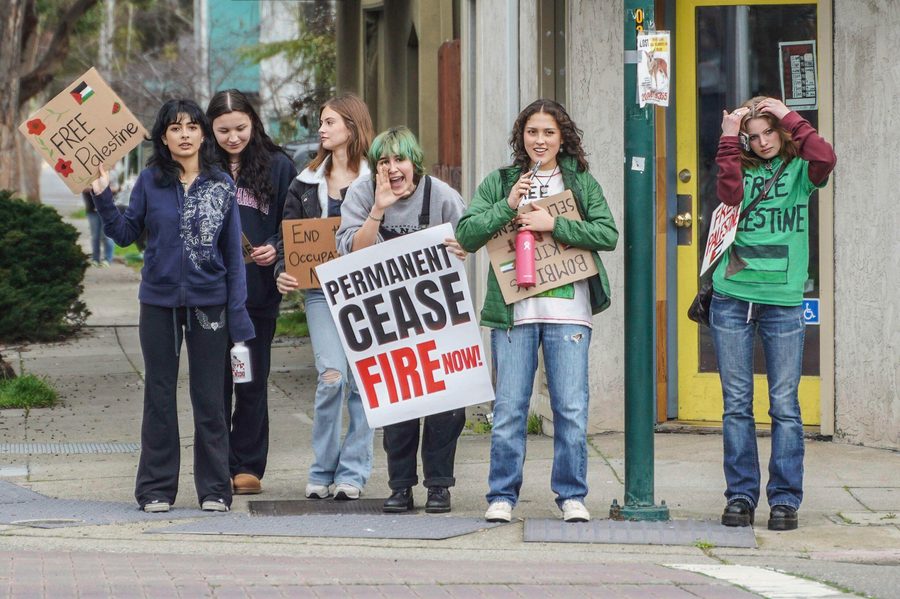
Students stage a walkout for a ceasefire in Gaza in Alameda, CA in January 2024.
It was on the weighty date of October 7th this year when California Governor Gavin Newsom of California signed the controversial education bill AB 715 into law. The product of months of political haggling, the bill establishes a new state office of civil rights and, within it, a governor-appointed “antisemitism prevention coordinator,” the first in the United States for K–12 education. The legislation instructs this new coordinator to “develop, consult, and provide antisemitism education to school personnel” in order “to identify and proactively prevent antisemitism,” and “requires districts to investigate and take corrective action” when “discriminatory content” is used in schools. The bill prescribes that any offending “instructional materials” be “immediately and permanently . . . omitted” from the classroom. Districts found to be engaging in discrimination may see a portion of state funding withheld. AB 715 also expands what is considered discriminatory in classrooms, establishing that “discriminatory bias . . . does not require a showing of direct harm to members of a protected group” nor does it require “members of a protected group to be present while the discriminatory bias is occurring.”
Jewish groups in the state are heralding AB 715 as a win for Jewish students, protecting them from what they describe as a precipitous rise in antisemitism in schools since October 7th, 2023. According to the Jewish Public Affairs Committee of California (JPAC), organizational support for AB 715 amounted to “the largest Jewish coalition ever assembled for a California bill.” Endorsers included every Jewish federation in California; the West Coast affiliates of the American Jewish Committee and the Anti-Defamation League (ADL); several Hillel chapters; 12 individual synagogues; the state Democratic Party-affiliated California Jewish Democrats; and Zionist groups like StandWithUs and Zioness. In turn, they faced opposition from every sector of the progressive movement, including Palestinian, Arab, and Muslim community groups; Asian American and Black community organizations; anti-Zionist and progressive Jews; education workers; and free speech legal experts. Many opponents warned that rather than protect students, the bill could give the state license to curb political content in classrooms under the guise of fighting antisemitism, a pattern already familiar from Donald Trump’s attacks on higher education in California, as well as from similar legislation in other states. Most notably, the California Teachers Association came out in opposition in July, expressing concerns that the bill “does not address any other forms of hate or discrimination” aside from antisemitism. They noted that because “we are already seeing ‘anti-discrimination’ frameworks weaponized to limit academic freedom” at the federal level, the state should “avoid a framework that punishes teachers for teaching students.” But not even the power of the largest teachers’ union in the state, which has over 310,000 members, could stop AB 715 from passing unanimously in the Assembly and Senate and receiving Newsom’s signature. (In response, the American-Arab Anti-Discrimination Committee has filed a lawsuit to challenge the statute’s constitutionality.)
AB 715 is best understood as a continuation of the five-year assault on ethnic studies curricula in California’s public schools, which has become a state graduation requirement in recent years. Emerging from radical student organizing in the 1960s and ’70s, ethnic studies is an academic discipline which centers the experiences of communities of color. While it is often erroneously understood simply as “multiracial education,” the discipline has always centered a radical critique of structures of injustice like colonialism and capitalism. Though AB 715 does not explicitly mention ethnic studies, a previous iteration of the bill, introduced in 2024 and defeated earlier this year, would have required school districts to submit ethnic studies curriculum to the California Department of Education for review, in order to root out alleged “bias”—chiefly antisemitism. That bill struggled to gain traction among legislators after constituents voiced fears that singling out ethnic studies for policing would mean students of color would have their communities’ stories suppressed. But the contention that ethnic studies contains antisemitic content dates back to the backlash to a state model curriculum for ethnic studies created after California passed the graduation requirement in 2021. The original Ethnic Studies Model Curriculum contained lessons on Arab American and Palestine studies, which were eventually excised from the final draft—along with other material, like explicit criticisms of capitalism—after an all-out campaign by Jewish and conservative groups. In the years since, the authors of the original curriculum and other ethnic studies educators developed the Liberated Ethnic Studies Model Curriculum, offering individual school districts the chance to return to the intentions of the original curriculum, before the more critical content was removed from the statewide version. When school districts across California have adopted this version, Jewish and Zionist groups have claimed that the curriculum contains and fosters antisemitism.
As they once managed to do in opposing ethnic studies, the backers of AB 715 pulled together an arguably diverse coalition against antisemitism in K–12 schools. The bill’s legislative co-sponsors included leadership of the California Legislative Jewish Caucus, Asian American and Pacific Islander Caucus, Latino Caucus, and Black Caucus. JPAC, too, paid lip service to California’s diverse communities in their official statements: “We know other vulnerable communities have also been subject to increases in discrimination in recent years. This surge in targeted hate incidents demands a firm and urgent legislative response.” According to them, AB 715 “reaffirms California’s commitment to creating safe, inclusive learning environments for all students—including Jewish students.” Indeed, on the same day AB 715 was signed, Governor Newsom signed SB 48 into law, creating four new discrimination prevention coordinators which broadly “focus . . . on religious, racial, ethnic, gender, and LGBTQ discrimination” for K-12 education, and which per the law, would only come into being if AB 715 was also enacted.
Yet SB 48 was originally meant to prohibit immigration officers from entering schools without a warrant and to restrict school law enforcement from cooperating with federal officials. It was amended in July to its current version. As a result, the pro-AB 715 coalition’s claim to support inclusivity appears suspect: It is unclear how a statewide antisemitism coordinator supports “safe, inclusive learning environments” for non-Jewish students; why the appointment of statewide discrimination prevention coordinators relied on the creation of an antisemitism prevention coordinator first; and why “discrimination prevention” took precedence over protecting students from ICE at a moment when officers are conducting warrantless raids across the country.
Ironically, the ethnic studies approach could help us better understand this series of events, from the competing claims of what constitutes “anti-discrimination” to the role of the California Jewish community as both a minority group and an effective wielder of political power. Yet rather than offering an opportunity to develop sharper analyses of antisemitism and racism, those that support AB 715—from mainstream Jewish institutions for whom Zionism trumps all else, to anti-DEI groups who wish to move into the mainstream of California political life—offer a static, tired understanding of antisemitism, one that conflates it with criticism of Israel and support for Palestine, and which suggests all Jews in America are in a static, immutable state of perpetual victimhood. Like previous efforts from mainstream Jewish Zionist institutions, AB 715 is not interested in combatting antisemitism so much as in suppressing Palestinian stories in the classroom and adding surveillance to teachers already under scrutiny. Even as these advocates work in the name of protecting children, those who stand to lose from AB 715 are California’s students—including its Jewish youth, an increasingly racially diverse group with diverse opinions on Palestine-Israel who would benefit from a robust curriculum that teaches us how both antisemitism and anti-Palestinian racism are connected to broader structures of empire and colonialism.
The show of force in passing AB 715 comes after parent groups, typically working in collaboration with established Zionist lawfare groups, have sought to thwart ethnic studies implementation across the state by filing suits against school districts and boards. In February 2025, a suit brought by the Louis D. Brandeis Center successfully stopped ethnic studies instruction in the Santa Ana Unified School District in Orange County until further notice. The Deborah Project has sued both the Mountain View–Los Altos High School District and the Hayward Unified School District for release of “records” related to ethnic studies instruction; both districts settled and agreed to pay the group’s legal fees. (Another suit filed against the Los Angeles Unified School District by the Deborah Project alongside a Jewish parents’ group was finally dismissed after two and a half years in December 2024.) Both the Brandeis Center and The Deborah Project are notable pro-Israel “lawfare” firms that have filed numerous Title VI complaints alleging antisemitism on both college campuses and in K-12 schools. In addition to these legal efforts, parent groups have used grassroots tactics to try to persuade districts to rethink ethnic studies—particularly in the South Bay area, which boasts a large Israeli American population. There, in Palo Alto and Menlo-Atherton, parents organized a letter and petition, respectively, complaining about ethnic studies content. In the latter town, the teacher whose ethnic studies lesson on “narratives and counter-narratives” in Palestine-Israel prompted the petition has sued the school district, accusing them of anti-Black discrimination in failing to protect her from rampant harassment by anti-ethnic-studies groups. This fall in the same district, an anonymous group of parents had begun messaging families encouraging them to “opt” their children out of ethnic studies classes.
Many such campaigns combine allegations of antisemitism in ethnic studies with broader attacks framing the curricula as subversive and anti-American. Outside of Sacramento, for example, the Coalition for Empowered Education brings together the conservative North American Values Institute (formerly known as the Jewish Institute for Liberal Values); the “Victims of Communism Memorial Foundation,” which claims that “Marxist socialism is the deadliest ideology in history”; and a multiracial variety of right-wing groups, including the Hindu American Foundation and Free Black Thought. In one publication, the Coalition argues that frameworks within ethnic studies “can damage the United States internally by instilling hostile and inaccurate views of American democracy into school kids, erroneously portraying the American democratic system as fundamentally racist, violent, and oppressive.”
The undisguised language of the right is absent in AB 715, which instead makes gestures to liberal multiculturalism. The final text of the bill proclaims that “antisemitism threatens not only the Jewish community, but all Americans. People who peddle these antisemitic conspiracy theories . . . also target other communities—including Black and brown Americans; Asian Americans, Native Hawaiians, and Pacific Islanders; LGBTQI+ individuals; Muslim Americans; women and girls; and so many others.” Yet AB 715’s external backers have contributed little to educational efforts about how antisemitism is linked to other forms of bigotry. Conservatives today demonize critical race and ethnic studies by claiming it teaches a version of US history where white people are monolithic oppressors and people of color are abstract victims. Aligning themselves with this critique, Zionist groups have claimed that such approaches offer no space for understanding American Jews, claiming at once that Jews are part of a Judeo-Christian civilization and that they are the ultimate victims of it. As I have written, a more accurate narrative of American Jewish racial position in the US today is one of mixed and complex relationships to power and privilege—especially when considering the racial diversity within the Jewish community. But too often, per historian of American Jewish identity Caroline Light, “Jewish coherence . . . depends upon shared appeals to the past that obfuscate alternative, ambivalent narratives” and “depend upon silences in the process of history itself.”
Critical race and ethnic studies, by contrast, pushes for a multifaceted analysis of American Jewish identity that does not rely on a universal victim narrative to “cohere.” Understanding antisemitism as a form of racism in the US requires reckoning with how some Jews became white. This reckoning can be aided by complex theories of racialization and white supremacy in the US, wherein some groups have found themselves in multiple conflicting positions of access to and exclusion from structures of power. Indeed, such theories can help us understand how California’s Jewish Caucus was reportedly able to spend “years and years of political capital” to get AB 715 passed over the objection of key stakeholders. Some criticisms of the Jewish Legislative Caucus or JPAC’s role in fights over AB 715 or the Ethnic Studies Model Curriculum suggest that Jewish Zionist groups have undue influence and power in Sacramento. On its face, such an assertion is an antisemitic canard, but the reality—in which such groups frequently have more legislative success than their progressive opponents—can be complex to grapple with. The truth is not that Jews qua Jews hold outsized political power or pull strings, but that Zionism and anti-Palestinian racism have become such deeply held American bipartisan values that organizations aligning with those values will see fewer barriers to their agenda.
We can come to terms with Jewish power alongside Jewish vulnerability if we take seriously the lessons from ethnic studies that describe how racial identities are not innate, but rather change shape through time and space in relation to structures of power. This suggests that what we need now is not only an assertion that anti-Zionism is not antisemitism; we need a new definition of antisemitism that understands that the racial position of American Jewry has shifted. We need scholars of antisemitism to critically analyze what antisemitic tropes or ideologies look like in the 21st century, and we need a framework for discussing how Israel’s actions can, in fact, foment antisemitism by claiming to be acting on behalf of all Jews when carrying out acts of genocide.
California could be a powerful place to develop such curricula. The state now has the second-highest Jewish population in the US. It is home to two of the largest metropolitan Jewish communities in the country: Los Angeles and the Bay Area. And the diversity within California’s Jewish communities is unique. Nationally, 89% of Jews are white, according to the American Jewish Population Project at Brandeis, but a 2021 study of the Bay Area Jewish community indicated that 25% of Jewish households polled include “a respondent or spouse who is Hispanic, Asian-American, African-American, or of mixed or other ethnic or racial background (other than white).” Among respondents aged 35–49, this rises to 28% and for ages 18-34, the number is 38%. In other words, Jewish families with school aged children in California are increasingly not white or Ashkenazi. Instead of isolating the Jewish experience and putting it in a zero-sum relationship to the stories of other groups, the California curriculum could offer an analysis of antisemitism and racism together that could help us better understand the experience of the many Jews of color in the community, as well as their non-Jewish neighbors. For instance, one might find a link between Jewish and Arab American histories by studying the history of Sephardi Jews from the Ottoman empire who were racialized as Arab upon immigration to the US, rather than taking the white, Ashkenazi history as the assumed starting point. Instead of teaching “Black–Jewish relations” that supposes a monolithic white Jewish community, schools could teach the history of Black Jewry in the US and abroad, offering insights about the relationship between anti-Blackness and antisemitism, rather than supposing that they are always separate and hierarchized.
At one point, I felt hopeful that some bridges could be built between ethnic studies and those whose stated goal was quality education about Jews and antisemitism. But as long as Jewish Zionist groups intervene every time that curricula veers even slightly toward acknowledging Palestinian human rights, the possibility for a robust cross-analysis of antisemitism within ethnic studies recedes farther from sight. This is especially true as previous campaigns to “include Jews in ethnic studies” have actually been Trojan horses for including pro-Israel content in ethnic studies. Ethnic studies educators spend so much time dealing with Zionist backlash to the potential inclusion of Palestinian stories that little energy is left over to devote to robust education on antisemitism. In doubling down on the same tired conflation of antisemitism with anti-Zionism, AB 715 has contributed to making the possibility of such education more remote by clarifying the intentions of groups like JPAC. Ethnic studies educators who are earnest about bringing in better Jewish education know they cannot win with these critics unless they plan to erase Palestinian stories and silence criticism of Israel.
Against this backdrop, the students of California are left to find their own way forward. After all, even where Palestine is successfully barred from the classroom, kids are hearing about Palestine anyway—from TikTok and Instagram; from Palestinian flags in their neighbors’ windows; from older siblings and cousins navigating campus activism; and from other students in California’s multiracial classrooms. Rather than assure that their loyalties stay with Israel, campaigns against ethnic studies have only deprived these students of a classroom setting in which to better understand what they are taking in from their environment. The groups behind AB 715 have cast the “liberated ethnic studies” curriculum in the role of an “outside agitator” infiltrating schools. But watching students speak at school board hearings and organize protests at middle and high schools, it is clear how homegrown support for Palestine is among students in California, even at young ages. And it’s clear that these supporters include many Jewish students and parents, who have recently begun joining pro-ethnic studies and anti-AB 715 coalitions in greater numbers than ever before—including many who weren’t already part of Jewish anti-Zionist groups like Jewish Voice for Peace. In fact, I’ve heard from many of these students and parents that they believe ethnic studies frameworks have helped them better understand their own identities as Jews, even where such connections aren’t made explicit in the curricula.
When Jewish Zionist groups prohibit students from engaging in this critical learning in the classroom, and as teachers are punished for teaching Palestine or shy away from it for fear of reprisal, California’s youth figure out ways to teach themselves. In March 2024, Berkeley Unified School District held a public comment session on whether to renew a contract to develop curriculum with the Liberated Ethnic Studies Model Consortium. The content of the hearing—one of several over the 2023-2024 school year—expanded beyond just ethnic studies into how Palestine-Israel is, or is not, allowed to be discussed in Berkeley’s schools. A Jewish senior at Berkeley High School pushed for the importance of teaching about Palestine in ethnic studies. “I think school is the place we need to be hearing about this from . . . Not teaching students about Israel-Palestine isn’t going to stop them from hearing about it.” And an eighth grader spoke about the “Watermelon Club” she co-founded at her middle school, which had been accused of perpetrating antisemitism through its organization of a student walkout. “Many students and parents may think that the club or the members of the club are anti-Jewish or antisemitic,” she said at the hearing. “But any student is welcome to the club. We as the club leaders will make sure it’s a safe environment where everyone’s opinions are heard.”
Selections in this essay, particularly the passage that begins "But too often..." and ends on "structures of power," were originally published in “Avoiding a Zero-Sum Game: Lessons for Jewish Studies from California’s Struggle over the Ethnic Studies Model Curriculum” in Shofar: An Interdisciplinary Journal of Jewish Studies. Reprinted with permission of Shofar and Purdue University Press.

I’m Peter Beinart, editor-at-large of Jewish Currents. Before you go, I need to ask something of you.
In recent years, I’ve watched as mainstream Jewish institutions and media have chosen ethnonationalism over liberal democracy and mass slaughter over the pursuit of a just peace. Jewish Currents offers something different. It’s a magazine built on intellectual curiosity and respect for the dignity of all people.
But a project like this doesn’t sustain itself, and we can’t do it without your help. If you share my belief in the importance of this mission, please consider making a donation—or even better, a recurring one. We need you with us.