“Giving Palestinians Fewer Rights than Eichmann Received”
Sociologist Ron Dudai discusses the new death penalty bill that has become a vehicle for the Israeli right’s revenge.
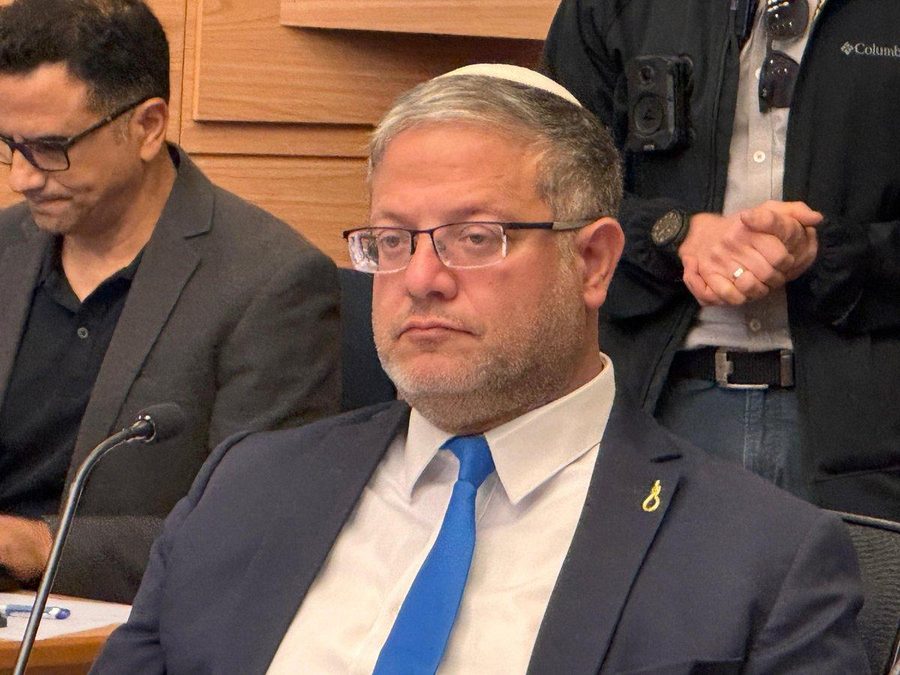
Israeli far-right minister Itamar Ben-Gvir wearing a golden noose pin.
On November 10th, 2025, the Israeli Knesset voted to advance a bill designed “to establish the death penalty for terrorists who have carried out murderous terror attacks.” If passed, the new law would require only a simple majority of judges to rule against a defendant; the convicted must then be hanged within 90 days without any possibility of commutation.
The bill, which applies only to the murder of Israelis, has become a symbol of the far right’s desire to extract revenge. “A death penalty for terrorists is a personal and national obligation,” Limor Son Har-Melech, the Member of Knesset who sponsored the legislation, said in a statement. It is a “bill that will frighten,” added far-right minister Itamar Ben-Gvir. The bill is currently being debated in committee; afterwards, it is expected to return to the Knesset plenary for final voting, where it appears likely to pass into law. In anticipation, the Israel Prison Service has announced that they have already begun designing special facilities where those convicted will be hanged, and training prison employees to perform the executions.
To learn more about Israel’s past positions on the death penalty, the details of the current legislation, and the cultural and political changes that have led to its advancement, I spoke with Ron Dudai, an Israeli sociologist who studies criminology and human rights. This interview has been edited for length and clarity.
Maya Rosen: Can you speak to the history of the death penalty in Israel?
Ron Dudai: When Israel was established in 1948, it inherited the death penalty [as the punishment] for murder from the British Mandate. Immediately, a debate arose about abolishing it, and following a Knesset vote in February 1954, it was outlawed. This was comparatively very early: France was still executing people with the guillotine at the time. There had been discussion about abolishing the death penalty completely, but it was ultimately abolished only for murder—in part because of the 1950 passage of legislation on Nazi crimes, which included the death penalty. That law was meant to be purely symbolic. No one anticipated Eichmann would be found and brought to Israel, but this happened. He was tried and executed in 1962—Israel’s only official use of the death penalty in its history.
But then, when Israel occupied the West Bank and Gaza in 1967, it argued that the British Mandate’s sweeping and repressive Emergency Regulations were still in force. The reason for this wasn’t about the death penalty; these regulations also allowed Israel to continue to subject Palestinians to practices such as administrative detention, and to more easily advance home demolitions, restrict freedom of movement, and prohibit political gatherings. But retaining the Emergency Regulations still meant that the military courts Israel established in the West Bank had the authority to impose the death penalty, though it was never used.
Since then, the possibility of using the death penalty against people who commit ideologically motivated violence (whom Israel calls “terrorists”) has been repeatedly debated. There have been new bills every few years to reintroduce the death penalty. But they have never passed because ultimately, the establishment—the army, the Shin Bet [Israel’s internal intelligence agency], and the judiciary—is against it.
MR: Why were the Shin Bet and the army historically opposed to the death penalty?
RD: We know from decades of research, mainly from the United States, that there is no evidence that the death penalty has any discernible deterrent effect. If you shift to life imprisonment, it does not affect the overall rate of murder, because people who commit murder don’t make a calculated cost-benefit risk assessment. This is true of ordinary murder and all the more so when we talk about “terrorism.” We also know this from many other regions, throughout many other periods of history, and with groups ranging from Palestinians to Irish to Sri Lankans. Someone who goes to carry out an attack or an operation is willing to die. Executing people in such cases may in fact create martyrs and mobilize further violence, rather than deterring it.
From the establishment’s perspective, there is also the question of Israel’s image abroad. The fact that Israel has never used the death penalty against Palestinians is one of the few issues that Israeli diplomats and spokespeople and United Nations representatives can boast about. Historically, Israel’s military has had a self-image as “the most moral army in the world.” The fact that Israel did not resort to the death penalty has been used as proof of that, to say: “We are heroic combatants. We kill reluctantly when we have to.” Having a civilian hangman kill someone who is obviously not a danger anymore—someone with his hands tied rather than at the scene of the crime or the battlefield—was seen as incompatible with this image. But this is what is now being reversed.
MR: Can you speak more about this reversal?
RD: The death penalty has become a rallying point for the radical right in Israel. For them, the military and the Shin Bet are the establishment, and like any populist movement, they define themselves in opposition to the establishment. So this has become one of the issues that they use to challenge the system—specifically by making themselves look “manly” against an “effeminate” establishment that doesn’t have the strength to impose the death penalty.
In the most recent Israeli elections in November 2022, the coalition that came to power included Likud and Ben-Gvir’s Otzma Yehudit, or Jewish Power, party. Part of the coalition agreement included committing to advancing legislation on the death penalty. Jewish Power introduced the specific bill in early 2023, and it began to make its way through Parliament. It is important to note that all of this preceded October 7th.
MR: How did things change after October 7th?
RD: October 7th generated a desire for revenge among the Israeli public, and the politicians who first introduced the death penalty bill used that to their advantage. At the same time, in early 2024, the legislation was blocked because of the issue of the hostages. Families of the hostages were in parliament, asking: “How can you even talk about the death penalty for Palestinian prisoners, when it would risk retaliation through the execution of our relatives?” So the bill got stuck in committee. Then, in October 2025, the bill was put on the table again. People hadn’t made more moral, human rights-focused arguments against the death penalty, so now that all the hostages are back, Ben-Gvir is saying: “Now we can do it.” And this time, it’s not a drill.
In December, Ben-Gvir and other far-right Members of Knesset wore golden pins shaped like nooses to a hearing on the death penalty bill. The pins are a play on the yellow ribbons people wore in solidarity with the hostages. The message is that the hostage movement was about negotiations, compromise, and being an effeminate loser, whereas the death penalty movement is about resolve, power, and manliness. In other words, Ben-Gvir and his ilk don’t want to apologize. They don’t want to hide behind euphemisms like the army spokesperson saying: “Things are under investigation, and we only responded to military targets that pose a risk.” They want to be able to say: “Yes, we kill Palestinians. Yes, this is revenge.” It’s about the primacy of their power against all the old calculations of diplomacy.
This is becoming possible in part because there is now a new far-right head of the Shin Bet, and in late 2025, he changed the formal position of the agency to no longer oppose the death penalty. The Shin Bet has not provided any rationale for this change. But the fact that all the previous heads of the agency have opposed the death penalty on security grounds (some of them wrote to the Knesset in November to reassert this opinion) indicates that the change is ideological.
MR: Can you speak more about the discriminatory nature of the death penalty bill?
RD: According to the bill, capital punishment under Israeli’s civilian law would only apply when the victim is an Israeli citizen or resident. Meanwhile, military courts only have jurisdiction over Palestinians in the occupied territories; Israeli citizens, including settlers, are explicitly exempt from their jurisdiction under the bill. This means that if a Palestinian and a settler in the West Bank are facing off and simultaneously shooting at each other, if the Palestinian kills the settler, the Palestinian would go to military court and would face the death penalty, but if the settler killed the Palestinian, the settler would go to civilian court and would not face the death penalty. When the bill’s sponsor Limor Son Har-Melech was asked about this, she said: “There is no such thing as a Jewish terrorist.”
MR: Can you explain what role the death penalty plays in a society that already regularly kills large numbers of Palestinians? Why is it important to the far right to kill Palestinians legally instead of extrajudicially?
RD: It’s an important question, because it’s not like things have been fine without the death penalty. Around 100 Palestinian prisoners have died in Sdeh Teiman and other Israeli detention and prison facilities over the last two years, not to mention the killings of Palestinians in the West Bank and the war crimes and crimes against humanity Israel has committed in Gaza.
But with extrajudicial killings, the state doesn’t always take formal responsibility, and often tries to explain things away as having happened in the heat of battle. And you don’t have the ceremony with those killings. With the death penalty, you get these rituals: “So-and-so will be executed on Tuesday,” the countdown, the last meal, the last speech. The far right wants these rituals. When the bill passed the first vote in the plenary, Ben-Gvir went around distributing baklava. I can only imagine the disgusting celebrations if the law is actually passed: the media reporting “72 hours until the execution,” then “48 hours until the execution”; Ben-Gvir and his people dancing outside the prison. This is not to say that the death penalty is worse than other forms of death, but it’s a more specific, narrow genre of violence, and that’s what they are looking for.
MR: An earlier version of the bill stipulated that the death penalty be carried out by lethal injection, but the more recent version of the bill changed this to death by hanging. Is this change also connected to the ceremonial aspect?
RD: When the first version of the bill mentioned lethal injection, which has to be performed by doctors, the Israeli Medical Association immediately announced that doctors cannot participate in executions because under the Hippocratic Oath and medical ethics guidelines, doctors cannot kill people. This might have been one reason they shifted to hanging.
But it is also true that they might have wanted to invoke the symbols associated with hanging. Lethal injection is about creating an illusion of painless death, of a sterile medical procedure (we know that this is only an illusion, because in truth the individuals are in severe pain). Hanging, on the other hand, is the most visceral symbol of power. You see the body shaking; it’s associated with lynchings, with the Wild West, with Eichmann. It offers a pure, clean expression of power, of Jewish supremacy, and of revenge.
MR: What would be the broader implications of this legislation passing?
RD: This legislation will be a tragedy for Palestinians, first and foremost. They will be facing something that there may not be another example of anywhere in the world: a mandatory death penalty without the possibility of reprieve. A mandatory death penalty is itself extremely rare—it is exercised in just a few countries and is a violation of international law. But denying the right to ask for reprieve may be unprecedented. Even under Louis XIV in 17th-century France, the condemned person could ask the king for a last minute clemency. Although he was denied, even Eichmann had the right to ask for reprieve. The current legislation would mean giving Palestinians fewer rights and protections than Eichmann received.
The bill will also be a major setback in the global fight for abolishing the death penalty. Since the late 1980s, the world has been moving away from the death penalty. Only a tiny minority of countries still use it, but now that number stands to grow.
Lastly, the bill would significantly affect Israeli society. By completely prohibiting the possibility of reprieve, it will advance the radical right’s challenge to both the judicial system and to the military establishment. When Ben-Gvir and his supporters say that the death penalty should be mandatory, they are saying: “We do not want to give judges any discretion. We don’t trust the discretion of the military’s chief of staff in the military courts, or the president or prime minister in the civilian courts.” Introducing a mandatory death penalty will also affect the culture more broadly. If you accept that the state can kill people who absolutely are not a threat anymore, I can only assume it will make extrajudicial executions and lynchings even more common.

I’m Arielle Angel, editor-at-large of Jewish Currents. Before you go, there’s something I need to ask.
We’ve seen over and over how the mainstream media falters in telling stories on our beats—whether it’s antisemitism, Israel/Palestine in American politics, Jewish identity, or the American left. At Jewish Currents we’re committed to uncompromising analysis and longform reporting on these issues and more—stories you won’t find anywhere else. In a media landscape that obscures injustice and flattens discussion, we’re changing the conversation. But we need you.
If you believe in this work, please consider making a donation—or even better, a recurring one—to ensure that we are able to keep publishing stories like this one. We can’t do it without you.

Maya Rosen is an assistant editor at Jewish Currents.