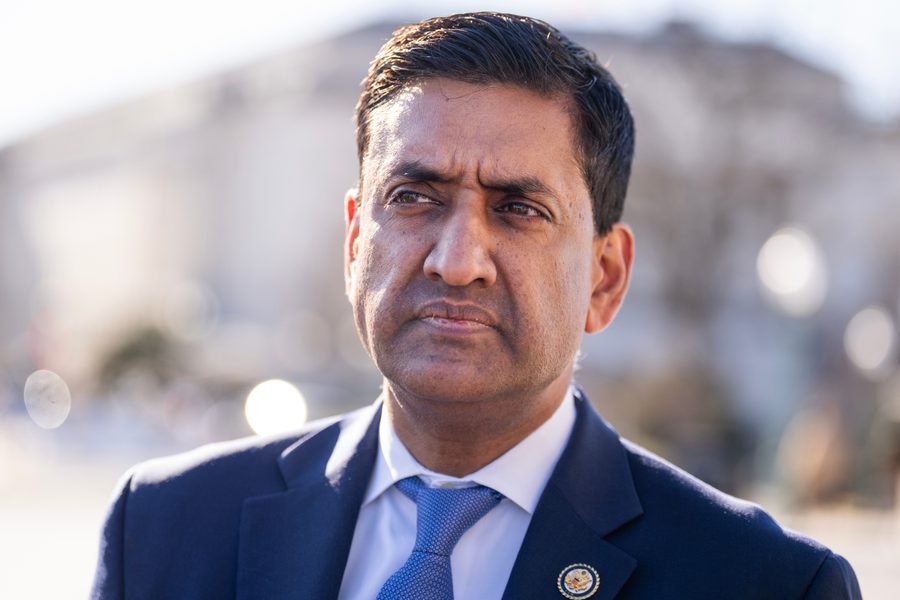
Likely Democratic presidential contender Rep. Ro Khanna has pivoted sharply on Israel in recent years.
This article first appeared in the Jewish Currents news desk newsletter. Subscribe here.
Five years ago, Rep. Ro Khanna signed an AIPAC-backed letter opposing conditions on US military aid to Israel.
Now, Khanna says he shouldn’t have signed. “It was a mistake,” he told Jewish Currents. “Israel’s actions have clearly shown that that aid has been used to kill civilians and to commit horrible crimes.”
Khanna’s journey from self-described “pro-Israel progressive” to one of the most outspoken Congressional critics of Israel—he is one of only 21 House Democrats to have signed on to a resolution recognizing Israel’s bombardment of Gaza as a genocide—is particularly stark. But his shift is far from unique among Democrats with presidential ambitions. Many in the likely pack of 2028 Democratic contenders for the presidential nomination have shifted to varying degrees on the issue, including Senator Chris Van Hollen of Maryland, and governors J.B. Pritzker of Illinois and Gavin Newsom of California. “What we’re watching is politicians responding to a new political reality,” said Hamid Bendaas, the communications director for the Institute for Middle East Understanding Policy Project.
For progressive voters, candidates’ positions on Israel are taking on outsized importance as the 2028 primaries approach. Leah Greenberg, the co-founder of the progressive activist group Indivisible and one of the organizers behind the No Kings protests, says that progressives see the issue as a proxy for political authenticity. “It’s about your relationship with money, and your overall ability to present yourself as a values-based politician,” Greenberg said. “It goes to the basic question of whether a voter can trust you as a straight shooter.”
The question is how much of an about-face on Israel Democratic voters are willing to accept when choosing their next presidential nominee. Progressive analysts say a change in position may not necessarily be a problem, especially because it’s a trajectory that mirrors Democratic voters’ own changes on the issue over time. In 2018, 49% of Democrats told Gallup they sympathize more with the Israelis than the Palestinians. Now, that number is just 17%.
“There is absolutely an appetite to accept an evolution—if it’s real,” said Rania Batrice, a Palestinian American political consultant and a former deputy campaign manager for Senator Bernie Sanders’s 2016 presidential campaign.
Khanna, who also said he wants to stop the sale to Israel of all weapons used to kill civilians, attributes his evolution to Israel’s bombardment of Gaza. “My views really shifted after the war in Gaza because you’re seeing the atrocities,” he said.
Not all of the potential 2028 Democrats have changed their positions on Israel. Pennsylvania governor Josh Shapiro continues to present himself as an unyielding supporter of Israel and a two-state solution, while Rep. Alexandria Ocasio-Cortez has the most consistent Israel-critical record of any potential candidate, though even her views continue to shift. (After this story was initially published, the magazine City & State reported that Ocasio-Cortez had told a Democratic Socialists of America forum in New York that she would oppose even defensive arms sales to Israel, a shift for Ocasio-Cortez that could reshape the debate among progressives.)
For the rest of the pack, though, support from progressive Democratic primary voters could hinge on whether their shift on Israel is convincing. “I don’t need to know someone’s sincerity or what’s in their heart. I just need to see action, especially if they are still in elected positions,” said Palestinian American Georgia State Rep. Ruwa Romman.
There are clear differences among those who have become more outspoken on Israel in recent years. One standout is Van Hollen, who shifted positions well before the Gaza genocide. Van Hollen had a traditionally pro-Israel record when he served in the House of Representatives from 2003 to 2016, and was backed by Haim Saban, a prominent AIPAC donor, during his 2016 race for Senate. But as a senator, Van Hollen has become a leading critic of Israel’s occupation, seeking to ban US funds from being used by Israel to annex the West Bank in 2020 and leading the effort for accountability after Israel’s killing of Palestinian American journalist Shireen Abu Akleh in 2022. Since October 2023, he has voted twice to block the sale of bombs to Israel, and says that the evidence points to Israel carrying out a genocide in Gaza. He told Jewish Currents in an interview that he supports a full ban on the sale of offensive weapons to Israel “unless we’re satisfied that they will comply with American law.”
Van Hollen told me his views have stayed “relatively constant,” but that Israel has changed, and he has reacted to Israel’s rightward lurch. “In order to hold the line on my views, I have obviously grown very critical of the actions taken by the government of Israel, especially the Netanyahu government,” he said. “As settlement expansion accelerated, as outposts accelerated, as Palestinians in East Jerusalem were evicted from their homes, it became clear that some people had to stand up and actually argue for using American leverage and influence to advance the policies we claim to stand for.”
Progressives say such a trajectory will be a boon to his standing among voters. “He has a demonstrated record of spending political capital on the issue,” said Indivisible’s Greenberg.
The Democratic governors looking to present themselves as increasingly critical of Israel, meanwhile, have taken fewer political risks on the issue. Pritzker, in February of 2024, said he was “disappointed” in a Chicago City Council resolution calling for a ceasefire in Gaza. Unlike Van Hollen and Khanna, he did not speak out against Israeli human rights abuses until last year, when he supported Sanders’s Senate effort to block the sale of bombs to Israel. This year, he has repeatedly criticized AIPAC, a group that Pritzker, a billionaire, used to donate to. In a statement sent to Jewish Currents, a spokesman for Pritzker’s re-election campaign said “his consistent position has been that Israelis and Palestinians deserve safety and self-determination,” and that the governor “withdrew his support” from AIPAC over a decade ago, “when the once-bipartisan organization abandoned its core principles and became a pro-Trump organization.”
Newsom may have the most trouble appealing to progressives on this issue. After the October 7th attacks, Newsom traveled to Israel, met with Israeli Prime Minister Benjamin Netanyahu, and issued a statement that made no mention of Palestinians. Left-wing and Palestinian groups have also criticized Newsom for signing a bill into law last year that they warn could censor criticism of Israel in California classrooms. Last month, Newsom appeared to make a sharp turn on the issue when he said it would be appropriate to label Israel an apartheid state. But three weeks later, he said he regretted those comments. (A Newsom spokesperson said his position on whether Israel is an apartheid state “has remained consistent. He’s always said that is the direction Bibi is taking the country.”)
Indivisible’s Greenberg says that Democratic hopefuls will need to convince voters their political swings on the issue are for real. “Candidates who are still trying to have it both ways and maintain warm ties to pro-Israel lobby groups are the ones who are going to really struggle with this in the primary,” she said.

I’m Arielle Angel, editor-at-large of Jewish Currents. Before you go, there’s something I need to ask.
We’ve seen over and over how the mainstream media falters in telling stories on our beats—whether it’s antisemitism, Israel/Palestine in American politics, Jewish identity, or the American left. At Jewish Currents we’re committed to uncompromising analysis and longform reporting on these issues and more—stories you won’t find anywhere else. In a media landscape that obscures injustice and flattens discussion, we’re changing the conversation. But we need you.
If you believe in this work, please consider making a donation—or even better, a recurring one—to ensure that we are able to keep publishing stories like this one. We can’t do it without you.