Crying Is Not Surrender
In wartime, expressions of sorrow are pushed away. But our grief is sacred. It demands to be felt.
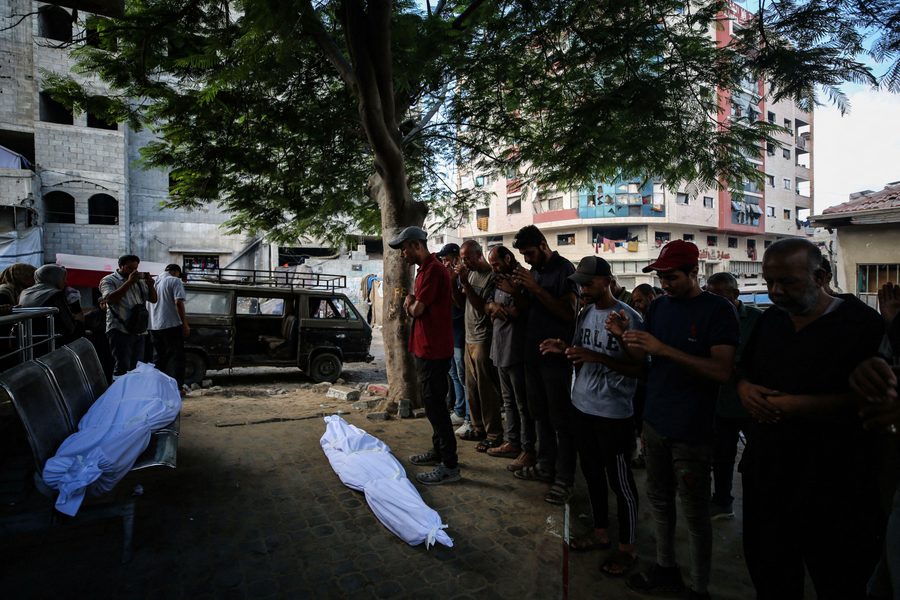
People mourn during a funeral at Al-Shifa Hospital for victims of Israeli attacks on Gaza City, September 3rd, 2025.
I’d gone to Al-Shifa Hospital to see my friend Imad, who had been shot in the leg while trying to collect humanitarian aid. It was not his wound, however, but a quieter image that stayed with me: In a chaotic hallway, I noticed a woman sitting on the floor, cradling her daughter in her arms. The girl, no more than 10, was wailing over her father’s body. Her mother did not speak. Her face was frozen. She did not cry. I kept wondering if she was strong, or if something inside her had perished.
War revises emotion. Sorrow is stifled. Sadness is stunted.
In Gaza, children are informed that their parents are martyrs, not victims. Women are applauded for remaining quiet during funerals, for sitting silently amid the veiled bodies of their children. Fathers stand at burial sites, shaking hands and accepting condolences. Their eyes are vacant, fixed on the spaces where the no-longer-living used to be.
People say, “I’m fine.” They smile in photographs. When memory overcomes them, they change the subject.
Slogans of tenacity and steadfastness—“Don’t cry. They want to see you broken.”—are repeated like commands, overtaking the wails of those mourning their loved ones. Endurance is a public duty. Tears risk admitting collapse—and collapse might be contagious. It might undermine the struggle. It’s a peculiar battle: surviving war on the outside while concealing everything within.
How many parents have buried their children without crying in public? How many people keep their screams inside, afraid of being perceived as weak or ungrateful or a distraction from the cause? People become monuments to suffering—unmoving, unspoken, unfinished.
Children learn from their surroundings. If a child does not see anyone cry, they may come to believe that articulations of sorrow are forbidden, that strength entails suppression, that the full expression of love must be buried with the deceased. One unacknowledged anguish fuels another. Grief burrows under the earth. It piles up softly.
In the moments of quiet disrupting the onslaught, grief returns in new forms. Sleeplessness that does not belong to the present night. Each tranquil moment, tormented by the past. The whole body speaks what the mouth cannot. Shaking hands. Sudden panic. Breathlessness.
You stand in front of loss and feel nothing—then, guilt for feeling nothing. Later this becomes a wound.
One day, I traveled to my grandfather’s house in Beit Lahia. When the call for noon prayer came, I walked to the mosque that his neighbors had built. Afterwards, I noticed a group of people lingering, preparing to pray again, this time over a small body. I joined them. The child, I learned, had been pierced by a stray bullet while playing outside.
His mother fell beside the body, crying quietly and shaking. She gripped the shroud as if attempting to keep him warm. His father stood by the door, receiving condolences and saying, “Alhamdulillah for everything” over and over, as if the phrase could keep the world together.
I stood there perplexed. Who was truly holding on, and who was simply not allowed to crumble?
But why is hopelessness unwelcome? Why must strength be audible and unshakeable? Why isn’t quiet collapse considered sacred?
Sometimes I feel guilty for wanting to cry. As if my grief needed to be evaluated, justified, and compared. Other people have lost more, I think. Do I even have the right to feel such sadness? Soon, my emotions feel like trespassing on the devastation of others.
But pain does not compete. It does not ask for permission. It simply demands to be felt.
This is the truth: War breaks things—bodies, homes, hearts. Sometimes, all that’s left to do is weep.
Crying is not surrender. It is a testimony. It means that, even in a place where death comes daily, the heart is still alive.

I’m Arielle Angel, editor-at-large of Jewish Currents. Before you go, there’s something I need to ask.
We’ve seen over and over how the mainstream media falters in telling stories on our beats—whether it’s antisemitism, Israel/Palestine in American politics, Jewish identity, or the American left. At Jewish Currents we’re committed to uncompromising analysis and longform reporting on these issues and more—stories you won’t find anywhere else. In a media landscape that obscures injustice and flattens discussion, we’re changing the conversation. But we need you.
If you believe in this work, please consider making a donation—or even better, a recurring one—to ensure that we are able to keep publishing stories like this one. We can’t do it without you.
Abdullah Hany Daher is a Palestinian writer and journalist from Gaza. He documents the human stories of war, aiming to preserve voices that the rubble cannot silence.