Writing Amid Catastrophe
In the wake of the Nakba, Jabra Nicola and his cohort of Arab communists created a vibrant anti-Zionist literary landscape.
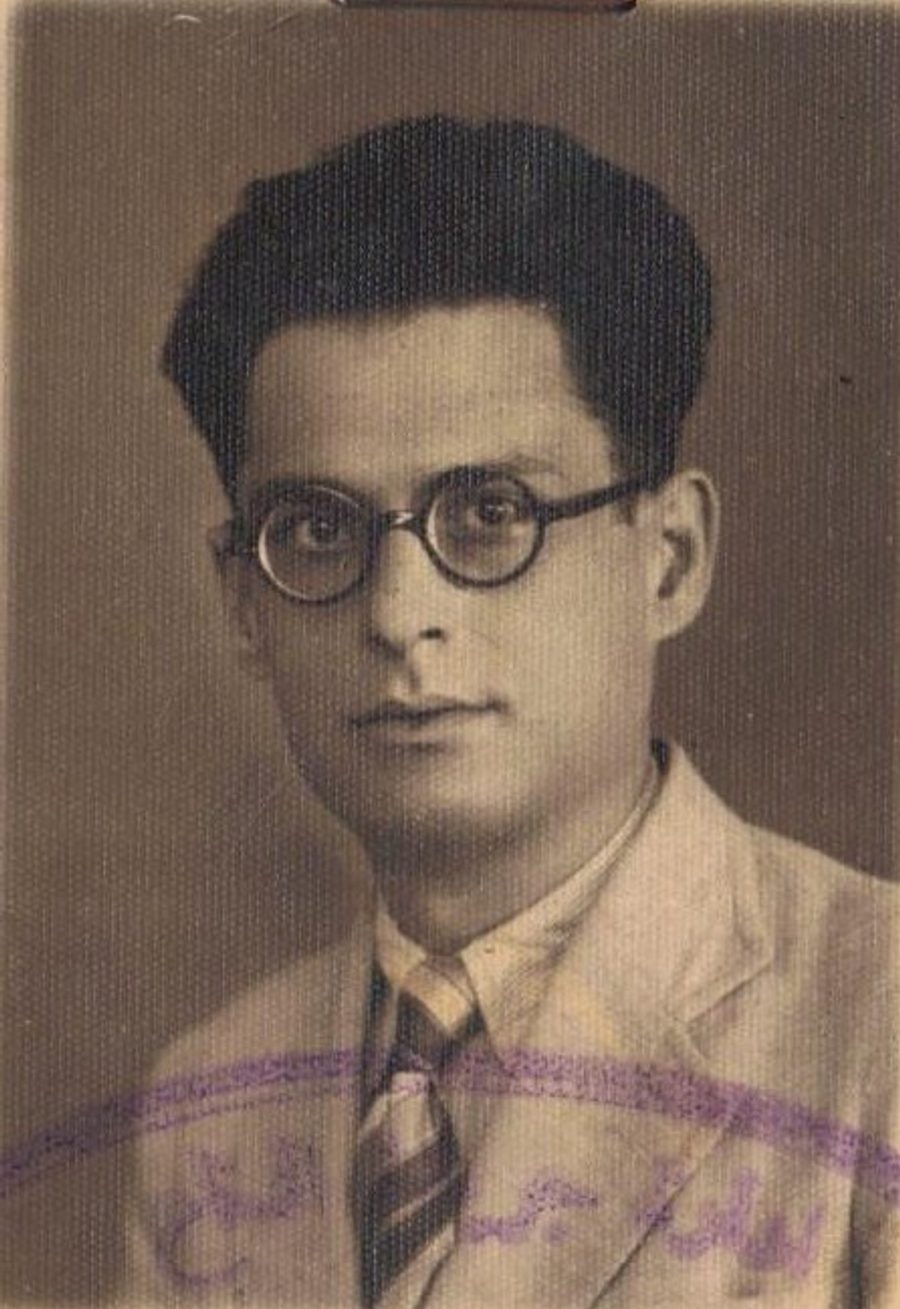
Press card issued to Jabra Nicola, circa 1944.
In 2014, after an Israeli airstrike killed his brother Ayman and four of his close friends, the Gazan journalist Ahmed Alnaouq received a message from his friend Pam Bailey. “Tell me how you feel,” the American journalist and activist wrote. When Alnaouq responded that he was profoundly depressed, Bailey encouraged him to write a story about Ayman. Over the course of several months, the pair edited the text, and then Bailey published it online. The response was immediate: People across the world reached out to express sympathy for the mourning family and rage at the conditions that led to their grief. “That changed my life,” Alnaouq later recalled. Inspired by the results of this collaboration, Alnaouq and Bailey co-founded We Are Not Numbers, a platform for Palestinian writing in English. “But under the current siege,” I asked Alnaouq in a public conversation at the University of Cambridge in March of last year, “is it still possible for Gazans to write?” Alnaouq replied that after the genocide began, not only did Palestinians in Gaza continue writing, but the number of submissions to We Are Not Numbers nearly quadrupled. “People write the stories on their phones while the electricity is down,” he explained. “The moment they find an internet signal; they send them out to us. They are writing their histories.”
This moving expression of the act of writing as a rebuttal to imperial erasure recalled for me another critical juncture in Palestinian literary production, in the wake of the Nakba. The devastation of 1947–1949, when Zionist forces expelled an estimated 750,000 Palestinians from their homes to make way for the State of Israel, reached every part of Palestinian life, including cultural life. In the first half of the 20th century, publishing had flourished in Palestine: There were over 60 active Palestinian newspapers and magazines, and periodicals from across the Arab world and beyond circulated there, linking Palestinians to the cultural hubs of Cairo, Beirut, Damascus, and Baghdad. Now this world crumbled as intellectuals, writers, and artists were displaced or killed en masse, while schools, publications, and printing presses were shut down and libraries were looted or burned. And yet, amid the unspeakable terror and loss—and the subsequent systematic repression of the Arabic language itself, through censorship and the defunding of education—Palestinian writers continued to create.
One such writer was Jabra Nicola. Born in Haifa in 1912, Nicola joined the Palestine Communist Party (PCP) in the early 1930s. The PCP had been founded the previous decade—part of a wave of burgeoning Communist parties and Arab socialist movements across the Middle East and North Africa that organized toward decolonization, national independence, and modernization free from Western and imperial control. Embedded in the Communist Internationalist movement, Nicola was compelled by Marxism, Trotskyism, and Leninism as tools of analysis: They not only helped explain the colonization of Palestine and its attendant structures of economic inequality, but also underscored global systems of capital and empire, thus linking the Palestinian struggle for liberation to anti-colonial battles from Algeria to Kenya to Vietnam.
This orientation toward solidarity across borders—and an insistence on the transformative possibilities of working-class unity—found expression locally in the constitution of the PCP, the only party at the time that comprised both Palestinians and Jews. Insisting that Jewish workers could reject Zionism and join Palestinians as comrades in a shared internationalist struggle rather than simply accepting their role as agents of colonial settlement, members of the PCP set out a vision of a binational, democratic Palestine with equal rights for all. As a member of the PCP, Nicola—who made a meager living as a journalist for a bourgeois Arabic daily and shared a one-room house with five family members—quickly distinguished himself as a bilingual editor, translator, and an organizer. He edited the party’s Arabic paper, El Nur, translated at party meetings, and published pamphlets on labor organizing, strike activity, and Zionism.
Of course, the PCP’s vision was plagued by a fundamental contradiction: the Jewish national movement was not anticolonial—it was intertwined with Zionism, an ethnocentric ideology incompatible with democratic co-governance. The PCP continued to grapple with the contradictions of organizing constituencies drawn from both settler and indigenous communities. But in the late 1940s, when members of the party reversed their adamantly anti-partition stance, rallying behind Moscow-aligned Communists who supported the UN Partition resolution, their credibility was irreparably undermined.
After the Nakba, Nicola found himself among a small cohort of surviving communist Palestinian intellectuals and writers—including Emile Touma, Emile Habiby, Hanna Abu Hanna, and Tawfiq Zayyad—who remained in the new state. As they worked to rebuild the landscape of literature and culture, exerting an influence far in excess of their numbers, Nicola and his comrades remained committed to an ethos of communist internationalism grounded in the possibilities of a shared struggle against capitalism and empire. So long as there was a shared opposition to Zionism and other forms of colonial domination, they maintained, they could meaningfully work together. Thus, during the 1950s, their ranks included Arab Jewish communists, largely from Iraq, such as Shimon Ballas, Sasson Somekh, David Semah, and Sami Michael. This partnership was rooted in overlapping experiences of dispossession. While Palestinians were undoubtedly Zionism’s primary victims—and while most Mizrahi Jews were later incorporated into the state’s colonial order—the initial effects of Zionism on Jewish communities from the Arab world were severe. Many were relocated to maʿabarot (immigrant transit camps), where they lived in tents and shacks, often without regular access to running water, medical care, or other basic amenities. Like Palestinians, they also faced pressure to abandon their native Arabic—a cultural and linguistic threat that powerfully drew together writers from the two groups, forming the basis of a literary alliance.
Together, in 1953, members of this cohort founded the cultural magazine al-Jadid, which, alongside al-Ittihad, the Communist Party newspaper, became a central platform for the reconstruction of an anti-Zionist, internationalist Arabic literature. The founders saw al-Jadid as a spark that would ignite a broad project of cultural resistance to Zionist hegemony. They dreamed of clubs, festivals, and literary organizations that would contribute to rebuilding an Arab social imaginary—a popular anti-Zionist movement made increasingly thinkable by what they called “Adab al-Sha’b” (“A People’s Literature”). This genre, as the communists conceived of it, would take the form of social realist, anti-Zionist Arabic writing that narrated the lives of common local people—giving detailed, documentary accounts of Palestinians forging communities under Israeli occupation, of Arab Jews protesting the harsh conditions in the transit camps, of fisherman struggling to make a living, and of laborers finding routes to cross-cultural solidarities through the shared context of capitalist and colonial exploitation.
Nicola played a key role in this burgeoning scene. A critic and political strategist, he was an ardent proponent of writing as a tool of social transformation. He penned several essays on the role of literature in politics, and in 1955 wrote a major review-essay for al-Jadid considering the emerging form of the Arabic short story, titled “The Story We Want.” In it, he praised Hana Ibrahim’s short story “Mutasallilun” (“Infiltrators”) for its nuanced portrayal of a Palestinian refugee family, and of a Jewish Israeli woman who attempts to shelter them from local militias on the borders. By contrast, Nicola criticized the lack of depth in stories like Jamal Musa’s “Ahmad on Trial” (“Ahmad fi al-Muhakama”), one of many contemporary narratives depicting Palestinian peasants confronting the oppressive military courts; such stories, he argued, were insufficient in their analysis of the intersections of class and colonialism, neglecting, for example, to engage with the ways that the elevated class position of some mukhtars (local leaders of villages and neighborhoods) shaped their willingness to collaborate with the colonial government. Nicola also objected to portrayals of Israeli characters as uniformly racist, arguing that depictions of ethical action by Israeli Jews were essential to imagining, and therefore making possible, joint struggle.
Unsurprisingly, many Arab writers pushed back against the didactic literary formulas advanced by Nicola and his comrades. And of course, this literary program and the movement from which it emerged were not without other flaws and limitations. Still, it represented something truly remarkable: Out of annihilation, these intellectuals forged a cultural, political, and organizational vision anchored in socialism and co-resistance, which shaped some of the most important Palestinian writing of the 20th century. Like Ahmed Alnaouq, Heba Abu Nada, Refaat al Areer, and many other Palestinian writers in our time, Nicola and the generation of the first Nakba continued writing under catastrophic conditions—and, in so doing, they continued rebuilding, strategizing, and dreaming. In their hands, culture became a means of articulating a new political imaginary, at a moment when for many, this possibility felt utterly out of reach.

I’m Arielle Angel, editor-at-large of Jewish Currents. Before you go, there’s something I need to ask.
We’ve seen over and over how the mainstream media falters in telling stories on our beats—whether it’s antisemitism, Israel/Palestine in American politics, Jewish identity, or the American left. At Jewish Currents we’re committed to uncompromising analysis and longform reporting on these issues and more—stories you won’t find anywhere else. In a media landscape that obscures injustice and flattens discussion, we’re changing the conversation. But we need you.
If you believe in this work, please consider making a donation—or even better, a recurring one—to ensure that we are able to keep publishing stories like this one. We can’t do it without you.
Hana Morgenstern is an associate professor in Global South and Middle Eastern literatures at Cambridge University. She is co-director of Revolutionary Papers—a transnational research collaboration on 20th-century anticolonial and anti-imperial periodicals—and the author of two forthcoming books, Cultural Co-Resistance in Palestine/Israel and A People’s Literature in Palestine/Israel: Anticolonial and Socialist Writing.