Wrestling with Martin Buber
The Zionist philosopher couldn’t escape a colonial mindset, but his binationalist vision offers a way forward in Israel/Palestine.
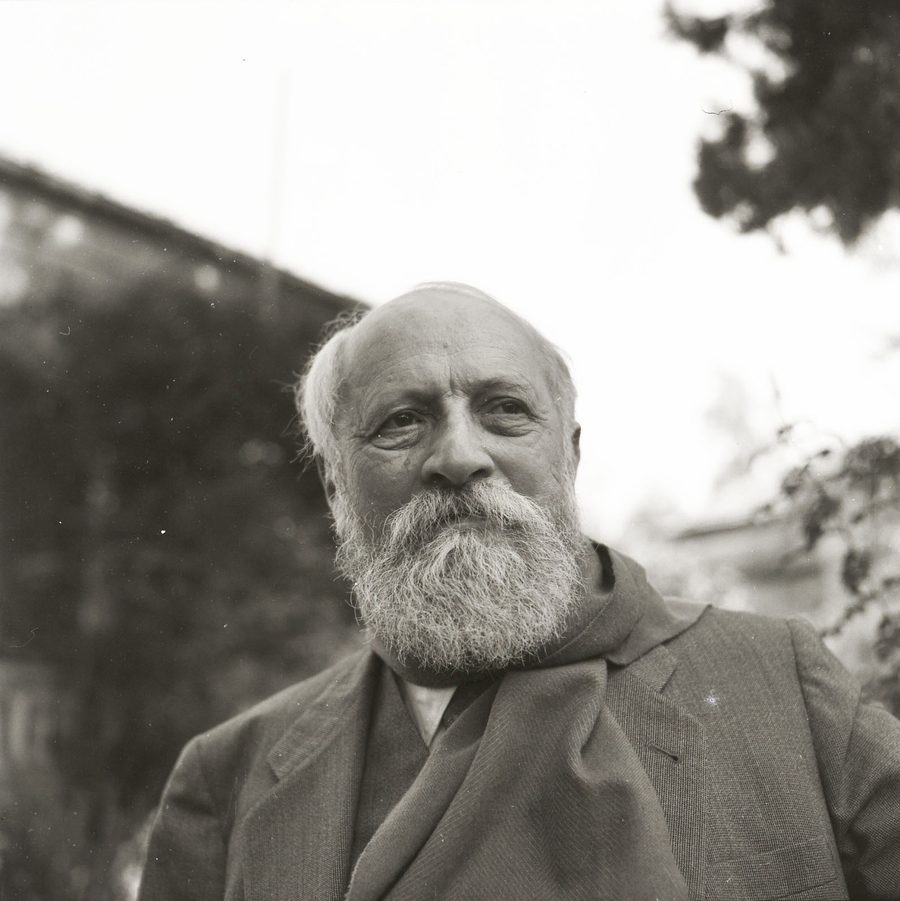
Martin Buber in Israel, 1962.
Reprinted with permission from A Land of Two Peoples: Martin Buber on Jews and Arabs by Martin Buber, edited with commentary and a preface by Paul Mendes-Flohr, with new forewords by Paul Mendes-Flohr and Raef Zreik, published by the University of Chicago Press. © 2025 by The University of Chicago. All rights reserved.
Martin Buber poses a greater challenge to Palestinian intellectuals than any other Zionist leader and thinker. The challenge posed by Ze’ev Jabotinsky, Menachem Begin, and David Ben-Gurion was not primarily of an intellectual nature. Their central claim—that conflict with the Indigenous Arab populations was inevitable and unavoidable—left Palestinians with few options other than to brace themselves for violent confrontations with Zionist colonizers. The challenge they posed could only be met on the battlefield. Most Palestinians were thus in closer agreement with Jabotinsky than with Buber, who insisted that Jewish and Palestinian national interests are compatible and thus amenable to mutual accommodation. Buber obliges you to engage in a dialogue with him; Jabotinsky forces you to fight.
Thus, in voicing a vision of a rapprochement between Zionism and the Indigenous Arab population of Palestine, Buber called into question whether the Zionist project, which seeks to secure the interests of the Jewish people, is or could be compatible with the interests and the aspiration of Palestinian people. Moreover, Buber’s unique position within the Zionist discourse raised a paradoxical and incomprehensible position for Palestinians: As a Zionist, he was part of the colonial project while opposing it. In many respects, Buber’s stance was akin to the description of the self-critical colonizer portrayed by Albert Memmi in The Colonizer and the Colonized. While socially, culturally, and economically he belonged to the settler society, he was nonetheless alert to the injurious effects of colonialism on the native society. Buber thus objected to some basic social and political structures that made his own existence possible. He was walking south in a train heading north. Indeed, he found himself in a seemingly untenable situation. In seeking to distance himself from the West in general and British imperialism in particular, Buber seemed to overlook the heavy debt that Zionism owed the British and Western colonial powers endorsed through the League of Nations, the Balfour Declaration, and the establishment of the British Mandate for Palestine.
Memmi was very much aware of this paradoxical situation in which a colonizer who resists colonization can find himself inextricably entangled in that very system. Memmi thus draws our attention to the sociological reality of “colonial life,” which one cannot simply transcend with ideas. The world in general cannot merely be split between people according to their ideology: progressives and conservatives, liberals and fundamentalists, socialists and capitalists, left and right, and so on. People are also distinguished according to their social location, their situatedness, and their objective location rather than by their ideas alone. There is a distinction between natives and settlers, and no matter how much a settler wants to renounce his privileges, he nonetheless continues to enjoy them. His connections, his web of relationships, his frame of reference—the entire context that ascribes meaning to his actions remains the settler’s society. There is a limit to how far the colonizer can identify with the colonized or embrace his position. For Memmi, if such a colonizer “cannot rise above this intolerable moralism which prevents him from living, if he believes in it so fervently, then let him begin by going away,” and cut his ties to the colonial project and settler culture. This is what Hans Kohn, Buber’s close friend and disciple, did. After the Arab-Jewish riots in 1929, Kohn declared that “Zionism is not Judaism,” surrendered his senior position in the Jewish Agency in Jerusalem, left Palestine, and eventually emigrated to the United States.
But Buber did not endorse Kohn’s decision. He remained a Zionist and did not acknowledge himself to be a privileged colonizer. He wanted to be part of the Jewish people and part of the Zionist project and to struggle from within the movement to direct it on a radically different course than it had taken. He opposed the creation of a state that would subjugate the Arabs to minority status; he did not want Zionism to be part of the imperial order; he wanted a Zionism that upholds the equality of Jews and Arabs and looked forward to establishing a binational state in Palestine. But did he have any reasonable chance of realizing this vision?
Was Buber merely a daydreamer? An apologist? Did he not understand the fundamental difference between politics and ethics? Was he simply “constructing myths,” as Memmi would have argued? Conversely, do we really want to subscribe to the view that first and foremost politics is about power, and as long as you lack power, no one will take you seriously? Are we sure that we want to divorce morality from politics?
As a Palestinian, I don’t know that I have adequate answers to these questions. Yet together with Buber I am wary of those approaches that tend to exaggerate the presumed tragic dialectic of history and politics. In his 1945 article “Politics and Morality,” Buber acknowledges that “life, in that it is life, necessarily entails injustice. There can be no life without the destruction of life.” Buber was not naïve. But he was neither ready nor willing, under the guise of this truism, to countenance cruelty and injustice as inherent in human affairs. For that reason he added the caveat, “we cannot refrain from doing injustice altogether, but we are given the grace of not having to do more injustice than absolutely necessary.” “The main point,” he duly emphasized, “is recognizing limits.” And thus he warned his fellow Zionists that “if one has the intention of driving people who are bound to the soil out of their homeland, then one has exceeded those limits. Here we confront an inalienable right, the right of one who cultivates the earth to remain upon it.” The concept of “limiting” injustice to the absolutely necessary creates the space for imagining another social and political reality in Palestine and offers some intellectual tools to argue against Jabotinsky’s logic of the ineluctability of the conflict with Palestine and the logic of us versus them that continues to prevail in the Zionist political imagination.
The logic informing Jabotinsky’s politics—and that of his disciple Benjamin Netanyahu—derives its justification from the past, when the Jews of Europe were subject to insidious, unrelenting antisemitism. Thus their exigent need for a safe shelter that they could not find in Europe, a shelter Jabotinsky averred could only be secured in Palestine in the form of a sovereign Jewish nation-state—a self-justifying objective to be attained by whatever means were deemed necessary. His single conception of justice for the forlorn Jews of Europe blinded him to the political and demographic reality of Arab Palestine. Hence, that conception is flawed from the beginning. This is different from a situation in which the conception of justice is reasonable, but its implementation would lead to undesirable consequences. Indeed, Jabotinsky’s exclusive focus on justice for the Jewish people deliberately ignores its consequences with regard to the Palestinians—their dispossession and the deprivation of political rights. His political logic is unbending and ruthlessly overrides ethical considerations. Buber challenges Zionist policy guided by this single political logic. In pursuing one’s fundamental interests, one must accept the moral responsibility of limiting the harm one’s actions may cause others. As Hannah Arendt put it, no one inhabits the world alone. We are destined to share the world and ultimately have no choice but to find a way to live on it together.
In honoring this existential and ethical imperative, Buber promoted the vision of a binational state. Neither the Zionists nor the Palestinians found it worthy of consideration. Let’s not forget that during the 1920s the Jews made up no more than 10–15 percent of the population of Palestine. It is true that the numbers increased in the next two decades, reaching 35 percent around the time of partition in 1947. Although the envisioned binational idea guaranteed Jews and Arabs equal share in the government and administration of the future state, Palestinians rejected it for several reasons. For one, the idea of parity irrespective of demographic proportionality implied that the Palestinians would surrender their majority status and homeland. The mere idea of a minority of immigrants (the Jews) offering equality—individual and collective—to the native Palestinian majority was understandably deemed unreasonable if not downright absurd. Why should the Palestinians give up half of their homeland? To be sure, Zionists would also have to surrender the dream of, as their national anthem has it, “a hope of two thousand years old / To be a free [politically sovereign] nation in our land / The Land of Zion, Jerusalem.” Still, there is some difference between giving up a dream and giving up your reality: your land.
The major issue that made the acceptance of binationalism most difficult was the mere fact that reality was not binational at the time. To accept binationalism, the Arabs would have had to accept Jewish immigration to Palestine under the tutelage of the British Mandate. Furthermore, Buber did not speak to the Arabs. He debated with his fellow Zionists. Nor did the Zionist leadership speak to the Arabs, assuming that only with the help of the British Empire could they succeed in establishing a national homeland in Palestine. In short, Buber’s attempt to situate Zionism as a subaltern nationalism, a nationalism of decolonization, was at odds with the facts on the ground. He was trying hard to situate Zionism beside and complementary to—not in opposition to—Arab nationalism, as anti-colonial nationalism, but that did not square with the fact that it was the British who laid the ground for the Jewish settlement of Palestine.
Buber’s arguments pose interesting questions to the Palestinian national movement, mainly due to his minimalism and his attempt to find a way to reconcile the interests of both movements without the domination of Zionism over the Arabs. Was Buber’s version of Zionism a plausible one that the Arabs should have accepted? In part this is a historical question. But the question is still relevant given the fact that we are still struggling to find a way to secure a peaceful, decent, and dignified existence for both peoples. Some of Buber’s arguments for the rights of the Jews in Palestine are explained in his 1929 talk “The National Home and National Policy in Palestine.” This text reveals clear traces of colonial thought and imagination, such as when he bases the right on “a proven fact: after thousands of years in which the country was a wasteland, we have transformed it into a settled country, where it was open to us to do so, by years of labor. The right deriving from creation and fertilization is in fact the right of settlers.” Even when Buber sought to extend equality to the Indigenous Arabs, he did it from the perspective of a colonial mindset, stating that “the situation of our settlement includes the lives of the Arab inhabitants of the country, whom we do not intend to expel.” To any Palestinian with a sensitive ear this sounds as if the Jewish immigrants are doing the Arabs a favor by not expelling them, a benevolent gesture that deserves to be rewarded!
Buber’s colonial mindset is again on view in his 1939 letter to Mahatma Gandhi, in which he seeks to explain why the persecuted Jews of Germany seek refuge in Palestine: “Jews are being persecuted, robbed, maltreated, tortured, murdered.” Why not a land other than Palestine? Because Jews have a historical religious and spiritual connection to the land, and it is theirs (“we need our own soil”). To those acquainted with the language of rights I might say that the argument refers to both a general right based on need and a special right that ties the Jewish people specifically to this land. Arguments of need are general. If I am starving, I have a right to be fed, but this right is general and is imposed on everyone who is able to assist; as a result it can impose an imperfect duty of solidarity. But my duty of solidarity with others, to help those who are in need, is different from my special duty to pay the one that I borrowed money from or the one whose property I damaged. Those are special duties and heavier than the general duty of assistance. The Palestinians had the duty of assistance, the duty of solidarity, as a general duty. This was the same general duty owed by the French, the Russians, the Iranians, and the Americans. How can a people wake up to find themselves owing a special duty to assist another people by giving up half their homeland, however dire the need? Arguments of need can hardly establish such a duty. Most Zionist leaders did not even contemplate offering arguments for or answers to this question. Buber gets close to an answer, but he does so in his epistolary debate with Gandhi, not with an Arab-Palestinian leader. Still, I think there is a difference between a duty of solidarity that guarantees the right of Jews fleeing persecution to immigrate and a duty to accept another people’s demand for a separate nation-state or even an equal partner in a binational state. That is not taken for granted and need not be so.
While Buber’s ideas were in his time consigned to the margins of history, it might be helpful to revisit them now in order to contemplate the future. As I mentioned above, one of the problems with Buber’s ideas is that he proposed a binational solution in a reality that was not binational. This was not only because the number of Jews was relatively insignificant but also because of the colonial nature of the settler project. While the colonial settler aspect still exists 100 years later, the demographic landscape is different—the Jews in Palestine today are the third or fourth generation on the land and know no other home. This makes Buber’s ideas relevant again, but clearly they must be updated to meet new challenges. Those challenges include the recognition of the Palestinian Nakba and the need to end the ongoing dispossession of the Palestinians. As a first step, Jewish Israelis would need to acknowledge and redress the historical injustices of dispassion, discrimination, and occupation suffered by Palestinians. Accordingly, binationalism can make sense only as a project of decolonization that brings to an end the legacy of subjugation and domination. Binationalism without decolonization is but a continuation of domination bedecked with different finery.
For many Arab intellectuals, binationalism is intrinsically untenable, for it implies recognizing the historical rights of the Jews in Palestine and acknowledging that the Palestinian resistance has failed and was perhaps simply misguided. Furthermore, many argue that the best solution for the Jewish question in Palestine would be a secular, multiethnic, liberal state based on equal rights for all its citizens without regard to race, religion, gender, or cultural affiliation.
A binational state that supports cultural and religious autonomy does not in my judgment necessarily require accepting the Zionist narrative regarding the historical rights of the Jews in Palestine. To recognize Jewish collective rights in Palestine need not be construed as acknowledging their historical right to the land. Many rights that we have are not historical, nor are they based on historical affiliation. My right to have a lawyer represent me in a criminal trial and my right to freedom of expression are purely legal rights. These rights are based on certain perceptions of the fragility of human existence and its basic needs. I don’t see any reason to believe that accepting a collective right of Jewish self-determination in Palestine within the framework of binationalism amounts to accepting any version of Zionism. We should be able to imagine a Jewish nationalism in Palestine that is not colonialist.
As to the suggestion of a secular liberal state that does not recognize any religious, cultural, or national affiliation in the public sphere, I tend to think that is not attractive at this time. The liberal dream of a neutral public sphere that brackets identities and limits them to the private sphere is not convincing. There is no need here to reiterate the whole literature in the last half century that stresses the importance of cultural identification, from Will Kymlicka to Charles Taylor, Bhaikhu Parekh, and others. I do tend to think that the collective identity for both groups is important to them, and they have a vested interest in keeping and developing their distinctive cultural and religious life.
Yet another reservation advanced by Arab intellectuals precluding any rapprochement with the Jewish state pertains to the Zionist alignment with Western imperialism and willingness to safeguard its interests at the expense of the East in general and the Arab world in particular. Buber shared some of these concerns and consistently denounced the Zionist leadership for seeking the support of the imperialist powers. He offered another kind of Zionism that was in a sense non-colonial (he tried to differentiate between expansive colonialism and concentrated limited colonialism, a distinction that can hardly hold in practice), despite the colonial rhetoric with which he celebrated the idealism of the pioneers of Zionist agricultural settlements (see his 1939 essay “Concerning Our Politics”). He envisioned Zionism as facilitating Jewry’s return to its origins in the Orient and thus serving as a bridge of reconciliation between the East and West (see his 1956 essay “Instead of Polemics” and his 1965 essay “The Time to Try”). But Israel, since its establishment 77 years ago, has chosen a path alongside the United States and other Western hegemonic imperialist powers of perpetrating an ongoing attack on the region, its people, and their interests and thus positioning itself as the enemy of the region (the wars of 1956, 1967, 1982, and 1996 are only a few examples). Furthermore, the more Israel launches wars against the region, the more dependent it becomes on Western powers, as the recent war in Gaza plainly demonstrates. This is just to say that the future of Palestine cannot be conceived without reshaping the image of the whole region and the nature of the relations of East and West, bringing colonial and imperial policies to an end. Buber hoped that the people of Israel would serve as a bridge of reconciliation between East and West. Since Buber’s passing six decades ago, the image of that bridge continues to recede into an ever-distant horizon. Israel is now fully entrenched in the service of the great Western imperial powers against the peoples of the Near East. The war of 2023 on the Gaza Strip against the Palestinians renders Israel increasingly akin to a crusader’s castle in the Holy Land, desperately fending off the armies of Saladin in the 13th century. Buber had anticipated that, and unfortunately, he was right.

I’m Arielle Angel, editor-at-large of Jewish Currents. Before you go, there’s something I need to ask.
We’ve seen over and over how the mainstream media falters in telling stories on our beats—whether it’s antisemitism, Israel/Palestine in American politics, Jewish identity, or the American left. At Jewish Currents we’re committed to uncompromising analysis and longform reporting on these issues and more—stories you won’t find anywhere else. In a media landscape that obscures injustice and flattens discussion, we’re changing the conversation. But we need you.
If you believe in this work, please consider making a donation—or even better, a recurring one—to ensure that we are able to keep publishing stories like this one. We can’t do it without you.
Raef Zreik is a Palestinian citizen of Israel, senior lecturer of jurisprudence at Ono Academic College, senior lecturer of political philosophy at the Academic College of Tel Aviv-Yaffo, and senior researcher at the Van Leer Jerusalem Institute.