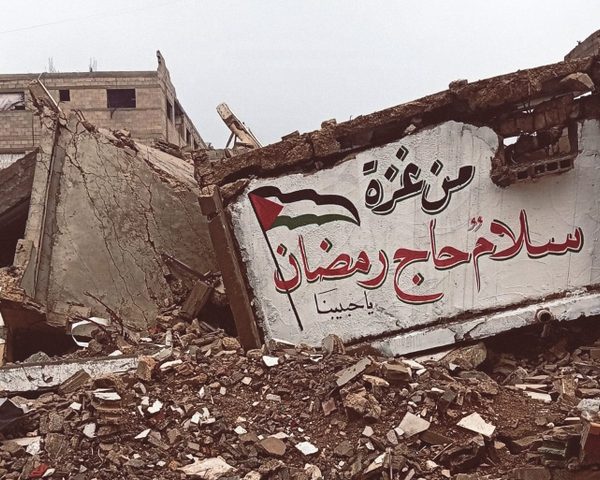
Under Cover of War, Israel Speeds Up Seizures of Palestinian Land
Courts had halted a military plan to wall off an area of the Jordan Valley. Since the war, it’s back on.
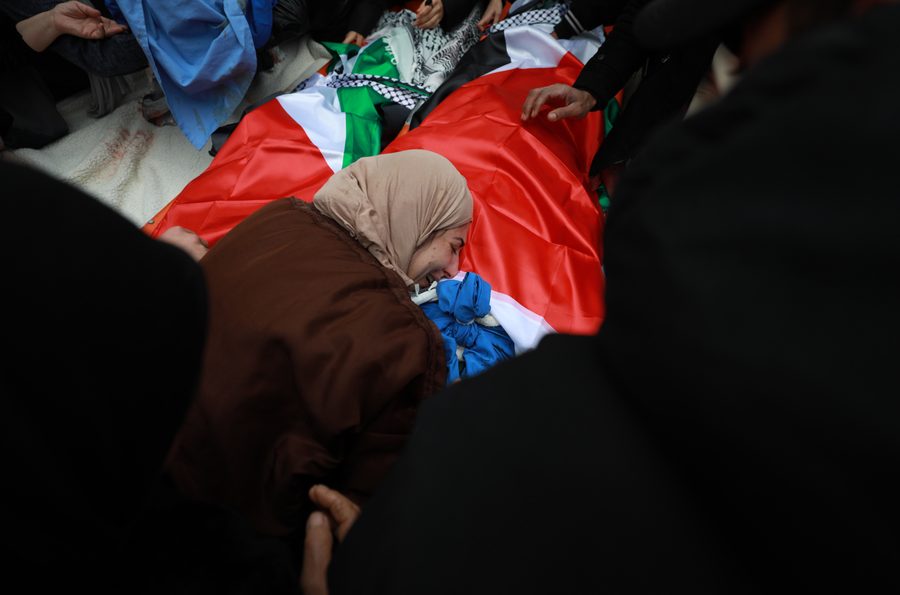
Relatives mourn four members of the Bani Odeh family shot by Israeli soldiers in the northern Jordan Valley on March 15.
This article first appeared in the Jewish Currents news desk newsletter. Subscribe here.
Early this year, Israel’s High Court halted a military plan to build a wall that would slice through the northern Jordan Valley, cutting off a vast area of agricultural land, and the thousand Palestinians who live on it, from the rest of the West Bank.
Since the start of the new Iran war, the plan is back on.
The wall, which the military refers to as the “Crimson Thread,” is part of a larger project aiming to build a 300-mile barrier from the very north of the country in the Golan Heights to the very south by the Red Sea, which would redraw the map of the West Bank with devastating consequences. The initial northern Jordan Valley section of the wall is intended to be 13.5 miles long and some 160 feet wide, and the military plans to demolish all homes, buildings, agricultural land, animal pens, greenhouses, water pipes and cisterns, and other infrastructure in its path.
An interim injunction from the Israeli High Court in late January had temporarily halted the project. But then came the Iran war. On March 2nd, two days after the first US-Israeli strikes on Iran, the Israeli military submitted a request for the order to be reconsidered in light of the war. The Court, noting “the urgent security need,” agreed, and construction began the following day. There is no obvious reason why conflict with Iran would require the Crimson Thread barrier, though Israeli officials have been linking the two for months: In December, Israel’s Defense Minister Yisrael Katz said that the Crimson Thread “will constitute a severe blow to the efforts of Iran and its proxies to establish an eastern front against the State of Israel.”
The construction of the Crimson Thread—and the havoc this work has wrought on the surrounding Palestinian communities—is perhaps the most pointed example of how Israel is using the war with Iran to seize Palestinian land through demolitions, settlement expansion, and raw violence.
Under the cover of war, and as missiles fall on Palestinian communities granted no protection, violence has exploded in the northern Jordan Valley, and across the West Bank. “The war with Iran has created distraction and an opportunity for increased settler violence and pressure on Palestinian communities to unfold with less international scrutiny,” said Belal Bani Odeh, a resident of the town of Tammun in the northern Jordan Valley, and a relative of a family murdered near the village by undercover Israeli soldiers on March 15th.
According to the Israeli human rights group Yesh Din, there were 170 distinct incidents of settler violence in 85 different Palestinian communities during the first 17 days of the war. The United Nations Office for the Coordination of Humanitarian Affairs, which works in the West Bank, has reported that Israeli soldiers and settlers have killed 14 Palestinians in the West Bank in the last two and a half weeks, and UN data shows that last week was the deadliest week of settler violence since October 2023.
“The violence has reached a new level we haven’t seen before, both in the intensity and in the places where it’s happening,” said Dror Etkes, the head of Kerem Navot, an organization that monitors Israeli land policy and settlement activity. “The war allows processes of dispossession to accelerate.”
In the northern Jordan Valley, the start of construction of the Crimson Thread has been accompanied by an extraordinary wave of settler and military violence. That violence reached a fatal peak on March 15th, when undercover Israeli forces opened fire on the car of the Bani Odeh family, who were returning to their town of Tammun, along the path of the Crimson Thread, from a pre-Eid shopping trip in the nearby city of Nablus. Within minutes, the parents, 37-year-old Ali and 35-year-old Waad, and two of their children, 7-year-old Othman and 5-year-old Mohammed, were dead—all four of them shot in the head. When Israeli soldiers pulled the surviving two sons, 11-year-old Khaled and 8-year-old Mustafa, from the car, one of the soldiers announced, “We killed dogs,” and proceeded to beat the two boys. “The soldier grabbed my hair, threw me to the ground, and they began jumping on my back . . . They sat us on the ground and tried beating Mustafa. I stood in their way so they beat me with iron rods,” Khaled recounted, adding that they were also strip searched at the scene. Despite the fact that the victims included very young children, Israeli media summed up the incident with the headline “Four terrorists eliminated.”
Similar incidents occurred regularly prior to the current war with Iran and the beginning of the construction of the Crimson Thread barrier. As the journalist Oren Ziv pointed out, the same unit that shot the Bani Odeh family was involved in an incident in November 2025 in which soldiers executed two Palestinians in Jenin who surrendered with their hands up.
But even amid this deadly context, violence along the path of the Crimson Thread over the last two and a half weeks has been extreme. On March 13th, some 30 masked settlers raided the village of Humsa, attacking residents and stealing hundreds of livestock. Settlers forcibly pushed all the residents, along with two international activists, into a single room and bound their hands and legs, beating them using batons and iron rods, slashing them with knives, pouring cold water on them, and threatening their lives. One man was sexually assaulted while his bound family members were forced to watch, and young girls were attacked in front of their bound parents. According to testimony from residents, one settler told them in Arabic, “This time we’ll take your sheep, but next time, we’ll burn the houses, kill the children, and rape the women.”
Earlier, on March 1st, settlers carried out a pogrom in al-Hadidya, destroying homes and property and attacking residents. When soldiers arrived, they arrested at least ten residents, but none of the settlers. On March 6th, settlers stole 150 sheep from Aqaba, and chased shepherds off their land in Samra. Back-to-back attacks in Ras al-Ahmar on March 7th and 8th left a total of 11 Palestinians injured. On March 10th, settlers brutally attacked one of the only Palestinian residents left in Hammamat al-Malah, sending him to the hospital.
The goal of this violence is to force remaining communities in the northern Jordan Valley to flee, clearing the way for the Crimson Thread project to permanently reshape the area. Following days of military incursions and settler attacks, which included beatings and the use of live fire, soldiers and settlers came to the village of Aqaba on March 7th and told residents their lives would be in danger if they remained. Six families left that day. By March 9th, the entire village was gone; 50 families in total had fled. Also on March 7th, soldiers threatened the village of Yarza, home to 82 people, which had faced weeks of intensified threats, harassment, and violent attacks. Most of the village left on March 8th, and by March 9th, the expulsion was complete. (Settlers later set fire to the empty homes.) On March 8th, Jordan Valley Brigade commander Colonel Gilad Shriki visited five Palestinian shepherding communities in the area—Samra, Makhoul, al-Farisiya, Hammamat al-Maleh, and Ein al-Hilweh—to tell residents that their communities would “be destroyed soon,” and that “it would be better for you to leave.”
“The situation is not just about isolated incidents, but a gradual and systematic change that is directly impacting people’s ability to remain on their land,” Belal Bani Odeh explained.
This recent violence is not limited to the northern Jordan Valley and the path of the Crimson Thread. It’s mirrored across the entire West Bank, with similarly deadly consequences. On March 2nd, dozens of masked settlers tried to enter a family’s home in Qaryut, in the Nablus district of the northern West Bank, throwing stones at the house and breaking windows. When a pair of brothers—52-year-old Mohammad Taha Muammar and 48-year-old Fahim Taha Muammar—tried to stop the assault, the settlers shot and killed them. Israeli soldiers who were present fired tear gas at Palestinian homes, rather than at the settlers. On March 7th, as settlers brought their animals to trample crops on private Palestinian land in Wadi Rakhim in Masafer Yatta, an Israeli reservist and local settler shot Amir Shenaran at point blank range in the neck, killing him, and shot his brother Khaled in the stomach, critically injuring him. (Days later, settlers returned to attack the family’s home.) On March 8th, some 20 masked Israeli settlers bearing clubs raided the village of Abu Falah, northeast of Ramallah, setting trees and other structures on fire. When local residents tried to drive them away, more settlers, including some who were armed, showed up. They shot both 24-year-old Thaer Farouq Hamayel and 57-year-old Farea Joudat Hamayel in the head, killing them. In the aftermath, Israeli soldiers shot tear gas at local Palestinians, which led to the cardiac arrest and death of 55-year-old Mohammad Hassan Mura.
These incidents, along with the several other murders over the last two and a half weeks, underscore the sharp escalation across the West Bank during the war—the dozens of incidents of settlers and soldiers using live fire, as well as countless other attacks: beatings, pepper spraying, arson, harassment, vandalism, demolitions, theft, and expulsion. These attacks have targeted shepherds, children, the elderly, solidarity activists, and livestock.
Meanwhile, settlements in regions across the West Bank have been expanding. On March 5th, Avi Bluth, the head of the Israeli military’s Central Command, which oversees the West Bank, finalized 16 jurisdiction orders establishing six new settlements, and expanding the footprint of another ten settlements. “At the height of a war for national renewal, as Israel restores its sense of dignity and asserts its right to live free from fear of any threat, a judicial order was signed that restores our dignity in settlement as well,” said Yossi Dagan, the head of the settler Samaria Regional Council. Days later, after working throughout the night, settlers formally established a new settlement, Mount Ebal, around dawn on March 11th. On March 12th, ten families took up residence in Homesh, and on March 17th, the first caravans were set up in Sa-Nur, both of which had been dismantled as part of the 2005 disengagement, in which Israel evacuated its settlements both in Gaza and in four locations in the northern West Bank. Settlers have also established outposts near Beit Iksa, Lubban al-Sharqiya, and Salfit in the last two and a half weeks.
The government and settlers are also using the war to promote the growth of settlements in areas of the Jordan Valley around the Crimson Thread—areas that, until recently, did not have significant settler presence. An advertisement put out last week by the Samaria Regional Council, the pro-settlement NGO Amna, and the Settlement Division of the World Zionist Organization reads: “The Iranian nuclear program is out; our settlement nuclei are in. You don’t need to be a [fighter] pilot to make history; join one of the nine new settlements and take part in the historical revolution of settling Samaria,” above a photo of a settlement on the wing of a fighter jet. One of the settlements promoted by the campaign is Tammun, a recently-established outpost adjacent to the Palestinian village of the same name where the Bani Odeh family was killed. “The settlement is part of a wider effort to reshape control over land and limit Palestinian presence in strategic areas of the Jordan Valley,” Belal Bani Odeh said.
The full extent of the damage of the last two and a half weeks remains unknown. Because of the severe wartime movement restrictions in the West Bank, many Palestinians haven’t been able to access their land to see what’s been damaged, and field researchers for human rights NGOs have had trouble accessing areas of the West Bank to report on new outposts or land takeovers. But Etkes, of the settlement monitoring group Kerem Navot, said that violence will necessarily increase in order to fully expel communities that have been stubbornly hanging on. “Against those that remain, you need to use more violence because they survived the previous waves of violence,” he said.
Taken together, the events of the past weeks sharpen a trajectory that has long been visible. As Sarit Michaeli, the head of international advocacy at B’Tselem, wrote, “I’ve lost count of how many times I’ve told people that we are only one war with Iran away from full ethnic cleansing in the West Bank. Knowing it was foreseeable doesn’t make it any less horrific.”

I’m Arielle Angel, editor-at-large of Jewish Currents. Before you go, there’s something I need to ask.
We’ve seen over and over how the mainstream media falters in telling stories on our beats—whether it’s antisemitism, Israel/Palestine in American politics, Jewish identity, or the American left. At Jewish Currents we’re committed to uncompromising analysis and longform reporting on these issues and more—stories you won’t find anywhere else. In a media landscape that obscures injustice and flattens discussion, we’re changing the conversation. But we need you.
If you believe in this work, please consider making a donation—or even better, a recurring one—to ensure that we are able to keep publishing stories like this one. We can’t do it without you.

Maya Rosen is an assistant editor at Jewish Currents.