The Zionist Right Has a MAGA Problem
A conference aiming to confront antisemitism on the right offers a portrait of an old guard left twisting in the wind.
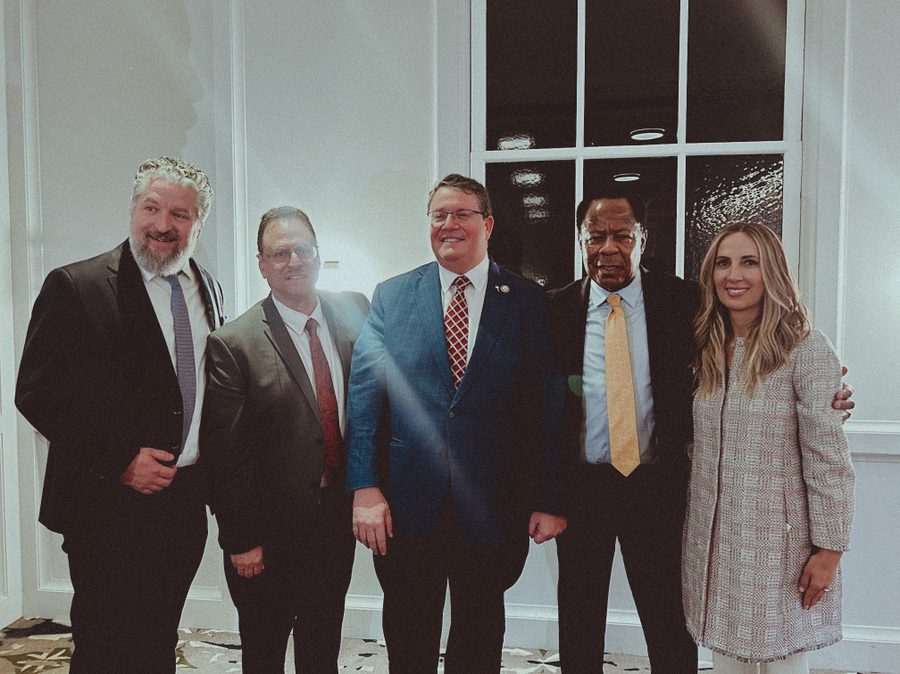
From left: Luke Moon, Mario Bramnick, Randy Fine, Leo Terrell, and Ellie Cohanim at the “Exposing and Countering Extremism and Antisemitism on the Political Right” conference in Washington, DC, November 18th, 2025.
MAGA’s crusaders against right-wing antisemitism couldn’t seem to agree on the problem they had gathered to solve. Huddled in a basement conference room last Tuesday, attendees of “Exposing and Countering Extremism and Antisemitism on the Political Right” had been called to Washington, DC, by the National Task Force to Combat Antisemitism, authors of Project Esther, the Trump administration’s blueprint for attacking the left via its commitments on Palestine. The Task Force was in disarray. Just a few days earlier, it had split from the Heritage Foundation after the powerful conservative think tank defended Tucker Carlson when Carlson gave a friendly interview to Nazi apologist Nick Fuentes. The group was ostensibly gathered to counter the mainstreaming of nakedly antisemitic figures like Fuentes within the MAGA movement and to chart a path forward. But hours into the half-day event, speakers ping-ponged between trivializing the online antics of “stupid 20-year-olds in their grandma’s basement,” in the words of Task Force co-chair Ellie Cohanim, and warning against an “explosion” of antisemitism on the right whose “dimensions are enormous and incomprehensible,” per fellow co-chair Mario Bramnick. While some, like Mort Klein of the Zionist Organization of America (ZOA), expressed fear that “mindless, vicious hatred, is becoming mainstream,” others tried to downplay the impact of Fuentes, Carlson, and their followers: “They want us to get angry and offended, and there’s really no reason to. I mean, these are a bunch of freaks,” said Gen Z MAGA Jewish influencer Justine Brooke Murray.
The conference came after several weeks of right-wing meltdown. Incited by Fuentes’s October 27th appearance on Carlson’s show, the controversy engulfed the right when Kevin Roberts, president of the Heritage Foundation, defended the organization’s “close friend” Carlson and railed against the “globalist class” and “venomous coalition” attacking him. The Task Force—which had been housed at Heritage from its inception and had collaborated with the think tank to author Project Esther—soon had a serious problem. At least nine member organizations and individuals publicly announced their withdrawal from the Task Force following Roberts’s statement, and its credibility was sinking by the day. At the conference, Luke Moon, Task Force co-chair and executive director of the Christian Zionist Philos Project, described spending countless hours on the phone trying to mend the fraying coalition. But eventually he and some of the other co-chairs felt they had no choice but to sever ties with Heritage, “at least for a season,” to stave off an exodus of the remaining members.
Pulling together the conference in DC was like “herding cats while building an airplane in the sky,” Moon told the audience of 50 or so, composed mostly of End Times Christian Zionists, anti-LGBT ideologues, and Jewish MAGA influencers. Joined by an anti-DEI activist with a Tikvah Fund luggage tag and a German Shepherd bomb-sniffer-in-training wearing a vest with an Israeli flag patch, this motley crew had urgent business to discuss: The Carlson-Fuentes-Heritage episode was only the latest evidence that right-wing support for Israel was eroding. Polls indicate that younger conservatives increasingly view Israel in a negative light. Even leading MAGA figures—not just Carlson, but influencers like Candace Owens and politicians like Marjorie Taylor Greene and Thomas Massie—have criticized Israel’s crimes in Gaza and called US support into question under the banner of “America First.” The challenges ahead were clear enough: How could the Task Force, along with the broader pro-Israeli right, counter this growing dissent? And how best to respond to the rise of overt MAGA antisemitism?
When he and three others started the Task Force in November 2023, Moon explained to the room, they made a conscious decision to target opponents on the left. “We did see in the corner of our eye the rise of antisemitism on the right,” he acknowledged, but they chose to stay focused on Palestine solidarity movements because, in their view, “it was 100 pro-Hamas people to one [right-wing] antisemite in his mom’s basement eating Hot Pockets.” As Bramnick, a prominent Christian nationalist and pastor, said, the sentiment was that “our real problem is the Islamists and the progressive leftists that have already sold out our nation.” Trump’s presidential victory in 2024, said Bramnick, was seen by the MAGA coalition as “a mandate to combat woke socialism, globalism, [and the] anti-Christian, antisemitic, and anti-Israel agenda.”
In recent months, however, as right-wing skepticism of US support for Israel has moved toward the mainstream, even figures like freshman Florida Rep. Randy Fine, who has built his brand from vitriolic attacks against Israel critics on the left, were now telling the conference that “Tucker Carlson is the most dangerous antisemite in America.” And while charges of antisemitism lobbed at left-wing critics of Israel are frequently spurious, on the right they often carry more substance: For open white nationalists like Fuentes, the problem with Israel is not imperialism or apartheid but an all-powerful global cabal of subversive, disloyal Jewish interlopers who are assailing Christianity and undermining America from within.
Confronting their fellow right-wingers also presents a particularly tricky problem, because after years of heated crusades against DEI and “wokeness,” much of the MAGA movement is in no mood to launch any kind of sustained inquiry into accusations of bias within its ranks. Doing so would mean mimicking “BLM, MeToo, left wing moral panic behavior,” tweeted Rachel Bovard, vice president at the Conservative Partnership Institute, an institution that the New York Times called a “nerve center for the right wing.” Responding to criticism of Roberts, Carlson, and others, Curt Mills, executive director of The American Conservative, a non-interventionist journal, posted on X that “the Israel First censoriousness mirrors the late 2010s-early 2020s woke left speech crackdown.”
Trump has long seemed a reliable ally for the pro-Israel right, from his move of the US embassy to Jerusalem during his first term to his staunch backing of Netanyahu’s genocide and crackdown against protesters more recently. But the White House now seems hesitant to take a stand against Carlson, the most influential pundit in the MAGA-verse. The weekend before the conference, the president told a reporter “you can’t tell [Tucker Carlson] who to interview . . . If he wants to interview Nick Fuentes, I don’t know much about him, but if he wants to do it, get the word out.” Vice President J.D. Vance, meanwhile, castigated pro-Israel activist Sloan Rachmuth on X for speculating that Carlson’s son, Buckley, who serves as Vance’s deputy press secretary, may be a “vile bigot” like his father, since “racism and antisemitism is a family trait.” “Sloan describes herself as a defender of ‘Judeo-Christian Values.’” Vance tweeted. “Is it a ‘Judeo-Christian value’ to lie about someone you don’t know? Not in any church I ever spent time in!” The day after Vance’s tweets, Rachmuth appeared at the Task Force conference.
In the face of this right-wing infighting—some of it intergenerational—the mostly older Task Force members and supporters gathered in DC to reaffirm their commitment to fighting what Bramnick called a “spiritual war” against antisemitism. But that, as it turned out, was about all they could agree on. From divides over how, and whether, to publicly criticize Trump for his countenancing of Carlson and Fuentes, or Carlson and Fuentes themselves, to the lack of a clear definition of what constitutes antisemitism in the first place, the conference ultimately clarified only one thing: The pro-Israel MAGA coalition is twisting in the wind.
Throughout the half-day conference, speakers struggled to understand the root causes of antisemitic and anti-Israel sentiment among their own. “What happened?” thundered the ZOA’s Klein, wearing his signature “Never Again” lapel pin in the shape of a yellow star. “Why this transformation? . . . Some people say it’s Qatar money. I don’t know, but there’s something strange going on.” Former Trump appointee Cohanim similarly claimed that “foreign operators” and “foreign adversaries . . . want to divide us and pave the way for [MAGA] electoral loss.”
As speakers debated the source of antisemitism on the right, some veered into antisemitic tropes. Ralph Reed, founder of the evangelical Faith and Freedom Coalition, claimed that antisemitism is rooted in “collectivist ideologies” like communism and fascism. Anyone who resents capitalism and its merit-based free-market system “will come to hate the Jew,” said Reed, because “wherever Jews have gone, if they were not persecuted or denied a right to be full participants of society, they have risen to the highest level in that economic system.” Reed’s analysis conveniently obscured the fact that most MAGA conspiracy theories target left-wing specters like philanthropist George Soros or “cultural Marxism,” and affirmed the antisemitic notion that Jews are inordinately powerful. Murray, the Gen Z influencer, put it more bluntly: “[Antisemites] always tweet about how ‘we’re noticing how the Jews are in every high position’ . . . Yeah, it’s because we’re successful! We have mothers who foster success, who drum it into our heads . . . It’s a form of jealousy.” The crowd chuckled approvingly.
Comments like these were more feature than bug of the gathering. Klein suggested that Soros, a frequent target of antisemitic conspiracies, belongs to a nefarious group of left-wing funders “promoting hatred toward Israel.” Yaakov Menken, rabbi and founder of the right-wing Orthodox advocacy group Coalition for Jewish Values, contrasted the “educated Jews”—yeshivish rabbis of the Haredi enclave of Lakewood, New Jersey, who voted for Trump en masse —with the “nonsense” from “left wing Jewish clergy,” a broad category which for him included “Reform, Reconstructionist, Conservative, Jewish Renewal and mail order [rabbis] in the entire country.” The crowd met his delegitimization of most of the American Jewish rabbinate with applause. During the post-conference shmooze and cocktail hour, a Daily Signal journalist covering the event dipped further into the well of conspiracy, excitedly plugging his Substack and recent book, both titled The Woketopus, which detail the “left-wing, dark money” “cabal” funding everything from “anti-Israel protests” to “unions, transgender orthodoxy” and more. (His book cover is a dead ringer for the classic antisemitic Nazi cartoon from the early 1940s.)
When it came to tactics for addressing right-wing antisemitism, the path seemed no less muddled. Several speakers implored the group to maintain “robust coalitions” and expand their base. But they were light on details about what any of that meant—who could be added to the base, for instance, and how? As co-authors of Project Esther, the Task Force was accustomed to advocating for the use of state and legal power to address perceived antisemitism on the left. The founding statement of their coalition, which Moon read aloud in his opening address to the conference, endorsed the controversial IHRA definition of antisemitism, which has been used in disciplinary and legal proceedings in governments, universities, and civil society. But, perhaps reflecting the influence of the many conservative leaders who have come out against the use of legislative speech codes to combat antisemitism in the past year, the Task Force disagreed about whether they would call for such tactics to now be used against opponents on the right.
Even Leo Terrell, who currently heads Trump’s federal Task Force to Fight Antisemitism at the Department of Justice, didn’t seem convinced that a legal approach was the path forward. Terrell—a former Fox News talking head who woke up the sleepy room with a lively monologue about how antisemites “aren’t after Jews, they’re after Western civilization!”—has championed high-profile efforts to arrest and deport activists like Mahmoud Khalil and to defund universities like Columbia. But aside from a passing comment affirming the DOJ’s commitment to prosecuting hate crimes, Terrell didn’t seem enthusiastic about using the tools of the federal government in the fight against right-wing antisemitism. “Some people have Jewish fatigue,” he said. “You got the president who is 100% committed. You got an attorney general who’s 100% committed. But people in between . . . I hear stuff like ‘we got enough.’” Rather than rely on legal remedies, he told attendees, it was up to them to post on social media more frequently. “We’re losing the public relations war,” he said, and “we need to be just as loud, just as vocal as the other side, because they have groups helping them. I don’t want to mention their names because I don’t want to embarrass these people.” (He then mentioned CNN, MSNBC, The New York Times, The Washington Post, and The Los Angeles Times.)
Murray seemed more aware than her elders that attempting to enforce speech codes on the right would backfire. “There’s some people, even on our side, who talk about hate speech. Never use that phrase,” she said to the group of mostly Boomer evangelicals. “There’s no such thing as hate speech.” (She thanked the one person who applauded.) Echoing Terrell, she instead implored conservatives to counter Fuentes and Carlson with “more speech.” “We know what’s hateful,” she said, “but instead of showing that we’re angry or that we’re offended, we need to hold up a mirror to them.” Murray praised Chaya Raichik, founder of the MAGA doxxing account Libs of TikTok (“a proud Jew!”) for modeling a path forward with her posts ridiculing “blue hair nut jobs” who “don’t know what gender they are.”
To address right-wing antisemitism, several speakers acknowledged, would require calling out members of their own camp. Bramnick was all for this: “We need to hold proper accountability, which is what the left did not do and now their party is now being run by Mandani [sic], AOC, and Bernie Sanders,” he said. “This is not going to happen to the MAGA movement, not under our watch.” Rep. Fine admitted, however, that while “it’s easy to call it out on the other side—I like to do it, it’s fun—it’s a lot harder to do it on our own.” This proved especially contentious when it came to Trump. When Klein told the attendees he’d been “disappointed” by the president’s comments defending Carlson, he apparently rattled Cohanim, who earlier had praised Trump as “the greatest friend and supporter of the Jewish people and the Jewish state of Israel in all of history.” She took the mic after Klein to announce that “sentiments that are shared by the speakers today do not necessarily represent the views of the Task Force.”
Later in the afternoon, after a standing ovation for Terrell and before a lecture titled “Is Christian Zionism a Brain Virus?”—the title a retort to Tucker Carlson’s viral claim—the conference attendees struggled to make a minyan. Between speakers, Rabbi Menken popped his head back into the conference room to plead for a few more adult Jewish men. “It doesn’t matter if you haven’t been inside a synagogue since Yom Kippur!” he said. But the crowd, made up primarily of evangelical advocates and leaders, mostly stayed seated.
That interlude perfectly illustrated another challenge the Task Force faces as it tries to regroup. When Project Esther was released in October 2024, the authors received much criticism for involving relatively few Jewish organizations in their efforts. Since leaving Heritage, they have not moved to blunt that criticism: The Task Force is now affiliated with the Conference of Christian Presidents for Israel (CCPI), a new umbrella coalition of evangelical leaders modeled after the Conference of Presidents of Major American Jewish Organizations. CCPI coordinates pro-Israel advocacy at the federal level and has flanked the hardline Israeli right; its influence at the conference was evident. Most speakers followed a familiar formula for the pro-Israel Christian right: pound the Bible, invoke national security, reference the Founding Fathers, repeat. Bramnick summed it up neatly, saying that “antisemitism is not just an anti-Jewish problem. It is anti-Christian, anti-American, and anti-Western.”
As Bramnick, who has supported End Times prophecy and proselytizing to Jews, put it, “God’s covenantal promises to Israel and the Jewish people is [sic] unconditional, and God will defend Israel. He will and is defending the Jewish people.” Other speakers insinuated that Trump himself, as well as appointees like Terrell and US Ambassador to Israel Mike Huckabee (who made a brief appearance from Jerusalem via recorded video), were chosen by God for a divine task. For them, it is self-evident, as Faith and Freedom Coalition’s Reed lilted in his Georgia twang, that “being a good Christian means defending Jews. That is in the DNA of the American church.” He pointed to polling showing that large majorities of evangelicals (70% of white evangelicals, according to one 2022 poll) believe that God gave the land of Israel to the Jewish people. “That’s about twice, by the way, the level of American Jews,” he remarked. “What that says about the Jewish community? I don’t know. I’ll leave that to others to say.”
But Reed’s style of Bible-thumping is losing sway with young Christians. A September 2025 survey showed that only 29% of evangelicals under 35 believe that Jews are God’s chosen people—a core belief of Christian Zionist theology—and concluded that “while support [for Israel] exists, it is not universally deep nor comprehensive across the evangelical spectrum.” Nor is this a recent trend: A 2021 survey showed that support for Israel stood at only 33.6% for evangelicals ages 18-29, a notable drop from a 2018 survey showing 69% support in the same category.
For all their talk of “Judeo-Christian” values, last week’s attendees and speakers may well be spitting into the wind of a Christian nationalist movement that is increasingly dropping the hyphen and leaving the “Judeo” behind. When a college student pressed Vance last month to justify US support of Israel—while, in the student’s view, the Jewish religion supports the persecution of Christians—the vice president responded not by defending “Judeo-Christian values,” but by affirming theological differences between Jews and Christians. Similarly, in his defense of Carlson, Heritage president Roberts emphasized that “Christians can critique the state of Israel without being antisemitic,” proclaiming that “my loyalty as a Christian and an American is to Christ first, and to America always.” For Christian Zionist members of the Task Force, that view is tantamount to a heresy.
At the conference, such biblical invocations were supported by old neoconservative lines exhorting a partnership with Israel rooted in shared military aims. The 64-year-old Reed emphasized that evangelical support for the Israeli government “is not some false and patronizing philosemitism,” but “love for the Jewish people that we view through the prism of US national security interests.” Accordingly, Reed argued that Israel must be backed because of its crucial function as “a land-based aircraft carrier” for the US in the Middle East—tellingly lifting a phrase popularized in the Reagan era. But many MAGA adherents no longer accept this paradigm as self-evident, any more than they agree with other speakers who asserted that Israel has a God-given right to annex the West Bank, or that its 2005 disengagement from Gaza was an affront to God’s will. “MAGA has been co-opted by neocons that are more concerned with protecting Israel, Ukraine, Indian and Chinese H-1B visa workers, and foreign students than American workers, American taxpayers, and American students,” tweeted one leader of College Republicans of America a week before the conference, epitomizing a schism over the future of the conservative movement that touches not just Middle East policy but also issues of immigration, economic populism, and national identity.
It was left to the few young people who addressed the conference to acknowledge that institutional leaders like Reed misunderstand the younger MAGA mood. The Philos Project’s Isaac Woodward, a millennial, encouraged conservative groups to go beyond theology and engage young right-wingers on the merits of their political concerns—preferably offline, where face-to-face interactions could more effectively change hearts and minds. As an example, Woodward praised as a “blessing” the hundreds of trips to Israel that Philos has led for young Christians, saying “those are the things that move the needle.” During a post-conference interview, Dimas Guaico, the head of Philos’s youth project Gen Zion, said that he also felt like the elders in the room were out of touch and needed a more grassroots approach to organizing. Sporting a silver necklace in the shape of the undivided Land of Israel— which, he explained, contained “a piece of the Iron Dome”—Guaico said he had been criss-crossing the country to recruit 20 pro-Israel student representatives to join him at the upcoming TPUSA conference, where he expects to encounter some opposition. “We have to do social media, yeah, but we have to do real life,” he said. “This generation wants action.”
But even the youth at the conference did not seem particularly attuned to the populist trends currently convulsing the right. While Murray advised conservative leaders to be more sensitive to the concerns of MAGA youth, for example, she was scornful when discussing the dismal economic outlook fueling the populist appeal of leaders like Fuentes. “Maybe actually get a job,” she lectured her peers. “Maybe try to improve your life, maybe study a little bit harder . . . [instead of saying] no, it’s somebody else’s fault that you are in the condition that you are currently in.”
Ultimately, while conference speakers projected bravado—with Rep. Fine calling on the audience to “punch [antisemitism] right in the face”—attendees left with few solutions for the problem of antisemites in the MAGA ranks and little clarity on the transformation taking place before their eyes. Perhaps that is unsurprising, given that the right’s decades-long campaign to smear progressive critics of Israel as antisemites has shown little nuanced understanding of antisemitism, nor of why so many are critical of Israel in the first place. Now, faced with the rise of a more unequivocally antisemitic form of anti-Zionism on their own side, the Christian and Jewish right find themselves similarly ill-equipped to meet the moment.
“In every major scientific revolution, the elites . . . refused to acknowledge the evidence that was right in front of their eyes,” pontificated Christian Zionist scholar Gerald McDermott at the conference, comparing those who dismissed the theories of Galileo and Newton to the critics who dismiss Christian Zionism today. “Their brains were so wired to the old paradigm that they could not see it . . . Or some actually did see it, but they had so much invested professionally in the old paradigm that they chose not to see it.” Perhaps McDermott, and the others on stage, imagined they were speaking truth to the likes of Carlson and Fuentes; in truth, they were talking only to themselves.

I’m Arielle Angel, editor-at-large of Jewish Currents. Before you go, there’s something I need to ask.
We’ve seen over and over how the mainstream media falters in telling stories on our beats—whether it’s antisemitism, Israel/Palestine in American politics, Jewish identity, or the American left. At Jewish Currents we’re committed to uncompromising analysis and longform reporting on these issues and more—stories you won’t find anywhere else. In a media landscape that obscures injustice and flattens discussion, we’re changing the conversation. But we need you.
If you believe in this work, please consider making a donation—or even better, a recurring one—to ensure that we are able to keep publishing stories like this one. We can’t do it without you.

Ben Lorber works as senior research analyst at the social justice think tank Political Research Associates, researching antisemitism and white nationalism. He is the co-author of Safety through Solidarity: A Radical Guide to Fighting Antisemitism.
Jess Schwalb is a former Jewish Currents fellow and currently works at Diaspora Alliance. She lives in Chicago.