The Group Forging a “Judeo-Christian” Zionism for the New MAGA Age
Israel365’s decades of outreach to Christian Zionists has made it a power player from the World Zionist Congress to the White House.
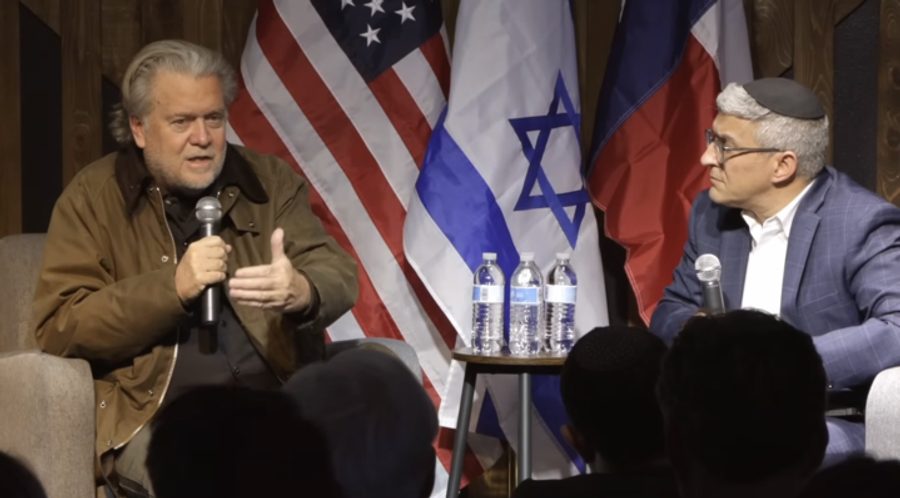
Steve Bannon with Israel365’s Pesach Wolicki at the National Religious Broadcaster’s conference in Dallas in early March.
After record turnout, votes are now being tallied in this year’s World Zionist Congress (WZC) election to determine which factions will emerge victorious. Established by Theodore Herzl in 1897 as the founding legislative body of the Zionist movement, the WZC helps direct the policy and funding of legacy Zionist organizations like the World Zionist Organization (WZO) and the Jewish National Fund (JNF)—which have been key actors in the process of Palestinian dispossession since the pre-state era. Historically, the American branch of the WZC has been dominated by the Reform movement, but the 2020 election saw Reform’s historic dominance shaken by a surge in support for a newly formed ultra-Orthodox slate, granting the Jewish far right an unprecedented, and slim, majority of seats within the so-called “parliament of the Jewish people.” Against the opposition of a reinvigorated liberal camp, this new leadership has moved to increase funding for settlements, support the Israeli right’s judicial overhaul, and block educational programming promoting religious and cultural pluralism within WZC member institutions.
If the 2020 WZC election marked the ascent of Jewish right leadership within the WZC, this year’s election portends the rise of yet another, aligned current: Christian Zionism. This tendency was represented at the 2025 election in a slate assembled by Israel365, a group that specializes in building Jewish Zionist partnerships with the US Christian right. Since its founding in 2012 by the American-born Israeli Orthodox Rabbi Tuly Weisz, Israel365 has dedicated itself to advancing the Israeli far-right’s cause with the American evangelical public. The group has achieved this using a digital media wing that produces a steady stream of what Weisz has called “Biblical journalism”; a publishing arm that produces an Israel-themed Bible, along with an array of religious books; a charity wing that raises funds for ventures ranging from farms in West Bank settlements to winter gear for Israeli soldiers; and a marketing wing that connects Israeli companies with Christian consumers. Thanks to this outreach, Israel365 has become an established face of biblical hasbara for US Christians. More significant still has been the group’s advocacy wing, which seeks to strengthen the partnership between Jewish and Christian Zionist faith leaders, politicians, and influencers by organizing a bevy of campaigns, speaking tours, conferences and summits, webinars and prayer calls, sign-on letters, and tours to Israel.
This steady drumbeat of faith-based diplomacy has built crucial connective tissue between Israeli settler leaders on the one hand and MAGA movers and shakers like Steve Bannon, the Heritage Foundation, and evangelical leaders like Paula White-Cain (director of Trump’s White House Faith Office) on the other. For the hardline religious nationalists on both sides of this biblical romance, this partnership offers a way to achieve shared political goals. Building on the victories of the first Trump administration—the moving of the US embassy to Jerusalem, launch of the Abraham Accords, and more—such groups are now seeking the full Israeli annexation of the West Bank, an escalation of the exterminationist war on Gaza, and Jewish sovereignty over the Temple Mount. The ambitiousness of these goals reflects both movements’ optimism in the new MAGA age: As Pastor Mario Bramnick, globe-trotting Christian Zionist operative in the upper echelons of the first Trump administration, effused in March, it is as if “God is giving Israel a blank check to begin to write upon, to dream again.”
For many Christian Zionists, these goals feed into End Times fantasies, where the steady advance of Israeli expansion and domination paves the way for a final apocalyptic battle centered in Jerusalem, prophesied to culminate with the return of Jesus and global triumph of the Christian faithful. Previously, most Jewish Zionists balked at these fantasies even as they partnered with their Christian counterparts on shared goals. “Until I see Jesus coming over the hill, I’m in favor of all the friends Israel can get,” Lenny Davis, former chief of research at AIPAC once said; in the same breath, however, he admitted that “these guys give me the heebie-jeebies.” But Israel365 does not hold such reservations. Instead, the group shares the messianic motivations of its allies, and sees its work organizing Christian support for Israel as a way to speed the hour on God’s prophetic clock, with Weisz telling a 2021 Christian livestream that “it’s so important that we get this right in order to bring about the ultimate redemption—the Messiah, the Moshiach that we’re all waiting for.”
With the support of evangelical allies, Israel365 is now bringing this End Times-inspired project to the institutions of the Jewish Zionist diaspora. “I see Israel365 as the MAGA movement inside the Jewish people and for Israel,” far-right leader Steve Bannon told the group at a virtual rally held in March. Bannon then charged Israel365 to take a “commanding role” in the WZC “so that you have a platform to fight this fight for Western civilization.” “We’re going to shake up the Jewish establishment, the failed status quo,” explained delegate Josh Hammer, a popular MAGA pundit, at the same rally, promising to direct WZC-controlled funding “for strengthening . . . biblically-undergirded national populism all throughout the Western world.” In practice, this may mean a stronger political partnership between Jewish and Christian Zionists across Israel and the US. While much of the US membership and ostensible base of institutions like the JNF and Hadassah (an affiliate of the WZO) remains anti-MAGA, an ascendant Israel365 may try to steer these institutions to work more closely with Christian Zionists on educational, hasbara, and Israel advocacy campaigns, and even to back Christian right campaigns around prayer in public schools, funding for religious schooling, and more—leading to the further consolidation of an American Jewish flank of the Christian nationalist coalition. Considering the Democratic leanings of most American Jews, the prospect of Zionism’s central organ for diaspora participation retooling itself into an organ for Christian outreach and wading into MAGA culture wars might appear counterintuitive. But it may well reflect the true nature of the oft-vaunted “Judeo-Christian” partnership at the heart of today’s US–Israel relationship, and of 21st century Zionism as a whole, which relies far more on evangelical support than on American Jewish backing.
The alliance between Jewish and Christian Zionists is not new. Since the 1970s, Israeli and American Jewish operatives have cultivated close, if often complicated, political relationships with pro-Israel Christian right leaders like Jerry Falwell, head of the Moral Majority, and Pastor John Hagee, head of Christians United for Israel (CUFI). These policy partnerships contributed to the establishment of the US–Israel “special relationship” since the 1980s, helping translate evangelical Zionist fervor into effective political advocacy.
Despite their success, such alliances remained controversial for many Jewish Zionists, who remained theologically opposed to partnership with Christians, suspicious of missionary intent, and averse to Christian apocalypticism. But in the past few decades, certain Jewish Religious Zionists (adherents of the movement synthesizing halachic observance with nationalist fervor that has grown to dominate Israeli politics since the 1967 War) have warmed to the theological potency of Jewish–Christian partnerships, and some have even come to embrace the End Times orientation of their Christian allies. Specifically, the Center for Jewish–Christian Understanding and Cooperation (CJCUC)—the first Orthodox institution dedicated to Jewish–Christian partnership, which was established by the American-born Rabbi Shlomo Riskin in the West Bank settlement of Efrat in 2008—quickly gained notoriety in the Orthodox Jewish world for accommodating Christian messianism by drawing on a parallel set of eschatological beliefs in Judaism. In addition to carving out a greater role for Christians to play in the Jewish version of the End Times saga, the CJCUC also pioneered joint Jewish–Christian religious ritual, undertook shared theological dialogue and Bible study, and publicly flanked antisemitic Christian Zionist leaders like Pastor John Hagee.
In the face of criticism from other Orthodox and settler leaders, Riskin justified this work as politically necessary. “We are in a third world war,” he told a journalist at CUFI’s 2017 annual conference. “Jews have to be strong . . . Jews need alliances.” Indeed, the Jewish–Christian alliance was so central to CJCUC’s worldview that it understood the partnership as “not really an interfaith relationship in the traditional understanding of the term,” per Rabbi Pesach Wolicki, who used to lead CJCUC and now heads Israel365’s lobbying arm. Instead, Wolicki said, the connection he was cultivating was “more of an intra-faith relationship,” one that “seeks and expands upon common points of faith.” Israel365 builds on this foundation, advancing an eschatology where the growth of Christian Zionism around the world, much like the creation of Israel, is itself a fulfillment of biblical prophecy, and where a Jewish–Christian Zionist partnership is thus a key to moving the End Times process along. “Jews and Christians must begin to work together . . . because it’s part of the biblical plan,” Weisz explained in a 2023 interview. “The active participation of Bible-believing gentiles in the Zionist project is not only politically expedient,” Wolicki added in a March 2025 op-ed, “it is part and parcel of the way the redemption of Israel is meant to play out.”
Fueled by Israel365’s relentless efforts, this bid to ally with the “Bible-believing gentiles in the Zionist project” has lately been reaping material dividends, especially in the aftermath of October 7th, 2023, as the group’s advocacy has reached the heights of the MAGA coalition. This became apparent on a clear afternoon in March 2024, when Weisz and Wolicki gathered on a West Bank hilltop with Christian partners and a pair of silver trumpets. They were there to renew an ancient Israelite wartime ritual that marked, according to Wolicki, a holy war not only in Gaza but also against the Biden administration (which had renewed calls for a two-state solution in contravention of God’s supposed will). The ritual was attended by two A-list Christian Zionist power brokers who were on a solidarity delegation to visit Prime Minister Benjamin Netanyahu in the wake of October 7th: Tony Perkins and Pastor Mario Bramnick. Perkins is president of the flagship Christian nationalist group Family Research Council, which has advanced decades of Capitol Hill lobbying against LGBTQ and reproductive rights, church-state separation, and other culture war crusades. Meanwhile, Bramnick is head of the evangelical advocacy group Latino Coalition for Israel and a key figure behind the Heritage Foundation task force which produced Project Esther, a plan to destroy American left movements, starting with the movement for Palestine.
The relationship did not end with a shared ritual. The following month, Weisz and Wolicki paid Bramnick and Perkins a visit, this time meeting up at the Washington, DC, offices of the Heritage Foundation to launch “Keep God’s Land,” a faith coalition uniting over 150 American Jewish, Christian, and conservative leaders and organizations in opposition to the two-state solution. The launch event featured recorded remarks from Netanyahu as well as in-person guests including Member of Knesset (MK) Ohad Tal and GOP leaders like House Speaker Mike Johnson and New York Rep. Claudia Tenney. The gathering, like so much else unfolding in Heritage’s offices at the time, was close to the nerve center of a conservative movement positioning itself to storm the White House. As such, it spoke to Israel365’s niche among key power brokers on both sides of the US–Israel alliance, and the group’s strategic role as a faith-based bridge-builder between these camps.
The re-election of Trump supercharged these partnerships, and further elevated Israel365’s position. As Israeli Finance Minister and Religious Zionist leader Bezalel Smotrich proclaimed that “2025 will be the year of sovereignty for Judea and Samaria” and Christian nationalists put the demand for West Bank annexation front and center, Israel365 found itself back in Washington in January. This time, Weisz and Wolicki joined Bramnick and Perkins for the launch of Rep. Tenney’s Friends of Judea and Samaria Caucus, which Israel365 claimed to have helped organize. Since then, caucus members and fellow-travelers like Senator Tom Cotton have all called on Trump to recognize Israeli sovereignty over the West Bank and for official United States documents to refer to the territory as “Judea and Samaria.” Many of Israel365’s partners have also organized energetically for this agenda within MAGA institutions, developing infrastructure to coordinate pro-Israel lobbying across the institutional Christian landscape. In February, the momentum continued with Weisz and MK Tal meeting with White-Cain in Washington, as she began her new role as director of Trump’s White House Faith Office. Israel365 had invested in a prior relationship with White-Cain, one of Trump’s earliest evangelical advisers: On a trip to Israel she took in summer 2023, the group accompanied her and her husband Jonathan Cain (one-time rhythm guitarist for the rock band Journey) to ascend the Temple Mount, meet Religious Zionist leaders, and learn Torah in West Bank yeshivot. This relational work now paid off: After the White House meeting, Weisz gushed about their deep alignment. “She understands Judea and Samaria . . . we talked about building the Third Temple,” he relayed in a video uploaded to Israel365 Action’s Facebook account. “We had a very spiritual conversation, and a very practical conversation.”
These political-theological partnerships are continuing well into the first year of the new Trump term. In March, the leaders of Israel365 visited Dallas, Texas, for the annual conference of the National Religious Broadcasters (NRB), a global consortium of leading Christian media organizations claiming a combined audience of over 100 million viewers. There, Israel365 leaders not only mobilized further Christian support for Israeli annexation of the West Bank, but also took the opportunity to hold a celebratory dinner to honor Steve Bannon with a “Warrior for Israel” award. Bannon took the stage before a crowd of far-right Christians and Jews to accept the award and, living up to his reputation as a coalition builder, used his speech to outline the battle lines taking shape across what he called the “kinetic phase of the third world war” then underway. “The Judeo-Christian West is united,” he said, while the “red-green alliance” of DEI supporters, “neo-Marxists” and “radical Jihad” represented the “enemy” who “hate us, and there’s no middle ground, there’s no negotiation.” Recommending a brutal crackdown on campuses starting with the deportation of foreign students—which would begin one week later with the abduction of Mahmoud Khalil—Bannon also extended his militant posture to the Israeli front, calling for even more military aggression in Gaza and the West Bank, railing against regional powers like Iran and Turkey as civilizational enemies, and seeming to endorse West Bank annexation.
The event was not without its tensions. When Wolicki joined Bannon on stage after his speech and raised concerns about anti-Israel voices in the America First movement, Bannon interjected that “many of these are very close friends of mine [and] you have to understand where they’re coming from.” Citing widespread opposition to an interventionist Middle East policy, foreign aid, and the US’s role as global “hegemon,” Bannon estimated that support for Israel among MAGA supporters under 30 had dipped to the single digits. Signaling his own non-interventionist sympathies, he floated the idea of pausing a $3 billion arms sale to Israel then under consideration and offered that while Iran is the “ancient enemy of the West,” the US should likely avoid military entanglement against the country (an issue Bannon and Wolicki had debated fiercely on Bannon’s War Room show weeks before the conference). At times, Israel365’s leaders have professed common ground with skeptics of Middle East intervention—particularly on the question of gradually phasing out military aid to Israel, a position that has been voiced in some corners of the pro-Israel right, and has been echoed in recent weeks by the Heritage Foundation and even Netanyahu himself. Still, the energy in the room seemed to cool after Bannon’s provocations, and when Weisz acknowledged in his speech after the exchange that some in the audience may be “surprised to hear messages like that at a Jewish event,” it underscored the rift brewing in the MAGA ranks.
Nonetheless, Israel365 has a track record of tolerating substantial tensions within the “Judeo-Christian” Zionist alliance it is building. For instance, it claims to eschew partnership with Christians who hold a missionary agenda, but has continued partnering with Bramnick and Perkins who, like many Christian Zionist leaders, have seemed to support the conversion of Jews when speaking to Christian audiences. Similarly, nine days before being honored by Israel365, Bannon drew fire for making a Nazi salute at a conservative conference, but Israel365 was unfazed. Even when a local Orthodox day school where it had initially planned to hold the Bannon gala canceled the event in protest, the group proceeded by holding the event at the NRB convention instead. Indeed, Israel365 appeared in its natural element at the convention, leading workshops over Shabbat on topics like “Jews and Christians in the Age of Redemption” and “Filling the Void: Why Both Jews and Christians Need the Third Temple.” This suggests that while foreign policy debates continue in the MAGA camp, an energetic core remains focused on common goals and common enemies. “There’s a comfort level” to the relationship, Wolicki enthused during a conversation with two Christians on the conference floor. “The whole [project] of Jews and Christians coming together,” said his interlocutor, pointing upward, “comes from above.”

I’m Arielle Angel, editor-at-large of Jewish Currents. Before you go, there’s something I need to ask.
We’ve seen over and over how the mainstream media falters in telling stories on our beats—whether it’s antisemitism, Israel/Palestine in American politics, Jewish identity, or the American left. At Jewish Currents we’re committed to uncompromising analysis and longform reporting on these issues and more—stories you won’t find anywhere else. In a media landscape that obscures injustice and flattens discussion, we’re changing the conversation. But we need you.
If you believe in this work, please consider making a donation—or even better, a recurring one—to ensure that we are able to keep publishing stories like this one. We can’t do it without you.

Ben Lorber works as senior research analyst at the social justice think tank Political Research Associates, researching antisemitism and white nationalism. He is the co-author of Safety through Solidarity: A Radical Guide to Fighting Antisemitism.