The View from Evin
My family’s history with the notorious Iranian prison links me to a world of unfinished liberation movements.
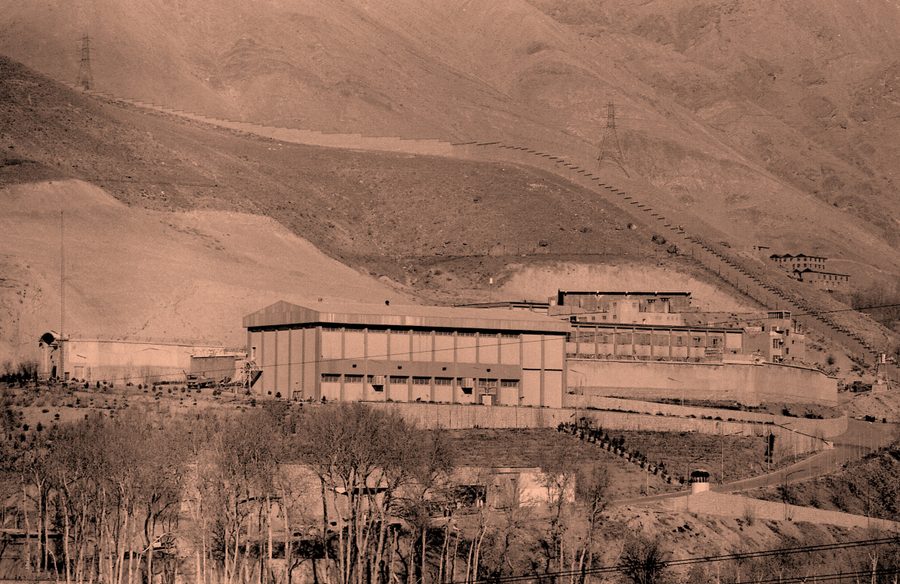
Evin Prison in Tehran, Iran, January 1987

When Evin Prison erupted in flames on the night of October 15th, 2022, Iran was already alight. A month prior, Jina Mahsa Amini, a 22-year-old Kurdish woman, had been beaten to death by the Gasht-e Ershad, Iran’s morality police, for the crime of not wearing her hijab in accordance with government standards. Grief gave way to fury, and fury to defiance as women flooded the streets, tearing off their headscarves and rejoicing around bonfires. The uprising came to be known as the Woman, Life, Freedom movement, its name drawn from a slogan first popularized by the Kurdish liberation leader Abdullah Öcalan. It soon grew into one of the largest and most enduring rebukes to the theocratic regime that, for the past 46 years, has relentlessly smothered dissent and denied even the smallest acts of self-determination, attempting to control how people dress, what they eat and drink, whether they sing or dance. The state had met the movement with characteristic brutality, countering the people’s hope with batons and bullets. Within the prison—which held thousands of activists, artists, and others who had dared to contest this oppressive order—chants of “Death to the Dictator” sounded in unison with the cries of the protesters outside.
No journalists were able to report how the fire started or document the casualties. From my Brooklyn apartment, where I sat clutching my phone, I could see only what was captured by flickering videos taken from neighboring windows and rooftops. I watched plumes of smoke tower over the prison, and what looked like Molotov cocktails hurled from the hills. I heard the echo of gunfire. As sporadic news came of security forces taking injured prisoners not to hospitals but to other detention centers, and blocking streets to prevent families from reaching their incarcerated loved ones, I felt myself unravel.
I called my parents in California. “Are they about to kill everyone inside?” I asked, my voice trembling. “Burn them alive? Is this another massacre?” My parents were silent. We knew the horrific possibilities of that place intimately. My uncle Mohsen, my father’s brother, was among the thousands of people executed there during the notorious 1988 massacres of political prisoners that took place around the country. My parents only narrowly avoided this fate; they had once been political prisoners in Evin. I, too, had passed through its halls. This was the place where, in 1983, blindfolded, handcuffed, and chained to a bed, my mother gave birth to me.
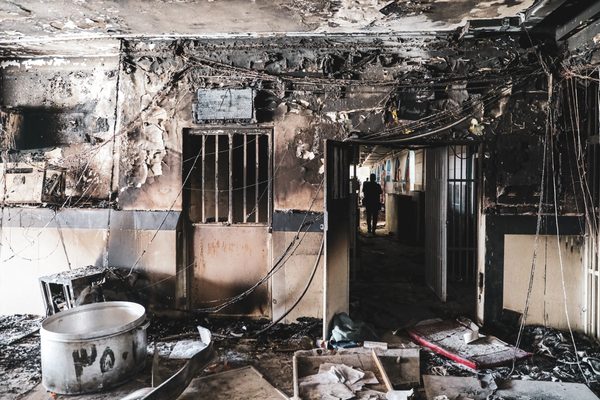
A room in Evin Prison following a fire that killed four prisoners, October 16th, 2022.
As flames engulfed the prison that day three years ago—and again this past summer, under Israeli bombardment—this truth confronted me: I am undeniably tethered to this place. Evin is not just a distant cluster of buildings where I happened to be born; it is the axis of my geography. The prison stamped its coordinates on my body. In the key of its fearful and tyrannical map, my destiny was fixed. This map seeks to contain not only me and my family but the very idea of us and our people. Denying the enduring evidence of resistance, it aims to trap us within a familiar script, rendering us unruly people in need of discipline or helpless victims awaiting salvation.
And yet, because Evin is, for me, where everything began, my compass points out from this narrow place toward a wider world. My origin directs me to return, always, to what the regime, along with its imperial co-conspirators, disclaims: those stubborn histories of revolt it has never been able to fully crush—the archives it has endeavored to destroy, the voices it has tried to silence, the lives it thought it had extinguished. When I look out from Evin, the view widens beyond Tehran’s walls: toward other uprisings, other unfinished liberation struggles, every place where people refuse the borders drawn to contain them.
Evin Prison’s role as an antagonist of popular struggle precedes the Islamic Republic. Opened in 1971 in the beautiful village of Evin in northern Tehran under the reign of Mohammad Reza Shah Pahlavi, the prison was originally a high-security detention center run by SAVAK, the Shah’s dreaded secret police. The complex comprised two large communal blocks designed to hold 300 people, 20 cells for solitary confinement, a court room, and an execution yard. In 1953, after the US and UK, hoping to protect Western oil interests, orchestrated a coup ousting the democratically elected Prime Minister Mohammad Mossadegh, the CIA assisted in establishing SAVAK, and the prison became a key site for the secret police to incarcerate, torture, and kill opponents of the Shah. (In the 1960s, as relations between the US and Iran became increasingly strained, Israel’s Mossad helped to train SAVAK agents, with whom they also carried out several joint operations.) By the 1979 revolution, Evin held more than 1,500 people, including 100 political prisoners in solitary confinement.
In February 1979, a month after the Shah fled Iran, as Ruhollah Khomeini rose to power, the doors of Evin opened to the public for the first and only time. Crowds stormed the prison to bear witness to the torture chambers and solitary cells that had come to symbolize the Shah’s brutal rule. Hours later, the gates shut again. The revolution had prevailed; the Shah was gone for good. But what awaited the population was not the end to state violence that the newly formed Islamic Republic had promised, but a new wave of it, even deadlier than before. Inside Evin, the regime established the notorious Ward 209, where political prisoners—including dual nationals and foreign citizens—are held in particularly brutal conditions, and which has since become synonymous with fear in the Iranian imagination. People incarcerated here are kept in prolonged solitary confinement, denied legal access and medical care, and subjected to torturous interrogations designed to coerce confessions.
When the Iran–Iraq War began in 1980, the regime used the fighting as a pretext to further crush internal opposition. Among those arrested and sent to Evin were my aunts and uncles, my father, and my mother, who was pregnant when she was taken. After my birth, I stayed with her in her cell for just over a month, and then was handed to my grandparents, who raised me along with my cousin and my brother until my parents were released in the mid-1980s.

A bracelet of date pits the author’s father made while incarcerated in Evin, from the early 1980s.
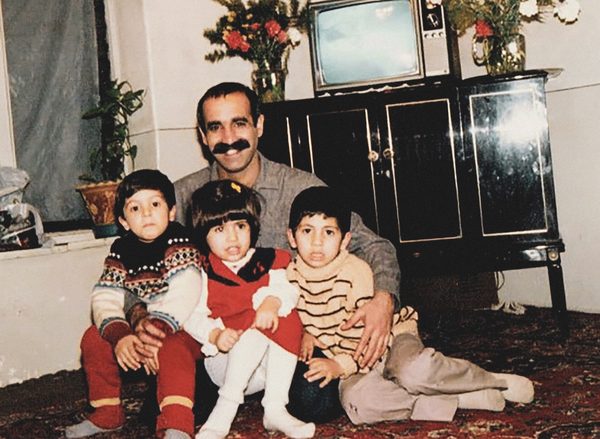
The author’s father on the day of his release from Evin Prison with, from left to right, the author’s brother, the author, and the author’s cousin, 1986.
By the time Iran entered the final stretch of its eight-year war with Iraq, the Islamic Republic had suffered an estimated half a million casualties. The regime, humiliated by its failure to deliver the divine victory it had promised the nation, turned its wrath inward. In July 1988, Khomeini issued a fatwa to execute all those members of the opposition forces judged unrepentant “in their war against God.” A “Death Committee” was formed to adjudicate. The doors of Evin and other prisons were sealed shut. As desperate families camped outside prison gates, and the world’s attention shifted to the UN-backed ceasefire between the warring nations, a hidden massacre was unfolding. In a matter of months, thousands of prisoners—including my uncle Mohsen—were hanged or shot, their bodies dumped into unmarked mass graves. The massacre clarified in no uncertain terms what many had long feared: Utter impunity was the blueprint of the regime. Families like ours were banned from displaying photographs of the murdered, holding funerals, or speaking publicly about what had happened.
A few years after the massacre, my family moved to California, where a different kind of silence enveloped us. Here, no one knew anything, no one asked anything, no one seemed to care. The agonizing stories we carried felt surreal against the imperturbable placidity of our new surroundings. What was I supposed to say amid the Christmas parties, sleepovers, and green lawns? How could I possibly explain the tangled labyrinth of our inherited trauma to the people living by the bright blue ocean? In America, I wasn’t afraid to speak. What I feared was the void I’d face once I did.
Still, that past was inscribed deep in me, waiting to resurface. It was as simple as that: One day I beckoned the stories, and they began to arrive. To tell them, I turned to fiction, which felt like the genre that welcomed them most fully. It offered distance from the regime’s official records—its denials of the atrocities, its criminalizing of our grief—and a route to enter memory, to speak in the language not only of the survivors but of the dead and the disappeared. I began writing my novel, Children of the Jacaranda Tree. Drawing on my family’s experience, the book traces the way the horrors within Evin’s walls reverberate in lives far beyond them.
Fiction offered distance from the regime’s official records—its denials of the atrocities, its criminalizing of our grief—and a route to enter memory.
When I approached my parents as part of my research, it had been years since we had spoken about their time in Evin. As they told me about the interrogation my mother endured while in labor; about the bracelet my father carved from date stones for a daughter he’d seen only once in the prison courtyard; about my grandparents raising three grandchildren while fleeing Iraqi bombs; about my uncle, his lifeless body swaying from a noose—something felt different. I’d heard these stories before, but now they would no longer be ours alone. They would leave the safety of the private world we’d worked so hard to build and enter the realm of a public we had never trusted. And, in 2013, as the book began to make its way in the world, I felt the warnings we had received as children to never speak of where our parents had been or what had been done to them surge within me once again. My hands shook as I read from the novel to audiences gathered in bookstores. My voice caught every time I said “Evin.” At night, I dreamed of abandoning my mother and father to drown at sea. But despite my fear, making this suppressed, private history public also felt like a kind of release. For me, Children of the Jacaranda Tree was not the narrow story of a few people living in the shadow of Evin; it was a bid to stoke what the prison itself aims to extinguish. It was a small rebuttal to power’s claim to its singular truth, to its attempts to erase our stories and deny our will to speak.
On June 23rd, 2025, Evin Prison was once again targeted, this time by Israeli airstrikes. Bombs struck the visitation center, administrative buildings, and multiple wards, including Ward 209. The assault came during Israel’s Twelve-Day War, which struck not only government targets, as Israel claimed, but also hospitals and residential buildings. When Israel, followed by the US, attacked Iran, it was no aberration but a continuation of a long, bloody campaign of domination and control: the slaughter of Palestinians, the bombing of Syrians, Lebanese, and Yemenis. Within hours of the attack on the prison, Minister of Defense Israel Katz took to X to boast that Israeli forces were assailing “regime targets and government repression bodies in the heart of Tehran”; an IDF press briefing called Evin “a symbol of oppression for the Iranian people,” emphasizing that “individuals defined as enemies of the regime” are imprisoned there and “subjected to severe torture.” With this familiar rhetoric, Israel attempted to frame its assault as an act of solidarity with the Iranian people, even as the bombs reportedly killed not only staff and guards but also prisoners, visiting relatives, social workers, and a five-year-old child.
According to testimonies from political prisoners inside, security forces stormed the prison just hours after the bombing, not to offer protection to the besieged inmates but to force terrified prisoners back into blown-out cells at gunpoint. Wounded, thirsty, and starving, many lay trapped for hours while the shaken regime scrambled for its next move. As dusk fell over Tehran and Israeli bombardments continued, prisoners were ordered to prepare to evacuate under the threat of death. Given just minutes to gather what remained of their belongings, they were chained together, passing corpses in body bags as they were marched at gunpoint through the wreckage. Those who had been held in Evin were dispersed to other prisons and detention centers, and, yet again, all information was withheld from anxious families outside the prison. Days later, some relatives received brief phone calls. Many received nothing at all. Once more, people who lost loved ones were interrogated and made to promise their silence in exchange for the return of the bodies of their kin.
The Israeli attack against Evin Prison was part of a long, unholy alliance between imperial forces that claim to free us and the regimes that claim to protect us from them.
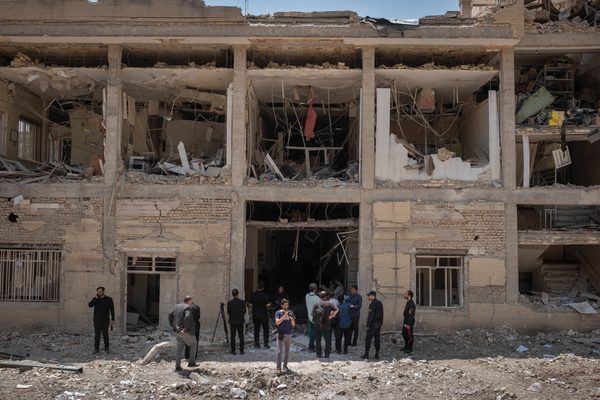
Iranian journalists gather outside an office building at Evin Prison, destroyed by Israeli strikes in northern Tehran, July 1st, 2025.
I sat with this torrent of news, struggling to assimilate another iteration of the same structure of violence that has terrorized my family, my people, for generations. Following events from the US, which had endorsed and participated in Israel’s strikes, the terrible logic they revealed was especially clear. Despite their outward antagonism, and beneath a thin pretense of care, the Islamic Republic and Israel—along with its sponsor—acted in unison against the Iranian people; the attack was thus part of a long, unholy alliance between imperial forces that claim to free us and the regimes that claim to protect us from them.
It should come as no surprise that the locus of this shared assault was Evin. The prison, filled with generations of dissidents, contains—and attempts to extinguish—a story that defies the one upheld by dictatorship and empire alike. Its crowded cells speak not of masses cowed into submission or awaiting salvation, but of a people fiercely committed to their own liberation. Contrary to the isolation these oppressive orders seek to impose, those who reject the imposition of such violent enclosures—from Kurdistan to Iran to Palestine—draw the lines of a different map pointing the way toward a future where not only the prisons, but the very orders that sustain them, will burn.

I’m Arielle Angel, editor-at-large of Jewish Currents. Before you go, there’s something I need to ask.
We’ve seen over and over how the mainstream media falters in telling stories on our beats—whether it’s antisemitism, Israel/Palestine in American politics, Jewish identity, or the American left. At Jewish Currents we’re committed to uncompromising analysis and longform reporting on these issues and more—stories you won’t find anywhere else. In a media landscape that obscures injustice and flattens discussion, we’re changing the conversation. But we need you.
If you believe in this work, please consider making a donation—or even better, a recurring one—to ensure that we are able to keep publishing stories like this one. We can’t do it without you.
Sahar Delijani is the author of Children of the Jacaranda Tree, an internationally acclaimed novel, translated into 32 languages and published in more than 75 countries. Her writing has appeared in The New York Times, Literary Hub, McSweeney’s Quarterly Concern, BOMB, and many other publications.