The Sympathy Trap
In Perfect Victims, Mohammed El-Kurd argues that attempts to “humanize” Palestinians reinforce the Zionist politics they purport to contest.
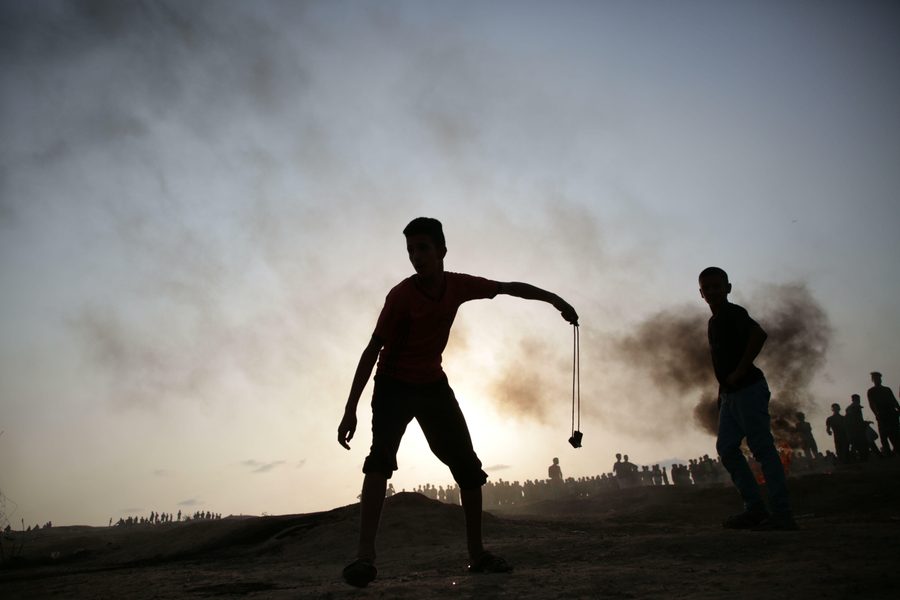
A Palestinian boy throws a rock at Israeli troops on the border of the Gaza Strip, August 31st, 2018.

Discussed in this essay: Perfect Victims: and the Politics of Appeal, by Mohammed El-Kurd. Haymarket Books, 2025. 256 pages.
On January 29th, 2025, I was at work on this review, and Hind Rajab had been dead for exactly one year. How many of us had wept, listening to the recording of the five-year-old’s last phone call? “I’m so scared, please come. Come take me,” Hind entreated a responder from the Palestine Red Crescent Society. “Please, will you come?” For people across the world, the wavering of Hind’s small voice made the depth of Israel’s brutality intimately present. We could feel the child’s utter desperation as she pleaded from inside the car, where she was surrounded by the bodies of her aunt, uncle, and four cousins, who had just been murdered by Israeli soldiers as the family attempted to flee the war zone Israel had made of their home in Gaza. By the time we heard the recording, we already knew that, not four hours later, Hind would be dead, as would the paramedics sent to rescue her. An investigation by Forensic Architecture later found that an Israeli tank fired 335 rounds of bullets at the Palestinian family’s car.
Many people committed to a free Palestine, myself included, circulated the story of Hind’s murder by Israeli forces. We posted pictures of the little girl with a floral headband and a radiant smile. We shared the audio recording of her tender, terrified voice. We asked others to look, to listen, to not turn away. It’s no surprise that Hind’s heartbreaking and rage-inducing story traveled widely. She was so clearly innocent—and thus, though we did not say it, so clearly not a “terrorist.” In the year and a half since Israel began its indiscriminate war against the people of Gaza, this kind of story has become horribly familiar: newborn twins slain while their father was at a local government office registering their birth; a grandfather beloved by children and kittens killed in a bombing; a software engineering student burned alive in a medical tent with an IV still hooked up to his arm, days shy of his 20th birthday. See, we said, these people so clearly posed no threat to anyone—did they not deserve to live?
What so many of us were doing was curating a selection of “perfect victims” that would make the Palestinian cause more sympathetic, more palatable to a liberal audience, in the hopes that those who professed to care about universal human rights might use whatever power they had to help end this horrendous assault. In his new book, Perfect Victims: and the Politics of Appeal, writer and activist Mohammed El-Kurd critically interrogates this approach. By emphasizing victimhood as the condition for sympathy, he argues, this strategy grants the moral authority of those in power—those who preside over the world structured by colonial brutality—and requires Palestinians to maintain a posture of pitiable powerlessness. Indeed, the perfect Palestinian victim cannot express rage—not toward their Israeli occupiers, nor the soldiers killing their people en masse, nor the Western powers that send funds and arms to their murderers. Even in the context of occupation and genocide, they must exhibit only passive suffering and a desire for reconciliation; any other affect or expression threatens to eject them from the narrow role of sympathetic object. Banishing Palestinian resistance from the frame, this recourse to appeal ultimately strengthens the Zionist project it often purports to contest.
Of course, as El-Kurd readily acknowledges, this terrible bind—in which victims of structural violence are coerced into an impossibly constrained position or even blamed for their own oppression—is neither new nor particular to Palestinians. I wrote about this phenomenon in the context of American anti-Blackness more than a decade ago, in an essay called “Against Innocence.” In that piece, I argued that “a liberal politics of recognition can only reproduce a guilt-innocence schematization that fails to grapple with the fact that there is an a priori association of blackness with guilt (criminality).” In other words, according to the dominant anti-Black order of things, Black people are afforded empathy only when they sufficiently distance themselves from Blackness; appeals to worthiness in the eyes of the law will only ever exempt the individual, not overturn the structure that condemned them in the first place. Keenly attuned to this reality, El-Kurd invokes the parallels between Palestinians living under Israeli occupation and Black Americans murdered by police. “We hamper them with innocence,” he writes of the latter group. “‘They were artists’ or ‘They were mentally ill’ or ‘They were unarmed.’ (It is as if condemning the state for sanctioning the death of a Black person is permissible only if the slain person is a sterile model of American citizenry.)” A similar logic, he notes, operates for victims of sexual assault.
Though I know well the dangers of sorting victims into categories of deserving and undeserving, since Israel began its genocidal assault in Gaza, I have been surprised by the degree to which I’ve found myself limiting my own speech to stay within the accepted bounds of liberal discourse, both to convince others and to protect myself. For instance, I noticed myself not only focusing on spreading stories like Hind’s and emphasizing the proportion of civilians killed by Israel, but also gravitating toward promoting the viewpoints of pro-Palestinian Jews or joining Jewish-led actions as a way to preempt charges of antisemitism. My speech felt further constrained by my awareness that one of my colleagues was under investigation for posts on X calling out Israeli war crimes. Indeed, no matter how much we contorted ourselves in our expressions of Palestine solidarity, no matter how agreeable and commonsensical our positions, the accusations were always the same—and they bore material consequences. In the US, you could lose your job for a social media post calling attention to the historical context in which the October 7th attacks took place. You might be deported for writing an op-ed criticizing your university’s complicity with genocide. Even for many of us who have long had no illusions about the brutality of this nation, the repression was much fiercer than expected. After all, the US—with its deep-seated infatuation with the mythos of free speech—habitually neutralizes leftist movements by substituting representation for structural transformation. Articulations of dissent become profitable, movements become yard signs—and too many of those who had been oriented to collective change take the money, the jobs, the accolades, as the people they claimed to serve are left to languish. But in the case of Palestine, it seems, no such cleavage between righteous speech and material vulnerability is possible. And here, El-Kurd’s book offers a vital clarification: Tame platitudes and semantic acrobatics will not protect us; they will only serve to further hem in those already suffering in militarized enclosures.
Although only 27 years old, El-Kurd already has a long history of navigating the vexed question of what it means to speak under conditions of extraordinary repression. El-Kurd grew up in half of his family’s home in the East Jerusalem neighborhood of Sheikh Jarrah; the other half had been stolen by settlers from Long Island. As a child he became, as he writes in Perfect Victims, “a docent of dispossession,” translating the strange contours of his circumstances for “the foreign diplomats and journalists who would sit in our ‘solidarity tent,’ drinking our tea and ‘witnessing’ our catastrophe.” He felt “special” when, at age 11, he was selected as the protagonist of a documentary about the neighborhood. A decade later, El-Kurd came to understand the terms of this platform differently. In 2021, he was thrust into the international spotlight once again when an anti-expulsion campaign mounted by Sheikh Jarrah residents ignited an uprising across Palestine. El-Kurd soon found himself fielding requests from American politicians, who wished to speak to Palestinians about what they called “the situation.” They did not, however, want to talk with just any Palestinians, but with Palestinian children—those “whose fangs are not yet sharpened,” El-Kurd writes. Not only was the bizarre request emblematic of how innocence functions as the primary modality through which Palestinian dispossession is made legible to Western audiences; it also exemplified “a morbid correlation”: “The more martyrs there are, the more podiums.”
In this context, where the death of one’s kin forges the route toward opportunities for public address (albeit extraordinarily constrained), El-Kurd refuses the mantle. “I do not want to audition before the reader; I want to address the reader as if they are a guest in my living room,” he writes. In one’s own living room, one need not, while a genocide rages, condemn Hamas or respond to hypothetical future harm that might one day befall Jewish Israelis in order to be heard. In one’s own living room, one is free to address “the topics of discussion in accordance with their moral or political weight.”
The barrier to this approach is, of course, the politics of appeal—which follows an oppressive logic that, El-Kurd explains, proceeds in two parts: “dehumanization” and “humanization.” The former refers not only to those spectacularly vulgar “moments of televised fury when politicians slip up and call us ‘human animals’”—as Israel’s then Minister of Defense Yoav Gallant did on October 9th, 2023, when he demanded a “complete siege on Gaza”—but also to the more ordinary agents of obfuscation: journalists who conceal Israeli violence by writing about genocide in the passive voice, missionaries who enrich their sense of self through Palestinian immiseration, bureaucrats who couch their Zionist collaboration in muddled proceedings, and all the rest of those in the West who “refus[e] to look us in the eye.” Whereas dehumanization forms the basis of a Western common sense that indicts Palestinians for “what is logically understood to be man’s natural reaction to subjugation” (for example, rage in the face of generations of land theft and ethnic cleansing), humanization recuperates Palestinians by “depicting us in ‘respectable’ and ‘relatable’ terms,” emphasizing woundedness and grief and often focusing on the particular story of an individual, rather than the collective claims of the group. “If they are bereaved,” El-Kurd writes, “they can only be the wailing widows whose grief is too inexplicable to contextualize.” In short, dehumanization casts Palestinians as terrorists (guilty), while humanization portrays Palestinians as victims (innocent). The politics of appeal comprises the narrow route by which one might pass from the former to the latter.
In Perfect Victims, El-Kurd emphatically discards this vigorously enforced script. Recognizing the relationship between comportment and capitulation, he decisively rejects the polite discourse of reasoned neutrality and irreverently refuses to confine himself to a singular mode. He moves freely between sharp analysis, rhapsodic lyricism, journalistic matter-of-factness, and the no-holds-barred boldness of a revolutionary who is clearly fed up with the civility humpers who insist on a posture of respectability. After all, the rehearsal of the constrained forms agreeable to those in power functions as a ritual of submission through which acquiescent attitudes are established. Irreverence therefore interrupts the process of habituation to oppression, dilating the space of possibility; it is “a dignifying act of refusal, for those confined by siege or incarceration can be emancipated in the mind.” Like the Martinican psychiatrist Frantz Fanon, who famously theorized the linkage between psychological and material schemas of oppression, arguing that “decolonization, which sets out to change the order of the world, is, obviously, a program of complete disorder,” El-Kurd underscores that meaningful change is possible only when the colonized themselves and those in solidarity with them undergo radical transformation. Only by completely disregarding the oppressor’s rhetorical and narrative strictures, by orienting oneself toward the truth that “the Palestinian struggle for liberation is heroic—no qualifiers needed,” can the vital activation come about, ultimately enabling the colonized to bring about an end to their occupation.
Irreverence interrupts the process of habituation to oppression; it is “a dignifying act of refusal, for those confined by siege or incarceration can be emancipated in the mind.”
Still, it would be difficult to argue that, over the past year and a half of genocide in Gaza, the politics of appeal has made no inroad for the Palestine solidarity movement. We have signed petitions, called our representatives, circulated heart-wrenching images of Palestinian victimization—and indeed, the Overton window has shifted. Polls have found that Democratic voters increasingly sympathize with Palestinians, and this past spring, 15 senators supported a pair of bills to cancel the sale of offensive arms to Israel, a tally that would have been unthinkable just years ago. Outside the US, the sense that Israel is an oppressive regime is even stronger. In a way, we are winning. The ferocity of the current repression is a testament to the force of the sea change: Those with power can no longer manufacture consent, so they attempt to keep people in line by threatening to fire them from jobs, suspend them from school, or even deport them for holding the “wrong” position.
Yet this shift in public opinion has not corresponded with material change. It doesn’t seem to matter to the ruling class that they have lost broad consent for Israel’s war against the Palestinians. Despite 83% of Democrats being in favor of a ceasefire in Gaza, Democratic representatives overwhelmingly do not support cutting off the money and weapons that underwrite the genocide. We have clearly seen that it is not the beliefs of the people but the interests of the powerful that ultimately determine policy. What good, then, is a politics that hinges on calling on the consciences of those who profit from the status quo?
In the context of the Palestine solidarity movement, El-Kurd is far from alone in taking up a decidedly anti-appeal approach. The Boycott, Divestment, Sanctions (BDS) movement, for instance, focuses not on changing the hearts and minds of Western actors, but on the structural antagonism and asymmetry of power between Israelis and Palestinians. For two decades, the movement has demanded, among other things, a boycott of “events, projects, publications, films, or exhibitions” that normalize occupation by bringing Israelis and Palestinians together “so they can present their respective narratives or perspectives, or to work toward reconciliation, ‘overcoming barriers,’ etc., without addressing the root causes of injustice and the requirements of justice.” Youth-led movements, such as the student intifada that generated the proliferation of encampments and other pro-Palestine activity on college campuses last year and the Palestinian Youth Movement (PYM)—a transnational, grassroots movement of young Palestinians—refuse the compulsion to construct perfect victims by focusing on materially ending support for the Israeli war machine. (PYM has, for example, led a campaign against the Danish shipping company Maersk, which transports arms to Israel, while the student intifada demanded that universities divest from entities materially supporting the genocide.) These groups have been able to remain clear-eyed about who the enemy is and continue to unapologetically use the language of resistance—honoring the martyrs, praising the intifada, and calling for a horizon of Palestinian liberation “from the river to the sea,” while others decry this lexicon as objectionable or nonstrategic.
The orientation of those who refuse the politics of appeal underlines the contested role of speech in political change. El-Kurd, for his part, remains ambivalent about what can be done with language, even as he has chosen a life of words: “Sometimes . . . I’m tempted to say that it’s all smoke and mirrors, that after all the poems and essays and speeches, there is not a dent in the status quo,” he writes. And yet, he remembers the Palestinian poet Rashid Hussein, who wrote “God Is a Refugee” in protest of the 1950 Absentees’ Property Law and the 1960 Israel Lands Administration Law, which facilitated Israeli land theft: “His poem not only documented Zionist land theft but helped catalyze the farmers and landowners toward launching a general strike.”
El-Kurd does not tidily resolve his inner conflict, so we are left with the question: What are the conditions that enable expressive acts to catalyze radical transformation? Hussein’s poem opened a space of possibility, but it was ultimately the action of the workers that made the poem an effective political tool. Only a synthesis between action and imagination can instantiate a new reality. As Black Liberation Army revolutionary Assata Shakur succinctly put it: “Dreams and reality are opposites. Action synthesizes them.” Repeated enunciation can contribute to making alternative realities thinkable, but power never yields voluntarily; we must identify our points of leverage so they can become the fulcrum we use to raise up a new, liberatory future for Palestine.

I’m Arielle Angel, editor-at-large of Jewish Currents. Before you go, there’s something I need to ask.
We’ve seen over and over how the mainstream media falters in telling stories on our beats—whether it’s antisemitism, Israel/Palestine in American politics, Jewish identity, or the American left. At Jewish Currents we’re committed to uncompromising analysis and longform reporting on these issues and more—stories you won’t find anywhere else. In a media landscape that obscures injustice and flattens discussion, we’re changing the conversation. But we need you.
If you believe in this work, please consider making a donation—or even better, a recurring one—to ensure that we are able to keep publishing stories like this one. We can’t do it without you.

Jackie Wang is a poet, scholar, and multimedia artist. She is the author of Carceral Capitalism (Semiotext(e), 2018); the poetry collection The Sunflower Cast a Spell to Save Us from the Void (Nightboat Books, 2021), which was a finalist for the National Book Award; and Alien Daughters Walk Into the Sun (Semiotext(e), 2023).