Wallace Shawn’s Moral Cliffs
While his latest show, What We Did Before Our Moth Days, trades political violence for marital strife, it is still an exercise in audience complicity.
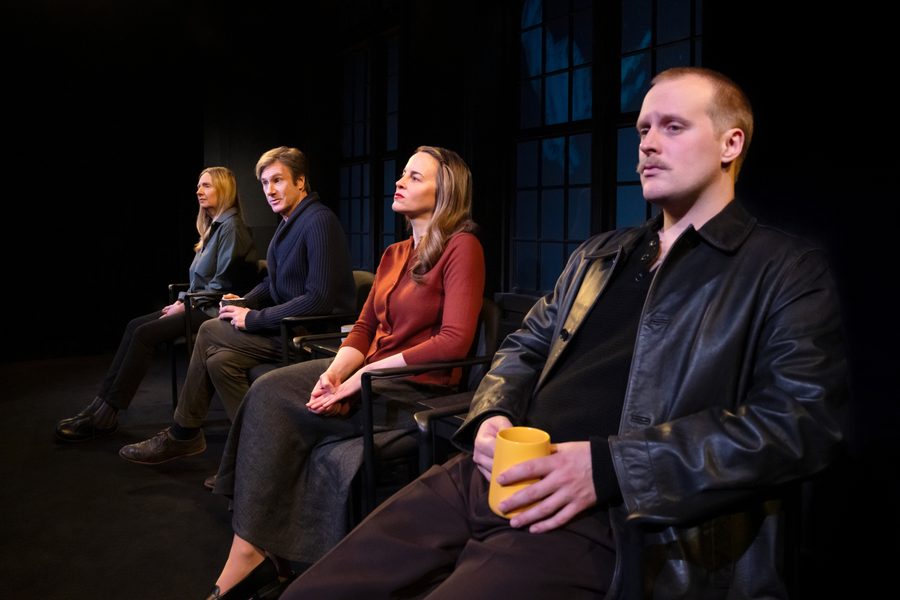
From left, Hope Davis, Josh Hamilton, Maria Dizzia, and John Early in What We Did Before Our Moth Days at the Greenwich House Theater in New York City.
“The thought did occur to me . . .” The words that begin Wallace Shawn’s new play, What We Did Before Our Moth Days (running through May 24th at Greenwich House Theater in Manhattan), have incendiary power. They ignite a fuse that smolders through this mild-mannered but emotionally agitating three-hour drama, which traces a simple-seeming plot: the developing, then dissolving, relationship between a husband and wife. Their grown son and the husband’s lover fill out the four-character ensemble. Thoughts occur to these characters, which they tell us in intertwining monologues, and we piece together how those thoughts lead to consequential deeds—and how those deeds lead the characters to spin self-justificatory thoughts.
In fact, if you had to sum up the method driving Shawn’s playwriting over the last four decades, you couldn’t do better than that opening six-word phrase. Typically, his plays wind through the thoughts of characters who take up an idea and follow it to apparently rational, usually self-serving, often disturbing, conclusions that they quickly assimilate as normal. In the quietly lacerating Aunt Dan and Lemon (1985), we are led logically and seductively to a shocking embrace of Nazism; in The Designated Mourner (1996), we trace the title character’s acceptance of widespread political disappearances and executions, even of his own wife and father-in-law; in the hilarious and terrifying Grasses of a Thousand Colors (2009), we enter a fantastical world of carnal mayhem and bestiality in which unchecked human (male) appetite and will to domination leads to ecological catastrophe. In Evening at the Talk House (2017), members of an old theater troupe find day jobs identifying strangers and friends alike for their government’s “Program of Murdering,” which eliminates “people who would like to harm us.” Informing—and even participating in the murdering—is no bigger deal than taking a shit, explains the former costume-shop manager: “I’m making an analogy between dropping some waste into the toilet, you see, and dropping a few small bombs onto certain targets, you know, dropping some rather small bombs onto certain people who pose a threat to us, all rather casual, and then you wash your hands and return to the table.”
Shawn’s beguiling characters carry us along on the incontestable force of their reasoning, casuistic though it may be, and then drop us off a moral cliff. We are left to clamber our way back, if we can, to the no-longer solid ground of our high-minded principles, searching for the consistency between our professed values and the ways we—the bougie “we” that attends the theater—actually live. That is to say, he is our most sly, supple, and challenging political playwright. A new stage work from Shawn is always reason to rejoice—and to tremble a little in our $200 seats.
The thought that occurs at the top of Moth Days doesn’t lead to affection for fascism, acceptance of brutish political repression, or acquiescence to authoritarianism. It points, instead, to the sort of reprehensible interpersonal notions that can arise and then dissipate harmlessly—or fester into toxic behavior. The son, Tim (John Early), tells us with a chuckle that he was thinking about killing himself and the sex worker he’d just driven to his home in a car with a failing exhaust system. In captivating, clever prose, Tim imagines simply sitting in the garage without turning off the ignition and inspiring “a curious story on the local radio station” about “two obviously sordid young people.” Played by Early as somehow likably, shamelessly smarmy, Tim is given not only to suicidal-homicidal ideation (and, we soon learn, to pedophiliac and Oedipal impulses) but also to empathic rescue fantasies: After a not-quite-coital but satisfying encounter with the woman, he imagines “driving her away from the violence and horror that I thought very probably went on inside the grim building from which I’d picked her up and to which I’d planned to return her.” He is in the midst of this savior fantasy when his mother calls with news that his father, at age 45, has just died.
In these first minutes of the play, Shawn establishes the terms of engagement: We’ll listen to characters share confessional stories in direct address as they remain seated in chairs lined up horizontally along the stage, facing the audience. And he begins to coil up some thematic knots that we will have to untangle ourselves as different strands of each character’s narrative, which are not always presented along the same chronological axis, cross or run parallel to the others’. Before long, their situation comes into focus: Tim’s father, Dick (Josh Hamilton) has maintained a 10-year affair with Elaine (Hope Davis), while continuing to live with his wife, Tim’s mother Elle (Maria Dizzia). Tim learns of the affair only after his father’s death. The setup seems so conventional that preview stories about the play characterized it as a major departure for Shawn, a shift away from crafty leftist critique to private family drama.
This assumed, and overly simplistic, characterization of the shift in focus may explain, in part, the rapturous mainstream reception that has (deservedly) greeted Moth Days, which played to sold-out houses even before the laudatory reviews were published. In the non-commercial theater world, Shawn has been a hero for decades, as his fistful of Obie awards suggests, but his most pointed political writing (and, perhaps his pro-Palestine activism) has sometimes rankled injudicious critics with what one once dismissed as a tedious “assault on the privileged class.” No doubt the celebrity cast and Shawn’s own fame as a Hollywood character actor have contributed to the draw of Moth Days (Metrograph has jumped in with a series of films that feature him as an actor or writer). But it also seems as if audiences and reviewers alike anticipated the pleasure and relief of entering a Shawnian world of marital discord rather than one of self-implicating political complacency. And it’s true, marital infidelity hardly comes close to swooning for Hitler or betraying friends to murderous state power. Still, perennial issues in Shawn’s work—the thin line between decency and monstrousness, the conflict between desire and duty, the staggering human capacity to rationalize selfishness, the ease of complicity, and the limits of compassion—swirl through Moth Days as well.
The continuities between the new play and the older ones have been underscored by Shawn’s simultaneous reprisal of his 1990 work, The Fever, at Greenwich House on the nights Moth Days is dark, as if to highlight the ways the two plays complement each other, luring us into a similar cognitive quicksand. As he has done now and then since its premiere in people’s living rooms some 35 years ago, Shawn performs the work himself. The speaker of The Fever, a searing, spiraling, two-hour monologue, experiences a radical revelation as he sits vomiting and shivering on the bathroom floor of his hotel room in an unnamed “poor country where my language isn’t spoken” and a rebellion is underway: that his own comfort back home depends on the immiseration and violent repression of people elsewhere. As his thoughts drift between memories of his cushy life and the bug-filled bathroom floor of his present circumstance, he recalls reading Marx and offers the clearest explanation of commodity fetishism you will ever hear on an American stage. “To understand it,” he says, “your whole life would have to change.” In the end, the speaker chooses not to change his life, despite all that he has witnessed and thought. He thus needs to justify his choice, and his sense of himself as a decent person, by concluding that he deserves what he has—that, indeed, everyone has what they deserve. Whether the speaker really believes this or not is hard to tell and in the end, beside the point. What matters is whether we believe it—and if we don’t, why do we live like we do? The Fever leaves American audiences squirming within the irresolvable yet untenable ethical contradictions of a privilege we can’t seem to escape. The urban, well-off culturati in Moth Days dwell in such contradictions, too, even if that’s not, strictly, the point. Dick is a successful novelist who, like The Fever’s narrator, believes he merits all that he has: “I deserve a reward” for giving readers the pleasures of his books, he reasons. He repeats the sentiment later in discussing his decision to pursue the affair: “I feel I deserve to have that experience.”
Dick is making the case for himself from beyond the grave. From the play’s start, he is dead, and so, it turns out, are the other three speakers: One’s “moth day” is Dick’s name for the date one expires. But the drama unfolds, of course, in theatrical present-tense, and there he is, in his heavy blue cardigan, a charmer who, in Hamilton’s twinkling performance, always seems a little surprised by the events he recounts, as if he is strolling through life, encountering something marvelous around every corner. Elle, a schoolteacher in a poor district, is one of those sources of amazement. They met in high school as book-loving teens and her attention to the diffident Dick “brought about a change in my character and personality,” he says. “The blood in my veins began to circulate faster.” His flowering, though, saps Elle of her confidence, as if he has siphoned away her spirit to feed himself. “He convinced me he should be the center of my life,” she laments, after he has abandoned this post.
But to summarize the play in this linear way misrepresents what it’s like to experience its alluring mysteries and disjunctions. As we listen to one character, then the next, we have to evaluate their claims, especially when they present themselves in ways that are at odds with what others say about them. Elle refers to “the deadly threat of Dick’s anger,” for instance, though all of what Dick displays is geniality; Elaine paints herself as never having been “the sort of person about whom people would say, ‘You can always count on her in an emergency,’” yet we see her embrace Tim when he turns to her after Dick’s death (in the play’s single, and hence breathtaking, moment when two characters face each other and exchange lines of dialogue). We discern how they hold secrets from each other and tell lies, but are they honest with themselves—which is to say, with us?
Early in the play, Tim describes his creepy closeness with a 13-year-old girl, saying that among their activities, they’d spend time together quietly reading: “We were a bit like two sheep grazing on the same hill—we were together, more or less, but had no obligations to each other.” That’s just how the characters look, arrayed in their row of chairs, occupying the same space but disengaged from one another: a visual correlative of Dick’s growing solipsism, Elle’s isolation, Elaine’s misanthropy, and Tim’s degeneracy. They talk and talk and talk, but (almost) entirely just to us. The issue of obligation, or a perceived lack thereof, seems to drive even Shawn’s more overtly political work: What responsibility do we have to others, whether those who share our bed or those in a poor country where our language is not spoken?
Shawn once told the critic Hilton Als that his favorite kind of theater involves “very realistic plays—naturalistic plays in which the actors are able to make me believe that they really are those people and that I’m looking at life.” The actors in Moth Days, who worked for nearly a year and a half under the gentle, energy-shifting Shiatsu touch of director and longtime Shawn collaborator André Gregory, certainly achieve that level of credibility, melting into their roles with calm expertise: no histrionics, no splenetic sputtering, no melodramatic shouting or weeping, despite the sometimes shocking information they share. When Dizzia does cry briefly after Elle learns of Dick’s affair—because “I became so nervous that I couldn’t read”—the stab of the loss of her deepest joy (and the basis of her teenage courtship with Dick) cuts to the core.
Shawn’s dramaturgy, though, does not otherwise abide by his preference for realism, at least not the old kitchen-sink variety that has long dominated the mainstream American stage. There’s no sustained fourth wall in Shawn’s oeuvre. “Hello, dear audience, dear good people who have taken yourselves out for a special treat, a night at the theatre,” begins Lemon at the top of Aunt Dan and Lemon. The speaker in The Fever, wearing street clothes, ambles in through the house, greeting people amiably along the way, and continuing the chit-chat as he settles himself on stage. (On the two nights I saw this iteration, Shawn commented on the weather, the war in Iran, his multi-layered clothing.) The confessional direct address, Shawn’s favored form, is a method as old as Iago: It seduces us into an intimacy with a character, into collusion, bringing us so thoroughly inside a character’s head that we share their thinking even as we regard them—and hence ourselves—with mistrust. There’s no redemptive arc here (nor in the earlier plays) of the sort American realism typically demands, either. Shawn’s characters don’t learn anything about themselves that initiates reform; no one transcends anything. In the absence of character or plot development that points to a true north, we have to set our own moral compass; this process takes labor, the pleasurable labor of attention and thought.
No doubt Shawn’s own acting has enriched his capacity to create layered characters eliciting both warmth and wariness—not so much from playing the roles for which people recognize him on the street (in, for example, Young Sheldon, The Princess Bride, and Clueless) but from playing the protagonists of the great Modern dramatists, Anton Chekhov’s Uncle Vanya and Henrik Ibsen’s Solness (in The Master Builder). Shawn performed both parts in close-knit ensembles directed by Gregory and rehearsed on and off for years (both were later brilliantly adapted for film). Like those magnificent plays, Moth Days doesn’t ask us to settle on any simple explanations for why characters do one thing or another, or why they are the way they are. Is Tim perverse and depraved because he always sensed the lie at the core of his parents’ marriage? Maybe, maybe not. This isn’t Death of a Salesman, in which a son’s discovery of his father’s affair is a sensational, elucidatory plot point. Besides, Tim has his own theory for why he is “sleazy as they come”: He expounds at mesmerizing length about how everything that has ever happened or will happen was set in motion four billion years ago, when the elements collided and produced earthly life—a convenient premise for evading any culpability. “We can’t get rid of the characteristics we have, we can’t trade them in for better characteristics, that’s just not possible,” he says. “Our characteristics are mapped in advance the way everything is.” The speaker in The Fever makes a similar argument, pointing to the immutable accidents of birth that land some people in comfort and others in penury. Social being doesn’t just determine thought in his calculus; it determines action, rendering no one responsible for their deeds, and no one capable of change.
In Moth Days, though, we hear of transformations that disprove Tim’s thesis. We know how Dick changed after meeting Elle as a youngster. From his further accounting of his life, we know how he became a regular at a risqué club, perpetually lying to his wife. He “turned into a different person,” says Elle. “His whole manner was different. The way he ate his breakfast was different.” What made the difference, we learn in an astonishing speech of Dick’s, is that he’d “dropped the idea that I was a particularly good person,” joining the ranks of those who go after their desires despite knowing that they might hurt others in this pursuit. “And that was sad, if you thought it was sad, or I suppose it was sad, or some people probably would say it was sad.” That slippery syllogizing as he succumbs to amorality lays out a continuum on which spectators must choose to locate themselves.
Repeatedly, characters in Moth Days declare themselves and others “good” or “decent,” and the scale seems to slide depending on what they need to believe. Elle fantasizes about responding to overtures from a traveling businessman she meets in a neighborhood restaurant, and worse, imagines killing Dick and, to harm him most, their son. But she declines the businessman’s invitation and never actually stabs anyone. So, while she entertains arguably the worst thoughts of anyone in the play, she acts the most honorably. In this way, Shawn offers a thread for us to pull that can unravel the skein of self-vindicating narratives the characters impart. Because we hear their inner musings without directly witnessing the scenes they describe, it’s in the thatch of their reflections that events occur: Dramaturgically, thought is action for Shawn. Nonetheless, within the world these stories construct, and beyond, it’s behavior that counts: what they did before their moth days.
What they, in fact, did, has ramifications only within a small, circumscribed, emotional sphere; Shawn does not ask us to judge Dick, the worst offender in Moth Days, with the same disdain we apply to the turncoat in The Designated Mourner or the informants of Talk House. Dick’s journey is not the slide into world-altering, self-preserving malevolence; rather, he just blithely drops his scruples like so much litter as he rambles along. Meanwhile, it’s hard not to fall for Dick’s ingratiating appeal—to be enchanted by his carefree company, to sympathize with his regrettable and inexplicable experience of feeling his love for Elle leak away—yet that acceptance of amorality, familiar from Shawn’s more directly political plays, conceivably places him in the company of Shawn’s capitulating sophists and neo-fascists. Moth Days elicits a tenderness toward all its characters that feels new in Shawn’s oeuvre; it’s the only one of his plays that has ever made me cry. That makes its moral challenge all the more acute.

I’m Arielle Angel, editor-at-large of Jewish Currents. Before you go, there’s something I need to ask.
We’ve seen over and over how the mainstream media falters in telling stories on our beats—whether it’s antisemitism, Israel/Palestine in American politics, Jewish identity, or the American left. At Jewish Currents we’re committed to uncompromising analysis and longform reporting on these issues and more—stories you won’t find anywhere else. In a media landscape that obscures injustice and flattens discussion, we’re changing the conversation. But we need you.
If you believe in this work, please consider making a donation—or even better, a recurring one—to ensure that we are able to keep publishing stories like this one. We can’t do it without you.

Alisa Solomon is the author of Wonder of Wonders: A Cultural History of Fiddler on the Roof, and of Re-Dressing the Canon: Essays on Theater and Gender and a professor at the Columbia School of Journalism.