
The Many Equivocations of Curt Mills
The MAGA journalist wants to bring respectability to “America First” opposition to Israel. Just don’t ask him about the Groypers at his heels.

Last October, months before the United States and Israel launched a full-fledged war against Iran, a young right-wing journalist named Curt Mills appeared on Al Arabiya’s show CounterPoints to discuss whether such a conflagration might be in the offing. The prior summer, President Donald Trump had sent stealth bombers to attack Iranian nuclear sites in a move that MAGA pundits like Tucker Carlson derided as “a middle finger in the faces of the millions” who had voted to “finally put the United States first.” Mills, the 35-year-old editor of The American Conservative (TAC) magazine, stoked the anti-war outcry by publishing a steady stream of critical essays while the bombs were falling. Now, he faced off against Elliott Abrams, a 78-year-old Iran hawk who served in the Reagan, George W. Bush, and first Trump administrations. Abrams cracked a withering smile when Mills called the Iran strikes “needless aggression.” But when Mills asserted that Trump had “allowed neoconservative elements in the United States and in Israel to sabotage” nuclear talks with Iran, griping that “the Israelis have an inordinate amount of influence in our politics,” Abrams, who is Jewish, appeared to take it personally. “I really take exception to the argument that Trump and the whole US government is kind of putty in the hands of the Israelis; that is a very old antisemitic canard,” he said. Mills dramatically rolled his eyes. “I didn’t say anything about Jews,” he averred, calling Abrams’s “baseless kind of accusations of prejudice . . . pretty gross.”
The on-air spat pointed to a generational battle raging on the American right. In the year-plus since Trump returned to the White House, inheriting a US-funded genocide in the Gaza Strip, a once-fringe debate within conservative circles over the US relationship with Israel—and over foreign entanglements more broadly—has erupted into an open brawl. On one side are career officials and bigwigs of the Republican political establishment; on the other, a motley cohort of young staffers, outsider politicians, and influential media figures demanding a retreat from military adventures abroad. Leading the insurgency is Carlson, the former Fox News host turned independent podcaster, who sits on TAC’s advisory board, and whose surprising recent record includes flaying Senator Ted Cruz and Ambassador Mike Huckabee over their theological support for Israel; providing a platform to the United Nations special rapporteur on Palestine Francesca Albanese, who is currently sanctioned by the US; and visiting Palestinian child amputees at a care facility in Doha. The cause found another MAGA exponent in Marjorie Taylor Greene, the former congressperson from Georgia who flipped from condemning the “genocide narrative” around Gaza to using the term herself.
Underlying these high-profile defections is a shifting political tide: With billions in American aid funneled into livestreamed carnage in Gaza, just one in four Republican voters under 45 still supports multiyear military aid deals for Israel, and 53% of that group would like to see the current ten-year agreement—expiring in 2028—lapse without renewal, according to a December poll released by the Institute for Middle East Understanding. “If you’re under 35 years old and you’re MAGA, the support for Israel is virtually zero,” Steve Bannon, the far-right agitator and former Trump White House chief strategist, told me in a December phone interview. “Most of that’s driven by what’s happening in this Gaza war.”
This new brand of Israel skepticism is rooted in an old tradition of right-wing thought most prominently associated with the conservative provocateur and three-time presidential contender Pat Buchanan, who co-founded The American Conservative in 2002 to oppose the coming Iraq War from the right. Initially a voice of principled dissent, by the late 2010s the publication had, in Mills’s words, made “peace with Conservative Inc.” Taking the helm in January 2024—a few months into the destruction of Gaza and only a year before Trump’s return to power raised the stakes of the debate—Mills revived something of Buchanan’s anti-establishment energy, turning TAC into the prime organ of the emerging anti-interventionist movement within MAGA. In the process, he has brought the fight to the stubbornly pro-Israel conservative establishment, declaring at the National Conservatism Conference in Washington, DC, that the US–Israel relationship was “perhaps the world-historical case of the tail wagging the dog.” “Why are these our wars? Why are Israel’s endless problems America’s liabilities? . . . Why should we accept ‘America First,’ asterisk Israel?” Mills demanded in the September 2025 address, a “PEACE” pin cheekily affixed to the lapel of his suit jacket. The “spicy” conference session provoked “major fallout in the conservative movement,” enthused ex-lawmaker-turned-commentator Matt Gaetz, who invited Mills on his show for a fawning interview that week.
Through such provocations, Mills has quickly established himself as the intellectual leader of a movement that, while proximate to power, is starved for serious thinkers. “People like Tucker Carlson and others who have been around the thinkers of Conservative Inc., for decades really reach out to Curt for guidance,” Bannon told me. “He’s the smartest writer in representing this new national security position of MAGA.” Mills’s own assessment of his significance is, in some ways, even grander: “If there have been guardrails on this administration in its worst moments,” he told me, “it is because Trump is not exclusively surrounded by neocon imbeciles. There are cadres of younger people who are readers of The American Conservative.”
“If there have been guardrails on this administration in its worst moments,” Mills told me, “it is because Trump is not exclusively surrounded by neocon imbeciles. There are cadres of younger people who are readers of The American Conservative.”
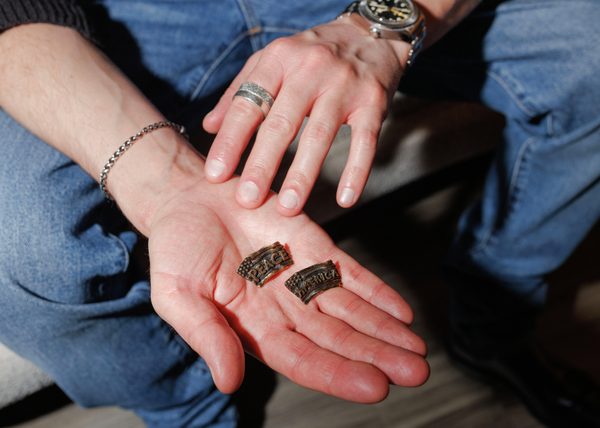
I first met Mills in December at an upscale cafe in West Hollywood, where he had traveled from his home in Washington, DC, to raise money for TAC. Slight, with sharp cheekbones and a coif of dyed black hair, Mills has a plasticky, TV-ready appearance, his wide-open shirt collars belying a somewhat stiff demeanor. I had invited the MAGA journalist-activist to lunch to try to understand what he and I, a Jewish writer on the anti-Zionist left, might have in common.
Quite a bit, it would seem. Mills says Israel’s assault on the Gaza Strip “has all of the hallmarks of a genocide,” though, given his center-right audience, he’s “far less likely to use the g-word” than a lefty. He admires New York City Mayor Zohran Mamdani’s answer, in a primary debate, to the question of where he would first travel if elected—“I would stay in New York City”—and he abhors the detention and attempted deportation of the pro-Palestine activist Mahmoud Khalil: “An immigration system based on someone’s political views is extremely dangerous.” In contrast to domestic policy, Mills concluded once our plates had been cleared, “foreign policy seems solvable. We could just not support the genocide in Gaza. We could just not invade Venezuela. Not killing people wantonly seems like a good place to start.”
I am not the first leftist to suspect that Mills might be someone I could talk to. Under his leadership, TAC has published the Israeli human rights activist Hagai El-Ad, the Palestinian journalist Daoud Kuttab, and the Palestinian American political analyst Abdelhalim Abdelrahman—helping these thinkers reach a MAGA readership, and embodying Ralph Nader’s 2014 observation of TAC in its early days that “The Nation magazine could easily carry many of its articles without skipping a paragraph.” Mills has appeared twice on the left-wing Know Your Enemy podcast as an enemy willing to analyze the shifting currents in his own coalition. He’s “quite genuine in his convictions about a certain kind of realist or isolationist foreign policy and the way that it has conflicted, often, with actual existing Trumpism,” Know Your Enemy co-host Sam Adler-Bell told me. Usefully, Mills also knows how to focus his message. “When he comes on the show, he isn’t shoehorning whatever his views are about race or immigration into a conversation about foreign policy,” Adler-Bell said, “though they may be lurking in the background.”
Mills may not lead with his views on immigration, but during the weeks I spent in conversation with him—weeks when ICE agents were occupying American cities, arresting people at mandatory immigration appointments, and snatching schoolchildren off the streets—I found them to be central to his thinking. “We’re letting too many people” become citizens, Mills tells me, saying he favors “pretty close to an immigration pause.” What most troubles him about the ICE raids in Minneapolis and elsewhere is that these headline-grabbing stunts “squander political capital” that the Trump administration will need to more smoothly carry out the millions of additional deportations he wants to see. Mills thinks the right would do well to internalize Hillary Clinton’s point, on a panel at the Munich Security Conference in February, that “more people were deported under [Bill Clinton] and Barack Obama, without killing American citizens and without putting children into detention camps.” Mills yearns for a return to the anti-immigration policies of the 1920s, which helped produce what he calls a “cohesive national culture.” “Too much diversity, unassimilated, will destabilize the American project, and already has,” he warns. And wasn’t the rise of Hitler, that “big bad guy we all talk about,” a result of too much diversity in the Austro-Hungarian Empire? It was moments like these, in my interviews with Mills, when I felt an unbridgeable gulf open up between us, and any impression that I’d been speaking with a fellow traveler, if not quite a comrade—a disorienting thought in itself—abruptly disappeared.
This anti-immigrant zeal betrays an uneasy fact: Mills’s corner of the right largely opposes war because of its tribal resentments, not despite them. Indeed, the America First movement Mills belongs to traces its lineage to Charles Lindbergh, the early 20th-century aviator turned activist who promoted antisemitic ideas in his effort to keep the US out of World War II, portraying American Jews as a foreign element within the country’s borders. In addition to Carlson and Greene, today’s universe of right-wing anti-Israel crusaders includes figures who would make Lindbergh squirm: Candace Owens, the podcaster who claims that “Jewish people were in control of the slave trade” (“your quarrel is not with white men,” she told her Black viewers) and that “Kabbalists” promote a “pedophile-centric religion,” among other libels; and perhaps most notoriously, the streamer Nick Fuentes, an open admirer of Hitler, who declares that “we are in a war” with a “Jewish fifth column” undermining the country from within. Fuentes broke into the political mainstream with an October 2025 appearance on Carlson’s show, where he told the host that “you cannot actually divorce Israel and the neocons, and all those things that you talk about, from Jewishness.”
“There are obviously antisemites on the right,” said Jacob Heilbrunn, the editor of the centrist magazine The National Interest, where Mills worked between 2017 and 2019. “I don’t think Curt is one of them.” Instead, the TAC editor is attempting to carve out an American nationalist opposition to Israel that rests on legitimate intellectual ground, focusing mainly on the country’s “inappropriate and dangerous” influence in US politics. Though Protestant by background, Mills identifies as secular, a rarity in a political scene where “Christ is king” is lobbed as an anti-Jewish taunt. And his rejection of concepts like “white genocide” puts him at odds with MAGA’s conspiracy-mongers. Fuentes “probably views someone like me as an irritant because I won’t just say ‘the Jews, the Jews, the Jews’ all the time,” Mills said. “And of course I don’t believe that.”
As Mills’s exchange with Abrams attests, the charge of antisemitism continues to be instrumentalized to discredit even the most reasonable Israel skeptics, on the right as well as on the left. Yet considering the blunt antisemitism pervading the anti-Israel right, an eye roll may not suffice as a response. In our conversations, Mills dismissed these uglier currents as evidence of a “post-literate society,” framing Fuentes in particular as a nihilistic “infotainer” rather than a political actor on the extreme-right end of the MAGA spectrum. “He revels in the theatricality and charisma of Hitler,” Mills said. “But what is his actual fucking proposal for the United States?” Mills conceded Fuentes’s sizable audience—the streamer commands up to 1 million views per episode on Rumble—but held that unless Fuentes ran for office or started a political organization, “I don’t think he is a significant danger in his current form.”
“The question is whether the advocates of Curt’s view will find themselves outflanked by people like Nick Fuentes.”
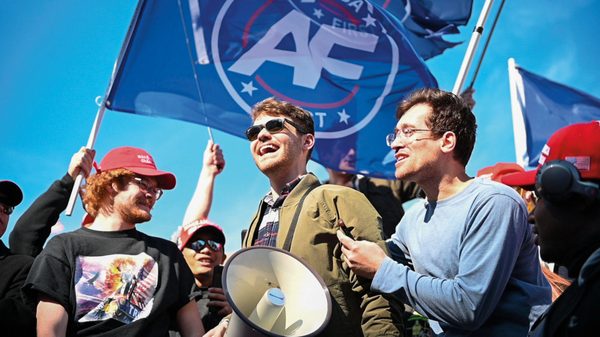
Nick Fuentes, the leader of an extremist, white nationalist group, speaks to his followers in Washington, DC, November 14th, 2020.
This conception of what counts as politics struck me as perplexingly narrow, especially coming from an extremely online millennial who prides himself on having supported Trump back when the entertainer was a political punchline. In fact, Fuentes’s online fever-swamp has already birthed one real life politician: James Fishback, a 31-year-old former hedge fund employee who, in his GOP primary campaign for governor of Florida, blends Groyper-style racism with a repudiation of pro-Israel lobbying reminiscent of Mills. When I asked him about Fishback, Mills cast the candidate as nothing more than “embodied internet vapor”; but Carlson, MAGA’s most important kingmaker outside of government, and a friend and mentor to Mills, has anointed that vapor “the future of the Republican party.” “You’ve got my vote,” the part-time Floridian told Fishback in a January interview. “The question,” Heilbrunn said, “is whether the advocates of Curt’s view will find themselves outflanked by people like Nick Fuentes.”
In a time of US-backed genocide and war—and amid the failure of left-wing efforts to stop the killing—it may be tempting to view the MAGA dissidents as potential allies for the left, if only on foreign policy, and if only temporarily. Yet their desire to stop foreign wars stems from the same “central concern” that motivates Christian nationalism at home, Ben Lorber, a senior researcher at the progressive think tank Political Research Associates who studies the far right, told me. “They’re trying to restore their vision of American honor and glory. Domestically, that looks like mass deportation; in foreign policy, it means pulling the US out of the Middle East to restore an American greatness subverted by Israel.” David Austin Walsh, the author of Taking America Back: The Conservative Movement and the Far Right, concurred, adding that “the heart” of MAGA anti-interventionism is anxiety about “‘aliens’ in the American body politic.”
Though he presents as more reasonable, Mills is still beholden to this way of thinking. To him, America is fundamentally “good”—a place where modern-day excretions of hate-mongering into the cultural bloodstream will be neutralized by some national immune system. If Mills is “steamrolled,” as Heilbrunn fears, by those who openly embrace tribal hatreds, it may ultimately be a predictable outcome, given how “America First” is not just a referendum on the wars we fund or fight, but also on who counts as an American.
When Mills was 13, a fire upended his young life. The house his family had planned to move into in the DC suburb of Oakton, Virginia, burned down while still under construction. Mills had already left his small Christian school and all of his friends behind in Maryland, and, after the family moved temporarily into an apartment near the Dulles airport, he struggled socially at his new public high school.
The year was 2003; the US had just begun the occupation of Iraq that would last into the next decade. In Mills’s telling, his experience of teenage alienation was inextricable from his budding political consciousness. “I very much didn’t like that we moved, and I very much didn’t like the direction of the country, and I very much didn’t like transitioning into adolescence,” he told me. He watched The McLaughlin Group—the roundtable debate show where Buchanan was a regular panelist—with his father, corporate litigator Laurin Mills, and soon discovered Buchanan’s magazine, then scarcely a year old. The American Conservative, with its everything’s-going-to-hell outlook, fit his mood. “It’s not exactly uplifting stuff that the magazine was founded on. But it was absolutely necessary and correct,” he told me. The following year, Mills devoured Buchanan’s latest book, Where the Right Went Wrong: How Neoconservatives Subverted the Reagan Revolution and Hijacked the Bush Presidency, which “really holds up,” he said. In it, Buchanan casts America as a virtuous republic that had lost its way through globalized trade and imperial expansion, and was now subject to a “foreign invasion” by the immigrants fast replacing the stagnant “native-born population.”
Throughout his teenage years, Mills—following Buchanan—laid the blame for this state of affairs at the feet of neoconservative intellectuals, whom he regarded as having a “spooky, gangster-like control of Republican thinking.” In college, he felt vindicated by “The Israel Lobby,” a 2006 London Review of Books article in which the political scientists John Mearsheimer and Stephen Walt argued that a “loose coalition of individuals and organizations,” like AIPAC and the Conference of Presidents of Major American Jewish Organizations, had successfully “steer[ed] US foreign policy in a pro-Israel direction”—and that the Iraq War, in particular, “was due in large part to the Lobby’s influence, especially that of the neo-conservatives within it.” When Mills took his first job in journalism at the Washington Examiner, he found himself sharing office space with the flagship neocon magazine The Weekly Standard; observing the editorial board’s “fanatical” opposition to President Obama’s 2015 nuclear deal with Iran, Mills told me, reinforced his impression of a “baby boomer default mode towards Israel.”
Throughout his teenage years, Mills—following Buchanan—laid the blame for American decline at the feet of neoconservative intellectuals, whom he regarded as having a “spooky, gangster-like control of Republican thinking.”

Curt Mills at home in Washington, DC.
Mills describes his father, Laurin, as one such “neoconservative by default.” “The guy reads the Wall Street Journal opinion page every morning, and every once in a while he’ll see his son mentioned as a very dangerous person,” Mills told me. He describes his father’s politics as archetypal of a Cold War Reaganism: “open markets, open borders, and the idea that any society that doesn’t look like the United States is the Evil Empire.” On Israel, too, Laurin Mills has conventional views: “Bibi is in a rough neighborhood, and he’s gotta do what he’s gotta do,” he told me when I reached him at his law practice. Though Laurin said he understands “why our involvement in the Middle East creates problems, I’m not going to criticize it like Curt does.”
The younger Mills doesn’t buy into Republican narratives of civilizational conflict or even the notion of “the West”—“I just don’t look at the Muslim world as inherently threatening; I don’t look at Russia as inherently threatening,” he told me—and he detests the “rough neighborhood” clichés his elders use to justify Israel’s actions. “Curt is part of a younger generation . . . fueled by a sense of grievance and resentment,” Heilbrunn said. Unsurprisingly, Mills is at his most engaging when attacking the party establishment, blending the anarchic energy of online discourse with a seriousness of purpose. “What we’re seeing right now is a baby boomer supernova,” Mills told me in the wake of Trump’s January bombing of Venezuela and capture of President Nicolás Maduro. “Cut taxes, don’t pay for any of them, invade countries randomly, own the libs, don’t think about anybody under 55.”
Even as Mills wages a fight for conservatism’s future, his ideas are a distinct throwback to those of Buchanan, now 87 and retired from public life. Marginalized as too extreme in the ’90s, the TAC co-founder’s views made a comeback with the rise of Trump (“Buchanan with better timing,” Politico called him). But TAC, by then, was less interested in right-wing revolution. Its most prominent columnist during Trump’s first term, Rod Dreher, was critical of the president, and the magazine as a whole evinced an elite anxiety over Trump’s character. In redrawing the editorial priorities, Mills dispensed with this concern for Washington pieties and, heeding advice from Carlson, went all in on the magazine’s traditional strength as an “America First” foreign policy rag. The new TAC “reopened to the anti-war left,” Mills told me, while at the same time radiating an open affection for MAGA that sometimes took the form of principled critiques of Trump. If the magazine had experienced “an unmooring of what it was really about,” said Kelley Vlahos, a former executive editor of TAC, now the editor-in-chief of the “transpartisan” restrainer magazine Responsible Statecraft, “Curt brought it back to its roots.”
Those roots lie in “paleoconservatism,” a term adopted in the ’80s by Buchanan and his set to explicitly oppose neoconservatism while signaling an affinity for a purportedly authentic, pre-Cold War right. The paleocons deplored the neocon project of exporting American-style democracy through expensive, often disastrous military interventions—in part because of their dim view of democracy, but mostly out of a conviction that foreign adventurism threatened America’s European-descended, English-speaking character. “There is a deliberately narrow vision of Americanness that is endemic in the paleoconservative world,” Walsh told me. “People who don’t fit in that category are maybe, in a legal sense, citizens, but are seen as less authentically American than others.” The neocons—originally a cohort of liberal New York intellectuals, most of them first-generation American Jews, who had shifted rightward—were the paleocons’ perfect foil; if not quite on the outside of authentic Americanness, they were nonetheless regarded as uniquely threatening to it.
In reality, neoconservatism was an idealistic “pursuit of American imperial power” that also attracted powerful non-Jews, Walsh said, but the movement “became so identified with Jewish conservatism” that it was treated almost as “an ethnic project.” Buchanan’s tendency to frame the neocons in Jewish terms is a case in point. In one much-criticized passage of Where the Right Went Wrong, he compares neocon strategist Richard Perle, a military adviser under President George W. Bush, to Fagin, the perfidious Jewish villain in Charles Dickens’s Oliver Twist—casting Perle as the foul influence behind the impressionable WASP politician. On The McLaughlin Group in 1990, with the Gulf War on the horizon, Buchanan said the “only two” groups “beating the drums for war” were the Israeli war ministry and “its amen corner” of Jewish war hawks in the US. He called Capitol Hill “Israeli-occupied territory,” a charge that Mills defends as “a true statement,” but which carries troubling echoes of the neo-Nazi epithet “Zionist Occupied Government.” Such analyses elided how US foreign policy was driven less by neoconservative doctrine than by “a brutally realist conception of national power,” commentator John Ganz writes in his book When the Clock Broke. As Walsh told me, “Buchanan is committed to this myth of American innocence, and therefore, it must be an alien faction that is the corrupting influence.”
Then as now, this perspective often put the leading figures of paleoconservatism just a step or two removed from avowed white nationalists and antisemites. A TAC co-founder, the Greek shipping heir Taki Theodoracopulos, hired white nationalist Richard Spencer to edit his far-right Taki’s Magazine after TAC itself fired Spencer for being “a bit extreme for us.” Theodoracopulos, infamous as a floridly racist society columnist, wrote in his own outlet in support of the Greek neo-Nazi party Golden Dawn and published Gavin McInnes announcing the creation of his extremist group the Proud Boys; this year, Mills incorporated what remains of Taki’s Magazine into TAC, publishing a weekly column by Theodoracopulos that blends breezy racism and antisemitism with anti-war commentary. The pattern goes back to Lindbergh, who in 1938 accepted an award from Hermann Göring, the highest-ranking Nazi official after Hitler, before serving as spokesperson for the popular, isolationist America First Committee. In an infamous 1941 speech in Des Moines, the aviator identified “the Jewish race” as one of the “three groups,” alongside the Roosevelt administration and the British, agitating for war with Germany. “Their greatest danger to this country lies in their large ownership and influence in our motion pictures, our press, our radio, and our government,” Lindbergh said of American Jews. In our conversations about this speech, Mills was skeptical of the consensus view that Lindbergh was an antisemite, and conceded only that Lindbergh’s language was not what he himself would have used. “There was a sense of [Jewish] ethnonationalist interest, and a critique of that,” he said, identifying Lindbergh’s message as akin to Walt and Mearsheimer’s. When I pressed him on the “greatest danger” line, which grossly inflates American Jews’ degree of organization and influence at the time, Mills posited that President Franklin Roosevelt’s cabinet was “probably disproportionately Jewish.” Asked why he ascribed so much importance to ethnic identity, Mills offered one of his signature deflections: “I don’t write for the magazine called Jewish Currents.”
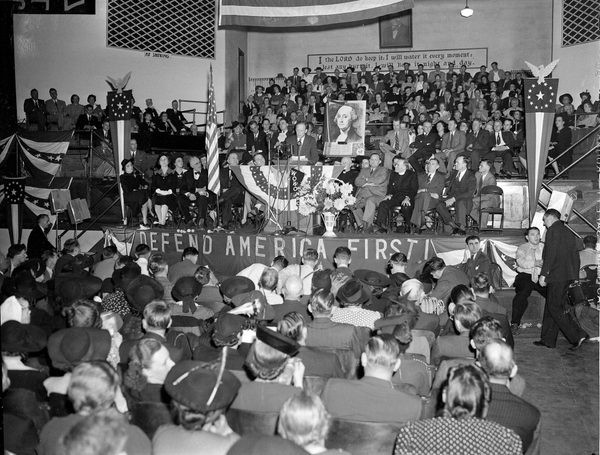
Charles Lindbergh speaking at an America First Committee rally, circa 1941.
While downplaying Lindbergh’s antisemitism, Mills is similarly cavalier about the antisemitism embedded in today’s right-wing thought, and often unwilling to name it as such. When I asked him about his own description of the neocons as having “dual loyalties” to the US and Israel, he quipped, “The joke would be that dual loyalty would be an improvement.” (I laughed, despite myself.) Asked about the “great replacement,” a conspiracy theory popular on the America First right that blames Jews for intentionally orchestrating an immigration wave to “replace” white Americans, Mills insisted that the theory’s adherents—most of whom likely “have never met a Jewish person”—are talking about “Ivy League elitists,” not Jews. Carlson himself has for years been the country’s leading promoter of “great replacement” thinking, portraying the behind-the-scenes puppet masters as vaguely defined elites. Mills flatly rejects that this amounts to an antisemitic dog whistle, repackaging his friend’s framing as garden-variety economic populism: The pursuit of cheap immigrant labor at the expense of working-class Americans “was an actual conscious policy choice by elites.” Less equivocating were the neo-Nazis at the 2017 rally in Charlottesville who chanted “Jews will not replace us,” or the shooter in the 2018 Tree of Life synagogue massacre, who cited fears of refugees “that kill our people”; Mills dismissed these figures as “fringe.”
If Mills has blindspots, it is likely because his worldview is shot through with nostalgia for early America, a place whose “founding ethnic contingent” was—not coincidentally, he believes—white, Anglo-Saxon, and Protestant. If he could, he would turn back the clock to the 19th or early 20th century. “There was such a thing as the old republic,” he said. “Yes, women weren’t fully enfranchised. Yes, there was slavery. Caveat, caveat, caveat.” But for a selection of people, “the United States actually did have real freedom and real democracy in a much more profound way, 100 to 150 years ago. The social tapestry that wove the country together, I think there’s a lot to be said for it in that period.” And now? “We are a country that is increasingly separated by language and background,” Mills said. He worries that without a “managed” transition to an inevitable white minority, the country will become a “balkanized ethnic economic zone” in which “nobody talks to each other, nobody believes in the founding ideals.” Mills clarifies that he isn’t advocating for “racial hierarchy” as an organizing principle; at the same time, he rejects the notion “that everybody who thinks these [founding] ideas has the right to be an American.”
“Yes, women weren’t fully enfranchised. Yes, there was slavery. Caveat, caveat, caveat.” But for a selection of people, “the United States actually did have real freedom 100 to 150 years ago.”
In August 2025, Mills’s TAC published Scott Greer—a frequent contributor who once wrote pseudonymously for a white supremacist outlet—on the online term “heritage American,” which, Greer explained, is “more palatable to the public than ‘white,’” and which “offers bright young people a compelling right-wing framework to champion immigration restriction, hostility to DEI, and genuine patriotism.” “I qualify [as a heritage American], as far as I’m aware,” Mills told me, descended on his father’s side from Scots-Irish “poor hill people” whose earliest American foremother dates back to the 1600s; “the most ‘ethnic,’ so to speak, that we get is the German side” through his mother. At our December lunch and in follow-up phone calls, Mills brushed off this “heritage American” frame as “less a preoccupation for me” than for Greer, describing himself as “bored by tribalism.” But it was hard to miss his close attunement to ethnic and religious demographics. “I think it’s notable, the disappearance of relevance of a lot of people with my background,” Mills mused in a January phone interview. “Within media and political circles—not the politicians, but the staffers and journalists—it’s almost always Catholics and Jews.” As if remembering the Jew in media on the other end of the line, Mills assured me, “I think you and I are equally American.” That it needed to be said at all somewhat undercut its intended effect.
On February 28th, American warplanes joined with Israeli ones in a fresh attack on Iran, killing Supreme Leader Ali Khamenei, as well as hundreds of civilians within the first few days, and setting the stage for a drawn-out war. Waking up to the news in DC, Mills told me by text that he felt “crestfallen and disgusted.” He spent that Saturday coordinating with his staff, giving comments to the media, and obsessively watching the Al Jazeera live feed. Though the attack was not entirely unexpected—for weeks, Mills had a dual time zone watch set to Iran time—this “betrayal of America First and MAGA” still shook him. “I really do have the felt sense, waking up today, February 28th, that my life has really changed,” he told me. The moment had an “accelerationist element,” in which “the contradictions of the right will be brought to the fore.” That translated to a renewed sense of mission: “I hate to say it, but it’s good for business.”
In many ways, the situation is familiar to a magazine like Jewish Currents, or to the anti-Zionist left as a whole. “Our movement is still the way of the future,” Mills told me in late January, after the US invasion of Venezuela—a line that could have been uttered by any pro-Palestine organizer in response to the innumerable setbacks of the past two years. One key difference is that, while President Biden was a creature of the political establishment, ignoring the seismic shift in opinion among his party’s own voters, Trump is Mills’s man, the product of an outsider movement built on Buchanan’s anti-war ideas.
This proximity to power only heightens the MAGA restrainers’ feeling of betrayal. “There was a lot of optimism in January 2025,” Vlahos told me. Members of the ideologically diverse anti-interventionist movement were cheered to see the realist policy wonk Elbridge Colby appointed as a top official at the Pentagon and the heterodox former congresswoman Tulsi Gabbard named as director of national intelligence—moves that contributed to “a sense that, despite some of these more concerning nominees, like Marco Rubio, at least our community of realists and restrainers had a toehold in this new administration,” Vlahos said. But lately, in light of Venezuela and Iran, Trump 2.0 has begun to feel like an even bigger disappointment than the first term, when the US withdrew from the Iran nuclear deal. Mills attributes this, in large part, to Trump’s developing “a greater self-regard even than he had before” and embracing more fully the “neocon talking point” that MAGA is whatever he says it is. “What’s astonishing is the degree to which the administration doesn’t need to marshal support for this war,” Mills said on the Iran war’s first day. With only 27% of Americans approving of the strikes in their immediate aftermath, according to a Reuters/Ipsos poll, Mills described the situation as “a collapse of all processes of a deliberative society.”
“There was a lot of optimism in January 2025,” Vlahos told me. But lately, in light of Venezuela and Iran, Trump 2.0 has begun to feel like an even bigger disappointment than the first term.

An American fighter jet launches from the USS Abraham Lincoln aircraft carrier during the Iran war, February 28th, 2026.
Mills has previously made common cause with members of the anti-war left, including Keane Bhatt, the policy director for the Congressional Progressive Caucus, and think tanks like the left-leaning Just Foreign Policy and the ideologically mixed Quincy Institute, which publishes Responsible Statecraft and was initially funded by both George Soros and Charles Koch. Their common enemy is what former Obama adviser Ben Rhodes has termed “the Blob.” “In both parties, there is a foreign policy cartel—a set of old wise people and their protégés who, no matter how much they fail, consistently seem to rotate back into government and move up the ladder,” said Matt Duss, executive vice president of the progressive think tank Center for International Policy. A former foreign policy adviser for Senator Bernie Sanders, Duss worked on the 2018 joint resolution introduced by Sanders and two colleagues—including Republican Senator Mike Lee, a Trump ally—to end the US role in the civil war in Yemen (Trump ultimately vetoed the measure after Congress passed it). More recently, Representative Marjorie Taylor Greene’s unsuccessful effort to block missile-defense funding for Israel garnered support from progressive Democrats including Representatives Ilhan Omar and Rashida Tlaib. “The left is often accused of purity politics, and sometimes that’s valid,” Duss told me, but foreign policy “is an area where the left is absolutely not doing that.”
Duss views Mills as an ally in the fight to “end the era of neoliberal, neoconservative interventionism.” “Given where he’s coming from, we may have disagreements about the kind of America we both want to build. But there is a shared goal of redefining American foreign policy,” he said. The neoconservative Tikvah Fund—of which Elliott Abrams is chairman, and which recently received a $10.4 million grant from the Trump administration—has taken note of this political shift, warning in a December video of an “improbable Tucker Carlson–AOC alliance against American civilization.”
The Iran war has only intensified this sense of a left-right convergence. Three days in, Secretary of State Rubio told reporters that the administration’s calculus included the knowledge “that there was going to be an Israeli action” against Iran, suggesting that the Israelis had drawn the US into battle, and providing grim vindication for Mills’s thesis that “we got here . . . at the behest” of Israel. As he trashed Trumpworld hawks like Defense Secretary Pete Hegseth (“Crystal Meth Rumsfeld”) in the war’s first weeks, Mills’s acerbic critiques were not out of step with the warnings of Democratic lawmakers, who were themselves becoming bolder about identifying an outsize Israeli national interest. “The simplest explanation might be . . . that Israel made us do it,” Senator Chris Murphy said on MS NOW.
In reality, such alliances may still be messier and more fleeting than this rhetorical convergence suggests. A major reason is that, as the understanding of Israeli influence in US warmaking has gone mainstream, MAGA’s most prominent anti-Israel voices are moving deeper into conspiracy-mongering. In the first week of the war, Carlson spun a theory that Chabadniks, alongside Christian Zionists, were subtly fomenting a “religious war” that aimed to erect the Third Temple. Meanwhile, in a campaign-style monologue on his show, America First, Fuentes sought to galvanize a broad coalition of “goyim”—“left and right, Republican, Democrat, Christian, Muslim, white, Black, men, women”—to liberate the US from a “hostile occupation” by the “alien force” of “organized Jewry.” Even Joe Kent, the counterterrorism official who resigned from the Trump administration in March in protest of the Iran war, overstepped the historical evidence when he blamed Israel for the war in Iraq and said it “manufactured” the war in Syria, where his wife was killed in action—suggesting a Lindberghian tendency to downplay the US government’s own motives in foreign warmaking. “I desperately want it to be the case that these young conservatives, newly disgusted and outraged by Israel’s behavior—certainly absorbing sources that I would not endorse—could actually have an effect on reshaping our policy,” Know Your Enemy’s Sam Adler-Bell told me. But he is frustrated by the way the MAGA rebels resist “making themselves into more suitable ad hoc allies in a moment of existential crisis” for the Middle East. “It drives me crazy that somebody like Curt won’t just say, ‘Well, Charles Lindbergh was a Nazi, and I don’t like him,’” he said.
More distressing for the present moment, Mills won’t use that term for Fuentes, either, even as he concedes that the streamer “obviously has genuine hatreds.” “If I just got up there and made the crude [comment], like, ‘This is a Nazi,’ it would imply this specter that I think is really not there,” Mills said. Which makes a kind of sense: As long as the specter’s not there, it can’t haunt him.

I’m Peter Beinart, editor-at-large of Jewish Currents. Before you go, I need to ask something of you.
In recent years, I’ve watched as mainstream Jewish institutions and media have chosen ethnonationalism over liberal democracy and mass slaughter over the pursuit of a just peace. Jewish Currents offers something different. It’s a magazine built on intellectual curiosity and respect for the dignity of all people.
But a project like this doesn’t sustain itself, and we can’t do it without your help. If you share my belief in the importance of this mission, please consider making a donation—or even better, a recurring one. We need you with us.

Will Alden is a writer living in Los Angeles. Their work has appeared in Jewish Currents, The Nation, The New York Times, BuzzFeed News, The Iowa Review, and elsewhere. They have been a recipient of the Larry Birger Young Business Journalist prize and a finalist for the Nonprofit News Awards.