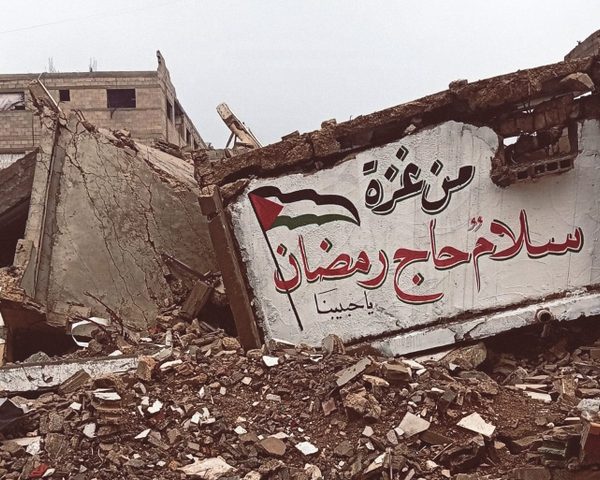
“Education Cannot Wait”
Gaza’s decimated universities are trying to build an improvised academic life under siege.
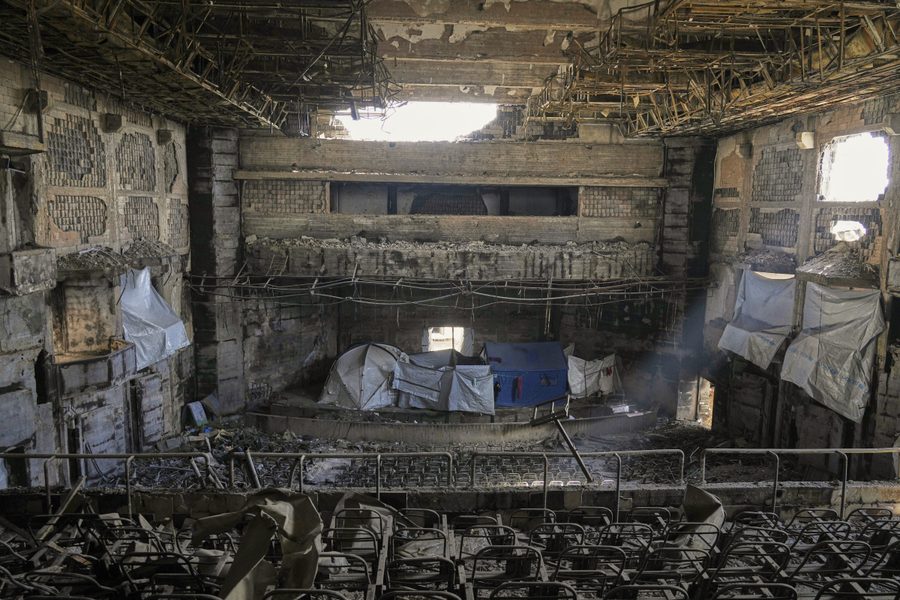
Tents for displaced Palestinians are set up in the auditorium of the Islamic University of Gaza, April 5th, 2025.
On November 29th, 2025, the Islamic University of Gaza (IUG)—one of the largest and most prominent academic institutions in Palestine—resumed in-person classes for the first time since October 7th. “Today is a historic day,” the university president, Asaad Yousef Asaad said in a video message that morning. “We are returning to education despite the tragedy and cruelty left behind by the genocide.” The university later posted videos of hundreds of students walking through shattered gates on that first morning. “Some classrooms still have broken windows and cracked walls,” Aya, a first-year medical student who requested her full name not be used for safety reasons, told Jewish Currents. Still, she added, “we sit close together, trying to study medicine in a space that sometimes feels more like a shelter than a university.”
Before Israel’s ferocious assault on Gaza, widely understood as a genocide, the IUG was a major academic hub—serving approximately 17,000 students across eleven faculties and three campuses, including the largest academic library in Gaza, advanced laboratories, research centers, and a business and technology incubator. It was a central node in a higher education sector that consisted of an additional 16 accredited public, private, governmental, and United Nations-affiliated institutions serving nearly 90,000 students.
Starting October 2023, Israel brought this system to an abrupt halt. What followed was the erasure of an entire academic ecosystem. The Israeli army killed students, professors, researchers, and university administrators. Among the dead were three university presidents, including Sufyan Tayeh, president of the IUG, who was killed in December 2023 along with his family when his home in northern Gaza was bombed. Israeli airstrikes also destroyed campuses, archives, research centers and laboratories. According to official figures, virtually all of Gaza’s universities and colleges were completely leveled, while others sustained partial damage. According to the Gaza Government Media Office, losses to the education sector exceeded $4 billion.
Human rights watchers have argued that educational institutions didn’t just suffer collateral damage: They were an explicit target. “These attacks are not isolated incidents. They present a systematic pattern of violence aimed at dismantling the very foundation of Palestinian society,” a panel of UN experts wrote in early 2024, after universities were struck repeatedly despite surrounding neighborhoods already being razed. In some cases, entire faculties were wiped out; in others, buildings remained standing but unusable—gutted, burned, or structurally unsafe. Al-Azhar University, for instance, endured repeated bombardment throughout late 2023. Satellite images revealed the near-total destruction of key buildings, including faculties of science and agriculture. Similarly, on January 17th, 2024, Israeli forces released a video showing an explosion at the campus of Al-Israa University in Gaza City after the area had already fallen under military control. The once-green campus of the IUG—one of the most architecturally distinguished in Palestine, and a winner of awards for sustainability and design—was also decimated: More than 80% of its buildings and assets now lie in ruins.
Despite the scale of destruction, universities like IUG quickly took steps to resume educational activity, starting with restoring institutional servers and academic databases in order to enable online learning. The university also worked to establish new research collaborations and academic partnerships with European universities so as to offer additional support to students and staff. Additionally, an Emergency Committee of Universities in Gaza was formed to mobilize international support and ensure continuity of teaching. “The Emergency Committee reflects the collective voice and determination of Gaza’s universities,” Ahmed Abu Shaban, a dean at Al‑Azhar University, said in a speech accepting a prize for the committee’s work. “Its work underscores the urgency of safeguarding academic freedom and sustaining academic life.”
Since August 2024, these structures have enabled thousands of students at the IUG to complete four academic semesters online. “At times we risked our lives to log in,” Dania, a third-year translation student who requested that only her first name be used, told me. “I remember walking long distances just to find a signal so I wouldn’t miss a class.” According to the Workers’ Union of the IUG, more than 350 faculty members worked to make this learning possible. One lecturer, who requested anonymity for fear of retaliation, described teaching “while searching for water, while grieving, while being bombed.” “That struggle became an act of resistance,” said Asil, another third-year translation student who also requested partial anonymity. “Education was our weapon; it gave us strength when everything else was falling apart.”
After the ceasefire in late 2025, efforts shifted to restoring in-person learning. In the months that have followed, students have been distributed across partially restored campuses, temporary halls in central Gaza, and newly prepared locations in the south. The initial return has prioritized faculties that cannot function remotely—medicine, health sciences, and engineering—as well as disciplines requiring laboratories, equipment, and clinical training. “Medicine is practical, and we strive to attend classes physically,” Malak Al-Moqayyad, a medical student, told the Anadolu Agency. Other students’ return has been more gradual, retaining hybrid options alongside in-person classes.
At the IUG, this effort has targeted the few structures that remain standing. So far, only two buildings, renamed Irada (Will) and Palestine, have been partially rehabilitated. Beyond the problem of infrastructure, the return to in-person education is further complicated by widespread displacement, including families that are still sheltering in university buildings. “I come from Deir al-Balah,” Farah Abu Abed, a fifth-year architecture student, told Jewish Currents. Her home in Khan Younis was destroyed in December 2023, and she now travels two and a half or three hours to attend class. “The commute is exhausting,” she said, “but I refuse to give up. I want to help rebuild Gaza.”
Ultimately, students and faculty say that these efforts add up not to a return to the pre-genocide status quo, but rather the creation of a fragile, improvised academic life under siege. “This is not a return to normal,” said Aya, the medical student. Speaking to Aljazeera, Ahmad Abu Foul, a civil engineering lecturer at the IUG, expressed a similar sentiment. “We are doing our best to keep the academic continuity alive even as infrastructure and daily life crumble around us,” he said. The situation is “not sustainable,” Bassam Al-Saqqa, vice president for academic affairs at IUG, admitted to me, “but education cannot wait.”

I’m Arielle Angel, editor-at-large of Jewish Currents. Before you go, there’s something I need to ask.
We’ve seen over and over how the mainstream media falters in telling stories on our beats—whether it’s antisemitism, Israel/Palestine in American politics, Jewish identity, or the American left. At Jewish Currents we’re committed to uncompromising analysis and longform reporting on these issues and more—stories you won’t find anywhere else. In a media landscape that obscures injustice and flattens discussion, we’re changing the conversation. But we need you.
If you believe in this work, please consider making a donation—or even better, a recurring one—to ensure that we are able to keep publishing stories like this one. We can’t do it without you.

Taqwa Ahmed Al-Wawi is a Palestinian writer, poet, and editor from Gaza, currently completing a BA in English literature at the Islamic University of Gaza. Her work amplifies Gaza’s voice and has been featured in leading international platforms.