The Meaning of Trump’s $10 Million Grant to a Jewish Nonprofit
The administration is boosting an older, neoconservative politics even as US–Israel relations are increasingly contested on the right.
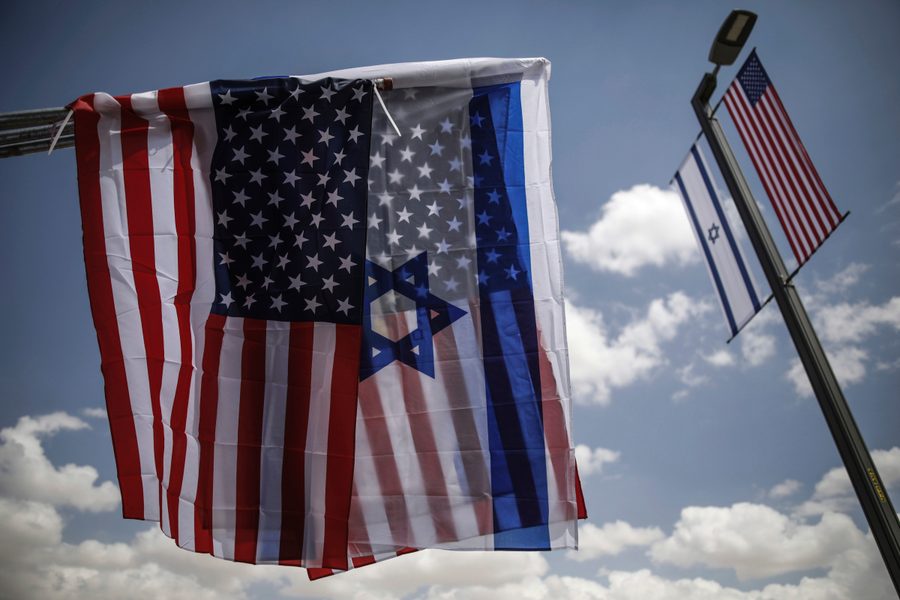
US and Israeli flags are placed on the road to the new US embassy in Jerusalem, 2018.
When the National Endowment for the Humanities (NEH) announced on September 15th it was awarding the Tikvah Fund a sum of $10.4 million, the largest grant in the agency’s history, to “combat the recrudescence and normalization of anti-Semitism in American society,” there was an audible groan from many Jewish studies scholars. Coming on the heels of the NEH’s decision last April to cancel over 1,000 grant projects—including, as The Forward reported last spring, multiple awards to Jewish studies scholars and Jewish institutions, with resources for Yiddish language and culture taking a particularly hard hit—the award to Tikvah is particularly notable. As Sam Brody, a professor of religion at the University of Kansas, lamented on Bluesky, “Every Jewish Studies colleague I know who had an NEH grant saw their funding cut earlier this year. Now we know where the money went.”
It’s not surprising that Trump’s NEH would turn away from the breadth of contemporary Jewish studies scholarship and toward the ideologically aligned Tikvah Fund. Founded in 1992 by the financier Zalman Bernstein to support educational projects that comport with its conservative Zionist worldview, the Tikvah Fund is rooted in a belief in the inseparability of American and Israeli interests, the righteous necessity of imperial power, and American exceptionalism, which it traces at least in part to the centrality of Jews to the American story. To promote these ideas, Tikvah has historically bankrolled educational programs and fellowships for students, educators, and professionals. Tikvah has also long supported conservative Jewish media, from Commentary to its in-house publication, Mosaic, as well as a podcast series. More recently, Tikvah launched Emet Classical Academy, a private school for fifth to twelfth graders located on the Upper East Side of Manhattan. Billed as “America’s First Classical Jewish Prep School,” where students combine the study of Greek, Latin, and assorted “great books” with Hebrew and Judaic studies, Emet avows commitment to “the perpetuation of Jewish, Zionist, and American exceptionalism.”
Tikvah’s commitment to Western civilization and American exceptionalism mirrors the NEH’s new statement of priorities. The agency announced in April 2025 that it would no longer fund projects that “promote extreme ideologies based on race or gender” and instead would award projects that “instill an understanding of the founding principles and ideals that make America an exceptional country.” Tikvah was reportedly invited to apply for the grant by an unnamed official within the NEH, and the funding, according to the press release, will support programs that explore “the influence of Hebraic ideas on Western and American civilization” and the “development of university courses in Jewish humanities, to be offered in partnership with new Western Civilization BA programs.” Taken as a whole, the grant attempts to shore up the beleaguered concept of the “Judeo-Christian,” instilling the dangerous idea that antisemitism is best combatted by leaning upon supposed bonds of civilizational kinship.
This logic—which maintains that antisemitism is wrong because Jews are part of the West, not because it violates the principles of equality upon which this republic is founded—is coherent for a regime that regularly violates the law and fetishizes European ancestry, but for American Jews, the irony is palpable. To the extent that the United States has provided them with an exceptional level of security and freedom, it is on account of the liberal principles that Tikvah not only regards as inapplicable to the land of Israel, but increasingly rejects at home. It is worth recalling that the Tikvah-funded Kohelet Policy Forum (led by Tikvah board member Moshe Koppel) was the leading force behind the Netanyahu’s government so-called judicial reform efforts in 2023. An attempt to undermine the independence of Israel’s judiciary, the reforms represented the culmination of a decades-long assault on the principle of equality before the law. Meanwhile in the US, Tikvah has been cheering the Trump administration’s assault on academic freedom, advocating in Mosaic for the use of financial and legal penalties to bring universities to heel—and celebrating their capitulation.
Accordingly, it is possible that there is little to see in the NEH Tikvah grant beyond an administration rewarding a particularly loyal friend with the spoils of public funds, much in the same way that it has inked new defense contracts with Palantir and Anduril. But viewed against the rise of a new generation of America Firsters, Israel skeptics, and antisemites within the MAGA coalition, the decision to single out Tikvah as the recipient of government largesse appears more consequential, given that Tikvah represents an older model of neoconservative Jewish politics in which American imperial power advances shared US-Israeli interests. Seen in this context, the Tikvah grant represents an attempt not just to defund various “woke” academic projects, but to reinscribe Jews in a narrative of American identity and empire that appears increasingly dubious to a new generation of right-wing thinkers and activists, many of whom have coalesced under the National Conservatism movement and its model of ethnonational, rather than imperial, governance. Beyond a pragmatic move to keep a motley crew of coalition partners within the Trumpian fold, the grant suggests an attempt to return the genie of right-wing antisemitism to the bottle after years of railing against globalists engineering the “great replacement.” To ask “Why Tikvah and why now?” helps uncover an emerging fault line within the conservative world over the future of Zionism and the nature of Jewish belonging.
Most observers of the American right, asked to point to the most dynamic institutions in the movement today, would point not to Tikvah but to National Conservatism—though the two do have overlapping lineages. The National Conservatism movement is organized under the umbrella of the Edmund Burke Foundation, established by the American Israeli political philosopher Yoram Hazony, whose previous ventures include the Tikvah-funded Shalem Center (now College). NatCon, as it is known, has labored to erect an intellectual scaffolding around various forms of right-wing agitation by articulating a political vision that places the ethnonational community at its core. Central to this project is the rejection of liberal principles related to equality and individual rights in favor of a nationalist brand of “collective freedom,” which is equally attentive to enemies without and traitors within. The movement’s key enemies are not just the “woke neo-Marxists” (per Hazony’s characterization) who supposedly control the Democratic Party, but the United Nations, European Union, International Criminal Court, and any other international body that claims the right to police the behavior of sovereign states.
At first glance there may not appear to be much daylight between Tikvah’s orientation and that of National Conservatism. Hazony is also an ardent Zionist who has long argued that the Western political tradition is deeply rooted in the Hebrew Bible. As Elisha Kelman has recently written, Hazony claims it is not Locke or Rousseau but “a little-known seventeenth-century Christian Talmudist and constitutional scholar named John Selden [who] is the true intellectual godfather of the American founding.” This view is wholly consonant with the Tikvah Fund’s ideological project, and indeed, one can still study “The Meaning of Jewish Nationalism” with Hazony via lectures he recorded for Tikvah several years ago.
But beyond a shared view of the Western political tradition’s indebtedness to Jewish sources, subtle but important differences abound between Tikvah and National Conservatism. Tikvah upholds a significantly older party line. Within its protected walls, neoconservatives who have otherwise fallen out of favor on the American right can still agitate for war with Iran and conflate American and Israeli interests. Tikvah’s current chairman, Elliott Abrams, is infamous for his role in the Reagan government’s Iran-Contra scandal and his support for the 2003 invasion of Iraq, during which time he served as the National Security Council’s senior director for Near East and North African affairs. He is also the son-in-law of Norman Podhoretz, legendary editor-in-chief emeritus of that most neoconservative of outlets, Commentary. It is hard to envision a more representative figure of what Donald Trump called “the so-called nation-builders” and “neocons’” who “wrecked far more nations than they built.” (Despite this ideological bluster, President Trump’s decision to bomb Iranian nuclear facilities last June signals that the neocons still have friends in high places.)
For his part, Hazony rejects the neocon project of “spreading democracy” and reshaping the world in the American image. Key to his position is the argument that nationalism and imperialism represent competing political models, with the Greco-Roman tradition serving as a forerunner to the globalist attempt to forge a monoculture—the antithesis of the independent nation-states Hazony claims can be found in the Hebrew Bible. Tikvah, on the other hand, asserts that harmony reigns between Athens and Jerusalem. Jewish nationalism and American empire are understood in terms that are complementary rather than mutually exclusive. While Zionism remains the fund’s most sturdy ideological commitment, Tikvah does not imply that all Jews belong in Israel. Rather, its leadership is committed to American Jewish life as the great facilitator of the Zionist fever dream. In this, it echoes the position of twentieth-century liberal Jews for whom Zionism was crucially important—but for other Jews.
Here we arrive at the most substantive point of disagreement between the two approaches to right-wing Jewish politics: Where, precisely, do Jews belong in a modern political order organized around the nation-state? Though Hazony stops short, at least in his public remarks, of condemning diasporic Jews, everything about his political thought suggests that they are in the wrong place, both physically and spiritually detached from their “real” national home. In particular, he rejects the premise of “credal nations” built around a shared commitment to certain principles rather than ethnic belonging—in other words, the very arrangement that has allowed American Jews to flourish. When J.D. Vance argued that the US is not an idea, but rather a nation bound together by blood, he was merely echoing Hazony’s core theory.
Another point of tension stems from Hazony’s claim that America’s founding fathers made a mistake in following Thomas Jefferson’s doctrine of separation of church and state, as reflected in the First Amendment’s Establishment Clause. Echoing the post-liberal thought of Catholic integralists like Patrick Deneen, Hazony contends that the experience of liberal individualism—each person pursuing their own ends and deciding their own truths—has led to the decay of traditional moral values, particularly the respect for hierarchy and order. The state must therefore forcefully intervene to right the ship by actively cultivating religious virtue among its fallen people. As he writes in Conservatism: A Rediscovery: “In America and other traditionally Christian countries, Christianity should be the basis for public life and strongly reflected in government and other institutions, wherever a majority of the public so desires. Provisions should be made for Jews and other minorities to ensure that their particular traditions and way of life are not encumbered.” In a footnote to the book, Hazony writes that the conservative intellectual Irving Kristol once told him in private conversation that “only Christians should be able to vote in a Christian majority nation such as America; and that, by the same principle, only Jews should be able to vote in Israel. If someone wanted to be recognized as a member of a certain political community, they should adopt the public religion of the majority.” This idea is presented without comment.
It is these aspects of National Conservatism that most trouble the Tikvah intellectuals. Meir Soloveichik, a rabbi who is chief-of-staff for Tikvah Ideas, the organization’s media wing, wrote a critical review of Hazony’s The Virtue of Nationalism for Commentary in 2018, notably titled “Saving American Nationalism from the Nationalists.” More recently, Elliott Abrams expressed his discomfort with Hazony’s views in an interview with Kelman, stating that National Conservatism “doesn’t exist in the Jewish world, except as a danger.” He continued, “It reeks of tolerance,” echoing “a kind of antisemitism that is really a return to toleration, in a sense that Jews do a lot of good things, they’re not really Americans.” Abrams was particularly disdainful of “the apparent supposition that America is a Christian country and the government should reflect that.”
Taken to its logical conclusions, National Conservatism not only represents a threat to Jews and other minorities in the United States, but to American support for Zionism as well. For every Oren Cass forcing himself into contortions to defend the “special relationship,” there is a Tucker Carlson wondering why successive US administrations have acquiesced to Israel’s most destructive impulses. (Mosaic’s response: “Tucker Carlson’s Obsession with Jews Reflects a Hostility to America.”) Given the centrality of Zionism to Hazony’s political vision, it is not surprising that earlier National Conservatism conferences largely toed the conventional Republican Party line regarding US-Israel relations. Over the last two years, however, conservative advocates of foreign policy restraint and America First intellectuals have increasingly contested the United States’ deferential relationship toward its “vassal state” (in the words of Steve Bannon). This growing rift was on full display at the recent NatCon conference in Washington, DC, in a debate over the recent Iran–Israel “war” between political scientist Max Abrahms and Curt Mills of The American Conservative. Mills characterized the US-Israel relationship as “perhaps the world-historical case of the tail wagging the dog,” further adding: “Why are these wars our wars? Why are Israel’s endless problems America’s liabilities? . . . In the national conservative bloc, broadly speaking, why do we laugh out of the room this argument when it’s advanced by Volodymyr Zelensky but are slavish hypocrites for Benjamin Netanyahu? Why should we accept America First—asterisk Israel?”
It is within the context of such advocacy for the uncoupling of American and Israeli interests, and not just growing popular support for the Palestinian cause in the United States, that one should understand Benjamin Netanyahu’s recent statement that “We will increasingly need to adapt to an economy with autarkic characteristics.” Though he still claims to believe in the free market, the prime minister cautioned that “we may find ourselves in a situation where our arms industries are blocked.” The only path forward, he stressed, is “to develop arms industries here— not only research and development, but also the ability to produce what we need”—liberating the state from the vagaries of American politics. For neocons like Abrams, for whom the righteous symbiosis between American and Israeli interests is an article of faith, this possible rupture is precisely what Tikvah must guard against.
Even Hazony, meanwhile, seems anxious about the noxious undercurrents he has helped unleash—in short, that many people on the American right have taken his ethnonationalist ideas too seriously. Most of his opening address at the Washington conference was dedicated to the emerging cracks in the NatCon community, driven in his eyes by conservatives who “used to think that Jews and Christians should be allied to save America, and now they think that, actually . . . they think Jews are a big problem.” His tone was muted, the jubilant energy seen in his prior NatCon addresses nowhere to be found. While acknowledging the need for dialogue and disagreement about Christian–Jewish relations and the role of Israel, he also reminded attendees of the vital need to keep various parts of the coalition intact. “This coalition is broad enough to be able to win the next election, and the next one, and the next one,” but it will crumble if certain members (presumably Jews) are driven out or dishonored. Still, as he told the audience by way of consolation, “Nobody ever said that to be a good NatCon you have to love Israel. Nobody ever said to be a good NatCon you had to love Jews.” Seen in this light, perhaps the Tikvah grant can also be understood as a salve for the antisemitism mainstreamed by the American right—one side of the MAGA coalition cleaning up the mess made by its purported partner. Though the NEH’s acting chairman, Michael McDonald, predictably pointed to “the sinister and hate-filled attacks on Jewish people that we have been witnessing on American campuses” as justification for the grant, rhetorically linking antisemitism to the left, Hazony’s remarks point to growing concern about the discourse authorized by the populist right.
As for Tikvah, the NatCon vision presents a distinctive threat precisely because it is more ideologically coherent: If Israel is the Jewish national home, that’s where Jews should live, and there is no good reason for the United States to get involved in Israel’s wars. Tikvah’s leadership, on the other hand, understands that the material reality of Zionism has always depended on a loyal cadre of diaspora activists, however at odds diaspora may be with the ideological claim that a genuine Jewish life can be lived only in Eretz Yisrael. It is but one of many contradictions that sits at the heart of the Tikvah project, and that not even $10.4 million in government funding will be enough to resolve.

I’m Peter Beinart, editor-at-large of Jewish Currents. Before you go, I need to ask something of you.
In recent years, I’ve watched as mainstream Jewish institutions and media have chosen ethnonationalism over liberal democracy and mass slaughter over the pursuit of a just peace. Jewish Currents offers something different. It’s a magazine built on intellectual curiosity and respect for the dignity of all people.
But a project like this doesn’t sustain itself, and we can’t do it without your help. If you share my belief in the importance of this mission, please consider making a donation—or even better, a recurring one. We need you with us.

Suzanne Schneider is a historian, writer, and core faculty member at the Brooklyn Institute for Social Research. She is the author of Mandatory Separation: Religion, Education, and Mass Politics in Palestine and The Apocalypse and the End of History: Modern Jihad and the Crisis of Liberalism.