The Eyes of Silwan
As settlers evict families from their homes in an East Jerusalem neighborhood, a community art project called I Witness Silwan ensures that they are always being watched.
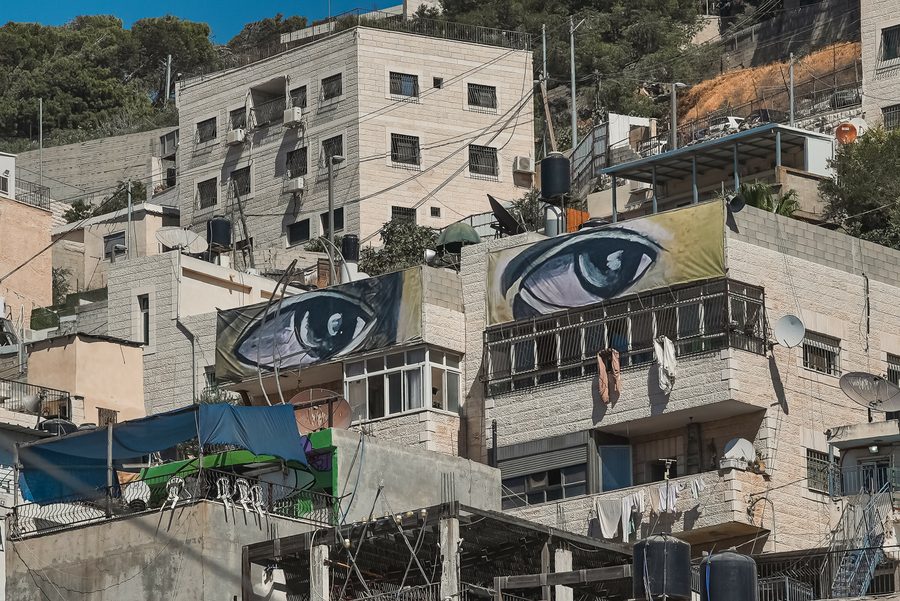
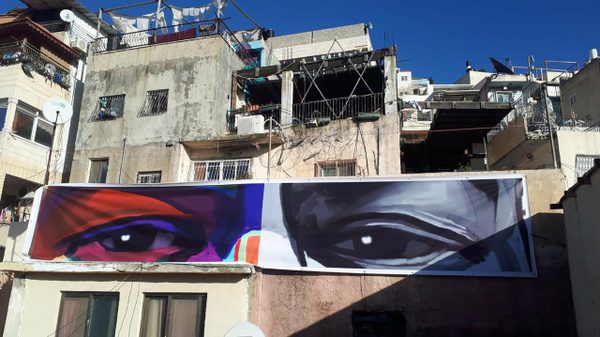
The eyes of Ghassan Kanafani, painted by Palestinian American artist Chris Gazaleh and installed in the hills of Batan al-Hawa in Jerusalem.
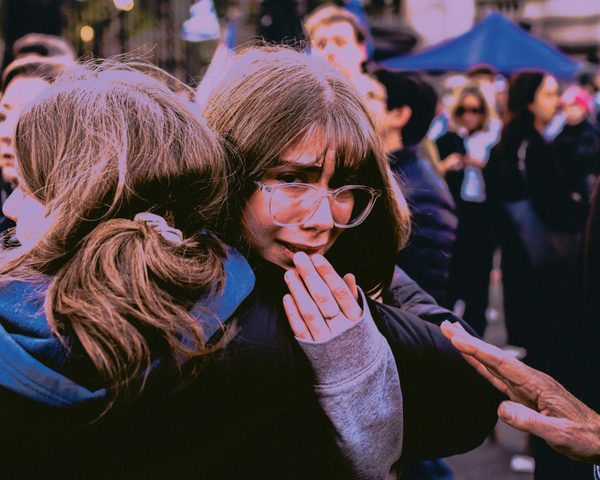
On the afternoon of December 14th, some 20 Israeli police and army officers arrived in the Silwan neighborhood of East Jerusalem to tell Umm Nasser Rajabi that she and her family of 18 had a few hours to pack and permanently leave their four-story home. Although Rajabi had been issued an eviction notice for early December, and had seen her next-door neighbors forced out the previous month, it still came as a shock when the police showed up. Umm Nasser and her relatives began frantically emptying the home as Israeli settlers, who had been scoping out and photographing the property for months, gathered to watch and celebrate. “This is my house,” Umm Nasser said between tears. “I spent 50 years in this house, raising all my kids here.” After the sun had set and the family’s belongings had been cleared out, nearly a dozen people helped Palestinian Red Crescent staff carry Awad, Umm Nasser’s grandson, out of the house on a hospital bed; since suffering a stroke five years ago, Awad has required full-time care, hospital-grade equipment, and intravenous food, all of which Umm Nasser had specially fitted the first story of her home to provide. As the family drove five miles across Jerusalem to a hastily-rented unit in Beit Hanina that they can’t afford long-term, nearly three dozen settlers seized the house under the protection of police and private security forces.
Along with the police, soldiers, and settlers, other silent witnesses were looking on as the Rajabi family was forced out. Painted on the front of the house in colorful hues are the eyes of Milad Ayyash, a 17-year-old Silwan resident who was shot and killed by settler security in 2011, while etched in bright blue on a balcony is the eye of a younger Umm Nasser, looking protectively over the neighborhood where she grew up and raised her 11 children. These painted eyes are among dozens adorning the stacked houses of the dense Batan al-Hawa section of Silwan, where more than 85 families—some 700 people—are facing expulsion to make way for ever-expanding Israeli settlements. The product of “I Witness Silwan: Who Is Watching Whom?,” a public art project established in 2015, the murals invert a reality in which Silwan’s residents live under constant surveillance by the regime seizing Palestinian property, turning the gaze—and the accountability that comes with being watched—back outward.
Ateret Cohanim, a settler organization working to Judaize areas of East Jerusalem, began filing dozens of eviction suits against Silwan residents in 2001, claiming legal rights to the land after taking control of a Jewish trust that had operated in the neighborhood in the late 19th century to aid the poor. Under Israel’s 1970 Legal and Administrative Matters Law, Jews are permitted to reclaim property in East Jerusalem that was lost during the 1948 war, despite the fact that most have already been compensated for lost property—and that those taking over land tend to have no historical connection to the particular property they claim. (Palestinians, who were not compensated for land lost in 1948, are denied the same right.) The Rajabis and the other targeted families waged years-long legal battles in response, but many of their cases ended in June, when the Israeli Supreme Court ruled in favor of Ateret Cohanim. At least 30 families in Batan al-Hawa, which sits close to the Old City walls, have already been evicted, with more to follow until, ultimately, the section is in the hands of settlers.
As the evictions ramp up, the eyes, bright and unblinking, stare at the settlers. To date, the I Witness project has painted nearly 100 murals on the facades of homes that have been issued eviction and demolition orders. Some murals are painted directly onto Silwan’s concrete walls; others are applied as large vinyl stickers of printed photographs. Often, they are accompanied by touchstones of Palestinian identity—olive trees, lines from the poetry of Mahmoud Darwish, or portraits of figures like Edward Said. While they mostly depict the eyes of current or former residents struggling against displacement, a few famous intellectuals and revolutionaries peer out as well: Che Guevara, Sigmund Freud, the Palestinian writer and revolutionary Ghassan Kanafani. On one house, the eyes of George Floyd, the Black American killed by Minneapolis police in 2020, appear next to those of Iyad al-Hallaq, a young Palestinian man with autism killed by Israeli police in East Jerusalem five days after Floyd was murdered.
Another set of eyes, featured on one of the neighborhood’s largest murals, belongs to Shireen Abu Akleh, a Palestinian American journalist murdered by the Israeli military in 2022. Her eyes grace the exterior walls of the home of Zuheir Rajabi, Umm Nasser’s nephew and a community leader who co-directs I Witness Silwan. Zuheir wakes up each day knowing that the Supreme Court could issue a final ruling to greenlight his eviction, too. For him, Abu Akleh’s eyes—and the murals across the neighborhood—are part of a struggle for survival. The art “sends a message that people exist and want to continue to live in Silwan,” he said. “Even if we are pushed from our homes, our eyes will remain, always watching.”
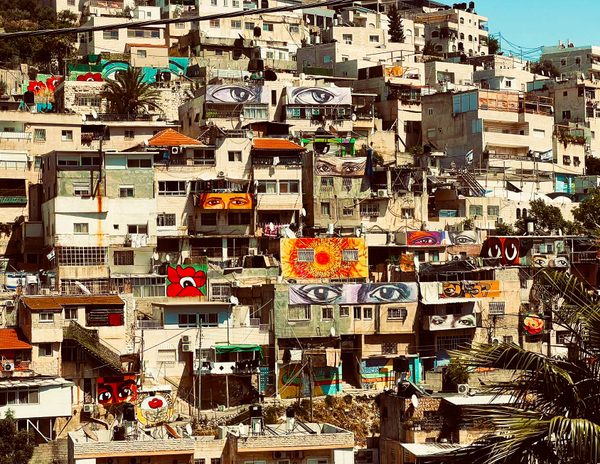
I Witness Silwan murals on the hillside of Batan al-Hawa, which include the eyes of Silwan community members, living and martyred; Palestinian luminaries like Ghassan Kanafani and Shireen Abu Akleh; and international figures like Malcolm X.
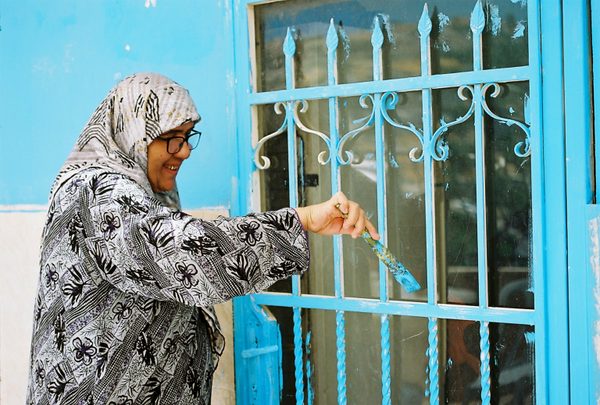
Umm Nasser paints her home.
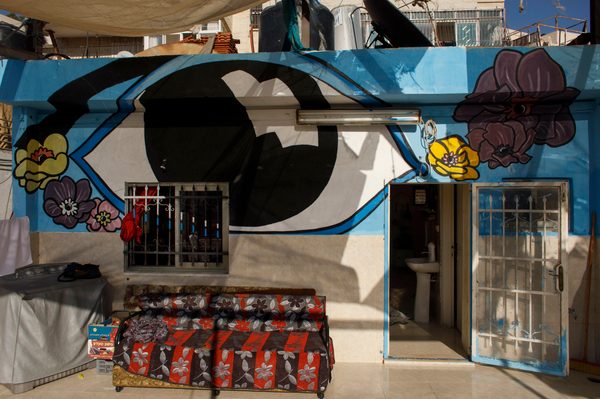
Eye of Umm Nasser painted on the backside of Umm Nasser’s home.
Over a five-year period, I Witness Silwan worked with Umm Nasser to paint the entire facade of her home. Facing the main street of Batn al Hawa, the building was painted with flowers, eyes, and a four-story-tall image of a woman in prayer. Umm Nasser and her extended family were forcibly expelled from their home on December 14th, 2025, after a ten-year struggle, which was then handed over to Israeli soldiers. The settler organization Ateret Cohanim, fully backed by the state, has based its ownership claims on the fact that Yemeni Jews lived in this part of Silwan more than 100 years ago.
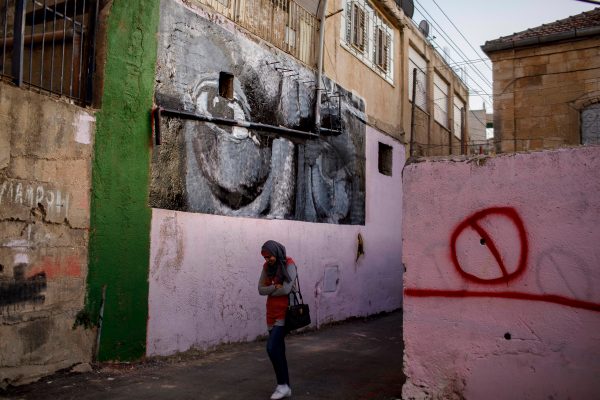
Eyes of John Berger, an art critic, painter, and writer whose work has shaped how people see, analyze, and understand their world, and who was a staunch advocate for Palestine.
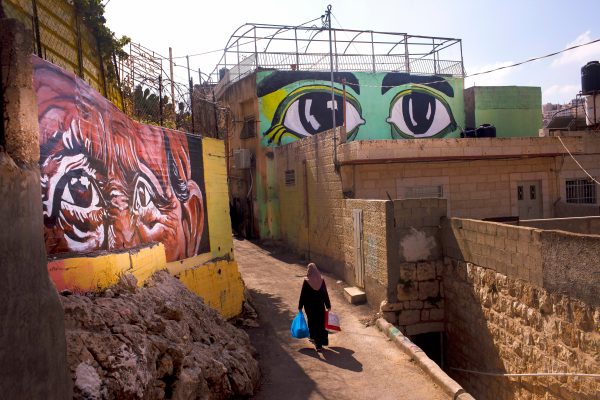
Eyes of Bai Bibiyaon Ligkayan Bigkay (left), designed by CeCe Carpio and a Silwan community member.
Bai Bibiyaon Ligkayan Bigkay is a Lumad leader and Talaingod woman-chieftain in the Philippines, leading her tribe in the indigenous defense of ancestral lands. Her eyes in Silwan make visible connections between the Palestinian liberation struggle and global indigenous struggles against colonization.
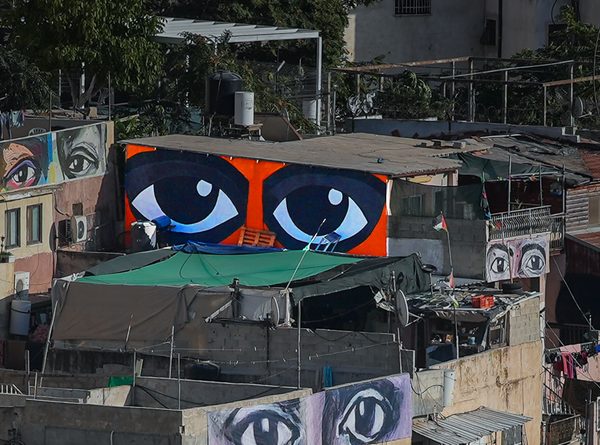
Eyes of Eyad al-Halak, a young man with autism who was murdered in the Old City by border police on May 30th, 2020.
Eyes of George Floyd, who was murdered by police in Minneapolis on May 25th, 2020.
Zuheir Rajabi of Silwan said, “George Floyd was killed because of racism and state violence. George Floyd’s story parallels what is happening to us in Palestine.”

I’m Arielle Angel, editor-at-large of Jewish Currents. Before you go, there’s something I need to ask.
We’ve seen over and over how the mainstream media falters in telling stories on our beats—whether it’s antisemitism, Israel/Palestine in American politics, Jewish identity, or the American left. At Jewish Currents we’re committed to uncompromising analysis and longform reporting on these issues and more—stories you won’t find anywhere else. In a media landscape that obscures injustice and flattens discussion, we’re changing the conversation. But we need you.
If you believe in this work, please consider making a donation—or even better, a recurring one—to ensure that we are able to keep publishing stories like this one. We can’t do it without you.

Charlotte Ritz-Jack is an editorial fellow at +972 Magazine living and writing in Jerusalem.