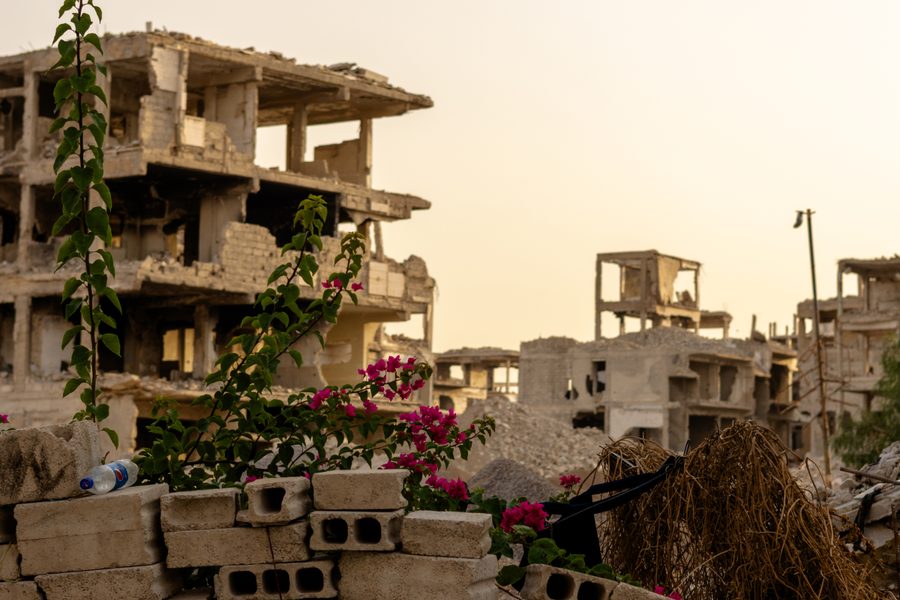
Yarmouk camp near Damascus, Syria, August 11th.
All photos by Theia ChatelleReturning to Yarmouk
After the end of a 14-year civil war, residents are making their way back to the heart of Palestinian life in Syria.
Yarmouk, located some five miles from the center of Damascus, Syria, was once the largest Palestinian refugee camp in the world. Many of those expelled from their lands during the 1948 Nakba found a home there, first living in tents and then building permanent housing as the prospect of an immediate return to Palestine faded. But all that changed with the outbreak of the Syrian civil war in 2011, when fighting between forces loyal to the Assad regime and the opposition wreaked destruction across Syria—including in Yarmouk, where civilians endured years of indiscriminate bombardment by the Assad regime, as well as repeated assaults and takeovers by ISIS. During this time, most of the camp’s Palestinians were forcibly displaced to other parts of Syria; those who remained faced apocalyptic conditions, as seen in a viral 2014 image of residents queuing for aid distribution.
After 14 years of war, everything changed again in December 2024, when Hayat Tahrir al-Sham (HTS), an Islamist faction of the Syrian opposition, launched a surprise offensive that toppled the Assad regime in a matter of weeks. The Head of HTS (which formally disbanded at the end of the war), Ahmad al-Sharaa, would go on to establish a transitional government. Today, Syria remains a country in turmoil, beset by ongoing sectarian clashes, alleged government atrocities against minority populations, and constant Israeli bombardment. But the end of the civil war has at least ushered in some sense of stability and enabled the start of a long process of reconstruction. As a result, an estimated 850,000 internally and externally displaced Syrians have been able to go back to their homes. Among them are many of Yarmouk’s residents.
During a visit to the camp in August, I witnessed the signs of the community’s return—construction workers clearing rubble; families doing their best to tidy up what is left of their apartments. It has not been an easy process: The camp, ravaged by years of war, verges on completely uninhabitable. Many apartments are exposed to the streets after their exterior walls were blown out during the extensive shelling of the camp; the walls still standing are dotted with shrapnel and bullet holes. With little help from the government, residents are forced to use dwindling personal funds and the support of the community to make the camp livable again. Still, they have opted to come back, and not only because of the high cost of living elsewhere in Damascus. As one resident told me in a street interview: “We are Palestinians first—so we choose to live here until we can return [to Palestine].”
Indeed, for many, choosing to live in Yarmouk despite the destruction is a recommitment to Palestinian identity—and to Palestine itself. To this day, the camp remains the heart of Palestinian life in Syria, its buildings plastered with posters of martyrs killed by Israeli forces in the West Bank; its walls sporting political slogans one would see in the refugee camps of Tulkarm or Jenin (“glory to the martys” is a common one); and its neighborhoods home to small but active branches of Palestinian revolutionary groups like the Popular Front for the Liberation of Palestine and the Democratic Front for the Liberation of Palestine. And if Yarmouk is the heart of Palestinian life in Syria, then the right of return is what lies at the heart of Yarmouk. “We will keep waiting to return, as long as it takes. One hundred years, it doesn’t matter,” a shopkeeper who had recently come back to the camp told me. In this telling, a return to Yarmouk is the first step on a longer road: One that leads back to the villages and homes these refugees were forced to flee in 1948.
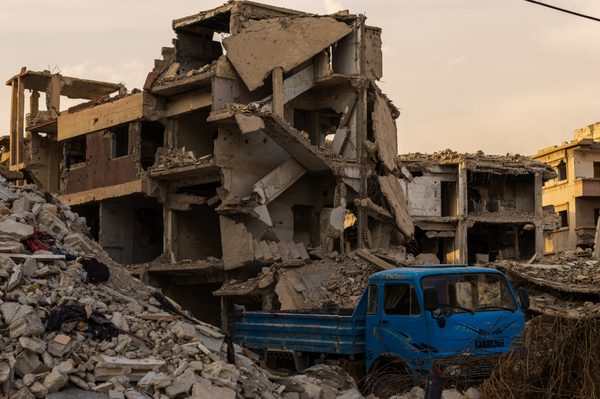
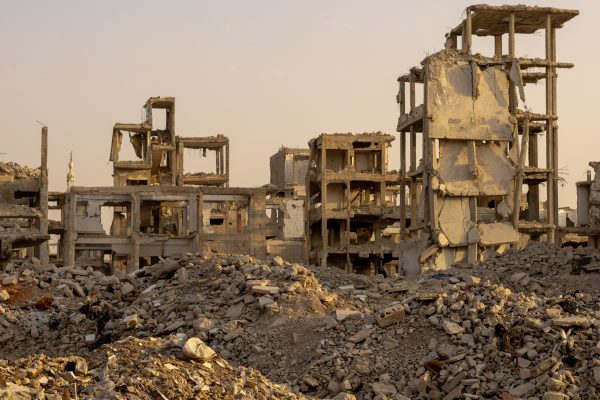
Partially destroyed buildings in Yarmouk camp, August 11th.
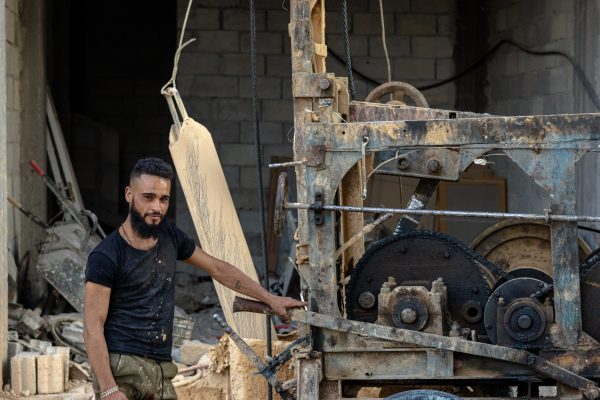
A young Palestinian worker poses with his construction equipment while working to repair a building in the camp, August 11th.
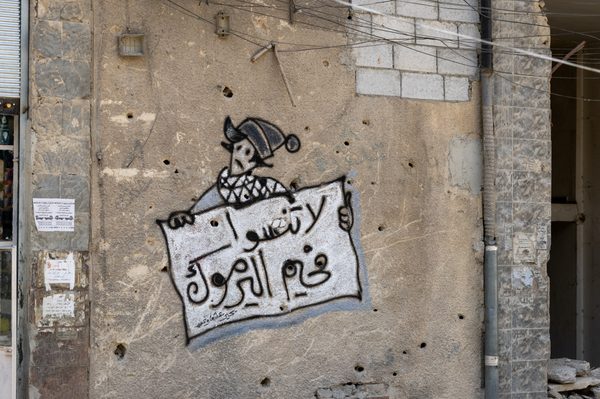
“Don’t forget al-Yarmouk,” reads a bullet-hole ridden mural in the camp, August 12th.
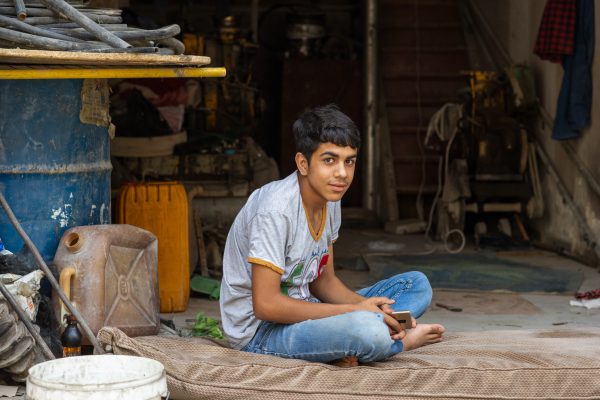
A young boy sits on a mattress in his family’s shop in Yarmouk, August 12th.
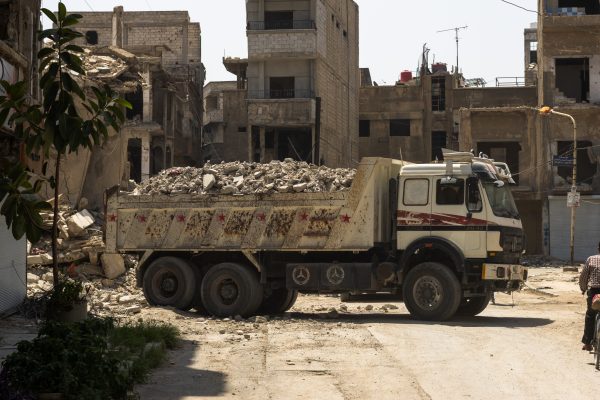
A construction vehicle bearing the flag of the old Syrian Republic hauls away rubble from the camp, August 12th.
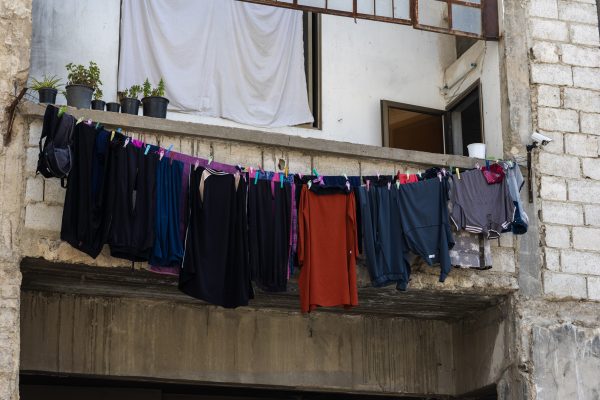
Clothes hang out to dry from a recently inhabited apartment in Yarmouk, August 12th.
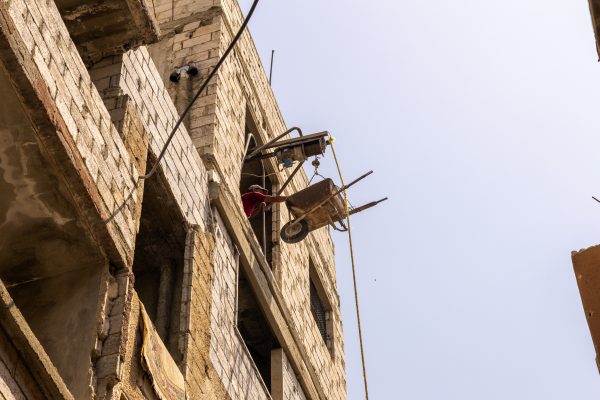
A construction worker hauls a wheelbarrow of concrete to the fourth floor of a building undergoing repairs in the camp, August 12th.
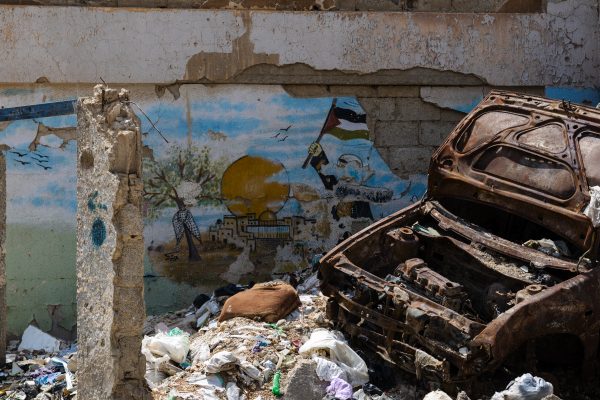
A mural depicting Jerusalem and a woman holding a Palestinian flag sits behind a burned-out car in the camp, August 12th.
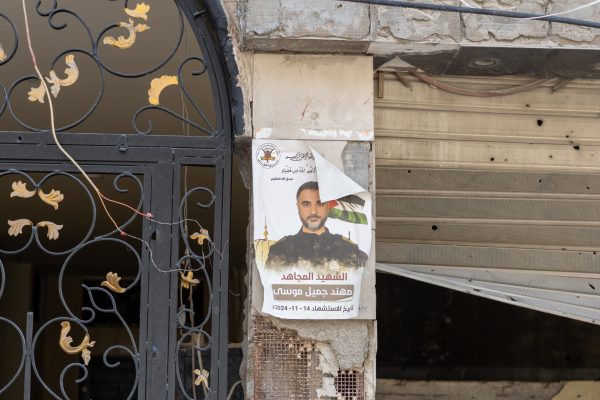
A Palestinian Islamic Jihad poster commemorates a fighter killed by Israeli forces in the Mazzeh district of Damascus, August 12th.
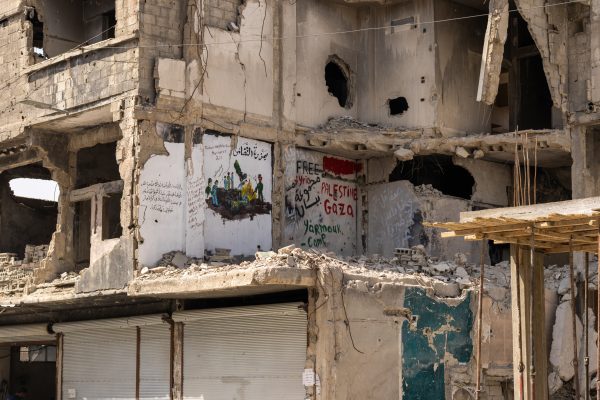
A collection of murals decorates the wall of a bombed-out building in Yarmouk, August 12th.

I’m Arielle Angel, editor-at-large of Jewish Currents. Before you go, there’s something I need to ask.
We’ve seen over and over how the mainstream media falters in telling stories on our beats—whether it’s antisemitism, Israel/Palestine in American politics, Jewish identity, or the American left. At Jewish Currents we’re committed to uncompromising analysis and longform reporting on these issues and more—stories you won’t find anywhere else. In a media landscape that obscures injustice and flattens discussion, we’re changing the conversation. But we need you.
If you believe in this work, please consider making a donation—or even better, a recurring one—to ensure that we are able to keep publishing stories like this one. We can’t do it without you.
Theia Chatelle is a freelance journalist and photographer covering conflict, human rights, and displacement across the Middle East, Europe, and the United States. Based in Jerusalem, she reports on war and social movements, with a focus on human-interest storytelling and investigations into state power.