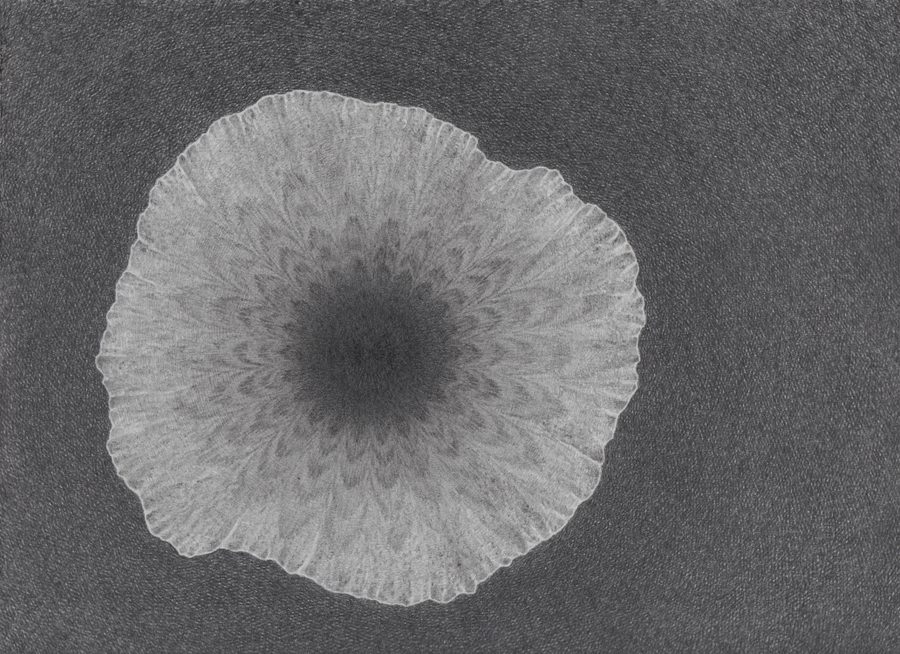
Stages of Fallout (Flower II), excerpt, 2021, graphite on paper, 9 x 12 in
The Event
“Something has taken place that we cannot speak of or know or even fully perceive, yet the fact of which sits before us.”

You can listen to “The Event” read by the author at the link below, or on our podcast.
1
It is still not possible to determine how the fire began or when or precisely where. Did it have, in fact, a single ignition, then subdivided as it spread, or were there several fires that started separately and joined together as they consumed the fuel between them? (And, if we are to take Nolan’s speculations[1] seriously, we have to ask: Was it even a fire?) Individual reports from outside the Event Field—there are, of course, none from within—are contradictory and of little value.
Direct, overhead satellite imagery (>60°) was lost three years ago on March 30 at 09:17:54 GMT (11:17:54 local time)[2] after which the only recorded orbital surveillance is “angular” (<45°, much of it <30°) with limited detail. All satellite footage preceding loss of contact, direct or angular, is open source and has been studied as closely as the Zapruder film, by far more people, without discovery of a consensus “initiating moment” or, indeed, any definitive evidence of a fire prior to 09:00:00 GMT. (The “thermal points” south of Hebron, visible from 03:29:06 GMT, are now generally accepted to have been Bedouin campfires.) All angular footage (<45°) that continues through the Event remains classified and unobtainable and, in any case, is said to be inconclusive. (Since the US withdrew from the IAST, the EU Directorate-General for Science & Technology has coordinated international research, set security policy, and monitored data release. This has not kept US spokespersons from disputing IAST figures and conclusions. Himmelfarb, Reed, and others have argued that these disputes and the resulting uncertainties are not accidental; that “authorities”—possibly rival authorities—have devised and deliberately spread conflicting accounts and competing rumors to effect a “reassuring unknowability.” As Himmelfarb put it, “Better seven theories than one.”)
We have spoken to nine individuals who claim to have seen at least some of the classified angular footage. Four refused to sit for a polygraph or fMRI, and those conversations went no further. Three gave vague or evasive accounts, lacking persuasive detail. The two we judged most reliable were interviewed separately, by different teams; each reported that in the footage viewed (roughly 11 minutes in one case, 19 in the other), the fire had already begun, and they could see almost nothing but smoke and, here and there, what they took to be flames. When asked, both asserted that the smoke blanketed not only the land itself, but also significant portions of the eastern Mediterranean.
Because the Event Field remains inaccessible to both humans and machinery, proper soil and debris tests cannot be performed. Atmospheric analysis in regions bordering incidents of this kind (Bhopal, Chernobyl, Fukushima, Rahway, Koeberg, as well as of various volcanic eruptions) is notoriously unreliable and, in any case, what readings we do have reveal nothing as to the source or progress of the fire. Airborne particulate matter (inorganic compounds, vegetable ash, fragments of carbonized animal remains) has, of course, blown across borders into accessible regions, but the samples reveal very little other than that all were subjected to extremely high temperatures, and that heat intensity appears to have been constant and uniform across much and perhaps all of the burn zone, a finding that contradicts everything we know about wide-area fires.
What happened was so vast and terrible, “absolute in its terribleness,”[3] and its cause so obscure that it became, in Marguiles’s sardonic formulation, “a perfect culture for growing theory.”[4] The number of “explanations” offered in the first month alone, by experts and amateurs, was beyond count,[5] many of them untestable, absurd or meaningless (“a local suspension of the laws of physics”; “invasion by an alien species”; something called “renumerology”).[6]
The most credible and widely accepted account of the fire was that an explosion (likely preceded by a meltdown) had occurred in one of the nuclear power plants or a missile silo. This, it was speculated, had ignited a coal seam or natural gas deposit, which, in turn, ran through underground formations to other power plants or silos and so forth. The theory had several virtues. It explained the remarkable speed of the fire, particularly in desert areas lacking sufficient vegetation to sustain it; the intensity and uniformity of the heat; and, importantly, the seeming omni-directionality of its advance—how it could appear to spread north across the Negev, south through the planted forests of the Galilee, and, as if at the same time, east from the coastal plain. The theory also contained an important promise: that once the relevant isotopes had been identified, we would be able to calculate when scientists or at least robotic equipment might be able to re-enter the land and gather evidence for further study. As Skomorovsky wrote at the time, “Of the several traumas inflicted by the Event, the epistemological is hardly the least serious.” The prospect of knowing more at some point in the future, however far off, was comforting not just to the technical community, but to the public at large.
Therefore, when tests conducted by satellite and at 23 sites around the perimeter of the burn zone—in the four contiguous states and from ships on the Mediterranean—failed to reveal elevated levels of radiation or even of atmospheric carbon and the nuclear theory began to deflate, there were urgent attempts, some of them quite ingenious, to patch the hole and pump it back up. As these failed, one after another, a strange silence began to descend over the subject. Even the professional talking heads one had heard from the start, the “experts” who, though they understood nothing, indeed precisely because they understood nothing, never lacked for a reassuring explanation—a new one each day when needed (theories which were, as Pauli used to say, “not even wrong”), even they managed finally to stop speaking. The ensuing silence was a relief. For the first time in months, it became possible to think.
2
Out of that silence, an unexpected consensus soon emerged: to put aside all theory and explanatory effort and focus instead on the so-called “reporting record.” Bardach (citing Benveniste, et al.) had proposed precisely that in the immediate aftermath of the Event.[7] But it would have taken a great deal of work to gather the reports and devise a methodology for analyzing them, and in those shocked early weeks, everybody wanted, as Michaelson wrote at the time, to “consume the whole apple in one bite”; few had the patience for such a dogged, tedious, and, frankly, modest method of inquiry. As it turned out, however, Bardach and her team had begun even then the work of collecting the extant record, so that when, months later, the Theorists finally yielded the stage to the Reporters, they already had a considerable part of what there was to find; and they knew where to look for the rest.
In the end, Bardach’s group had neither the manpower nor the conceptual apparatus to make full use of all the data they assembled. They tried for some months, but after her death, it became harder to go on, and eventually they—specifically Lagomarsino and Prempeh—approached us for help. I agreed at once (even before I got board approval) and quickly made two important decisions. First, that we would look only at exchanges between persons inside the Event Field and those outside. As I put it in a memo at the time: “We will presume that any communication which took place wholly within the field has been lost (and all participating parties are gone) and that any communication taking place entirely outside it is irrelevant.” If neither premise was strictly true, we would act as if they were. Second, we confined ourselves to communications occurring (though not necessarily commencing) in the 11 minutes between 09:12:00 and 09:23:00 GMT (11:12:00–11:23:00 local time). Loss of direct satellite contact (LDSC) occurred, as I’ve said, at 09:17:54 GMT, and the telecommunication record ends precisely there. We included the final six seconds of that minute and five additional minutes as a “safe margin” in case of stray or missed messages, or ones delayed in their delivery. These limitations produced a paucity of data that made the task possible. Instead of wading through tens of millions of telephone calls, emails, social media posts, and the like, we began with just under 9000 relevant communications, complete or interrupted (the latter, obviously, more important), 807 of which contained apparent reference to the Event as it occurred. The great majority of these are sudden silences, followed, a second or two later, by a break in the connection. In 241 we found an unarticulated vocalization, a half-blurted sound, usually just a gasp, an intake of breath, a grunt; sometimes, the beginning of a word that is never completed. These are not without a cumulative power. If you listen to them often enough—especially to some of the compilations (“playlists”) Braunschweig put together—they constitute, as he often said, a kind of music. Life being cut off so suddenly it is gone before the speaker can register its going. (El Koussa called it “death without dying” and “a kindness.”) All of them bear further study, but these notes will focus on three that are more elaborated.
The earliest real-time reference we have to the Event appears in an SMS exchange (in Arabic) between Ghena al-Masri, a kitchen worker at Grille Brasilia in Eilat (18 Derekh Begin) and her son Bassem, a porter at the Golden Tulip Hotel in Aqaba, Jordan. (The al-Masri home is in Aqaba, and Ghena would walk across the border every day to go to work. The Aqaba-Eilat checkpoint had recently reopened, and she had completed a full retinal scan, allowing her to pass through security in a matter of minutes.) The texts begin with Bassem’s complaints about the hotel (the “vulgarity” of the guests, the harshness of his supervisors) and Ghena’s response that his unhappiness at the job is not important, much less grounds for quitting. (“Think about what you are working for, not why it is difficult . . . ”) She then turns to the grocery shopping Bassem has said he will do after his shift. She is listing the items she wants him to buy (eggplants, peppers, cheese) when she abruptly types shob kt— (presumably shob kteer, “so hot” or “very hot”) at which point the text breaks off, seemingly in mid-word, yet was nevertheless transmitted. Ghena may have accidentally pressed “send” before she meant to, or perhaps the heat of the fire somehow caused the message to be sent. Whatever the reason, according to Bassem’s recollection in an interview conducted that September, at the same moment that his phone pinged with this message, he heard what he took to be fighter jets buzzing the city. He looked out over the Gulf of Aqaba—he had just brought a guest’s dry cleaning up to a penthouse suite—expecting a squadron of low-flying F-47s (“I was already furious”); instead, he saw Eilat completely engulfed in smoke, “like a corpse,” the translation reads, presumably referring to a shroud. He remembers turning to pick up the room phone, but nothing more. Apparently, he passed out and fell, hitting his face on the bedside table. The field notes record that he still had a scar at the time of the interview.
Ghena’s final message reached Bassem’s phone at 09:16:06 GMT, one minute and 48 seconds before LDSC. There follow more fragmentary but similar reports from Be’er Ora (09:16:15), Yotvata (09:16:39), Lotan (09:17:11), and Neot Semadar (09:17:39), as if the fire were traveling northward, albeit at a velocity not only greater than anything on record, but which thermal physicists maintain is physically impossible; molecules cannot transfer heat that quickly, regardless of wind speed. (There was very little wind that morning, pre-Event.) Lobadil has speculated that other fires were already burning in those places—perhaps separate ignitions—but, absent the nuclear theory, he cannot explain how they could have gone unnoticed and unreported.
Prior to the start of the al-Masri SMS exchange, we have an account of a telephone call placed from Mas’ade (not to be confused with Masada), a Druze village in the Golan Heights, over 400km to the north. A car dealer, Kadir Zeitouni, had gone to a local mediator to settle a dispute with a former employee over sales commissions. (Zeitouni appears to have been something of an outlier in the Druze community. He drove flashy cars, married a Sunni woman from Akko, and, his wife told us, took the dispute to this particular mediator hoping to “repair relations” with local authorities.) After presenting his case, Zeitouni stepped outside and telephoned his wife, Badia, who was on Cyprus vacationing with their children. He was—she told Prempeh in a phone interview—in a foul mood, worried that he had been “too argumentative” with the mediator, felt certain the decision would go against him and that he would lose a lot of money. Therefore, he was canceling his plans to fly over that afternoon and join them. Badia suspected that this was simply a ruse to spend the weekend with his mistress, whom he had sworn not to see again, and they argued about her with increasing vehemence until suddenly, in the middle of his rage, Kadir fell silent. She said, “What’s wrong?”—worried he had given himself another heart attack. He said nothing for several seconds then pronounced a single word: “Nar” (fire). There followed a sound she describes as “like the roaring of a great beast.” Just as it became so loud that she had to move the phone away from her ear, the connection was broken (09:17:51 GMT). She expected him to call back, and when he didn’t, she tried him several times without getting through. About 15 minutes later there was a tremendous noise. Everyone on the beach looked up and saw smoke billowing thousands of feet into the eastern sky. At the same moment, phones began buzzing all around her. She says she knew at once that she would never see her husband again and could not help thinking, though it made no sense, that whatever had happened was Kadir’s fault, that he had brought it on with his endless anger and impatience. Even so, she tried his number repeatedly for several hours. We know how many times she called and precisely when because, like Ghena al-Masri in Eilat, the Zeitounis used Orange Telecom as their carrier, a French company whose data is stored in the Alps. (The records of all local carriers are inaccessible and presumed destroyed.)
An hour and 17 minutes before the Zeitounis lost connection, long before Ghena al-Masri’s final text to her son, Eleanor Reynolds-Richards, an intellectual-property lawyer in London, initiated a three-party Zoom meeting with her clients Idit Geller and Aryeh Zachai, partners in a software design firm, ZGD; Geller was at the company’s offices in Tel Aviv, Zachai at his husband’s parents’ home in Goa. The call was recorded, audio and visuals, and we have obtained a copy.[8] The copy is technically damaged, or perhaps has been redacted to conceal proprietary information, but it brings us closer to the Event than anything else we have found. For that reason, I’d like to put a warning before what follows, some version of: Read at your own risk.
The previous week, the US Patent Office had rejected an application by ZGD (their initial application for this process), and the purpose of the call was to formulate an appeal. There is intermittent static on the audio track, but one understands that they are taking up the Patent Office objections, point by point. It is a technical conversation, a mix of IT engineering and patent law, and quite interesting. Reynolds-Richards explains an objection; Geller and Zachai propose amendments to their claim; Reynolds-Richards discusses why she thinks each of these will work or won’t; and on they go. Seventy-seven minutes into the call, at 09:17:21 GMT, Geller (in Tel Aviv) turns to look over her shoulder at a window that has been visible behind her throughout. She seems to have heard something not yet audible on the recording, or to have noticed a shift in the light, imperceptible to us. Or perhaps she has sensed a sudden change in temperature. This turn—I’ve watched it thousands of times—appears entirely ordinary, indistinguishable from other movements Geller has made during the conversation, yet Reynolds-Richards immediately asks, “Is everything all right?” Geller says, “Something’s happening.” Zachai (in Goa) says, “Idi . . . ?” Geller doesn’t respond, but begins to rise and turn toward the window, which is covered with one of those shades made of very thin bamboo strips; through it we get an odd, rippling view of the apartment block across the street.
It is difficult to describe what follows. As mentioned, there are dissenters even from the idea that it is a fire,[9] and while our internal consensus remains that what we see are flames, fire as we understand it cannot consume matter (steel, glass, poured concrete) at the rate at which it appears to be happening. Chen and Eftekhari have postulated that a sudden “massive transfer” of energy from the sun or, perhaps more plausibly, the center of the earth (the temperatures are similar) could conceivably have generated the heat capable of what we see on the recording.[10]
But what, in fact, do we see? Viewing the footage at normal speed (30fps), most people, myself included, perceive only chaos: incomprehensible disorder, impossible movements, and a shattering. (The camera mic blows out immediately, and it is hard to determine how much of what we hear thereafter is the Event itself and how much is audio distortion.) Even when we slow the footage down—going through it essentially frame by frame—the images remain largely nonsensical. (It would be simpler if they were entirely so). Often, one frame bears no obvious link to the next. Certain architectural features, the window in particular, persist throughout, but in unpredictable relationship to other elements: the aluminum electrical conduits, the ventilation ducts, even the ceiling soffit. Viewing it like this, of course, we miss details that are perceptible only in motion. Therefore, a serious study of the footage—and we regret not being allowed to make it publicly available; if there was ever a project for crowdsourcing, this is it—requires watching at many different speeds and trying to correlate one’s own (multiple) responses with those of colleagues. As Braunschweig wrote in an internal memo during our initial study of the footage: “These images cannot be ‘seen’ directly. They must be felt first, then seen . . . In the right state of mind (relaxed, open, without intention or purpose) they become legible; we are admitted to them. If one struggles, attempts to ‘will’ understanding, there will be nothing” (emphasis original). Yet it is important to say that when I describe, as I am about to, what “can be seen,” these are not just private, subjective fancies—the rhinoceros or outline of Virginia one divines in a passing cloud. Several dozen people from a variety of disciplines (and amateurs with no technical expertise at all) studied this footage over a period of months and recorded their individual responses. We then began to meet in groups and exchange impressions, sharing with one another what we thought we saw. We spoke, and we also listened. In time, each of us came to feel that at certain moments others had seen more clearly than we had, and—this is crucial—we began, in those places, to see what they had observed. The description that follows constitutes our collective understanding of “what is there,” much of which has been confirmed by persons outside the subgroup who, not privy to our conclusions, saw substantially the same things.
To wit: Geller rises from her chair and turns in a single movement.[11] As she takes a first step (left foot) toward the window, i.e., away from the camera, the Zoom image is engulfed in flames. These do not appear to come from outside—through the window—or from the floor or the ceiling, but from all directions at once, in an instant. If, instead of 30fps, the camera had been running at 60 or 300 or 1000, it would have further subdivided the instants, and conceivably we would see the fire appear and then advance. But this is all we have; in one frame there is no fire—no smoke, nothing—and in the next, it is everywhere. Geller immediately pivots back toward the desk (13 frames), her eyeline searching for and then finding the laptop’s camera lens, i.e., Reynolds-Richards and Zachai (22 frames). Her upper body inclines toward them, while her weight remains on the left foot, so we do not think she is coming back this way, yet she clearly appears to be seeking them out. Braunschweig, whose intuition in these matters was uncanny, believed that Geller was imploring their attention, saying, in effect, “Look. See this.” Not because they might fail to see it, or somehow overlook it, but in the sense of, “Behold . . . ”
Once Braunschweig had proposed this, many of us began to read the positioning of Geller’s arm, reaching back behind her, like a gesture in an allegorical painting directing our gaze to the essential subject, though what that is, we cannot see. In the next frame, her hair is on fire—all of it, at once, a corona. As it blazes, a living crown, her face remains calm. Her eyes are open. Her mouth forms a perfect circle,[12] yet there is no sign of pain—or horror, or even surprise. Then, in a single frame, she is gone. Everything is gone. The image is unreadable. There follow eight more frames (nine total) in which Geller is entirely absent (or has become indecipherable) each more chaotic than the previous, if that’s possible. On the final frame, the image pixelates, freezes, then stutters erratically for another 23+ seconds, at which point the connection breaks, and the screen fills with static. The break occurs at 09:17:54 GMT, 14 seconds after the end of the Zeitounis’ call, Golan to Cyprus, and well over a minute after Ghena Al-Masri’s final text in Eilat. LDSC takes place at the same moment, suggesting that it may not have been the fire in the room that ended the recording, but London losing the satellite feed. Conceivably, the camera in Geller’s laptop went on receiving images for some additional interval—seconds, even minutes—without being able to send them. If such footage exists, we would, to say the least, very much like to see it.[13] In any case, the reporting record ends with that frame.[14]
I want to pause here and make a comment not really relevant to my purposes in this document, yet I feel compelled to say it. There have been countless attempts, both in fiction and in what we might call “speculative journalism” to “re-create” (imagine) what happened on the ground during the Event. These seem to me futile and pointless. That the fire left no survivors now goes without saying. That was not initially evident, but in late May, when the smoke and clouds began to clear, there was a fresh deployment of surveillance drones and low-orbiting satellites. Those sent directly over the region again disappeared; however, the ones that passed nearby survived, returning patchy but useful images, both optical and thermal. From these and other data, one was forced to conclude that in the entire area west of the Jordan River—the state proper and the territories[15]—no human or large animal could have survived. The heat (which remains constant to this day) would have boiled off all water, blood, lymph, and mucus. The long-held hope of finding people alive in bank vaults, bunkers, underground caves, and the like had to be abandoned, and we were forced to accept that all that the many rescue efforts accomplished, heroic and selfless as they might have been, was to add to the number of victims.
About that, we can do nothing. But to then “depict” deaths no one has seen, a catastrophe and horror of which we know almost nothing, to try to “humanize” these moments with our fantasies of suffering and grief, seems to me not just naive but obscene. Perhaps we are all tempted in that direction; we want to personalize the impersonal. Yet that is exactly what cannot be done. When Prempeh asks me where I was when I first learned of the Event—people seem to love that conversation—I tell her this or that (it was 4 am in Washington; I was asleep; the calls woke me about 6), but never the truth. Not just because it’s none of her business, much less that there is anything to hide, but because all that is irrelevant. Who cares what I felt or thought or did? I am convinced that the best we can do by way of understanding (and honoring) what has happened—and this is important, it is necessary—is to recognize that it is beyond our grasp, beyond our selves. Something has taken place that we cannot speak of or know or even fully perceive, yet the fact of which sits before us.
It is for this reason that, despite agreements not to, I have described what appears on the Geller video—hoping to replace these nightmare speculations with what scraps of reality we possess, however fragmentary. All evidence suggests that any actual “experience” on the ground was extremely brief, and—given the fire’s speed and intensity, not to mention the physiology and neurology of the human body—no one felt more than an instant of astonishment. There was literally no time for suffering. There would have been, at most, a brief confusion or a sudden awareness—we see it in Geller—then nothing. Nothing. I am convinced there was no suffering there at all. The suffering is ours.
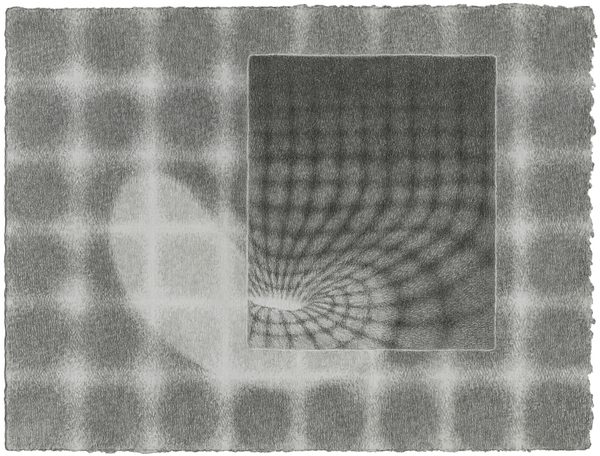
Stages of Fallout (window grid), 2022, graphite on paper, 9 x 12 in
3
Within 36 hours of LDSC, military forces from Lebanon, Syria, and Egypt had massed on the borders of the Event Field.[16] This occurred under a complete news blackout, so what followed remains largely unknown, and it has taken us months to piece it together. As early as the night of March 31—unaware of or ignoring initial accounts of failed rescue missions—the first troops crossed into the Event Field and were immediately incinerated. (We believe that crucial information, including the disappearance of advance drones, was deliberately withheld from the soldiers and even from their field commanders.) In several places, the ash of the forward units blew back into the faces of the men behind them; but because these incursions took place at night, in radio silence and under thick clouds of stinging smoke, those at the rear were often unaware of what had happened up ahead, so they kept going and were similarly destroyed. Military strategists tended, in those first hours, to dismiss these deaths as “local anomalies” and ordered squad leaders to try crossing at other points, first here, then there, looking for “vulnerabilities.” Only when the troops began to refuse orders, leading to summary executions, followed by the “fragging” of COs, did the generals and the politicians begin to accept that there were no vulnerabilities, that, at least within its boundaries, “the anomaly was universal.”
There is a piece of digital footage, made at about this time by an Egyptian soldier near Al Kuntillah in eastern Sinai. It was shot on an HH L6 and lasts just under eight minutes. We see a pack of 40-odd Nubian ibex (Capra nubiana, a desert-dwelling goat with large, curved horns) moving along at a decent clip. Without warning, the lead three animals burst into flame, one after the other, and are reduced to ash in a matter of seconds. The pack immediately veers off and pauses. After a moment, a few of the larger males warily approach the charred remains, and while they sniff the air, a kid of about six months wanders too close and is similarly destroyed. A mature female runs after the kid and is destroyed. The pack exhibits alarm and confusion. One of the large males, inadvertently it seems, steps too close; its right foreleg and shoulder suddenly ignite like a gas jet and crumble. The animal emits a terrible, piteous braying. For whatever reason, maybe a shift in the wind, we can hear the flesh crackle, but then it topples forward, burning; its magnificent horns burst into twin arcs of flame, and its vocalizations cease.[17] The other ibex now back away, turn and, without further ado, trot off in another direction. As the camera watches them go—not one looks back this way—a large bird appears in the upper right corner of the frame, and the Egyptian soldier, whoever he was, abandons the departing pack and follows this new subject. We quickly realize that it is an enormous creature (the wingspan estimated at over eight feet) with brown-tinged black feathers and rose-colored markings around the eyes. It would later be identified as a lappet-faced, or Nubian, vulture (Torgos tracheliotos), but we know on sight that it is a bird of prey, a scavenger come to see about the still-smoldering ibex. It passes once near the carcass, then, circling back for a second look, crosses directly over the animal and drops out of the sky, a ball of fire before it hits the ground.
Bardach, by means I still don’t understand, obtained a copy of this video only days after it was made.[18] Based on visible features of the terrain and her knowledge of Egyptian troop movements, she concluded that it had been shot right at the border[19] and that the goats and the vulture were destroyed when and as they crossed it. If you look closely at the images of that last ibex as it burns, you can see its blood running across the sand, then abruptly turning to pink steam precisely—we presume—where it transects the international boundary. Unlikely as that sounds, we have similar footage shot along the borders of the four contiguous nations, in which eagles, seagulls, camels, horses, donkeys, rabbits, tortoises, frogs, toads, scorpions, and snakes are obliterated in similar fashion. In the most difficult to watch (and hardest to obtain), a clan of Bedouins, perhaps confused by the absence of border patrols, attempts to drive its flocks west across a shallow stretch of the Jordan River into the smoky haze; they fare no better than the ibex.
It is strange how long it took us to accept what we were seeing. Watching those tapes hundreds and in some cases thousands of times, certain facts became apparent. The perimeter of the Event Field had been drawn as if with scientific precision, and it was inviolate; nothing could cross it and live. This was true not only on the ground, but to an altitude of at least 20,000 meters: Insects, birds, drones, aircraft, weather balloons, and so on were destroyed, at once and entirely. How far up this zone extends has still not been established. High-orbiting satellites have reported few difficulties, hardly more than pre-Event. The moon, the planets, and the stars appear to continue on their usual paths, though the IASA has scheduled high-precision observations over the next two years to confirm this. Yet for all that, it was not until September of year one, after a series of storms had swept through the region[20] and the skies cleared, that satellites on steep angular paths sent back the first comprehensive images of the area and, as El Koussa put it, “we finally saw what we already knew”; that the shape of the burn zone was a perfect outline of the vanished state and its territories, “from the river to the sea.” That and nothing else. This seemed impossible, yet it was so.[21] Where there were natural boundaries (the Jordan, the Dead Sea, the Gulf of Aqaba on one side; the Mediterranean on the other; even the hills of Golan in the north), this was easier to account for. But where it was simply—and literally—an invisible line drawn in the sand (Sinai, Lebanon, the Arabah region of the Jordanian border), life on one side, death on the other, a different sort of explanation was needed.
The religious had answers, as always, but they satisfied only the religious.[22] The practical had questions, the most salient being: Could this have been an attack by a hostile foreign power or asymmetric entity? Several terrorist groups had claimed responsibility, albeit without offering credible evidence. AllWorld, 4chan, Reddit, frommissouri, and similar sites teemed with speculation ranging from detailed foreign policy assessments to theoretical weapons systems (orbiting lenses to focus solar rays; “nano-explosives” dropped from the air or somehow “sown” into the land). The most astute of these, by Kaplan and Meyers,[23] argues that even in theory the resources required to develop such technology are beyond the capacity of any known terrorist organization and all but five state actors. Of the latter, they dismiss out of hand both the US (politically inconceivable) and China (not on their agenda); they maintain that “the Zionist state” as a US client was so useful to Russian ambitions in the region that Moscow would not have benefited from its disappearance. The Iranians were no doubt delighted when this happened, and had long been considered the most likely to attack, but “nothing in their weapons programs points even vaguely in such an exotic direction.” The authors then turn to the final and most interesting “suspect” on their list: the Jewish state itself. They theorize that a country surrounded by enemies committed to its destruction and waging a demographic war it seemed destined to lose might decide to build its own Doomsday Machine to assure that should the land ever cease to be theirs, it would become no one else’s; and that, having done so, the device might have been triggered by an accident or conceivably by an act of sabotage.[24] Yet what was this device, and how did it work? Even if one could explain the fire’s ignition, how had the destructive force been sustained for three years without evident fuel or visible flames? Above all, what would contain it precisely within historic borders? Kaplan and Meyers don’t know: “We continue to believe that a military strike (a conscious human act) is the only plausible explanation for the observed phenomena, yet we cannot propose or even theorize a credible technology for one.”
4
“Is the Event singular or exemplary?” El Koussa has repeatedly asked this, not for himself, I take it, but by way of thinking about the Christian response and particularly that of the Evangelical community. He finds in the latter’s writings and sermons three recurring themes: (1) grief for their Zionist friends; (2) joy at the impending Rapture, Apocalypse, Second Coming, and Final Judgment; (3) competing predictions about the timetable for these eschatological events. It is the problem of Judgment that especially interests him. He asks without irony—indeed, with his unfailing graciousness—if what has happened is unique to this one place, a single Judgment that for obvious reasons has been rendered in what he calls “the navel of the world.” Or is it the first in a series to be visited on various “trouble spots”? Should we understand it as a warning to humanity to shape up, or the material consequence of our having failed to do so? Or is it, rather, on the order of a plague, a comet, the explosion of a star, too vast to contain a mere “message” or “meaning”?
In attempting to discuss the religious and political aspects of what has occurred, I am hampered by both a general incompetence in these subjects and, I confess, doubt as to their explanatory value. Since comprehensiveness demands it, however, I will try to be brief.
The fire was greeted by an outpouring of what the Western press labeled “regional jubilation,” though that was a deliberate oversimplification. In fact, the celebrations extended well beyond the Arab world, to Iran, of course; to parts of Central and Southeast Asia, not all of them Islamic; across much of Africa and into the Muslim communities of Europe. One even heard a note of grim satisfaction in the responses of many European and North American leftists, progressives, and “pacifists” at what a commentator in The Guardian called “this inevitable reckoning.” To a gentile like myself, one who gives religion and politics barely a passing thought, it was difficult to understand how people who had been incensed at the destruction of olive groves and houses could accept so calmly, with almost a hint of approbation, an event which, after all, entailed the deaths of more than 15 million human beings. But the reality on the ground, even and perhaps especially in the Middle East, was more complex; not only Arab and Muslim grief for their Palestinian brethren and for the loss of beloved holy sites, but also terror and awe in the contiguous nations when they grasped the full power of the destructive force and how close it had come to their own borders. (Thus, the “miracle of our survival.”)
The response of diaspora Palestinians (the only Palestinians left) is of particular interest; the Event has generated myriad forms of denial that their homeland is gone—none more shocking than the “Children of the Return” (see below) even as many intellectual and spiritual leaders are advocating new varieties of sumud (steadfastness, perseverance), many of them reconceiving their national identity as “a way of life, rather than a place.” A number of these have remarked on the similarity to diaspora Judaism; as Y. Basharat put it in their “Family of Abraham” essay, “The Arabs and the Jews, brothers from the first, are together again at the last.”
Perhaps stranger still has been what one can only call the Zionist reaction. When, in the first hours after the Event, a visibly devastated Reuven Arieli, the legendary former ambassador (still residing in the Virginia countryside), said on CNN, “If you had told me it was just the settlements, maybe I would have understood. But the whole country, everybody . . . ?” He was denounced by allies, friends, and two of his own children; and he received sufficiently credible death threats that he had to disappear for several months. The stance of the former state’s apologists and defenders has been largely denial that anything fundamental has changed, mixed with outrage at the monumental “injustice” and “disproportion” of what has undeniably taken place. Many of them have continued arguing to this day, as if before a court that might somehow be persuaded to change its mind, that Syria or Saudi Arabia (not to mention the major powers) were “vastly worse” and “more deserving” of punishment; there was particular bitterness that recent diplomatic breakthroughs had been ignored or given insufficient weight, that the catastrophe had occurred just when peace was “within reach.” An AIPAC spokesman actually insisted that the “sovereignty of the Jewish state has not been altered in any way, nor its size diminished by one square centimeter.” An Iraqi minister agreed, telling a Paris luncheon, “The Zionist entity has been granted all the territory it ever claimed, from the river to the sea. And its borders are secure.” (He later denied saying this.)[25]
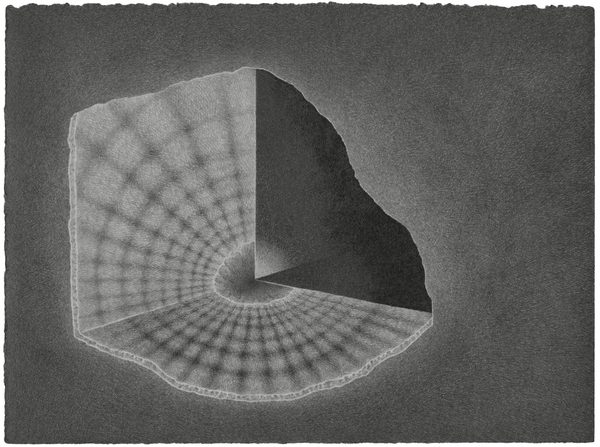
Stages of Fallout (mirror portal), 2022, graphite and charcoal on paper, 11 x 15 in
5
Over the past month, Prempeh and I have been making our way around the perimeter of the Event Field. It is a trip I had been scheduling and postponing for over a year, and in the end both the board and the staff strongly urged that I take her with me—i.e., they think I’m getting difficult, perhaps unreliable, and want someone along to confirm (or refute) my reports. They also know that I trust her completely. In fact, she is an excellent ambassador, not just for her youth and appearance, but even more for her manner: direct, pleasant, dignified, almost regal. Just the other day, thanks to her gentle non-insistence, we got to view some extraordinary, unedited footage shot near a refugee camp in one of the contiguous states.[26] From the codes on the tape and other details, we know that this was recorded on April 4, five days after LDSC, and already we see people holding up for the camera weathered parchment scrolls and crumbling documents, many of them hand-lettered in gorgeous Arabic script. As they speak in a variety of accents and languages, we realize that these are Palestinians come from all over the world—from Amman and London, Brooklyn and Brazil—bearing 19th-century Ottoman title deeds in the expectation that they will, at last, be able to recover their ancestral properties. By this point, the fate of the rescue missions and military incursions had been widely reported, so it is not clear what these “Children of the Return” (a phrase we see on countless signs and t-shirts) were telling themselves, but one feels the crowd working itself up. Some sort of anthem is playing on a PA system; there is a good deal of cheering and fist-pumping and, one infers, alcohol. A disparate collection of vehicles has assembled, everything from military personnel carriers to expensive Land Rovers, all-wheel drive SUVs, broken-down jalopies, and a couple of camel-drawn wagons. A man in a keffiyeh makes a speech in Arabic, and even without subtitles, one understands that he is rousing the crowd, inciting them to action. When he dismisses the “alleged dangers” attendant on entering the land as “Zionist lies” (the people showing us the footage translated), there are shouts of approval. Many appear to remain skeptical, but more than a few, caught up in the excitement, climb into their vehicles, start the engines, and drive in a large circle, waving their colored smoke sticks. Then, as if at a signal I fail to hear, they all head off toward the mountains of dark cloud looming over the border. After the last of them has vanished from sight, we still hear their engines and stereos, but these sounds eventually fade, and the green and red smoke dissipates into the desert air. None of them was ever heard from. Nevertheless, over the following days, others arrived with documents of their own, and some of those took the same path. Eventually, the contiguous nations stationed troops along these borders to keep people from coming to harm.
The land’s refusal to be possessed or repossessed by anyone at all did not bring the celebrations to an immediate end, but it muted them, after which, as Braunschweig reported last year, they transformed into something quite different. The living continued to visit the borders alone and in pairs, in family groups and on tour buses, but now, instead of firing guns into the air and blasting music over battery-operated loudspeakers, they simply stood or sat or walked along marked footpaths looking out over what the locals had begun to call almakaan almustahil (“the impossible place”). There was no music and very little conversation. Some left flowers or cakes or dyed eggs; some lit candles and said prayers for the dead. A grizzled figure along the Syrian border told Braunschweig in broken but impassioned English, “We are dead! We are all dead!” I was surprised how easily Braunschweig had gotten into the country, but it turned out that Jews had been making this pilgrimage almost from the beginning, though at first only on boats and ships that would anchor off the Mediterranean coast, where they would stand at the railings, looking eastward into the same silence that others were watching, looking westward across the Jordan. Many Jews initially refused to enter Arab countries, and the countries likewise restricted tourist visas for Jews, especially those with Israeli passports. But that, too, changed. During April of Year 2, a group of American yeshiva students made a well-publicized trek across Sinai with Egyptian friends,[27] and after that, others came to Jordan, Lebanon, and eventually Syria. Following some initial chilliness, hotels rented them rooms, and kosher meal plans were introduced.
Late last summer, a 19-year-old youth, reportedly healthy, intelligent, and in good spirits, walked across the 1974 ceasefire line in the Golan Heights and was incinerated before his father’s eyes. They were affluent Tamil Hindus, living in France, and the family had been camping for a week in the Syrian Golan. They cooked over a wood fire, swam in a small lake, and spent extended periods each day on the large rock formations that look out over the border. Prempeh and I visited there this winter, and we were told that although the number of visitors has fallen in recent months, back in August, on an afternoon of good weather, upwards of a hundred people, all ages and nations, many of them families, would have been scattered across the rocks, rarely speaking, sometimes reading or sleeping or quietly eating; yet whatever their eyes or mouths or hands were doing, they all sat facing in the same direction, like compass needles. Because it is hill country and the winds are strong, one can get excellent long views out to the west over the silent land. They are breathtaking.
The boy, Sharav, had not wanted to come on the trip; he was an athlete and had to miss an important Tae Kwon Do competition and was quite bitter about it. Yet from the moment he went out on the rocks, his complaints vanished. He sat in one spot for two hours saying nothing and seemed, his mother told us, “like a different person.”[28] He became helpful and good-humored in a way that the parents found almost worrisome. At home he was often surly, even a bully, but here all that changed. He would get up before dawn and go out on the rocks to see the land in the first light, spend much of the day there, coming back to help around the campsite, then going out again, especially at sunset; when he returned to camp at night it was pitch black and one could see nothing. On their last full day, he begged his parents to extend the trip or let him stay on by himself (there was another French Tamil family that could have brought him back to Paris), but they had their return tickets, and, frankly, the mother told us, they wanted to get him home and “back to normal.”
The next morning, they were all up early, and after everything had been packed in the rental vehicle, Sharav asked his parents if he could go sit on the rocks one last time. An hour later, his father came to get him. He couldn’t find him at first—that particular formation is large and elaborate, with scrub pines growing up out of crevices; you have to scramble about to see it all—and he called the boy’s name. Sharav’s voice answered him. The father waited, gazing out at the view, and perhaps his thoughts wandered, but after a couple of minutes, when he hadn’t appeared, he called again. This time there was no answer. He climbed about looking for him and reached a point where he could see out over the small, steep valley through which the Purple Ceasefire Line ran. There was a solitary figure down there, walking west toward the border, and he wondered for a second who that crazy person could be; then he realized. He says he knew at once what was happening. He called, shouted, waved his arms. Sharav turned and waved back, seemed to smile, but he kept walking and didn’t turn again. The father ran down the rocks into the valley, shouting the whole time. From the westward base of the rocks to the border is just under a kilometer, and the father, who had been an athlete himself, felt sure he would be able to catch him in time. But somehow the conformation of the land was deceiving, and though he ran as fast as he could—faster, he felt, than he had ever run—and though Sharav kept walking at the same unhurried pace, he saw finally that he was not going to make it, and he told himself that if the boy went across he would go, too, and either bring him back or die there with him. He was still 200 or 300 meters behind when the figure of Sharav turned to ash before his eyes. He slowed then; there was no longer a need to hurry. He realized that he lacked the strength or inner will or whatever it was to follow his son, and this seemed to him unbearably shameful. “The worst feeling of my life,” he told us. “Worse even than his death.” He stopped about ten meters from the line, and, as he stood there, a light breeze scattered the last of the ashes. With that, all trace of the boy was gone, and it somehow lifted his spirits.[29]
6
For obvious reasons, accounts of Sharav’s death and especially the way he met it (smiling, open-eyed, serene) were largely suppressed—over his parents’ objections, the local coroner ruled it an accident—so it is hard to argue, as both Statler and Katadin try to do,[30] that what followed was triggered by this incident. More likely, whatever moved Sharav moved others as well, and only when the number of “accidents” reached into the hundreds and then the thousands, and the world could no longer ignore them—passing in an instant from denial to panic—was the tale of the “happy martial arts champion” retrofitted as an origin myth. What strikes us both now, as we finally get access to the actual records, is the variety of people who, as they say, “took a walk.”[31] There were, inevitably, the old and the sick, troubled adolescents, brokenhearted lovers, and a few who declared it a form of martyrdom. But there were also middle-aged couples in good health with adequate means, farmers, lawyers, store owners, government bureaucrats, emergency room nurses, trust fund babies, at least two professors of philosophy, and a husband and wife wanted for several murders. Perhaps because of travel costs, there were not many poor people and, as far as we can tell, nobody who was actually homeless. Once Jews could easily enter the contiguous states, many of them crossed over, and because traditional halacha (Jewish religious law) requires withholding mourning rites for suicides, various rabbis have issued rulings that these people had not taken their own lives, but, rather, had “made aliyah” (literally had “ascended,” i.e., from the diaspora to the Holy Land). Before long, the neighboring nations had to redeploy the forces they had originally used to keep out returning property owners. But, as usual, the enterprising and the committed found ways around these impediments; the soldiers proved easy to bribe.
Indeed, the Jordanian troops here in this campground are so lax it is almost comical. When Prempeh and I arrived the other day, just to test their response, we walked down the embankment and across the mud flats toward the trickle that is the river at this time of year.[32] We had gone well more than halfway when a soldier with a bullhorn told us to come back; we could easily have made it across before anyone reached us. That evening, I asked one of them if they got in trouble when people died. He shrugged and told me: “They yell at us, but nothing happens.” We learned later that the soldiers themselves cross over more often than the tourists.
We are in the same part of Wadi Araba where the Bedouins are seen in that shocking video (and where Bardach disappeared). We have watched the footage so many times that, as with Dealey Plaza, I recognized the place almost before we got here, and felt such dread I might have turned back if I’d been alone. But Prempeh, who knows the footage as well as I do, simply said, “Here we are,” and we went on. A moment later, coming over a rise, we saw the nearly deserted campgrounds (which would have been crowded with visitors six months ago), the trash-blown parking lot, the desultory watchtower, and my fear dissolved into a kind of numbness or vacancy or something for which I cannot find the word. Pushed into a far corner of the parking area is a collection of vehicles left behind by people who have crossed over. These are now the province of rodents, snakes, scorpions, and their prey, which, one of the soldiers told us, is usually one another. The handful of tourists have spread themselves out over the vast grounds so that each party is almost alone, but there is a family camped near us, and that first evening, after we had pitched our tents and eaten something, we walked over and introduced ourselves. They are Palestinians, descendants of people who fled Jaffa in 1947, and they have traveled here from Southern California and Vancouver. Prempeh hit it off with them at once, especially the women; they were dazzled by her, the Oxford accent, the deep blackness of her skin and hair. They showed us a rusted iron key the size of my palm and talked about reclaiming their property, especially “a marvelous orange orchard” that none of them had ever seen. It is gone, of course, since long before the fire. Prempeh asked how they expected to take possession “with things as they are.” The oldest of them, a woman in her 70s, a dentist who had been born in Egypt after the family fled, told us, “We will never stop waiting.” She said it calmly, as if the waiting itself were sufficient. Her middle-aged children, a physical therapist, a drug counselor, a “first A.D.” (whatever that is), kept a respectful silence.
As I may have mentioned earlier, the number of new technical papers about the Event (the fire and its aftermath) has declined steadily over the past year, and I’m told that recent submissions are even lower. Whether this indicates gloom, acceptance, or a quiet gathering of energies is unclear, but it feels like a second silence, the first having followed the collapse of the nuclear theory. In the absence of significant new work—without which, Prempeh maintains, I don’t know what to do with myself—I have gone back to my favorite thinker, the Russian physicist E.I. Skomorovsky, and during the trip have been rereading some of his major papers[33] while keeping up with the shorter posts that still appear every week or so on his website. It was Skomorovsky who famously said that we know more about the Big Bang, which no one observed, than about the fire, of which we have actual video evidence. Lately, he has gone further, arguing that we will never know what happened, indeed, cannot know, that the obstacle is not “the impenetrability of certain events occurring in the Levant on 30 March” three years ago, but the shape of the human mind. We are “blind” to those events and even to our blindness. Yet we sense what we cannot see, “as if by the mental version of touch.” (El Koussa speaks of “seeing with our lips, our skin, our proprioceptive systems.”)
In a post that went up this Monday, Skomorovsky describes a Norwegian study that found an observable tendency in people living just outside the burn zone to avoid looking in that direction. He links to a video in which we see the subjects performing bizarre contortions for just that purpose, “averting their gaze from what they cannot fathom.” They have no idea they are doing it. When shown the videos, they are astonished and often laugh at themselves. Yet 30 minutes later, they are doing it again—again unawares. As usual, Skomorovsky draws unexpected conclusions: He believes that, in a cognitive sense, the Event Field is disappearing, “withdrawing from human consciousness,” even as the actual space remains before us. He predicts that within a few decades it will rarely be mentioned.[34] And if that is so, he speculates, it must surely have happened before in human history; other places (persons, colors, sounds, ideas, words) have vanished and been lost “like the sea closing over a sunken ship.” He wonders “if that is what became of Atlantis,” which I take to be a joke, though I’m not certain.
I read the whole post aloud to Prempeh yesterday afternoon as we sat on the embankment looking out over the river. What with questions, discussion, and going back over difficult passages, it took a couple of hours, and when we finished, we were silent, watching a pair of large black birds (Monk’s vultures, I believe[35]) circling over the desert to the south, looking for prey. They kept wheeling closer and closer to the perimeter without ever crossing it, and Prempeh remarked that they were not, as one might think, “avoiding” the Event Field; for them it had already ceased to exist. It was no longer there. The same appears to be true for most animals. Only a few humans (and a rapidly dwindling number of those) continue to be interested in that boundary and what lies beyond it. Prempeh recalled a paper she had read recently, a soil analysis of sand that had blown across the borders from the burn zone; it found a “complete lack” not only of burrowing animals and insects (their scat or DNA) but of microorganisms, fungi, even bacteria, actinomycetes, algae, or protozoa; there was no evidence of mitochondria. She pulled up the article on her phone and read aloud the final sentences. The author, Gosha, writes, “The sand is inert in a way one would not have thought possible in Nature. All life is absent, presumably burned up and consumed. Spinoza held that for every finite mode of extension (for every thing in the world), there exists a corresponding mode of thought from which it is not truly distinct. That is, every thing has a mind (of some sort) and is, to that extent, alive. But not this land. It is without life and without mind. It is not just dead. It is death.”
We sat there the rest of the day, reading, talking a little, and watching the river crawl past—it seemed to have freshened somehow, as if from an underground source. Around sunset, the clouds broke up, and we got a decent view of the blasted terrain on the other side. It was featureless in a way photographs cannot convey—there are no words for the color—and, as everyone remarks, it was entirely silent. When it began to get dark and cold, I said, “We should go,” and stood up. Prempeh, who is usually so responsive and accommodating, sat there as if she hadn’t heard me, staring out at the barely visible, barely audible river and the emptiness beyond it. Silence in daylight is one thing—sight fills the void—but in the dark we want sound, insects, animals, wind, something. Finally, she got to her feet, and we walked back to our campsite. The Palestinian family had left during the day, and the few remaining visitors were all at the far end of the grounds, their fires mostly lost in the darkness. Prempeh heated some food, we ate, and then, as I cleaned up, she went into her tent to read. With everything put away, I sat in one of the camp chairs meaning to answer emails and look at a few websites, but I did nothing. Prempeh’s electric lamp had turned her tent a glowing yellow orange, like a giant lantern, and I stared at it without a thought in my head.[36]
7
I woke up an indeterminate number of hours later in my own tent—maybe 30 minutes ago. It was cold and dark, and there was no light anywhere, which seemed odd since she is invariably up long before me, making our fire. Possibly, she had slept late for once, but that felt unlikely. I went outside with the small torch (Prempeh’s word for it) and let it play around the site, hoping she would see it and emerge. I said her name aloud—her Christian name, which I almost never use—then shone the beam through the netting; there was no one inside. I clicked it off, hoping that would make it easier to see her light if she was out there somewhere, but I saw nothing, not the other campfires, not the moon and stars, which were presumably hidden behind overcast, though I couldn’t see that either. I couldn’t see even the ground before me, yet the darkness felt more hospitable than the light, which had just bounced off the moisture in the air, obscuring more than it revealed.
I decided to walk out to the river; in case she had headed back over there. My body half-remembered how to go, what direction we’d turned as we left the campsite, and my feet felt their way across the uneven ground. I told myself I would sense the embankment when I came to it and the land started to slant downward, but, in fact, I wasn’t sure. I’d seen it in daylight, but hadn’t paid close attention, hadn’t thought to, and I could imagine stepping off the edge, or the ground tapering down to the river so gently I wouldn’t notice. After a bit, I felt . . . What I felt, in addition to the ground beneath my feet, was a chill in the air against my skin, more on one side than the other, which I took to be a breeze. If the wind was out of the west, as usual, and I walked into it, i.e., toward the cold side, it would take me to the river. So, I went that way and soon enough heard what sounded like moving water. Yet every step was so uncertain—I stumbled repeatedly without ever quite falling—that I couldn’t tell where I was or how far I had gone. Over and over, at each slight downward slope, I would think I had reached the embankment, yet it always seemed to lie farther ahead—unless the wind was out of a different direction, what sounded like water was something else, and I’d gone the wrong way altogether. Skomorovsky has written somewhere—I think it was Skomorovsky—that if truth is a correspondence between certain statements and the world they purport to describe, the Event corresponds to nothing at all, so no truthful statement can be made about it. (In which case, this report is useless, yet its very uselessness is a comfort, almost a purpose.)
Then I heard something I knew at once was neither the water nor the air. I stopped and listened. It came, and it went; and then it came again. I wondered if the breeze was carrying away the sound and bringing it back, but it rose and fell too steadily for that. It sounded, in fact, like something breathing. I stopped my own breath and held completely still. I filled those moments with thoughts of what it might be, a human, an animal, possibly a plant, even the land itself. Gosha had called the land death, but death might have its own sort of life. Maybe there was a realm, a truer reality, where death was ascendant. I found myself picturing Geller’s face in that final frame—as I often do, I think all of us do—the black circle of her mouth. I couldn’t hear the breathing anymore and wondered if whatever it was was holding its own breath, listening for me. But then, just before my air gave out, I heard it again, a soft, living exhale that was not myself. I could have spoken to it, I suppose, or shouted in a threatening way to frighten it off, but I didn’t. I don’t know why. It seemed important not to. The area is home to wolves and jackals, which travel in packs, and to striped hyenas, which hunt alone. Yet I had no fear—I had, in fact, a complete absence of fear—and for whatever reason I moved toward the sound. I didn’t care what the thing was or what it might do. I meant it no harm and felt it would know this, and that it was similarly disposed toward me. Even if it killed me, I believed, it would do so in all innocence.
The reason I closed my computer last night was that there was an email from Leah I wasn’t ready to look at; it had been there for two days, actually. Yes, I’ve made a mess of my life—who hasn’t—but the great blessing of the Event is that in its shadow none of that matters. It doesn’t take our sins on itself; it renders them meaningless. I began to smell mud and the odor of old, burnt things, like after a fire or in a ruined house. I sensed a vastness before me—it is before me now—sound and air, cool, fresh, yet with traces of fetidness coming up from below, and just then my foot felt beneath it a distinct lip of earth, beyond which the ground dropped away, and I knew I had reached the embankment at last. I sat down right there. Here. My legs reached over the edge; my feet rested on the downward slope. From this spot, I can hear the river quite clearly and, much closer, the other thing, whatever it is, still breathing to my left; I can hear particles of earth shifting beneath it, as if, like me, it is sitting or lying on the ground. I smell its fur or hair or skin, or what might be soap (though, if it is Prempeh, why hasn’t she spoken? but why haven’t I?) and feel heat coming off its body, for which I am grateful. I am not looking at it and feel certain it is not looking at me, but that we are both facing out to the west, toward the land we cannot see.
Nolan, Erich, “Disputing the Combustion Theory: A Quantum Wind Hypothesis,” Earth Science Review vol. 41, issue 2.
Benveniste, Byers & Oswego, An Ongoing Chronology, proposed considering this moment, loss of direct satellite contact, the beginning of the Event. As nonsensical as that sounds—how can a consequence be the beginning?—it anticipates Bardach’s notion of the “reporting record.” (See below.)
El Koussa, “First Anniversary,” Die Zeit.
Marguiles, Leah, private correspondence with her son, Julian, made available to me by him; cf. also her numerous skeptical posts on her Substack, Dubious Battle.
For a useful survey of discussions and conspiracy theories proliferating on X, TikTok, various subreddits, independent message boards, etc., see Perić, S.N., “Event Chatter” in Journal of Media Studies vol. 61, no. 4.
The commonest of these, unsurprisingly, was “an act of God,” though why God might have done it and to what end is a matter of dispute. Many saw it as a reproach or punishment of “the occupying power” (notwithstanding that the power’s victims suffered the same fate); certain eccentric rabbis, however, maintain that, as one of them wrote, “G-d [sic] did this out of his love for the Jewish people.” What that might mean is unclear.
There has been, of course, considerable disagreement as to exactly when—or if—the Event actually ended.
Pursuant to our agreement with the provider, we cannot discuss how we received it or from whom, except to say that it was not from Reynolds-Richards or anyone in her office.
Nolan, op cit, and after him others.
They don’t suggest how this transfer might have occurred.
Geller had been a gymnast and a dancer, and one feels that.
Physically impossible, but measurements confirm it.
Nolan contends that it would simply depict “more chaos,” and tell us nothing, a conclusion I agreed with at the time, though today I’m less certain. Skomorovsky recently offered what he calls a “proof” that the term chaos is itself now without meaning, and though I have trouble following his math, the conclusion has an intuitive appeal.
Braunschweig made a still from that final image of Geller’s face—flaming corona, mouth in a circle—blew it up to 24 x 18 and hung it on the wall of his cubicle. It so disturbed the staff—Lagomarsino called it a Gorgon—that a lot of them stopped going in there, and I was asked more than once to have him take it down. I didn’t, though frankly whenever I saw it, something in me shuddered, and I wished he would do it on his own. (He certainly knew how people felt.) Yet as Prempeh later pointed out—I hadn’t noticed this myself—I kept finding excuses for going in there and discussing matters I could have handled by text or email. Prempeh believes I wanted to see it; that the shudder had become a need. Others seemed to need it, too, and the complaints stopped. After Braunschweig left, someone suggested moving this image out into our cramped little “lobby,” but we never did; it remains hidden away in his former cubicle, like one of those cave paintings nobody sees.
Many, of course, maintain that there never was a clearly defined “state proper”; that its borders were always shifting and disputed.
Jordan declined to participate; the Egyptian government sent troops only after massive street demonstrations in Cairo, Alexandria, and other cities.
Reading this document at our campfire last night, Prempeh asked how I could reconcile the ibex’s agonized bellows with my assertion above that the fire caused no suffering. She suspects I am indifferent to the pain of animals (Leah once said something similar). My presumption is that the animal was caught between two zones—inside and outside the Event—and was therefore, in a sense, torn apart. That is, I feel certain, an exceedingly rare occurrence. Still, perhaps I am insufficiently concerned with animals.
At Bardach’s memorial service, her brother told me that as a child she never failed to find the afikomen. This is a piece of matza, hidden during the Passover seder, that has to be brought back to the table and eaten before the service can be completed.
There had been a fence on the eastern side, but, of course, it was incinerated in the first moments.
For a general discussion of the effect of burn zone heat on regional weather patterns, see Lobadil and Marmo, “Atmospheric Repercussions” in Report on Atmospheric and Meteorological Studies, no. 137.
On the night of the Event, I was, in fact, up late, proofing a paper, saw the first news alerts as they came in (none of this matters), and, without really thinking, I telephoned Leah, though we hadn’t spoken in months. I assumed I’d wake her—it was 1:30 am in California, and she is invariably in bed by 10—but she was up and in tears (Julian had already told her and was on his way over), which puzzled me since that whole subject had never seemed at all important to her—to her parents, sure, of course; to her right-wing brother, no doubt—but Leah, the Leah I knew, had always been on the political left, very critical of everything that happened there; yet here she was sobbing so hard she couldn’t speak. As she used to tell me, “You’re not a Jew. You don’t understand how these things work,” which I clearly don’t. In any case, she thanked me for the call, said she’d try me later, though of course she never did. Julian texted me some sort of explanation. As I say, all this is irrelevant.
I’m being unfair. There are a number of excellent collections of religious writing on the Event; even putting personal considerations aside, I would recommend, in particular, Fire This Time, Marguiles, Leah and Astroth, Julian, eds.
Jane’s Unconventional Warfare: 3003 Report.
Their list of possible saboteurs includes various foreign agents (remnants of Hamas, Hezbollah, etc.), former CIA/MI5 “cut-outs” now in private employ, anti-Zionist Hasidim, left-wing radicals, and, curiously, members of the nation’s own intelligence community—Shin Bet, Aman, Mossad—who “had begun to despair.”
I have omitted—for lack of space and because, frankly, I don’t know what to make of it—claims that the Event constituted “a second Shoah”; the launching of “fertility drives” to replace the “lost Jews”; the war of competing memorials (including physical violence in the dispute over giving “equal mention” to the Palestinian victims), the negotiations for a new homeland in the Western Sahara or the Canadian Arctic. And so on.
For complicated reasons, we have agreed not to identify the camp or the nation.
See “Pharaoh and Moses Take a Road Trip,” in the February issue of Strange Journeys.
Prempeh and I visited with the family in Paris on our way out there.
His actual words were, “C’était bien.”
National Geographic “Special Edition Year 3”; The New Realist, issue no. 4.
In fact, many drove or pedaled; a number even flew.
Without the snow runoff from Mount Hermon and other peaks, water levels are dangerously low.
See especially “The Blind Men Agree,” “Repeating Backwards,” “Has the Event Yet Begun?”
Unlike, say, Holocaust survivors, who dread the world forgetting what they have gone through, Skomorovsky treats it as natural, necessary, beneficial.
The guards told us these have reappeared in the region lately after a long absence.
Maybe this is the time to say that nothing has happened between Prempeh and myself, and nothing will. Twenty-five years ago, when I was her age, I probably would have made a clumsy attempt in that direction—one way I helped wreck my marriages—but at this point it’s hard even to imagine such things.

I’m Arielle Angel, editor-at-large of Jewish Currents. Before you go, there’s something I need to ask.
We’ve seen over and over how the mainstream media falters in telling stories on our beats—whether it’s antisemitism, Israel/Palestine in American politics, Jewish identity, or the American left. At Jewish Currents we’re committed to uncompromising analysis and longform reporting on these issues and more—stories you won’t find anywhere else. In a media landscape that obscures injustice and flattens discussion, we’re changing the conversation. But we need you.
If you believe in this work, please consider making a donation—or even better, a recurring one—to ensure that we are able to keep publishing stories like this one. We can’t do it without you.

Henry Bean wrote and directed The Believer, which won the Grand Jury Prize at the 2001 Sundance Film Festival, and has written screenplays for many other films. He was a staff writer on K Street and The OA. His 1982 novel The Nenoquich was republished last year, and his short fiction has appeared in McSweeney’s, Black Clock, and elsewhere.