Late
“There are no enemies. There’s no one left.”

I’d been eagerly anticipating the visit I was set on making to the Bay Ridge neighborhood of Brooklyn. On the subway, I kept looking at my watch, worrying that I might be late. This wasn’t my first expedition to the area known as New York’s Arab quarter. But this time was different, for my destination was the home of a Palestinian family whose surname was the same as mine, although we were unrelated. Again I looked at my watch. There was another reason for my excitement, a more salient reason: the old woman. “My aunt—my father’s sister—lives with us,” Layla had said. “She’s ninety years old—you have to see her.” I asked whether the aunt was able to speak. “Like a radio station with fifty employees,” Layla replied. “She fades in and out a bit,” she warned me, “and sometimes, when other people are around, she can behave unpredictably.”
My encounter with Layla was itself something I could not have predicted. I’d attended a soirée organized by one of the city’s Arab arts associations. I’d had to register for the event in advance, because attendees would receive certificates at the end, to recognize our contributions to our field. None of my grad school classmates went with me, all pleading their never-ending homework. I dislike taking long subway rides on my own in New York, but I went. It was such a lovely gathering, and so nice to hear Arabic, that I forgot my solitude. When the time came to hand out the certificates, the master of ceremonies began summoning us by family name. When “Khalifah” was called, I rose from my seat at the same moment as a beautiful young woman.
Afterward, driven by curiosity at the sight of this woman who shared my family name, I made a point of finding her to introduce myself. But seeing a young guy holding her hand, I quickly dismissed the idea that the encounter could have any deeper significance. She told me about her family, who had come to New York from Jerusalem after 1967. She introduced me to her husband, and they accepted my invitation to a nearby café. We talked a lot; I told them that from time to time I wrote stories, adding that Bay Ridge might be full of living characters who could provide inspiration.
“Like my aunt,” said Layla.
She described to me how her father’s sister had accompanied them when they emigrated. It surprised me to learn that the aunt was ninety years old, since Layla looked to be only in her thirties; she explained that her father was the youngest of his siblings. I asked her aunt’s name.
“Not important,” said Layla. “She’s always gone by the nickname ‘Khalifiyya.’ She’s the matriarch of the family, though she never married, because she didn’t want her memory preserved down the generations through her children.”
I wondered whether this rationale originated with the old woman or with the niece. I didn’t inquire, but I was intrigued. I asked Layla whether her aunt was open to having visitors—especially ones like me, who shared her family name.
“I’ll find out. In general she likes to be alone. She’s not interested in seeing anyone outside the family. All the rest, as far as she’s concerned, are strangers, and she’s always saying she doesn’t like strangers.”
I thought the old lady was quite right, since the strangers she’d known in her own country hadn’t been nice at all. All the same, I gave Layla my phone number, and asked her to keep
in touch.
A few days later Layla called and told me that her family would be happy to meet me, and that I could see her aunt at exactly nine o’clock that evening. That “exactly” really made me laugh—had her aunt actually become so Americanized? But Layla was clearly quite serious. “I’m begging you,” she said, “please don’t be late, not even by a minute. It’ll make things really tough if you’re late. Nine o’clock means nine o’clock. I’ll explain later.”
Her anxiety puzzled me, but I didn’t give it too much thought. Since I live in Manhattan, an hour by train from Bay Ridge, I took more than the usual care to allow plenty of time. As a result, I arrived at 8:30, and spent about half an hour wandering around the neighborhood, which was thoroughly Arabized. I took in the aromas of knafeh and hookah smoke; sometimes it seemed as though that was all I needed.
At five minutes to nine, I was at the family’s door. Layla ushered me inside, thanking me for being so punctual. She introduced me to her parents, and cautioned me not to expect too long a conversation with her aunt.
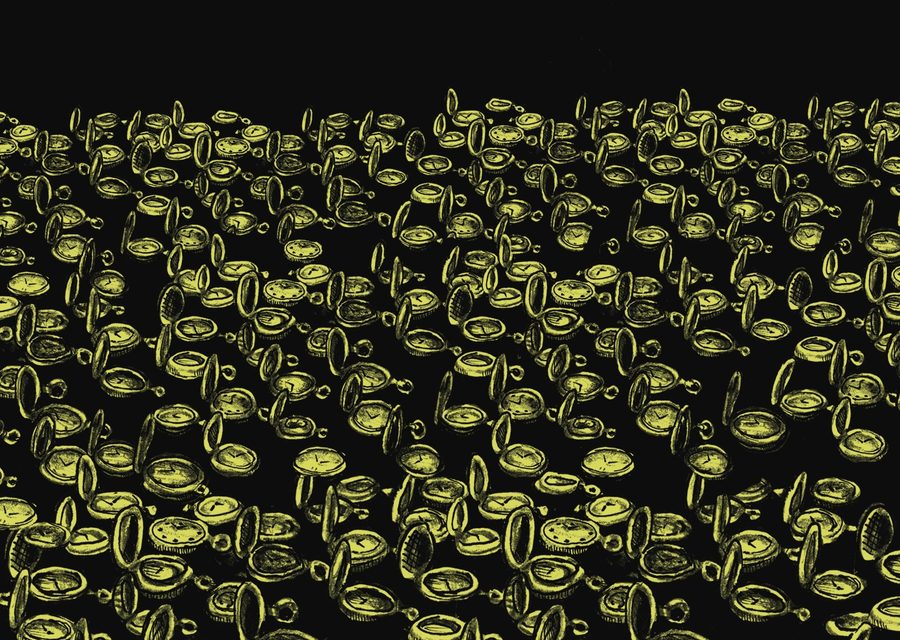
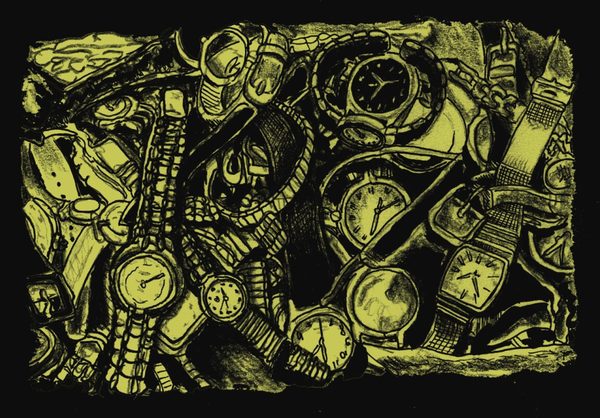
The old lady was seated in the middle of the living room, her head swathed in fabric such as I’d seen on my grandmother and other elderly Palestinian women. She wore a watch, conspicuously large, presumably so she could read the hands more easily. I couldn’t get over the preoccupation with time in this household. “Is he here?” she asked in a barely audible whisper.
“Yes, Hajja, he’s here,” Layla’s father replied.
I got down to the business of this meeting with Khalifiyya. Looking at her, I thought to myself that her nickname, whose root meaning is associated with commanders, suited her. She was sitting cross-legged on the floor, muttering softly to herself, and she took pains not to let you know she had any real interest in you, even while her eyes were full of questions—no end of questions. I seated myself on the floor, greeted her, and kissed her hand.
“So you’re a Khalifah, too?” she asked. Evidently she did not approve—it was as if I had committed some sin by affiliating myself with a sacrosanct family.
“Yes, Hajja,” I said. “We’re from a village near Nablus.”
“Right, that’s fine,” said the old lady, in a way that implied she meant just the opposite. “Another unfortunate one.”
I smiled and glanced at Layla, who signaled to me not to reply. I studied Khalifiyya. Her face seemed to me like a minefield of memories that might explode at any moment. It struck me, too, that her beauty, whose traces could still be discerned, had endured through a lifetime of solitude, without the touch of a man’s hand. Her affect suggested that she had no interest in further conversation, so I took a seat across from Layla’s father, and we started talking. It was obvious that Khalifiyya could hear us, even though we took no trouble to address our words to her. Her role seemed to be that of witness to an era—a witness those present were accustomed to seeing among them, in some way affirming their identity, you might say.
Suddenly the old lady moved her hand, bringing the watch face close so that she could see it; her expression changed markedly, and she repeated the motion. I didn’t know what was going on, but I sensed something in the wind. Once she’d made certain of the time, she started up like someone who’d just then remembered something. She began gesturing, looking all around her, and then she cried out, “Where’s the boy got to? Where’s he gone? Where is he?”
This threw me. It wasn’t a question, but something more like a long-rehearsed lament. And who was this “boy” she referred to? Layla and her father went to the old lady and tried in vain to calm her down. Her anxiety mounting, Khalifiyya began striking the floor with her hands as if looking for something to help her get up. “Where’s the boy?” I glanced at Layla, whose expression told me she didn’t want her aunt to stand. “He told me he’d be back by 9:30. It’s 9:35 now, and he’s not back. Where is he? They may have taken him away!”
“Hajja, no one’s taking anyone away here,” said Layla firmly. I thought perhaps it was time for me to be on my way, both because I didn’t understand what was going on and because the whole thing was so clearly a private family matter. But a couple of minutes later the boy appeared.
“Here he is, he’s back,” said Layla, gesturing to the boy to go to the old lady. Khalifiyya took hold of him—she seemed to be probing his body, looking for something.
“Did they do anything to you?” said Khalifiyya.
“Who?” the boy said innocently.
“‘Who’? Them. Who else?”
It was as if they were speaking different languages. I looked at Layla, who took me by the hand and drew me into another room. I was sorry that my first visit with the elderly woman coincided with such a distressing incident, but Layla, noticing my unease, was quick to reassure me.
“Not to worry,” she said, “we’re used to this. My aunt gets upset anytime someone shows up late.”
“And she’s really always like this?”
“She’s turned our house into a time factory. Before we go anywhere, she invariably asks us when we’ll be back. So sometimes we try to slip out quietly, without her noticing.”
“Does she sit in the living room all the time?”
“Usually. Sometimes she’ll be in her room. My father got us into the habit of kissing her hand before going out—he and my mother do this as well. So she gets to ask her question: ‘When will you be back?’ Then she says, without fail, ‘Don’t be late!’”
“And she’s able to remember the specific time?”
“Not only that, but she sits and keeps repeating the time she’s been told, whispering it under her breath as if she were praying. And she keeps perfect track of who’s supposed to come back when—she never gets mixed up.”
“But this is New York! You can’t count on the train schedules here.”
“That’s why we call home if it looks as though we’re going to be late. But if someone is late without explanation—well, what happens is what you’ve just seen.”
“But why?”
We went back into the living room. I could still feel the tension in the air. The old woman kept murmuring refrains from folk songs, although no one appeared to be listening to her. As I said goodbye to Layla and her father, I asked whether it would be possible for me to visit Layla’s aunt again. Her father said I would be welcome anytime, provided his sister was willing—which meant I had to ask her.
“Goodbye, Hajja,” I said.
“Goodbye,” she replied.
“I’d like to come back next week. I mean, so we can talk a little. What do you say?”
Khalifiyya studied me for a few moments in the manner of someone charged with a fateful decision. Then she said, “You’re welcome to come again. Only don’t be late.”
In the interval between that first visit and the next, I thought of the old woman often. It surprised me that she was willing to see me again, especially since Layla had told me she didn’t care for strangers. Maybe she was bored, or maybe my being a Palestinian who happened to share her family name got me a grudging pass . . . although she hadn’t asked me anything about my family.
But it was this “don’t be late” business that really got me thinking. What Layla had told me was awful. A number of Khalifiyya’s family members and friends had died in the wars of 1948 and 1967, and many of them had been lost in the same manner: They’d gone out, never come back home, and later turned up only as corpses. One day in 1967 marked a definitive turning point. Khalifiyya’s little sister, just a schoolgirl at the time, went out to buy bread at the market, saying she’d be back in a few minutes. Layla’s father told her they heard gunfire from their house and grew anxious when the girl—more like a daughter to Khalifiyya than a sister—failed to return. After ten minutes they went outside, only to find her out there, covered in blood. To this day, Layla said, Khalifiyya would sometimes get up at night to ask about her sister, and why she was late coming home.
Late, dead—what was the difference?
A version of this story originally appeared in Arabic in the 2010 collection As If I Were Myself, published by Azma Publishing and Distribution House in Amman, Jordan.

I’m Peter Beinart, editor-at-large of Jewish Currents. Before you go, I need to ask something of you.
In recent years, I’ve watched as mainstream Jewish institutions and media have chosen ethnonationalism over liberal democracy and mass slaughter over the pursuit of a just peace. Jewish Currents offers something different. It’s a magazine built on intellectual curiosity and respect for the dignity of all people.
But a project like this doesn’t sustain itself, and we can’t do it without your help. If you share my belief in the importance of this mission, please consider making a donation—or even better, a recurring one. We need you with us.

Omar Khalifah is an award-winning Palestinian writer and academic. His debut novel, Qabid al-Raml (2020), was translated into English by Barbara Romaine as Sand-Catcher in 2024 and won the 2025 National Translation Award in Prose.
Barbara Romaine is a translator of Arabic literature. Her previous translations include Egyptian novelist Bahaa Taher’s Aunt Safiyya and the Monastery (1996), Radwa Ashour’s novel Specters (2010), and Omar Khalifah’s debut novel, Sand-Catcher (2024), which won the 2025 National Translation Award for prose.