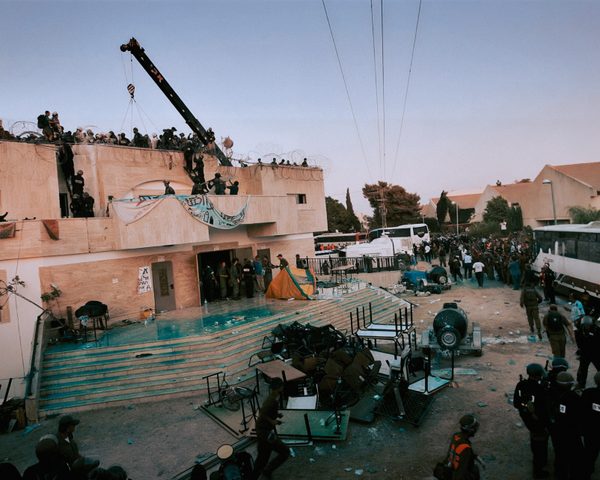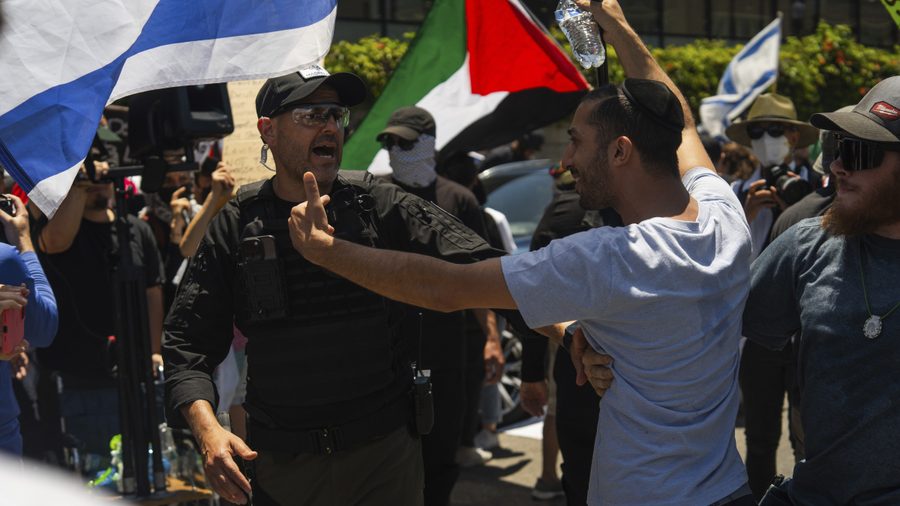
Protesters clashed outside Adas Torah, a synagogue in Los Angeles, in June 2024.
This article first appeared in the Jewish Currents news desk newsletter. Subscribe here.
A bill moving through the state legislature in California would make it a crime to approach a person within 100 feet of a synagogue in order to hand out a leaflet, hold a sign, or even “engage in oral protest.” Do it once and a judge could jail you for six months, per the law. Twice, and you could be jailed for a year.
The bill, which has the backing of the Jewish establishment’s lobby group in California, Jewish California, is cruising through the state assembly, where it was approved with no opposition by two committees last month. Civil liberties groups say it’s absurd, but 11 of the 13 members of the assembly’s Jewish caucus have signed on as co-sponsors.
The California bill is the most striking in a barrage of legislative proposals introduced in response to protests outside US synagogues hosting events that market land in West Bank settlements, including one protest Wednesday night in Manhattan that drew a forceful police response. Versions of the so-called buffer zone bills, named for the no-protest zones some of the measures would create around synagogue entrances, have passed in San Diego, Nassau County and New York City, while a federal measure is up for consideration in Congress. Early Wednesday, New York Governor Kathy Hochul said her budget, to be passed in the coming days, will include a buffer zone law. Since the New York proposal is bundled into a must-pass spending package, it’s likely to receive little public scrutiny, and will not be brought up for debate.
These efforts have alarmed civil liberties groups, who say the measures infringe on free speech rights and are unnecessary due to existing laws that prohibit obstruction of houses of worship. Palestinian rights advocates, meanwhile, say that the proposals are back-door efforts to protect events unlawfully marketing Palestinian land to American Jews, which the synagogue protests have targeted.
“What this boils down to is trying to squelch criticism and protect what Israel is doing,” said David Mandel, a California-based member of Jewish Voice for Peace who recently testified against the California legislation.
The California bill would create a 100-foot zone around synagogues and all other houses of worship in the state in which protesters would be legally barred from coming within eight feet of any person and handing them a pamphlet, showing them a sign, or engaging in “oral protest or education” without someone’s permission. In addition to the escalating jail sentences, protesters could be fined $1,000 for a first infraction, and $5,000 on repeated ones.
Proponents of the bill said the legislation was in response to protests like a June 2024 demonstration outside Adas Torah, a Los Angeles synagogue that was hosting a group that sells homes in West Bank settlements. Pro-Palestinian rights demonstrators blocked the entrance to the event, and violent clashes between pro-Palestine and pro-Israel protesters broke out. After publication of this story, Bocarsly emailed Jewish Currents to say that the bill was also in response to a December protest at another Los Angeles synagogue, Wilshire Boulevard Temple, during an event co-sponsored by Israel’s Consul General and featuring a speaker from the Israeli weapons company Elbit, whose bombs and drones have killed Palestinian civilians. Protesters gained access to the synagogue and caused property damage. “Services and Hebrew school were simultaneously underway; worshippers couldn’t enter to pray, and parents couldn’t reach their children for pickup,” Bocarsly said.
The legislation was drafted by Rebecca Bauer-Kahan, a Democrat representing parts of the East Bay, and modeled after a 1993 Colorado law that prohibits anyone within 100 feet of an abortion facility from coming within eight feet of a patient to counsel against abortion without a patient’s consent. The US Supreme Court upheld the law in 2000 in a ruling criticized by free speech advocates. “[It’s] protective of the First Amendment because you can be within 100 feet and speak and hold a sign, but you just can’t come up to a person who is trying to get in and out of their place of worship,” Bauer-Kahan said of her synagogue bill during the judiciary hearing.
“There’s some people entering synagogues who don’t want to hear somebody saying what Israel is doing in Gaza is genocide. I get that,” said Peter Eliasberg, a First Amendment attorney at the ACLU of Southern California. “But I don’t think we should live in a world where people can shield themselves from having to deal with that if they’re out on a public street.”
At an April 21st judiciary committee hearing on the bill, two state legislators voiced skepticism about its criminal provisions. “If Dr. King was in front of his church in Alabama in front of the Montgomery bus boycott trying to give leaflets to people, could he then be criminalized under a law like this?” said Assemblyman Isaac Bryan. (Bryan and another committee member, Ash Karla, abstained from the committee vote on the bill.)
Jewish California, a coalition group consisting of local Jewish federations and other communal organizations, supports the bill. “We’re able to strike the right balance of protecting freedom of speech and the right to protest even at a house of worship. You just can’t block someone from entering or intimidate them from trying to access their house of worship,” David Bocarsly, the executive director of Jewish California, told Jewish Currents.
It’s unclear whether the California bill will ultimately pass, though Bocarsly said he was “optimistic” that the bill will resonate with legislators. JVP’s Mandel said Palestinian rights groups will go to the capitol again to lobby against the bill once it comes before the state senate. “We’ll get started earlier and try to mount a more robust opposition,” he said. If the bill passes both the assembly and the senate, it would still need to be signed by the governor. A spokesperson for Newsom said the governor’s office doesn’t comment on pending legislation.
This story has been updated to include additional context on the protests outside synagogues that this bill is responding to.

I’m Arielle Angel, editor-at-large of Jewish Currents. Before you go, there’s something I need to ask.
We’ve seen over and over how the mainstream media falters in telling stories on our beats—whether it’s antisemitism, Israel/Palestine in American politics, Jewish identity, or the American left. At Jewish Currents we’re committed to uncompromising analysis and longform reporting on these issues and more—stories you won’t find anywhere else. In a media landscape that obscures injustice and flattens discussion, we’re changing the conversation. But we need you.
If you believe in this work, please consider making a donation—or even better, a recurring one—to ensure that we are able to keep publishing stories like this one. We can’t do it without you.