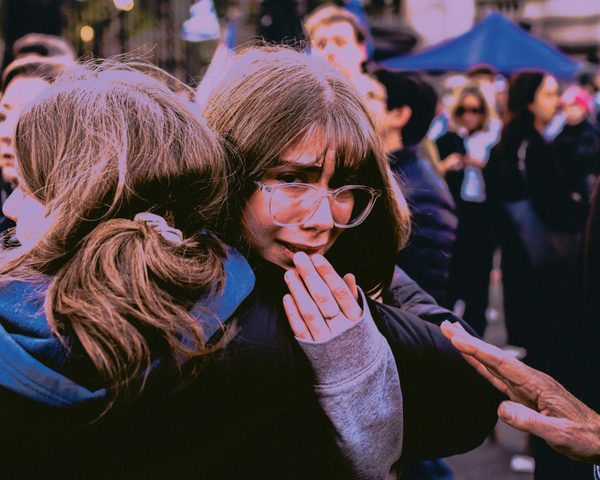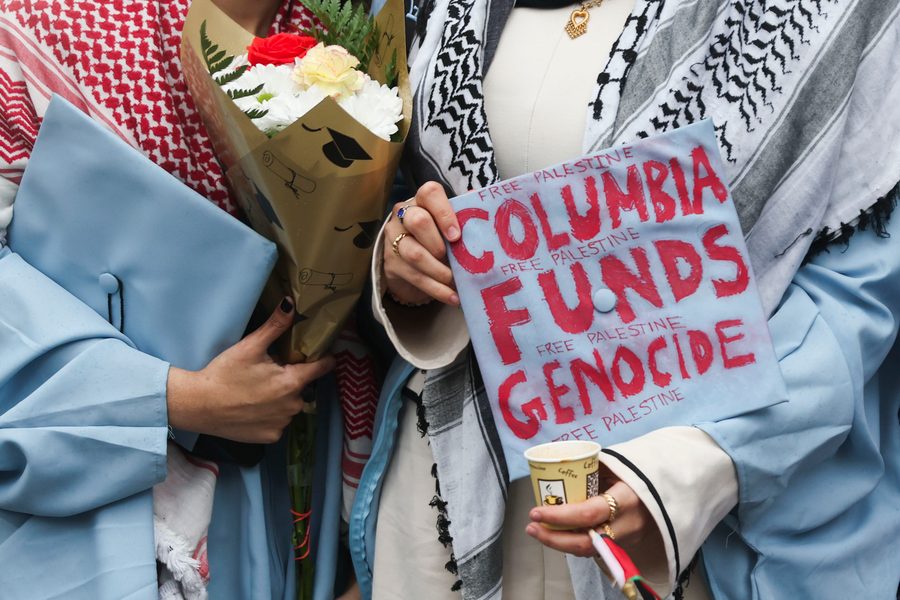
Graduating students pose for photos near the main gates of Columbia, May 21st.
The Monday after two plainclothes Immigration and Customs Enforcement (ICE) officers unlawfully detained Mahmoud Khalil at his Columbia University residence, I walked into my classroom in Kent 511, unsure who, if anyone, would show up. The night before, I had offered a hybrid Zoom option to undergraduates who felt uneasy about attending in person, given rumors that ICE was targeting international students across campus. I braced for an empty room. To my surprise, students filed into the damp classroom one after another. No one stayed home.
That evening, I opened class with an acknowledgment of the campus atmosphere—its heightened militancy and restlessness. Some students took this as an invitation to vent, while others reflected quietly. Most just laughed at the absurdity of their educational setting. I live two minutes away, but have to get to campus 15 minutes early to wait in the security line, one said. Sometimes, when I know I’m running late, I blame security, another confessed.[1]
Minutes later, we plunged into the day’s task: reading criticism. Shifting seamlessly from the temporal to the textual, students began discussing Tolstoy’s What Is Art? and Hanif Abdurraqib’s ode to Prince. Some contested Tolstoy’s claim that art could be defined as the transmission of emotion—the act of conveying feeling to an audience and inviting them to feel in kind. Others agreed with him. The discussion led students to the topic of persuasion. Is what moves us in art also what moves us in political rhetoric? they wondered. Indeed, is it the same thing that moves people to care for one another in the first place?
Certainly, care for each other’s perspectives had enabled the participants of this creative writing classroom to withstand the tumult of their college. Through Columbia’s many crises, inquisitiveness about one another had kept my students engaged, even across ideological fault lines. Every session, they came prepared to help their classmates’ writing improve, critiquing it to more fully transmit the intentions of its creator.
Outside our classroom, violent spectres had begun haunting campus. The grounds were dotted with vigilant officers and bulbous cameras that watched students’ every move and utterance for evidence of subversion. Many of my students were wary of the school’s server and avoided email or Zoom, fearing surveillance by right-wing media or punitive administrators. Some, especially those writing about protest activity or Palestine, asked the workshop to delete their papers after discussion, worried (with good reason) that people might leak their work to conservative news outlets. And still, in my classrooms students continued to move, whether defiantly or unwittingly, toward the very things two successive university—and presidential—administrations seemed determined to suppress: political deduction and the exchange of ideas.
During the 2024-2025 academic year, I taught four writing courses at Columbia University as part of my one-year postgraduate fellowship. Each semester, I led one nonfiction workshop and a seminar on the traditions of nonfiction.
My first time teaching undergraduates coincided with many of them regularly making global headlines. The year before, as a graduate student at Columbia, I watched the United States Congress grill the university’s then-president, Minouche Shafik, about the charge of rampant antisemitism on campus. Representatives inquired about specific professors by name, marshaling their social media posts and their pedagogy as evidence of antisemitism. It was clear that the country’s leaders placed a significant share of the blame for student activism on teachers. Shafik reassured them that she was “personally committed” to making sure that faculty did not “cross the line.” In the subsequent months, the institution unleashed a repressive juggernaut against supporters of Palestine on campus, resulting in hundreds of student arrests and in the loss of revered faculty.
At the beginning of September 2024, I completed the university’s new Title VI training, revised in response to the events of the prior year and the subsequent recommendations from the Anti-Semitism Task Force. The module instructed faculty on the handling of specific scenarios in and around the classroom. In one hypothetical, a professor holds a class about climate change near a protest. The protesters have signs suggesting people of Country Theta are “evil murderers,” causing a student from Theta to feel too uncomfortable to attend class. The training was fuzzy on the specifics of how such a situation could come to be. Was the class often held outside? Did the protest happen spontaneously, or was the professor aware it was about to happen? How is the class’s content relevant to the concerns of the protest? I did not know. Still, the training pronounced that the professor was limiting educational opportunities for the Thetan student, and told us that holding class near protests “crossed the line between criticizing a country’s policies and denigrating the people from that country.” “Academic freedom is not unlimited,” it concluded.
As an early-career educator, new Title VI guidance led me to deduce that it was essential to maintain a dry objectivism in the classroom.
As an early-career educator, this guidance led me to deduce that it was essential to maintain a dry objectivism in the classroom. In those early weeks, I overplanned lessons to avoid non-pertinent political discussions. I considered replacing an essay on my syllabus by Sarah Aziza on witnessing the Gaza genocide, and rehearsed my rationale should I be questioned on keeping it in. I gamed out how I might mediate if one student insisted on using “conflict” to describe the genocide and another student called it out. I stumbled when students brought up the brutalities enacted by Israel or mentioned the Gaza solidarity encampment. Often, I just nodded and quickly pivoted to the “germane.”
This approach worked for a time. As the circus raged outside, with its hawkish cameras and nosy ventriloquists, some students arrived in class eager to escape it all. They sought to dwell instead in the education they had come here for—to learn beyond the present moment, discuss something of the past, and perhaps even a hopeful something of the future. And so, in that first month, as the weather soured, they read and dissected Gay Talese’s “Frank Sinatra Has a Cold,” then wandered Manhattan looking for a compelling subject to profile themselves. For a few weeks, we managed to remain in a cocoon of craft. But it would not last.
The problem arose toward the middle of the semester, when students’ writing assignments came due and they began submitting some of the most urgent writing in America right now. Faced with essay prompts that encouraged them to engage deliberately with their environment, they wrote about reconciling what is and what could be. They wrote the benign brutally and the brutal delicately. They wrote about furtive sexual desires and quintessential fights with parents. They wrote about their fear of bugs and heartbreak and the encroaching police, about generational nihilism in a changing climate. And, time and time again, they wrote about the genocide of Palestinians: from a psychological perspective or through a feminist lens, in lyric essays and with ethnographic tools.
Why, despite my desultory efforts, had the politics of the present perforated the classroom? I sensed the answer had to do with the nature of what I was teaching, and the lives of the people I was teaching it to. Creative nonfiction charges us to extrapolate from our surroundings, using them as points of departure into more universal inquiries. My students instinctively reached for this horizon, writing not only about their experiences but also about how their lives were shaped by and linked to broader histories. Much had preceded my time as an instructor at this school: a pandemic that left students in bewildering isolation, the quashing of student unions, a steady consolidation of executive power, and the militarization of campus in service of curtailing anti-genocide protest, to name a few. These events pushed students away from the institution and into one another’s arms. Many began organizing, disagreeing, fracturing, and re-organizing—experiments in collectivity that organically found their way onto the page. Some confronted these topics experientially, as in essays about peers who were expelled, kicked out of university housing overnight, and left to seek shelter amongst friends. Others tried to make sense of their mediascape, dissecting and critiquing television shows and viral moments in popular culture. Reading their work, I began to understand that political engagement was not confined to a small, outspoken faction of undergraduates, as the media regularly insisted. It was, instead, a contagious sensibility that had taken hold in the tight quarters students were forced into.
In her 1975 essay “Notes of a Barnard Drop-Out,” the poet June Jordan wrote, “Barnard College did not teach me necessity, nor prime my awareness as to urgencies of needs around the world, nor galvanize my heart around the critical nature of conflicts between the powerful and the powerless.” I believe the same went for many of my students, who had been galvanized in large part by influences beyond Columbia’s iron gates—most pressingly, Gaza. A generation raised on mobile devices could scarcely ignore a livestreamed genocide. This is a fact pro-Palestine students’ detractors have delighted in pointing out, conjuring a generation of screen-addled minions in thrall to TikTok’s ahistorical propaganda. As recently as November, former Obama aide Sarah Hurwitz argued that young people in the US are shaped by the “post-literate media” of the internet, and are thus misinterpreting the carnage in Gaza as comparable to the Holocaust or the history of racism in America. But inference based on history and a critical understanding of power—the things that Hurwitz ironically deems “post-literate”—are in fact profoundly literate impulses, central to the work of higher education.
In my classrooms, students repeatedly demonstrated such instincts. They did not engage with Gaza merely as passive algorithmic consumption or performative online outrage. Instead, they often independently researched and synthesized what they saw on social media, conferred in clubs and common rooms to informally process the images, and then entered the classroom to engage in dialogue. For instance, when we read Teju Cole’s “When the Camera Was a Weapon of Imperialism and When It Still Is,” students connected Cole’s argument about a camera’s gaze being inherently political to the storm surge coming out of Gaza. They talked about the video of an 11-year-old Palestinian boy carrying the remains of his baby brother, Ahmed, in a blue backpack, or the footage of Ahed Bseiso being amputated by a kitchen knife with no anesthesia.
To sidestep the unrelenting genocide in Gaza, which animated so much of how people processed and grieved the world around them, would have been to retreat into the exact didactic teaching I was trained to avoid.
Such moments of extrospection were not tangents, I began to understand. They were the substance of how students were digesting their learning. To sidestep the unrelenting genocide in Gaza, which animated so much of how people processed and grieved the world around them, would have been to retreat into the exact didactic teaching I was also trained by the Title VI office to avoid. So I relaxed. I started letting students lead discussions, acting less as an instructor and more as an interlocutor. I opened myself up to the unruliness of a writing classroom that held, rather than excised, its students’ politics.
I had known from the start that the students in my classes were not all politically aligned. Some were adamantly socialist. Others had inherited an unquestioning centrism from their parents. Most had not yet decided on a political ethos but were moving through college looking for it.
In the workshop environment, there is nowhere to hide from such differences. Unlike seminars or lectures, workshops have no definitive syllabus outlining what students will gain in the course. Their peers provide the education. As the author and educator bell hooks writes, “There must be an ongoing recognition that everyone influences the classroom dynamic, that everyone contributes. These contributions are resources.” The workshop, then, by definition, fosters sustained exposure to other perspectives. Students have their writing read only twice or thrice a semester, yet spend the remaining eight to ten weeks emphatically debating how best to express another’s ideas—ideas with which they might bitterly disagree.
After I ceded some control over the classroom conversation, I braced for arguments and fracture, preparing (as the Title VI training forewarned) for Zionist students to file reports of discomfort caused by pro-Palestine writing, or activist students to drop out at the slightest hint of Zionism in their peers’ work. But something altogether different unfolded. Over the course of the semester, students who fundamentally disagreed on whether university deans were essential educators or overpaid middle managers collaborated on essays about just that, pointing out gaps in one another’s argumentation. Students from different class backgrounds read one another’s essays, then embarked on meaningful discussions about their divergent upbringings.
I watched these developments with hesitant optimism, cautious of what might still erupt. I feared that certain disagreements might trigger administrative meddling; I also worried that parents might be perturbed by the politically charged topics students were investigating in their art. Sometimes I recommended that students proactively seek input from their loved ones before presenting their writing to the class. But to my surprise, students preferred consulting with their peers—even those with whom they knew they clashed.
On multiple occasions, Jewish students submitted work or verbally grappled with how to continue supporting a Jewish nation-state, or how to express nascent critiques of Zionist commitments within their families. I could see that these students offered their experiences with trepidation, knowing that their sympathies might not be shared but seeking peers’ responses nonetheless. In turn, their critics—frequently first-generation college students, Black and brown women, anti-Zionist Jews, and queer individuals—responded with principled, constructive feedback, identifying logical fallacies or historical omissions in defenses of Zionism. The writers occasionally offered rebuttals shaped by their own communal considerations; at other times, they simply took notes. In the next session, they might flip positions, with anti-Zionist students submitting writing, and others in a position to critique. As in any workshop, such interactions sometimes led to heated exchanges: People quietly walked out of the room, or were on the edge of tears, myself included. Still, the following week, we all returned to the same muggy room, and students reentered the process of criticism all over again.
In her essay “Art Song,” Maggie Nelson recounts an episode in which photographer Catherine Opie is teaching an art criticism class. During the class, a student critiques another’s work, claiming it “signifies the backbone of colonialism,” leaving the artist visibly dejected as he mutters, “Damned if I do, damned if I don’t.” In response, Opie urges the artist to engage rather than retreat. “Stand up for your work!” she entreats him, “Open it up! Don’t shut it down, man.” Nelson uses this scene to illustrate her claim that “the pedagogical task at hand was not to discipline people for their failures, but to help them make more interesting art, discover how to talk about it together, and allow that shared fortitude and support to become a basis for motley community.”
I saw Nelson’s insights translate to the context of my nonfiction workshops, where the singular, often messy, goal was to make one another’s art sturdier so it could withstand the world’s scrutiny. Some sessions would begin with sentences like, “As you know, I don’t agree with what your narrator is saying, but I want to help you write it.” While I am unsure if anyone’s political position shifted, the sustained exposure to one another, and the trust accrued between them, encouraged students to consider perspectives they had not yet encountered or may not otherwise have engaged with so thoroughly. I cannot say what went on between these same students outside the classroom—they might well have never interacted, or have been active political adversaries. But each week in the classroom, they burrowed into one another’s viewpoint, at least for a short while. In the motley community of my classroom, we sought shelter from the institution’s fugue state. Amid a widening chasm of campus paranoia, we built a wobbly bridge of open exchange.
Amid a widening chasm of campus paranoia, we built a wobbly bridge of open exchange.
Like most liberal exercises, the workshop has its limitations. Not all topics merit generous feedback, nor are all tales of personal woe created equal. Dialogic interaction may improve our writing, but it’s certainly not a cure-all for solving our most urgent and dangerous political quandaries. Still, by demanding vulnerability, the space of the workshop offered an antidote to the stifling antagonism on campus. Here, if only for a brief moment, students could stand on somewhat equal ground and look one another in the eye; share incipient ideas, and open themselves up to robust inspection.
It is ironic that this kind of organic communion—so often upheld as an ideal within liberal university frameworks—has been effectively foreclosed by the very policies those institutions have pursued in the last two years. In that time, too many “adults” have seesawed between infantilizing students as confused conduits of a misinformed agenda, or demonizing them as fringe, even hateful, agitators destabilizing an otherwise apolitical campus majority. Such bad faith allegations have occluded the simple fact that college students are not brainwashed provocateurs, only young people straddling the precarious threshold of adulthood who, however imperfectly, are trying to forge an ethic toward life—and are doing so while bearing witness to the most persistent slaughter and starvation of our lifetimes. What has moved these students to dissent is ultimately obvious: It is the persevering disquietude caused by others’ circumstances—beyond the classroom, across an ocean, under the rubble. Gazans have screamed into the cavernous echo of the internet, and one of the only apt responses has emerged on university campuses. Amid a higher education system that is rightfully criticized for its insularity, these porous reactions to real tragedies ought to be encouraged. Instead, every effort has been made to suppress them.
And yet, during my year of teaching writing workshops at Columbia, I learned that there are limits to this suppression. By the end of my final term, I had realized that I was not the one engineering the alchemy of my classrooms. Instead, that space, as the university itself, was shaped by the students who inhabited it, undergraduates who were all politically occupied, regardless of the depth and direction of their commitments. These students came to class seeking dialogue with one another, and so long as that remained the primary mode of learning, I saw that no apparatus of surveillance could really blunt its transformative potential. A classroom, no matter how closely patrolled, has a stubborn way of remaining a place devoted to inquiry. So do the crevices of campus life—libraries, class breaks, even house parties—where students converse with someone who does not look like them, persuade and argue, and begin to organize. As long as such spaces survive, so will the conditions for interaction, for questioning, and, perhaps, for revolt.
The nonfiction writing classroom is governed by an ethic of discretion. To honor that shared understanding, all interactions with students have been anonymized and broadly paraphrased. No student work or direct quotations appear in this article.

I’m Arielle Angel, editor-at-large of Jewish Currents. Before you go, there’s something I need to ask.
We’ve seen over and over how the mainstream media falters in telling stories on our beats—whether it’s antisemitism, Israel/Palestine in American politics, Jewish identity, or the American left. At Jewish Currents we’re committed to uncompromising analysis and longform reporting on these issues and more—stories you won’t find anywhere else. In a media landscape that obscures injustice and flattens discussion, we’re changing the conversation. But we need you.
If you believe in this work, please consider making a donation—or even better, a recurring one—to ensure that we are able to keep publishing stories like this one. We can’t do it without you.
Ade Khan is a writer from Dhaka, Bangladesh. She lives in New York City.