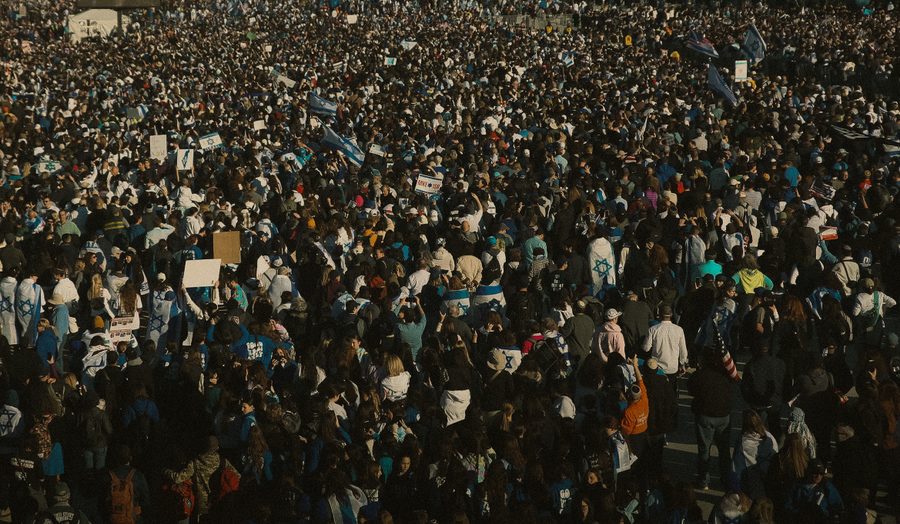
The March for Israel in Washington, DC, November 14th, 2023.
Robyn Stevens Brody/Sipa USARhetoric Without Reckoning
A new wave of liberal Zionist criticism of the Israeli government rings hollow without accountability for the genocide.
In late July, hundreds of rabbis signed a letter stating that even as they “unequivocally support” Israel’s battle against Hamas and Hezbollah, they “cannot condone the mass killings of civilians, including a great many women, children and elderly, or the use of starvation as a weapon of war.” The letter denounced Israel’s “severe limitation” on humanitarian relief in Gaza, and its “policy of withholding of food, water, and medical supplies from a needy civilian population,” saying it “contradict[s] essential values of Judaism as we understand it.” The letter currently has signatories from major denominations in the US, Israel, and around the world. This week 80 Modern Orthodox rabbis joined the chorus, signing a letter lamenting the Israeli government’s starvation campaign and intensifying settler violence in the West Bank. “Orthodox Jewry, as some of Israel’s most devoted supporters, bears a unique moral responsibility,” the letter says. “We must affirm that Judaism’s vision of justice and compassion extends to all human beings.”
Since Benjamin Netanyahu blatantly violated the ceasefire at the end of March—making clear he was abandoning the remaining Israeli hostages in favor of the territorial expansionist aims of his far-right coalition—a growing number of voices from within the heart of American Zionist Jewish life have publicly broken against Israeli government actions in Gaza. In the last several weeks in particular, as news of famine-related deaths has prompted international outcry and experts warn that we have passed the “tipping point” for mass starvation deaths, this wave of dissent has reached a fever pitch. On July 27th, the leadership of the Reform movement urged the Israeli government not to “sacrifice its own moral standing” by starving Palestinians and condemned calls from Israeli government ministers to decimate Gaza—the same type of incitement the movement had insisted in January 2024 “[did] not reflect the basis of Israel’s strategy in its war against Hamas.” On the July 30th episode of the popular podcast For Heaven’s Sake—a show affiliated with the Shalom Hartman Institute, an influential think tank for North American rabbis and institutional leadership—host Donniel Hartman made a stunning admission in a discussion attempting to face Israel’s policy of famine in Gaza: “It’s very convenient for us to say we didn’t know . . . We chose to hide what we know . . . What do you think we are doing when you create a siege?” he said.
While most of those speaking up for humanitarian aid within the mainstream have refrained from connecting their critique of Israel’s starvation tactics to a wholesale condemnation of its military campaign, and continue to blame Hamas for the large part of Gaza’s suffering, there are a number of other prominent Zionist figures who have recently reconsidered their resistance to the term “genocide.” Writing in the Forward in May, rabbi and scholar Jay Michaelson—who in late October 2023 adamantly denied that Israel intended to target Palestinian civilians and accused Israel’s critics of inciting violence against Jews—conceded that it is, in fact, Israel’s intention “to starve the population, to reoccupy much of the Gaza strip and level much of the rest of it, to force a million innocent human beings to leave or die.” He wrote that “the Netanyahu regime has made me, and liberal Zionists like me, look like the worst thing any Israeli can call another: a freier. A sucker. A fool.” Following a shifting liberal zeitgeist around the use of “genocide”—legitimized by historian Omer Bartov in the New York Times and Israeli human rights organizations like B’Tselem—Jeremy Ben-Ami of J Street said he has “been persuaded rationally by legal and scholarly arguments that international courts will one day find that Israel has broken the international genocide convention.”
In reading these unprecedented Jewish condemnations of Israeli actions, one gets the impression that something in Israel’s approach on the ground has changed dramatically in the past few months, not just in degree, but in kind. It has not. Experts were already ranking Israel’s military campaign among “the most destructive in history” in December 2023. By then, the damage to buildings in Gaza was already so extensive that the enclave was a different color from space. By early 2024, Gaza was reported to have the largest child amputee population in the world. Around the same time, humanitarian groups and other experts were already sounding the alarm that the blockade was creating a humanitarian crisis and that Israel was using starvation as a weapon of war. In November 2024, the International Criminal Court (ICC) issued arrest warrants for Israeli Prime Minister Benjamin Netanyahu and former Defense Minister Yoav Gallant partially due to their perpetration of the crime of starvation—a circumstance foreseen by Gallant’s infamous promise on October 9th, 2023, that Israel would allow no food or water to enter Gaza.
In reading these unprecedented Jewish condemnations of Israeli actions, one gets the impression that something in Israel’s approach on the ground has changed dramatically in the past few months. It has not.
In light of this, why is it only now that the silence in the American Jewish community over Gaza has at last broken? And what should those of us who were against the war on October 8th expect from those who have taken almost two years—in which we have seen entire families disappeared under the rubble, entire cities reduced to ghost towns, and now an entire civilian population wasting to the bone—to voice their concern?
The most generous explanation for what has taken these Jewish leaders so long is that many American Jews were shocked and horrified by the violence of the October 7th attacks, and subsequently felt it was their duty to stand shoulder to shoulder with Israeli society—95% of which supported the Israeli government’s war, declared in the name of defeating Hamas and freeing the hostages. But Israelis’ understandable grief was immediately sharpened into a monstrous call for revenge, which emanated directly from the Knesset. Mainstream American Jewry rushed to offer their unconditional solidarity and to take on the trauma of the October 7th attacks as their own, bolstered by a media echo chamber rife with misinformation, atrocity propaganda, and fearmongering. In the coming months, as the Israeli military flattened Gaza, American Jews remained stuck in the story of October 7th. They learned the names of every Israeli hostage, but nothing of Khalil Abu Yahia, Hind Rajab, Hossam Shabat, or Mohammed Abu al-Qumsan. Synagogues hosted speakers representing the 115 Israelis who lost both parents on October 7th, and sent solidarity delegations to the kibbutzim, while remaining willfully ignorant of the fact that doctors in Gaza had coined the term WCNSF, for “wounded child no surviving family,” due to the thousands of children they treated whose entire families had been killed. When information about the genocide did break through, it was brushed aside as blood libel and slander, the result of a scourge of rising antisemitism, on campuses and in the streets.
In part, mainstream American Jewish leaders have justified their refusal to face the facts of Gaza’s mass graves, barely functioning hospitals, and flattened universities via a dangerous, self-soothing Jewish exceptionalism—the belief that Jews are guided by a superior ethical code and that Israel as a Jewish state is, too. Speaking on For Heaven’s Sake in December 2023, Hartman declared, “I don’t believe . . . and nobody in Israel believes, that Israel’s targeting civilians. It’s not in our ethos. We know our army. We know our soldiers. That’s not what we do.” At that point, South Africa had detailed ample evidence to the contrary in their application to the International Court of Justice alleging genocide, including reports of summary executions of multiple members of a single family, the murders of unarmed civilians fleeing on designated “safe routes,” and the dropping of 2,000 pound “dumb” bombs which killed indiscriminately within a 1,000-foot radius. Hartman and his co-host Yossi Klein Halevi, both American émigrés to Israel, brushed off the indictment as antisemitism. Others acknowledged the damage but insisted it was a necessary cost of the war. Hartman and Klein Halevi’s colleague across the ocean, Hartman Institute President Yehuda Kurtzer, has made the case repeatedly since October 2023 that “Israel is fighting a just war based on a just cause.” In January 2024 he responded to American Jews growing uneasy with the carnage in Gaza by saying that he still believed there was no “moral imperative” to oppose the war and that he could not identify a clear “limit to the blood sacrifice we must demand or endure” in pursuing ends he believed in.
Watching the persistence of such arguments well into 2025, it’s hard not to conclude that the simplest reason why most American Jewish leaders didn’t speak out sooner is because they weren’t actually opposed to what was happening for most of the last 22 months. For Israel’s liberal defenders, the country’s show of dominance against Gaza, Lebanon, and Iran was necessary to restore Israeli deterrence against future attacks, even if it may have gone a bit too far. In May of this year, on his own Hartman podcast Identity/Crisis, Kurtzer discussed the destroyed buildings, the massacred families, and the campaign of starvation and concluded that he had not changed his opinion that Israel’s fight was just. And yet, where “I was willing to endure the costs to my enemies, to civilians, and even to my own moral fiber in that process,” he said, “I just am not willing to endure it anymore.” In other words, he is satisfied with the damage. Now that it’s done, it’s safe to be uncomfortable with it. In July, Rabbi Doug Kahn, executive director emerita of the San Francisco Jewish Community Relations Council, took a moment to praise Israel’s “brilliant strategic operation against Hezbollah and against Iran” as he implored the country to use its supposed military ingenuity to “find a way to end the humanitarian nightmare that exists in Gaza.”
All of this rhetoric betrays the clear hierarchy of the value of human life endemic to Zionism. Only the logic that Jewish death is unacceptable and Palestinian death is a tragic necessity can explain the way these leaders remained ensconced in a story about Jewish victimhood as Gaza burned. In fact, even within that very first week after October 7th, there was no way to tell a story exclusively about Jewish victimhood unless you simply did not value Palestinian lives. For one thing, over 200 Palestinians had already been killed in the West Bank in 2023, before the Hamas incursion took place. But for another, Israel’s retaliatory bombing began almost immediately, raining death on the neighborhoods of Gaza, while settler violence spread like wildfire across the West Bank. The Palestinian death toll far surpassed that of October 7th within a single week, hitting 2,300 people by October 15th. Early warnings from Palestinian analysts, journalists, and doctors, as well as genocide scholars, human rights organizations, and international bodies about where Israel’s campaign was headed were all ignored. Even now, as some admit aloud to the horrors they’ve long suppressed, most American Zionists frame the end to the war primarily in terms of the benefit to Israel. In articles and statements from conservative columnist Bret Stephens to the Reform movement, Israel’s self-interest and public image remain front and center, and harm to Palestinians remains a footnote.
Only the logic that Jewish death is unacceptable and Palestinian death is a tragic necessity can explain the way these leaders remained ensconced in a story about Jewish victimhood as Gaza burned.
Some progressive Zionist groups have been willing to go beyond open letters and podcast chatter. On July 28th, eight rabbis wearing tallitot and carrying sacks of flour were arrested for blocking the street outside of the Israeli consulate in New York. They held signs calling for food to be let into Gaza, and chanted, “Let Gaza Live.” T’ruah, the group that organized the protests, has been in support of a ceasefire since the end of 2023, but this was notably their first act of civil disobedience since October 7th. They have since helped organize similar actions in Chicago and San Francisco. A few days later, on August 4th, T’ruah and other liberal Zionist organizations joined a New York protest organized by the more left-wing group IfNotNow (INN), forming a previously unlikely coalition under the banner “Jews say no more to ethnic cleansing and starvation.”
This is a welcome step. Standing at the action that day, I was heartened to witness the growing ranks of Jews standing against the horrors in Gaza. But the presence of these progressive Zionist groups also provided a painful reminder of their long absence. After October 7th—while INN, Jews for Racial and Economic Justice, and the newly formed Rabbis for Ceasefire joined Jewish Voice for Peace (JVP) as part of a broad multifaith, multiracial anti-war movement—T’ruah, J Street, New Jewish Narrative (formerly Americans for Peace Now), and other progressive Zionist organizations that work together as the Progressive Israel Network (PIN) emphasized Israel’s right to defend itself and backed away from the “ceasefire” call. While these groups had critiques of mainstream Jewish organizations who wholeheartedly endorsed Israel’s onslaught, ultimately they chose to stand with them over the pro-ceasefire left, even joining a war rally in November 2023, when over 5,000 Palestinian children had already been killed. Most of these groups took months to push for meaningful material costs on Israel, like limiting weapons sales, and in the meantime, many of them made the work of those who did advocate for such measures more difficult. J Street threatened to withdraw their endorsement of lawmakers who dissented against the Gaza war, and their dithering on adopting the word “ceasefire” signaled to lawmakers that they should do the same. “We’ve spent 15 years building this political power to rival AIPAC,” a J Street staffer who quit in protest told Jewish Currents in March 2024. “And now, all of a sudden, when that power could be wielded during a literal genocide, it’s like, ‘Oh, we actually can’t do any of the things we’ve been saying all these years that we can.’”
I couldn’t help but feel a version of this frustration thinking about the impact these newly emboldened rabbis and organization heads could have made a year and a half ago. Through their network of staff, boards, donors, members, and congregants, these leaders have access and power. They doubtless faced enormous pressure from many of those corners to hold a pro-Israel line after October 7th, but few seemed to believe there was anything they could do besides flow with the communal current of panic and revenge. They might have taken the opportunity to lead rather than follow, to train their constituents’ grief and anger on stopping a military escalation that would evidently only lead to more death and suffering, and away from the disregard of Palestinian humanity. As Democratic opinion shifted dramatically against Israel, these individuals and groups could have used their access to make waves. Rabbi Rachel Timoner counts staunchly pro-Israel Senator Chuck Schumer among the congregants of her Brooklyn congregation; Rabbi Sharon Brous of IKAR in Los Angeles gave the benediction at the Democratic National Convention, where the Uncommitted Movement was shamefully barred from speaking. They might have stepped out and pushed Democratic leadership. It would have mattered. Instead, they lagged behind them, reserving their most forceful public words for campus activists or Zohran Mamdani.
Crucially, the statements of newfound moral urgency from both groups of latecomers—the progressive ilk and the Zionist mainstream—so rarely acknowledge or reflect on their catastrophic delay in taking a stand. This trend has been evident for over a year: When PIN groups collectively began endorsing the call for a ceasefire in March 2024, when the death toll in Gaza passed 30,000, they took great pains to distinguish their calls from those of groups farther to their left, making it clear that they continued to stand with Israel. In her remarks at the recent IfNotNow action, Jacobs cited T’ruah’s October 12th, 2023, statement, which called for humanitarian relief in Gaza. “I wish we had been wrong,” Jacobs said. What she omitted is that her organization’s original call for humanitarianism was made within an explicit endorsement of the Israeli government’s military operation in Gaza—signed by the entire Progressive Israel Network. Similarly, as Michaelson embraced the “genocide” designation this spring, he defended his previous positions, and castigated those who leveled the charge of genocide before he did. “Looking back, I still believe I was correct then—and am still struck by how quickly some of Israel’s critics leapt to the most incendiary and extreme characterization of its military operations,” he wrote. Kurtzer, too, has appeared unwilling to examine any of his priors. In a piece earlier this month, he continued to defend the “just war” framing while conceding that “we may have passed the threshold” of its relevance. Still, he aimed his concern chiefly at Holocaust historian Raz Segal’s essay in this publication, arguing that “It was incoherent to make the claim of genocide in Gaza back in October of 2023 . . . It is a textbook example of what we call confirmation bias . . . one of the worst transgressions a scholar can commit.” He asked his readers instead to “to confront [the] horror and to feel it deeply . . . but to stop short of giving it a name.”
To harp on accountability is not about settling accounts, or discouraging anyone from joining an urgent fight. It is to insist that only an honest reckoning with what has gone wrong these last two years can ensure that the same harm is not repeated.
Altogether, the result is that nearly two years into a genocide, leaders of a community that has actively offered political, financial, and narrative support to the perpetrators are acting as if their sudden disavowal is enough to erase their complicity. To harp on this is not about settling accounts, or discouraging anyone from joining a desperately urgent fight. It is to insist that only an honest reckoning with what has gone wrong these last two years can ensure that the same harm is not repeated. Jewish leaders’ insistence on clinging to their priors and shunning those who predicted many of the horrors they now decry speaks to their refusal to engage in the uncomfortable work of transformation—of changing the structure that enabled the genocide in the first place, and does so still. In a telling example, a rabbi who spoke at the July 27th T’ruah rally published an op-ed a few days later explaining the significance of his protest coinciding with the day his son was joining the Israeli military as a lone soldier: “My stake in the future of Israel as a democratic state with a moral army is greater than ever,” he explained—as if the mass starvation of Gaza he protested is somehow separable from the impunity of the occupying army bolstered by foreign Jewish recruits like his son.
The Rambam teaches that there are multiple steps to teshuva (repentance for harm). The wrongdoer must recognize and regret the behavior; cease the wrongdoing; confess the wrongdoing; then reflect on the impact and ask for forgiveness. Finally, teshuva requires a commitment not to repeat the action when confronted with a similar situation in the future. In her book On Repentance and Repair: Making Amends in an Unapologetic World, Rabbi Danya Ruttenberg writes that a “victim centered approach” to repair values the needs of the victims above the stability of the “institutional ecosystem” that allowed the harm. She recognizes that addressing the harm will necessarily challenge those in power, and that “this may be exactly why those who are culpable wish to avoid the conversation altogether.” But she insists that this is an inevitable part of the process. “How can we change if we don’t know who we are? If we can’t face what we have done?”
It may feel premature to speak of teshuva as the slaughter in Gaza continues, but the framework can offer us tools to shift course towards more effective action. As we enter the reflective month of Elul, we must ask, what would real teshuva look like in practice within the Jewish world? The first step must be an honest intracommunal reckoning. This may start behind closed doors, as Jewish people who supported the war process the harm they’ve done with their families, friends, and broader communities. These conversations should account not just for the unbearable starvation today, but for Israel’s decades-long process of dispossession and dehumanization of Palestinians, which led Israel to perpetrate a genocide in the name of the Jewish people. Those in need of inspiration in facing complicity head-on, without making excuses, might look to Lihi Ben Shitrit, an Israeli political scientist at NYU, who reflected recently in the Forward on the intellectual and emotional blocks she experienced to recognizing and naming the genocide in Gaza. Once “taken aback by [Raz] Segal’s certitude,” she now concedes that, “when it comes to the threat of genocide, [Segal’s] being alarmist is precisely what is needed.” She continued, “Liberal Jews like myself need to overcome our shame, which pushes some of us to avoid or even deny the reality of Gaza . . . Writing this article is my first step in this direction.”
Like Shitrit’s did, this private reckoning should quickly graduate into the public sphere. Rabbis and institutional leaders who regret past statements should walk them back in front of their congregations and in the media, explaining clearly what made them change their minds. They can model vulnerability and courage in speaking to why they dismissed the expressed genocidal intent of Israeli leaders as rageful bluster, while ignoring the clear warnings of Palestinians who live the devastating impact of Zionism every day. They can acknowledge the ways that “Jewish unity” was marshaled at the expense of Palestinian lives, and its catastrophic failure to succeed even on its own terms—to guarantee any of us safety, least of all the Israeli hostages. Rabbis who have catered to the most belligerent right-wing voices in their communities should trust that they have a quieter constituency desperate for moral leadership and ready to be brave, and an opportunity to help those who are scared or stuck to change their minds. “The larger the scale of harm—and the greater the number of people obligated to address and repair that harm—the more critical the first step of repentance is,” Ruttenberg writes. “The work of confession forces the penitent . . . to resist the temptation to minimize, to gloss over, to skip a reckoning with what actually happened, how it happened, by whom, and why.”
In addition to making efforts to educate themselves, communities should invite Palestinian speakers whose voices have been kept out of frame for too long. This will require apologizing for smearing many of them as antisemites, paving the way for the firing and harassment of Palestinians and their allies, and the detention of student protesters. Not everyone will accept these invitations, but some will, especially if they see Jewish groups newly activated in defending those under attack by the administration and civil institutions. Liberal Zionists may find they need the help of anti-Zionist Jewish organizations they previously shunned, like JVP, to share their experience with direct accountability and partnership with Palestinians.
Jewish communities should ask themselves “What would you have done to stop the annihilation of the Jews of Europe?” and should do just that for Palestinians now. You are either for genocide or against it.
The goal of these listening and learning programs must be material commitments to mobilize the power of Jewish institutions to end the unfolding Israeli attempt to complete the Nakba and empty the land of Palestinians. Leaders must take action. They must focus their considerable political energy on stopping the flow of weapons from the American government to Israel, putting pressure on electeds and participating in civil disobedience. They can also start addressing the complicity of our communal institutions: cutting ties with Jewish organizations that still fully support Israel’s genocide, including AIPAC, the American Jewish Comittee, and the Anti-Defamation League; canceling their mission trips to Israel; and reorienting their relationships with Israeli partners toward supporting disruptive civil disobedience and scaling up protective presence in the West Bank. Institutions of all stripes should commit portions of their annual budget to reparations for Palestinians living in Palestine, and to groups supporting the displaced and injured in diaspora. Congregations should demonstrate the understanding that there are more important things than “unity” by bringing delegations to the UN and the Hague to support the prosecution of Israeli officials at the forefront of dismantling the tenets of international law. Reconsidering the communal taboo on Boycott, Divestment, and Sanctions—a commonsense, nonviolent program that Palestinians have long advocated for—would be a bridge to allyship not only with Palestinians but with international partners, reconnecting Jewish communities to the rest of the world. Jewish communities should ask themselves “What would you have done to stop the annihilation of the Jews of Europe?” and should do just that for Palestinians now. You are either for genocide or against it.
The temptation to avoid this reckoning and stay in safer territory will be strong. But the stakes are too high and too many lives have already been lost. Business as usual must be disrupted for the genocide to end. If leadership resists this process, it will be the responsibility of the rank-and-file—the membership, the congregation, the employees—to insist on it. Those in stubborn institutions should leave, or band with others to start new spaces where they themselves can lead. Liberal Jews willing to engage in public reckoning may find that many of us on the Jewish left will be softened by it. After all, most of us—myself included—had our own painful confrontation with Zionism. We recall both the isolation of being cast out of the mainstream Jewish community and the sweetness of building new relationships of solidarity. I’m only here today because many people offered me an off-ramp. That’s why many in my position feel that it is our responsibility to engage—to exercise humility and grace as we sit with other Jews in their fear and shame, and invite them to take action with us.
This week, Israel announced that it was calling up 60,000 reservists in preparation to reoccupy and ethnically cleanse Gaza City, and also presented plans for a major settlement project in the E1 corridor in the West Bank, with the stated goal of preventing a Palestinian state. We very well may hear the anguished complaints from liberal Zionists who believe that Israel has once again gone too far. At this point, there can be no mistake that this is not an aberration, but the state’s intended course—a course it maintains because it can. There is no more time for handwringing; there is work to be done. Showing up today means committing to the long haul of protecting Palestinians living between the river and the sea and enabling them to rebuild and return home. The road to freedom and justice is long and we need as many people actively on it as possible. But there is no justice without teshuva, without accountability. It is painful work, to be sure, but it is the only hope toward bringing a better world for all of us, including all who call the land home, on the other side.

I’m Peter Beinart, editor-at-large of Jewish Currents. Before you go, I need to ask something of you.
In recent years, I’ve watched as mainstream Jewish institutions and media have chosen ethnonationalism over liberal democracy and mass slaughter over the pursuit of a just peace. Jewish Currents offers something different. It’s a magazine built on intellectual curiosity and respect for the dignity of all people.
But a project like this doesn’t sustain itself, and we can’t do it without your help. If you share my belief in the importance of this mission, please consider making a donation—or even better, a recurring one. We need you with us.

Simone Zimmerman is an organizer and strategist based in Brooklyn. She is a co-founder of the anti-apartheid group IfNotNow.