Newsletter
May
28
2026
Good afternoon from the Jewish Currents news desk. In today’s newsletter, Mari Cohen explains why I should care about the boycott vote at that supermarket in Park Slope. And we ask a few quick questions about what New York State’s new synagogue buffer-zone law means.
I’m Josh Nathan-Kazis, and here’s what we’re talking about today at the Jewish Currents news desk.
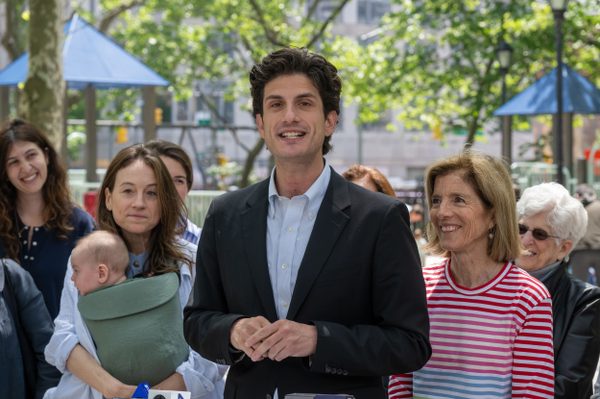
Congressional hopeful Jack Schlossberg and his mom, Caroline Kennedy, in Manhattan this month. Schlossberg has recently made a show of swinging left on Israel.
Ron Adar/Sipa USA via AP
SAME OLD: Haaretz is reporting that the next Israeli consul general in New York is likely to be Caroline Glick, the acerbic American-born extremist who was last seen trying to deport Palestinians from Gaza to Somaliland, and who famously despises American Jews. She fits the pattern: The Israelis keep filling their most important US diplomatic posts with US-born provocateurs who hate any American Jew to the left of Netanyahu, which is to say, most of us. There’s the Scranton-born Yechiel Leiter (formerly “Michael”), the current Israeli ambassador to the US, who called J Street a “cancer” the other week; Ron Dermer, another Israeli ambassador, who was born in Miami Beach and spent his time in DC trying to undermine President Obama; and Dermer’s immediate predecessor, Michael Oren of New Jersey, who treated American Jews with a sneering contempt that drew complaints from even the most milquetoast leaders of the American Jewish establishment.
The appointments are part of a decades-long effort to undermine and embarrass American Jewish liberals by elevating ex-Americans whose annexationist politics put them well outside of this country’s Jewish mainstream. The diplomatic titles the Israelis bestow on these lapsed Americans give them power and influence in Jewish circles they never could have achieved as Caroline from Chicago or Michael from Scranton or Ron from Florida, when their repugnant ideas kept them on the fringes of communal life. As official representatives of the Israeli state, they are awarded invitations and audiences and respect—privileges they then use to stomp on the toes of American Jews.
GREATER ISRAEL: Israel on Wednesday ordered residents in and around the southern Lebanese city of Tyre to evacuate to the north and declared all of Lebanon south of the Zahrani River a combat zone. Since March, Israel has occupied much of Lebanon south of the Litani River, which bisects the country around fifteen miles from the Israeli border; the Zahrani is another dozen miles north of the Litani.
In April, Maya Rosen prefigured these developments in an article for the Jewish Currents news desk. The piece explored how the push to permanently move the Israeli border north to the Litani, once a fantasy of the most extreme settlers, had become a mainstream position in Israel—and warned that the settler movement had begun to talk about expanding its ambitions to the Zahrani. Now we’re seeing that talk turn into reality as Israel takes advantage of this uncertain moment to advance the settlers’ wildest dreams.
FAKE OUT: A few weeks ago, Alex Kane wrote for the Jewish Currents news desk about the heated primary race to replace Democratic veteran Jerry Nadler, and how none of the leading candidates were in favor of blocking weapons sales to Israel. That appears to have changed: Kennedy scion Jack Schlossberg is now portraying himself on social media as the left-wing candidate on the issue, saying he’s the only one among his competitors who supports “no weapons to Israel” and that he wants to “halt military assistance” to the state. (He still backs US funding for Iron Dome.) And yet: Politico reported on Wednesday that, at a private event earlier this month (at the Manhattan club Michael Bloomberg resigned from before he ran for mayor in 2001 because its membership was virtually all white), Schlossberg described himself as “a stronger supporter of Israel than I ever thought I would be.” He also vowed that he “would have continued funding Israel’s offensive weaponry within the years following October 7th.”
Schlossberg’s public rebrand as an opponent of weapons sales comes in the wake of a scathing New York Times report that seems to have scuttled his chances at victory in the June 23 primary. His belated discovery of what the Israeli military has been doing with the bombs we send—a spokesperson told Politico that his “views have evolved as the situation has”—isn’t fooling anyone. But it’s extraordinary that the savvy move right now in a Democratic primary in the most Jewish district in the US is to pretend that you’re farther left on Israel than you really are. It’s a dramatic inversion of how Democratic politics have worked in this country for thirty years. AIPAC and its allies aren’t scaring nearly as many people as they used to.
OWNING THE LIBS: The UJA-Federation of New York on Thursday sent out a press release announcing it had bought 20,000 bags of the Israeli-made puffed peanut butter snack Bamba to hand out at this Sunday’s Israel Day parade. The reason: to counter the Park Slope Food Coop’s vote to boycott Israeli products. BJ’s sells 24 bags of Bamba for $18.99, or 79 cents per bag, which implies that UJA is dropping nearly $16,000 on snacks in order to own the libs. I wonder what the charities (legal aid groups, eldercare organizations, summer camps, day schools) that the UJA notionally exists to fund think about that.
SPLIT DECISION: A poll out this month from the Jewish Voters Resource Center has been drawing lots of attention for its finding that 24% of American Jews—and, according to the Forward, 44% of those under 35—support a single binational state “that is neither Jewish nor Palestinian.” But there’s another data point that’s just as startling: 22% of American Jews, according to the survey, support “Israeli annexation of the West Bank and Gaza that establishes one state as the national homeland of the Jewish people, and allows Palestinians to vote for their municipal leaders but not vote for Israel’s national government.” In other words, permanent apartheid. The poll’s margin of error is +/- 3.5 points, which suggests that among American Jews, support for anti-Zionism and apartheid are roughly equal.
The Jewish Currents news desk is directed by Josh Nathan-Kazis, with reporting from Alex Kane and Maya Rosen and editing by Mari Cohen. Want to get in touch? Email me at jnk@jewishcurrents.org, or message me on Signal @jnk.56. If you were forwarded this email, subscribe here so you don’t miss the next one.
A Couple of Quick Questions on the New Buffer Zone Law in New York State
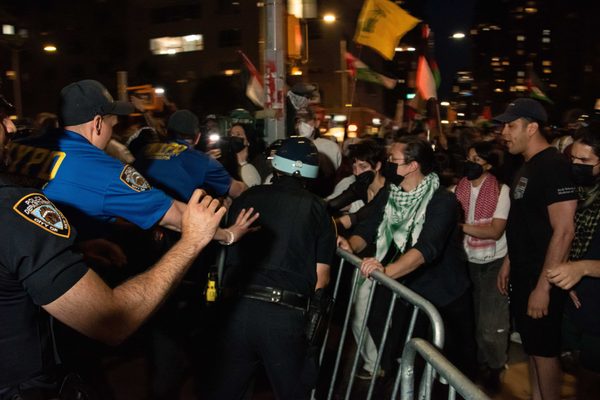
Police hold back demonstrators at a protest earlier this month outside of Manhattan’s Park East Synagogue, which was hosting an Israeli real-estate event.
Neil Constantine/NurPhoto via AP
New York State governor Kathy Hochul on Tuesday quietly signed into law a synagogue buffer zone bill, part of a new wave of legislation aimed at criminalizing protests near Jewish institutions and houses of worship. A similar set of local measures in New York City set off a noisy political battle between Mayor Zohran Mamdani and Julie Menin, the City Council speaker, that’s still ongoing. The state law, however, was slipped into a 189-page must-pass budget bill, and was signed with little public notice or debate. “We commend Governor Hochul and the state legislature for taking decisive action to protect New Yorkers,” the UJA-Federation of New York said in a statement.
The language of the law is ominous, but its implications are unclear. To help explain what it will mean for New Yorkers, I reached out to NYCLU legal director Molly Biklen.
Josh Nathan-Kazis: How will this buffer zone law change how protests are policed in New York State?
Molly Biklen: This law is largely performative and should not change how police protest demonstrations in New York. On its face, the law mostly duplicates existing crimes and confirms powers that the police already have—so it should not create major changes, unless the police use it to discriminate on the basis of viewpoint. That said, the NYCLU will be watching closely to see how the law is enforced and to ensure New Yorkers’ First Amendment rights are respected and upheld.
I also spoke with Sophie Ellman-Golan, director of communications at Jews for Racial & Economic Justice, which has opposed buffer bills at both the state and city levels.
JNK: We’re seeing more of these buffer zone bills across the US and in Washington. How are they being used politically right now? What are they meant to symbolize?
Sophie Ellman-Golan: They’re safety theater—symbolic gestures to mollify segments of the Jewish community that are genuinely concerned about antisemitism and/or incensed by or uncomfortable with Palestine solidarity organizing. It’s about checking a box, not changing material conditions. The most upsetting thing is that any material impact they will have won’t be to make Jews safer but to suppress dissent and criminalize protest.
Mari Cohen Explains Why I Should Care About the Boycott Vote at the Park Slope Food Coop
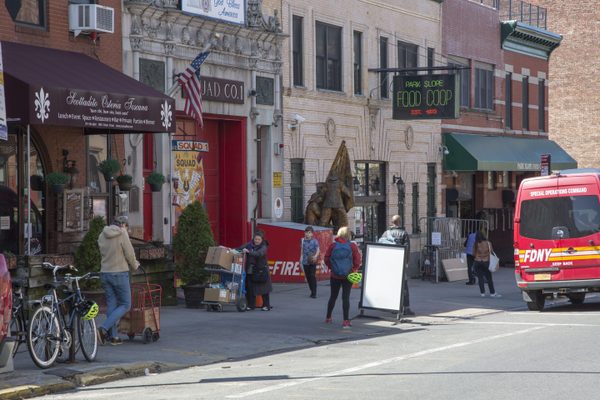
The Park Slope Food Coop, the cooperative Brooklyn supermarket where a fight over a proposal to stop selling Israeli goods drew international attention this week.
David Grossman via Alamy
One of the biggest stories consuming New York media (the world?) this week has to do with the purchasing policies of one members-only cooperative supermarket in a Brooklyn neighborhood where the median home sale price is $1.7 million. I don’t live in that neighborhood, and I’ve never been inside of that supermarket, and I’ve had a very hard time getting myself to care about what tahini brand they do or do not sell. But! On Tuesday night, 4,551 members of the Park Slope Food Coop voted in favor of a boycott of Israeli goods while only 2,547 voted against, scoring a victory for the boycott effort after many years and many attempts. There was jubilation in the Jewish Currents Slack—so, on Wednesday, I called my colleague Mari Cohen, a member of the coop, to ask what I had been missing and whether this vote mattered.
Josh Nathan-Kazis: Mari, as you know, I’ve been pretty bored by the build-up to this vote. It seemed to me that we had done this before—plenty of times!—and there wasn’t any reason for those of us who live outside of the immediate vicinity of the Park Slope Food Coop to pay attention. And then it turned out the editors of nearly every publication in New York disagreed with me, and there’s been wall-to-wall coverage from New York Post, the Times, NY1, and everyone else. And people are talking about it, even outside of Brooklyn. What did I miss here? Why is this important?
Mari Cohen: The coop itself has always been a subject of media fascination, because it’s a symbol of this granola culture among Brooklyn yuppies and brownstone dwellers that people like to make fun of. There are always stories about the little fights co-op members are having about what kind of compost bags to use for produce or whatever, and that’s long been a thing in media and literature, in part because that’s where many of the people who work in New York media live.
So we can’t discount that. But I think there’s something more going on, which is that there’s a real level of symbolism to this vote. The coop is a place where you have different political constituencies interacting, and the way that it’s changed over time does show a real shift in how those constituencies are thinking about Palestine and about Boycott, Divestment, and Sanctions.
There’s a big liberal Jewish constituency in Park Slope. It’s typically more liberal than comparable affluent Jewish constituencies in Manhattan—in the mayoral election, this demographic voted for Brad Lander and Zohran Mamdani, not Andrew Cuomo—but there’s still historically a strong pro-Israel sentiment there, in a way that’s typical of many liberal Jews in the US. You can see that represented by the lobbying that Rachel Timoner, the rabbi at Congregation Beth Elohim in Park Slope, was doing for people to oppose the boycott vote.
But also you do have a lot of anti-war progressives who are part of the coop. There are many anti-Zionist Jews—represented by the fact that many of us on staff at Jewish Currents are coop members—but it’s a multi-religious, multiracial, multi-ethnic group. People who are members of the coop, and involved in this kind of community governance model, do tend to be more inclined towards progressive values, social justice, human rights.
JNK: One of the things this episode revealed to me is that BDS remains a major sticking point even for the most progressive of the liberal Zionists. Rachel Timoner is among the most progressive liberal Zionist rabbis in New York on Israel-related issues, and yet she and her congregation pushed really hard against this, and lost. Do you understand the dynamics at all?
MC: Timoner has an interesting history. Immediately after October 7th in 2023, she was very adamant that it was a moment to let go of criticism of Israel and cohere around support for Israel. She resisted calls for a ceasefire early on. She always has had that element in her politics. But it is true that more recently she’s been part of this growing movement of liberal rabbis who are revisiting some assumptions and being more critical of Israel, and are even tentatively endorsing pulling back on US aid to Israel.
As we were following Timoner’s approach to the coop boycott in the news desk newsletter over the past few weeks, I was surprised to watch her sermon on the vote, and to see how she was talking about BDS. On the one hand, she is talking about Palestinians and her concerns about the occupation in ways that some establishment Jewish leaders still won’t touch. But she also is talking about BDS in the same way that everyone in the pro-Israel world has talked about it for years. She said in her sermon: the “BDS movement seeks the elimination of Israel, the one Jewish state on earth.” All her rhetoric was very similar to the typical anti-BDS rhetoric, and that was surprising, because the Overton window has moved so much in American politics that BDS, as a nonviolent movement aimed at organizing within liberal institutions, doesn’t seem particularly shocking, or like it’s as much of a lightning rod anymore. And so to know that liberal rabbis still see it the same way they did ten years ago is striking.
JNK: And it wasn’t just her, right? Rep. Dan Goldman and Brad Lander, who are competing in a Democratic Congressional primary in the district that includes Park Slope, both said they would vote against the boycott resolution if they were members.
MC: I don’t think Goldman is surprising. I would never expect him to support it. Lander for a long time has said he’s opposed to BDS, and so I guess he’s still saying it. It’s notable that he still feels like he has to take that stance in order to be electable in his district, even though this district is clearly not happy with the pro-Israel politics of Goldman, who is trailing in the polls.
JNK: The other set of questions is about why the boycott vote passed this time. There have been many rounds of efforts to pass BDS policies at the coop over the past two decades. I know there were procedural wranglings around the electoral thresholds for boycott votes. But beyond those technicalities, why did BDS win?
MC: I think it’s very clear that post-October 7th political energy around Palestine solidarity has made it so that the coop just couldn’t ignore this issue. I think it shows an evolution in this Progressive Except Palestine politics. Historically, you could have a crunchy, lefty, progressive, anti-war, hippie vibe social space, that’s also like, we’re not going to touch the Israel thing, it’s too controversial. Or enough members were personally invested in Israel that pro-Palestine politics was a nonstarter. And now you see it’s just not really tenable for them to be Progressive Except Palestine.
JNK: And that gets to the last question, which is, does it matter that this members-only supermarket changed its rules and pulled a few products from its shelves? Does it matter from a BDS strategy perspective? Does it matter in terms of seeking justice in Israel-Palestine more broadly?
MC: I’ve had this question myself. As a coop member, I’ve been pretty impressed with the members of the organizing team behind this resolution. They’re making tons of calls, they had a pretty organized apparatus for getting information out to people about the votes. They had a lot of volunteers and a disciplined communications strategy. And so sometimes I was like, what does it mean that all of this labor is being used on a pretty small stage regarding a handful of products from Israel? Would it be a better use of this energy to work on a larger campaign with more material impact?
I think that actually opens a bigger question around BDS: What is the goal of a boycott campaign? Is it direct material impact, so that the state of Israel feels a financial hit? Or is it really a symbolic impact, so that more people start to question pro-Israel narratives because they’re learning about these boycotts in their local spaces? I think this is a contested question.
With something like the co-op, maybe the impact here is going to be less about the products. Maybe it’s really going to be more people feeling like they’re educated on this issue, and maybe they’re going to do something else about it. Maybe it will mean that more politicians in Brooklyn feel empowered to take votes against aid to Israel because they know that their constituents are now turning this way, because they voted for it at the coop.
I think it’s an opportunity to talk a little bit about BDS strategy and what it means, and maybe the outcome of this will help us understand more about what these boycotts actually do. It will also be a test of the strength of the anti-boycott movement: Opponents of the boycott, including pro-Israel organizers within the coop and outside advocacy groups, are already talking about litigating against the coop and accusing the store of discrimination under state law. Can that playbook still work in New York?
JNK: So I guess I was wrong to be so bored by this.
MR: I think it’s good to keep it in perspective, but I think it does matter as a bellwether of where sentiment is in progressive spaces in the United States, and I think that time will tell how significant it actually is.
