Minnesota Goddam
In the Twin Cities, the hand of a polluted country reaches to choke the future out of us.
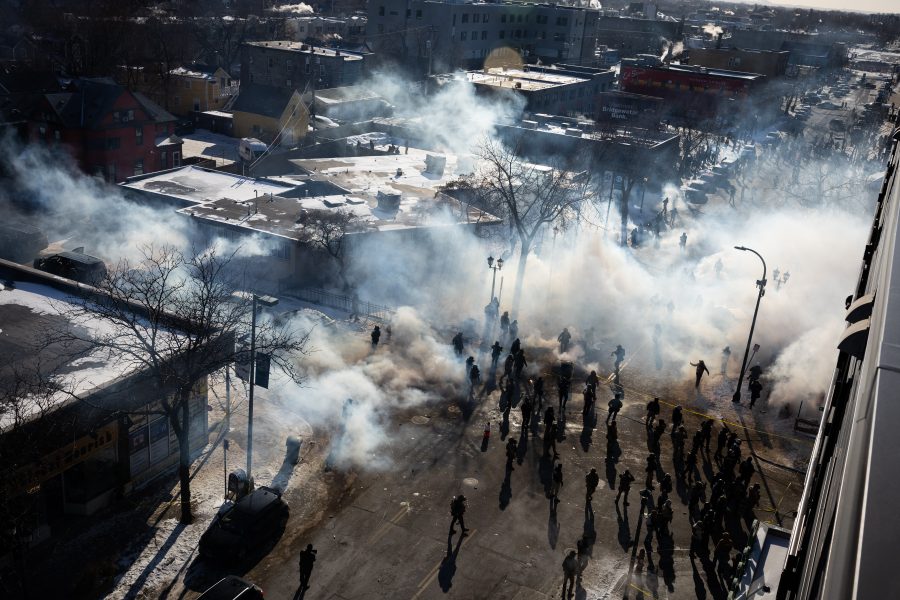
Federal agents deploy munitions into a crowd in Minneapolis after a federal officer fatally shot Alex Pretti, January 24th, 2026.
Somewhere back in 2020, in the long night after Minneapolis police officer Derek Chauvin murdered George Floyd—the latest in the endless procession of those whose lives have been stolen by agents of law enforcement, after Philando Castile, after Thurman Blevins, after Breonna Taylor, after Tamir Rice—and as people rose up in the Twin Cities and around the world, I called my dear friend, the poet Franny Choi. I wept joyful tears as I shared the good news: The Minneapolis City Council had pledged to dissolve the city’s police force. It felt like a new dawn. The Covid-19 quarantine had left us at once liberated from capitalism’s ordinary rhythms and urgently attuned to the need for alternatives to the relentless brutality that had gotten us here. As businesses closed, food drives had opened up. In one part of town, we’d celebrated as righteous flames incinerated a police precinct. In another, we’d gathered to protect our neighborhoods from agitators who descended on the city setting fire to places the people would never burn. Now, from within the exhilarating, terrifying, bewildering swirl of grief and dreaming, we could see it: Abolition was finally on its way, freedom from the vestiges of chattel slavery within reach at last. Something beautiful would rise from the ashes.
Six years later, the phoenix that had promised to emerge is dead. Voters rejected the charter amendment proposal that would have realized the City Council’s vow to disband the police. The Minneapolis Police Department got more money, hired more cops. And now ICE, the Trump administration’s rogue militia, has invaded the city, carrying out kidnapping sprees and instigating chaos. Once again, I watch videos of my neighbors killed and raging in the streets, as whistles ring shrill warnings like panicked bells outside my window. I see the anxiety nesting in my husband’s body, his fear at the simple act of going to work, his movements, once loose and free, now shallow and shackled. Still, even as federally employed white supremacists of every creed and color swarm upon us, I can touch that moment years ago when my voice caught as I reached for my beloved friend to tell them that the fires had been worth it. I fortify myself with the memory of what I know to be true—it matters that, even for a moment, we had forged a path elsewhere.
Why here? Maybe it’s the water that makes our state this way. Minnesota—from the Dakota Mni sóta, meaning “sky-blue water” or “sky-tinted water” or, what resonates most now in this season of deep uncertainty, “cloudy water.” Could be the Mississippi’s headwaters flowing from this land, head of a 2,350-mile-long snake, that destines some mighty or monstrous future to begin its journey in this place. Maybe it’s the 10,000 lakes, from the small ones like Como where, growing up, I walked with my mother, smoked with my friends, took my dates to watch the summers pass by, to great Superior, bone cold even in August—their possibility and insistence. Maybe this water—most ancient ancestor, ruler of this land, flowing, frozen, or falling—means that we have made a home here, inside ever-running transformation.
Sometimes these movements are ruthless. When I outlined this essay, federal agents had murdered Renee Good not two miles from where I live. By the time I sat down to write, they had killed Alex Pretti and abducted five-year-old Liam Conejo Ramos. Countless others, children and adults alike, gassed, beat, and hunted on their way to school or work or the doctor one day, then shut inside their homes in terror for weeks. ICE smashes car windows, tearing drivers from their vehicles, glass shattering in the streets indistinguishable from winter’s fragments—my beautiful sun-loved people running from their cars into buildings where they might hope to escape the cold or the tyrannical force moving through our state more brutal than any wind. Our normally boring, fly-over state, once again the center of a wicked attention.
“The worst of the worst” is the phrase I hear from politicians and pundits when asked who they’re after. They claim to be in Minnesota because of “rampant fraud,” but they didn’t send accountants, they sent slave catchers to round people up and contain them in service of their own extractive lust. My country is full of lies sing-scream-screeches Nina Simone in the middle of “Mississippi Goddam” and more than six decades later I scream it back from the other end of our shared river. Donald Trump has got me so upset. Kristi Noem made me lose my rest. Pam Bondi, guard dog of evil, too damn rotten. Gregory Bovino almost had me stop believing in prayer. Minnesota, goddam. Chicago. Both Portlands. New England. LA. NYC. Fascism bares his greedy fangs at the home of the wolves. Everywhere the hand of a polluted country reaches to choke the future out of us.
But networks of care and resistance run deep among my winter-toughened kin. Organized trainings dispense tactics about how to better protect one another. Groceries are delivered to those unable to brave the streets, addresses scribbled on paper, to be swallowed should we encounter federal agents. Daily dog walks have become ad hoc patrols. Signs on storefronts all around deny entry to our invaders. In restaurants and on street corners, stocks of whistles and hand warmers and snacks emerge, are taken and replenished. Despite their bluster, their violence and vicious lies, the administration is clearly shaken by our resilience and resolve. On the news, I see them accusing protesters of being paid. No, we aren’t paid. We are neighbors. We are loved. We are loved.
Goddam it’s cold. But I was raised here. I know that winter is just a season. I know that moving fast and sloppy in these conditions will put you on your ass quick. That ice turns to water and that great life force is a portal—at once continuity and rupture. Minnesota. Land of 10,000 ruptures, 10,000 portals. Land that remembers well the rupture of colonialism, land where the enslaved Dred Scott saw a portal to his freedom, land where my grandparents and so many others saw a way out of the bind of Jim Crow nightmares, land where Hmong, Somali, Mexican, and other immigrants found new life possible, even as the greed and violence of US empire set so many of them in motion in the first place. Oh, polluted waters. Land that was, is, and will be the land of the Dakota and Sioux, Chippewa and Ojibwe, land where the river begins again and again, rushing, rushing, rushing to somewhere. Up ahead we’re already there together, readying ourselves for the return of this bitter season.

I’m Arielle Angel, editor-at-large of Jewish Currents. Before you go, there’s something I need to ask.
We’ve seen over and over how the mainstream media falters in telling stories on our beats—whether it’s antisemitism, Israel/Palestine in American politics, Jewish identity, or the American left. At Jewish Currents we’re committed to uncompromising analysis and longform reporting on these issues and more—stories you won’t find anywhere else. In a media landscape that obscures injustice and flattens discussion, we’re changing the conversation. But we need you.
If you believe in this work, please consider making a donation—or even better, a recurring one—to ensure that we are able to keep publishing stories like this one. We can’t do it without you.

Danez Smith is the author of four collections including Bluff, a finalist for the 2025 Pulitzer Prize in Poetry. Their prose has been featured in The New Yorker, GQ, Harper’s Bazaar, and elsewhere. Danez lives in the Twin Cities with their people.