Lessons from La Guardia
Can Zohran Mamdani reshape New York—and national—politics like Mayor Fiorello La Guardia once did?
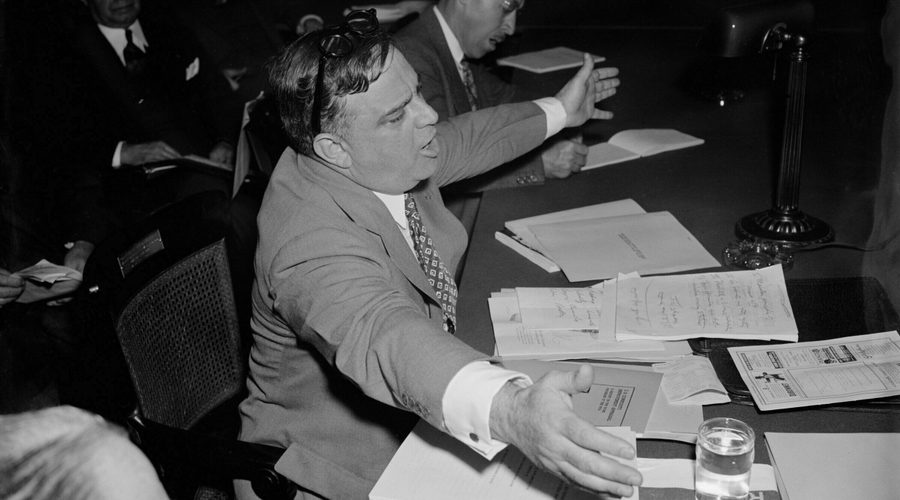
New York City Mayor Fiorello La Guardia testifies before Congress in 1939.
Zohran Mamdani has no shortage of enemies. The Queens assembly member and democratic socialist, who handily beat disgraced former governor Andrew Cuomo in the contest to become the Democratic candidate in New York City’s upcoming mayoral race, can count few supporters among Wall Street tycoons or real estate magnates. Nor does he have deep roots in establishment Democratic Party circles. The prevailing attitude among New York’s financiers, lawyers, and corporate executives toward the nominee was summed up by Kathryn Wylde, president of the business-friendly Partnership for a Better New York, to CNBC on Primary Day: “Terror is the feeling.” In the coming months ahead, the vicious campaign against him is likely to be driven not just by Mamdani’s opponents within the city, but also by national political dynamics. President Donald Trump has insinuated that Mamdani, who was born in Uganda and moved to New York with his family at seven, is “here illegally,” promising investigations of his immigration status and threatening to arrest the candidate if, once elected, he tries to block ICE from operating in the city. The president has also threatened to block federal funding to New York if the “communist lunatic” gets elected.
As a result, though Mamdani is now consolidating support from certain establishment Democratic politicians and centrist unions who recognize him as the fair-and-square winner of the nomination, nothing about the upcoming election can be taken for granted. And if Mamdani does manage to triumph over the split opposition of Cuomo, also-disgraced current mayor Eric Adams, and Republican candidate Curtis Sliwa, the question remains: How will he govern? What would it mean to have a mayor who has so openly criticized some of the city’s most significant power centers—the financial industry, real estate, the police? Can his agenda overcome these roadblocks?
In thinking through these questions, it’s helpful to consider that, while Mamdani’s ascent has been shocking to an entrenched political order, it also echoes a major shift in New York politics a century ago—one with consequences that transformed the city. Like Mamdani, Fiorello La Guardia, who ran an unexpectedly successful mayoral campaign in 1933, faced significant opposition from the city’s political establishment while running for office, and his candidacy likewise elicited dire warnings of imminent socialist takeover. Less of a political unknown than Mamdani, having staged two previous bids for mayor and served in Congress, La Guardia took over City Hall at a moment when New York was ravaged by the Depression, its finances in shambles. He built a political coalition that united immigrant workers, left-leaning activists, and an influential faction of the city’s upper-middle class, drawing them together in opposition to a corrupt Democratic political machine and offering them a radical vision of New York as a working-class city, a city of immigrants, and—as such—an emblem of American democracy and possibility. Today, almost 100 years later, La Guardia’s legacy can be felt in the city’s physical infrastructure (its highways, bridges, tunnels, and airports; its schools, zoos, and playgrounds; the campuses of Brooklyn and Queens College); its social programs, from public housing to health clinics to investment in the arts; and perhaps most of all, in the ambient stubborn optimism that the city might become a democratic place in which working people of varied backgrounds could live lives of decency and abundance. For those wondering what lies ahead for Mamdani, La Guardia’s triumph may offer some lessons.
Often, La Guardia’s success is attributed to the New Deal-era generosity of the federal government. That federal spending was real, and it was transformative. But this explanation for the accomplishments of the “Little Flower” (as the mayor was nicknamed) does not give La Guardia—or New Yorkers—enough credit. The vision of a New York for its people came from within the city, not from Washington, and the mayor’s political mobilization of New Yorkers in the 1930s played as key a role as federal dollars in building New Deal institutions there. At the same time, La Guardia enjoyed certain political advantages that Mamdani, if he wins, will not. Despite the epithets aimed his way on the campaign trail, La Guardia never considered himself a socialist. While he did stand for working-class politics—he called for New York City to become a “100 percent union town”—he linked this to a vision of a modernized city that used public power to reduce disorder, municipal waste, corruption, and crime in ways that appealed to the upper-middle classes and New York business leaders. While Mamdani has also expressed a desire to reclaim “quality of life” issues for the left, his politics, by contrast, are more deeply based in class antagonism: The call to take back the city from the very rich for working people is central to his campaign. And while La Guardia was the first major Italian American political leader from New York, winning power at a moment when Italian immigrants were still viewed as subordinate to native Anglo-Saxons, he was not perceived as a distinct racial other; Mamdani, on the other hand, is a person of color, a Muslim, and a Palestine supporter, and as such he represents a political identity that many constituencies within the city have long oriented themselves against.
Most significantly, La Guardia came to power at a moment when the city’s old economic elites were reeling under the Depression, the New Deal Democratic Party was emerging, and the president had every reason to ally with New York. Today, the city is home to a phenomenally wealthy upper class that has been growing more powerful rather than less, the Democratic Party is divided, and Washington can anticipate political rewards from attacking New York. Still, if the challenges are real, so are the possibilities, just as they were in the 1930s. La Guardia’s mayoralty offers a framework for thinking about how what might seem to be fixed political alignments can, in moments of popular discontent, shift radically, bringing real change even to a city as large and complex as New York. His tenure is also a reminder that what happens here has implications far beyond the five boroughs—that it can, under certain circumstances, both anticipate and spur political transformations for the country as a whole.
Like Mamdani, La Guardia did not himself hail from the city’s working classes. He was born in Greenwich Village to well-educated immigrant Italian parents (his mother was Jewish, his father was not), but his family moved to Arizona when he was a young child, and he grew up in the West. When he returned to the city as a young man, he joined a political milieu shaped by the socialist and other left-wing currents that roiled New York in the years before World War I. He met his first wife on an Amalgamated Clothing Workers picket line. But his approach to politics was also shaped by the reform tradition in the city, which opposed the Democratic machine known as Tammany Hall for its systematic corruption and abuse of city funds through patronage, kickbacks, fraud, and bribery. Reform politics were dominated by upper- and middle-class New Yorkers, including both those who disliked the machine for its endemic inefficiency and those who were morally outraged that it siphoned resources from poor people while doing little to relieve their conditions. Because of La Guardia’s opposition to the machine (which was Irish-dominated and would not have tolerated an Italian standard-bearer under any circumstances) and his identification with Progressive Republicans on the model of Theodore Roosevelt, he first ran for office as a Republican.
Early in his political career, La Guardia, like Mamdani, cultivated a reputation as a radical. In Congress, where he served before running for mayor, he opposed the sweeping immigration restrictions of 1924, which he denounced for their “fixed obsession on Anglo-Saxon superiority”; sponsored the Norris-La Guardia Act of 1932, which protected certain rights to unionize and picket; and called for progressive taxation (“Soak the rich!”). All of this led much of the city’s business leadership to oppose his run for mayor in 1933. In various New York Times articles about the race, La Guardia’s opponents claimed that he would back “every radical and socialistic nostrum,” and that he was “a Communist at heart, an irresponsible and dangerous radical” who would refuse to use the police to restrain his “comrades.” A subtext of the race was the idea that La Guardia, as an Italian, represented the disorderly lower classes of the city—often imagined, only a few years after the execution of Sacco and Vanzetti, to be connected to anarchist circles.
But the political rot in New York’s Democratic machine ultimately facilitated La Guardia’s path to victory. The mayor who preceded him—Jimmy Walker, a high-living singer and nightlife devotee better known as Beau James—was compelled by Governor Franklin D. Roosevelt to resign following a judicial investigation that revealed widespread corruption. The Great Depression had almost bankrupted the city, which turned over financial control to major banks to get funds for basic needs and economic relief. Tammany Hall ran a nondescript hack to replace Walker, but New York’s elite reformers settled on La Guardia as their candidate, backing him on a third-party ballot line bolstered by Republican support. In response, business leaders—who opposed Tammany due to its rampant waste but did not want union-friendly La Guardia in charge of New York—worked with the Roosevelt-backed wing of the Democratic Party to run a third candidate as another independent, a former party leader who came out of political retirement to warn that La Guardia would bend to the “importunities of the mob.”
La Guardia, who raised less money than either of his major adversaries, nonetheless trounced the opposition, largely by mobilizing the new immigrant population of the city. Millions of Eastern European Jews and southern Italians had flooded into New York in the late 19th and early 20th centuries, but were shut out of city politics as Tammany Hall remained almost entirely Irish. With La Guardia as a candidate, the “lodges, churches, trade unions, businesses, neighborhoods, athletic teams, and extended families” of Italian New York transformed into “campaign machinery,” as historian Arthur Mann put it. (“When you used to give those boxes of spaghetti to my poor children…[you never thought] it would be a trump card for you,” one campaign worker wrote.) La Guardia appealed not only to Italians who identified with him, but allied himself with immigrants more generally. He spoke Spanish, Yiddish, and Italian among other languages, having worked as a translator on Ellis Island while attending law school at night at NYU; he identified himself with the cause of the newcomer, the new American. At the same time, he spoke to the reforming middle classes of the city, who were tired of the tent cities and Hoovervilles that were spreading throughout the city. Turnout in wealthier city neighborhoods was especially high in the 1933 mayoral race, and much of this went to La Guardia.
Finally, La Guardia marshaled the protest politics of the early 1930s—the unemployed marches, anti-eviction rallies, and overall vigorous left-wing scene that included rival Socialist and Communist wings—and turned it toward electoral ends. He spoke of “wresting control” from the political bosses and making the city “a great big, beautiful, kind New York.” The labor movement intensified in the city over the 1930s, expanding from its base in skilled trades and the garment industry to include transit workers, teachers, department store workers, elevator operators, restaurant workers, and even the maintenance staff at Columbia University. These constituencies—sometimes overlapping, sometimes distinct—rallied behind La Guardia’s idea of a city that, as he put it in a campaign speech during an earlier mayoral run, would “provide more music and beauty for the people, more parks and more light and air and all the things the framers of the constitution meant when they put in that phrase ‘life, liberty and the pursuit of happiness.’”
All these are instructive points of comparison to Mamdani. Over the past 50 years, New York City has been remade by immigrant communities from around the world: the Middle East; Latin America; the West Indies; all across Asia and Africa. Those communities are now under siege, but even before Trump’s recent onslaught, they have gone largely unrepresented in city politics. At the same time, Mamdani draws on the reforming traditions of the city and its long history of support for social welfare. Calling for social order can mean sweeping people off the street through aggressive policing; it can also mean, in Mamdani’s case, creating a society in which people are not forced to live on the street to begin with.
Mamdani’s campaign, like La Guardia’s, has emerged out of a period of public upheaval in New York City and across the country. The last few months have seen massive marches protesting the Trump administration; the last two years, countless demonstrations against the war on Gaza. Although in many ways the city’s labor movement remains more quiescent than it should be, the Amazon union election victory on Staten Island, the Starbucks organizing drive, the academic labor movement, and organizing campaigns at quirky retail outlets (the Strand, gaming stores, REI) have all provided a jolt of energy. Meanwhile, the revival of the Democratic Socialists of America—which over the past seven years helped get Mamdani and five other socialists into the state legislature, and more recently played a pivotal role in Mamdani’s primary campaign —has provided a steady organizing presence. All this has created a political culture in which today’s Democratic establishment—which, as in Tammany days, expects a supine working class easily bought off with symbols and favors—cannot run the city, or even its own party, unchallenged.
Once La Guardia took office in 1934, he embarked on a remarkable expansion of the city’s physical and social infrastructure, building schools, zoos, playgrounds, health centers, highways, tunnels, an airport, City Center, and the glorious swimming pools that help New Yorkers cool down in the summers even today. He quickly moved to establish the New York City Housing Authority, the first public housing authority in the country, which would come to build and administer thousands of units of low-income housing. La Guardia pressed for more public relief, rent control, low-cost transit, and efficient, effective public services available to all; he passed a 2% sales tax increase to give the city more room to maneuver financially. He modernized and professionalized the city’s civil service, opening it to the children of immigrants who had previously been shut out—the Italian and Jewish “Depression geniuses,” as they would later become known.
All of this was intrinsically linked to his love of the city itself and his ability to tap into its frenetic energy, showing up at a fire here, a concert there, a relief office the day after. As historian Mason Williams has shown in his 2013 book City of Ambition, this ubiquitous presence, along with the public works he sponsored, helped La Guardia expand his base, in particular mobilizing working-class Black and Jewish voters, and in 1937 he won re-election with a resounding majority. Mamdani’s well-publicized social media efforts—diving into the ocean at Coney Island, walking the length of Manhattan, popping up in Morningside Heights to denounce the kidnapping of Mahmoud Khalil—have demonstrated the continued power of such efforts, which in the 1930s as today create the effect of a public servant channeling or even becoming the city.
Yet there was another aspect to La Guardia’s success: his ability to present himself to many audiences as not being a radical at all. While he galvanized the city’s immigrant working class, La Guardia also tapped into support from some wealthier New Yorkers, which grew out of their mutual disdain for the dense neighborhood loyalties, personal favors, bribes, and patronage on which the Democratic machine relied to stay in power. He was a familiar type in city politics: a good-government politician, bent on reform and on transparent governance. In a 1936 interview with the Times, he said that he sought to run the city in a “business-like way.” One of the first things he did in office was move to balance the city budget and restore the conditions for New York to issue bonds. The crusade against political corruption also became a campaign to create a more orderly, virtuous city by restraining nightlife, breaking up gambling rings, arresting prostitutes, and policing poor people.
Some of La Guardia’s calls for order were benign enough. He sought to clean up the pushcarts that crowded the narrow streets of the Lower East Side and East Harlem by reducing their permits and redirecting vendors to his public “indoor markets” (an idea that bears some similarity to Mamdani’s call for city-owned grocery stores). Others, though, reflect the uglier side of New-Deal-era New York. His public housing authority was racially segregated—as one of its early leaders told Harlem activists, the city believed white tenants would refuse to live in integrated projects—and it took two riots in Harlem, in 1935 and 1942, for him to begin to pay attention to the distinct problems of Black New Yorkers. (In a telling false start after the first of these riots, he put together a commission of Black and white social scientists to study the causes of distress leading up to it—and then refused to release the report, deeming it inflammatory.) Historian Emily Brooks has shown how La Guardia emphasized “morals policing” of crimes such as disorderly conduct, gambling, and sex work, using tactics that fell most harshly on the city’s Black and Puerto Rican population. And at the outbreak of World War II, La Guardia moved quickly to detain Japanese immigrants and even Japanese-Americans, turning Ellis Island into a detention camp. Yet even despite his ability to appeal to affluent New Yorkers with his law-and-order sensibility, La Guardia never did establish a local tax base capable of financing the generous local government he created, which caused serious problems after federal funding slowed—and ultimately helped lead to the fiscal crisis of the 1970s.
La Guardia, then, represents both the high point of New York’s 20th-century liberalism and its limits—and understanding these internal contradictions also helps us see more clearly the challenges confronting Mamdani today. Mamdani cannot draw in city elites by leading the charge against a corrupt political machine. The mainstream Democratic Party still in some ways functions like a political machine of old: It manages to mobilize and deliver working-class votes without doing anything substantive for the working population of the city. But it is still very different from the Tammany Hall of the early 20th century, which used public funds to buy patronage and favors; today’s Democratic Party, by contrast, has been more fully captured by business interests as a whole—which thus have little incentive to join a crusade against the establishment. And when it comes to social disorder, not only would Mamdani himself reject a strategy based on promising to enforce order via intrusive policing as morally wrong; politically, his supporters would reject this turn, even if he wanted to make it. What’s more, Mamdani’s opponents— particularly those outside New York who want nothing more than to punish the city for its political transgressions—have little incentive to compromise with him; at least right now, he is worth far more to them as an enemy than a potential ally.
Imagining a Mamdani mayoralty, then, means imagining a politically mobilized city that can push for real social change without needing permission from elites—a city in which the balance of forces has shifted so that an investment in public services comes to seem like common sense. This might seem implausible, but given the intense economic pressure of life in New York today for everyone who is not extremely rich, might it be possible to convince small business owners, middle-class professionals, and homeowners to see themselves in solidarity with immigrants, union members, renters, poor people, and the legions of people working in the city’s service sector? Just as La Guardia mobilized against the “bosses,” could Mamdani build an emergent coalition to challenge the vast power of concentrated wealth?
In terms of policy, if he is able to marshal sufficient political support within the city, there is in fact much that Mamdani could in principle do on the local level to raise money to cover free buses and even universal childcare. Freezing the rent, for its part, takes political backbone, but it likewise does not necessitate funding from the state or federal governments (though constructing new low-cost housing probably would). New revenue streams can be found by taxing the wealthiest New Yorkers, yes, but also by hiring new auditors to bring in unpaid taxes that are due already, ending rental assistance for charter schools, allowing certain tax abatements to expire, or raising the “mansion tax” for the most expensive apartments. As far as experience goes, Mamdani, should he win, would be able to draw on the knowledge and ability of longtime leaders in the city—starting with city comptroller Brad Lander, a Democratic primary rival who became one of his most public and enthusiastic supporters—who might be able to help him negotiate the complexities of governing New York.
But to realize his most ambitious proposals, Mamdani clearly would need support in Albany—since most changes to the tax code must be passed at the state level—and in the end, he would have to confront the federal government. To do this, to take on Trump, he would thus need to make the case that his politics can provide a way forward for the Democrats outside New York City as well as within. But here, too, history is helpful. The Democrats were a divided party in the 1930s, split between the immigrant working classes represented by the Congress of Industrial Organizations and the one-party “Solid South” based on Jim Crow and disenfranchisement of Black voters. La Guardia’s success in New York helped to strengthen the former—and the party ultimately recomposed itself in a way that pushed out Southern segregationists altogether. It is anybody’s guess whether the leadership of today’s Democratic Party will be able to recognize, in Mamdani’s vision of an egalitarian, culturally rich, diverse, and affordable New York City, a way forward for the country, a rejection of the privatized excess and loony sociobiology offered by Trump and his ilk. But they should, and if they do, perhaps in time the national situation might become less bleak than it is today.

I’m Arielle Angel, editor-at-large of Jewish Currents. Before you go, there’s something I need to ask.
We’ve seen over and over how the mainstream media falters in telling stories on our beats—whether it’s antisemitism, Israel/Palestine in American politics, Jewish identity, or the American left. At Jewish Currents we’re committed to uncompromising analysis and longform reporting on these issues and more—stories you won’t find anywhere else. In a media landscape that obscures injustice and flattens discussion, we’re changing the conversation. But we need you.
If you believe in this work, please consider making a donation—or even better, a recurring one—to ensure that we are able to keep publishing stories like this one. We can’t do it without you.
Kim Phillips-Fein is a professor of history at Columbia University. She is the author of Fear City: New York’s Fiscal Crisis and the Rise of Austerity Politics (Metropolitan, 2017).