How the Swedish Public Saw Israel/Palestine
Director Göran Hugo Olsson discusses his latest documentary, assembled from three decades of state TV footage.
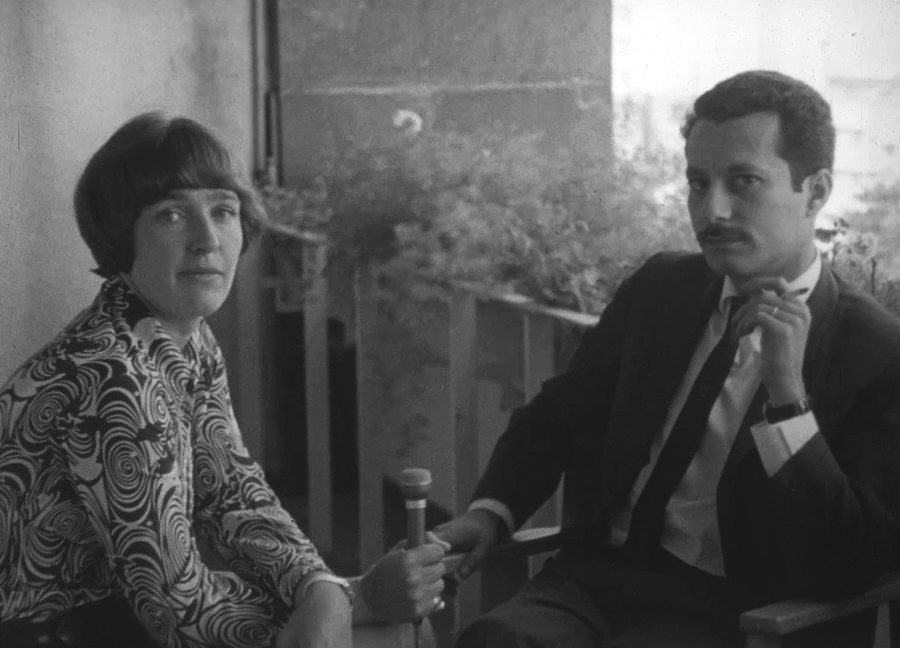
Swedish TV reporter Vanna Beckman interviews Palestinian writer and revolutionary Ghassan Kanafani, representing the Popular Front for the Liberation of Palestine.
Göran Hugo Olsson’s latest documentary, Israel Palestine on Swedish TV 1958–1989, opens with text announcing that the film “does not presume to tell the whole story of the Israel Palestinian conflict,” but aims only “to show how it was presented by the public service in Sweden” during that period. A nearly identical disclaimer prefaces his 2011 film The Black Power Mixtape 1967–1975, which is likewise constructed from footage filmed by Swedish news crews and broadcast over the state channel that held a monopoly until 1989. (His 2014 documentary Concerning Violence fashions material from the same archive into what postcolonial scholar Gayatri Spivak, in her introduction to the film, calls “a tribute to and an illustration of” Frantz Fanon’s 1961 book The Wretched of the Earth.) These works are thus as much portraits of Swedish society—and the views that emerged from and shaped it—as they are meditations on their subjects.
For American viewers, the range of images and perspectives on display is a dramatic departure from what we’re used to seeing on public and mainstream news networks. Sweden’s neutrality in global conflicts has allowed its journalists to penetrate worlds we’re rarely shown—Concerning Violence features footage from liberation struggles in Angola and Mozambique—and the films exhibit a striking openness to anti-imperialist politics. Though they let the material speak for itself, Olsson’s assemblages convey his own anti-colonialism, which dates back to days in his youth spent collecting money for African National Congress during the struggle against apartheid in South Africa.
In some ways the story in Israel Palestine on Swedish TV is more familiar. The early footage shows Swedish sympathy for a Jewish state emerging from the Holocaust and governed by the Labor Party. The language and imagery of the first decade or so echo Israeli propaganda: the country making the desert bloom while its citizens dance the hora. But as the years pass, Israel’s abandonment of its democratic pretenses is reported in no uncertain terms. Long before the disruption of the Zionist consensus in the US, we see Swedish TV rigorously examining the dispossession and resistance of the Palestinians. Swedes, the film shows us again and again over its three-hour running time, were a privileged people, presented with points of view often suppressed elsewhere in the West.
Ahead of its limited American release earlier this month, I spoke with Olsson about the making of his illuminating new film. Our conversation has been edited for length and clarity.
Mitch Abidor: Have you come up with a name for these types of films, built of footage shot for Swedish TV?
Göran Hugo Olsson: People have labeled me as an “archive filmmaker,” and rightfully so. It was a very conscious decision for me, 15 years ago, to stop filming. I used to film my documentaries, and be a cameraman for others’ as well. But today, I think documentary films are made by filmmakers from the community, from the environments where they take place. I don’t have ownership over an interesting environment or community—but like most other people living in Sweden, I do have ownership over the Swedish broadcast archive, because that stuff was made for me as public service television. I’d watched it even as a kid.
MA: For this new film, what did you go into the archives expecting to see, and what did you end up finding? Was there a difference between the two?
GHO: There wasn’t too much of a difference between what I expected and what I found. But I was impressed by how much coverage they had from this time. It’s a small country, with a population of eight million at the time, and they had three different teams in the Middle East, which is really impressive. This was a monopoly, a public service monopoly, and everybody watched it, no matter their class or education, and they were really committed to making it understandable for everyone. It’s very different from British or French media, where journalists were snobbish and their goal was to impress their colleagues, to make a career. In Sweden, it was very much about people’s education.
MA: The film follows the footage chronologically, so you can see how the point of view on Israel changes. There’s a very clear shift around 1967.
GHO: That’s the story of the film, basically. At first it’s a total love affair. Sweden was very much about the social democratic thing, you know, and the kibbutz thing. These days people tend to forget that Israel was, next to India, the most socialized country in the free world—that all the big companies were government-owned or controlled, and so were interest rates and loans for buildings and homes, even more than in Sweden. For Swedes that was fantastic. And Golda Meir was seen as such a character, a great personality—she was like Marie Curie or something. Everybody admired her.
MA: In 1964 there’s a discussion between a Swedish diplomat, Gunnar Hägglöf, and a professor. And the professor continues with the pro-Israel line with all its mythology, but the diplomat brings up the injustice done to the Palestinians and the plight of the refugees. It’s really striking, because so few people spoke of that then.
GHO: Oh yes, he was very early, but he was not just anybody; he was one of the seven diplomats who founded the UN. What is interesting is that it’s prime time, this famous intellectual talking about the Palestinians.
MA: It’s surprising how Swedish national TV gave voice—or gave screen time—to figures that would never, ever show up on American TV: radical Palestinians like Ghassan Kanafani and Raymonda Tawil, activists like the Jordanian artist Mona Saudi. There’s talk of leftist groups like the anti-Zionist, revolutionary socialist Jews of Matzpen. Over the years the news covered the discrimination against Mizrahi Jews, and you include a long segment with the Israeli Black Panthers. There’s an appearance by Uri Avnery and the sadly forgotten human rights activist Israel Shahak. In this film, as in Concerning Violence, you see a remarkable openness to anti-colonialist perspectives. How did this come about?
GHO: Yeah, I think we have a special case here. Mostly it’s about Sweden being neutral in the Cold War—because of this, Swedish journalists and filmmakers had access to both sides, could go to both North Vietnam and South Vietnam—and being a social democratic and a kind of radical state. But it’s also that Sweden looked upon itself as not a colonialist country. That’s not true—but we’re not a colonial power. So in that way Swedish TV was not like French or British or American media.
MA: There’s a scene from 1973 in which Swedish workers talk about how they’re split 50-50 between the sides they support. Was that really how Swedish society was?
GHO: When that worker said they were split 50-50, I think he meant that all of them are split 50-50 within themselves: They’re saying that people saw that you can see it one way, but you could also see it another way. I grew up in a well-off neighborhood where there was nothing strange about that position. Many people had this box to collect money for, say, an ambulance in Israel. At the same time, the young people in the same household had the Palestinian scarf. People were on both sides all the time.
MA: There’s a scene from 1984 with Meir Kahane where he has the most significant line in the film: He says that there’s a fundamental contradiction between Zionism and democracy. That sums it all up; it totally undermines the whole Zionist enterprise. And today’s Israel is there to confirm it.
GHO: Yes, yes . . . everything he said became reality. Before that he’s justifying violence against what he calls “dirty Arabs.” Today people talk about this as the dehumanization of the Palestinians, and I can’t interpret what’s happening now in any other way. How can young Israelis do what they’re doing to other people, to kids—soldiers laughing when they kill someone—without this dehumanization that’s been going on for so long?
MA: Watching all three of the archive films now, there’s this overwhelming sense that things have either not changed or gotten worse. You watch Concerning Violence, and there’s Robert Mugabe, who’s still there, whereas a great figure like Thomas Sankara of Burkina Faso was killed a couple years later. You watch The Black Power Mixtape and the injustice of racism remains, but there aren’t leaders like Malcolm X and Stokely Carmichael and H. Rap Brown. And then, of course, the Middle East—there’s nothing that needs to be said. It just gets worse and worse. So working on this film must have been a depressing experience.
GHO: Mitch, it’s so depressing, and I’m so depressed, I’m so in despair. It’s hard for me to talk about. I spent five or six years of my life watching these images every day, and trying to figure it out. When I started the film I knew that something would explode, but I had no idea that it would be of this magnitude, with this much suffering and violence. I’m proud of the work we did with the film. But for me as an individual . . . it did me great harm. I’m not the victim; nobody should feel sorry for me. But it’s unbearable.

I’m Peter Beinart, editor-at-large of Jewish Currents. Before you go, I need to ask something of you.
In recent years, I’ve watched as mainstream Jewish institutions and media have chosen ethnonationalism over liberal democracy and mass slaughter over the pursuit of a just peace. Jewish Currents offers something different. It’s a magazine built on intellectual curiosity and respect for the dignity of all people.
But a project like this doesn’t sustain itself, and we can’t do it without your help. If you share my belief in the importance of this mission, please consider making a donation—or even better, a recurring one. We need you with us.

Mitchell Abidor, a contributing writer to Jewish Currents, is a writer and translator living in Brooklyn. Among his books are the biography Victor Serge: Unruly Revolutionary, a translation of Serge’s Notebooks 1936-1947, May Made Me: An Oral History of My 1968 in France, and I’ll Forget it When I Die, a history of the Bisbee Deportation of 1917. His writings have appeared in The New York Times, Foreign Affairs, Liberties, Dissent, The New York Review of Books, and many other publications.