How Israel Smothered a Palestinian Watchdog
Khaled Quzmar, former head of Defense for Children International-Palestine, discusses his organization’s decision to close after a five-year harassment campaign by the Israeli government.

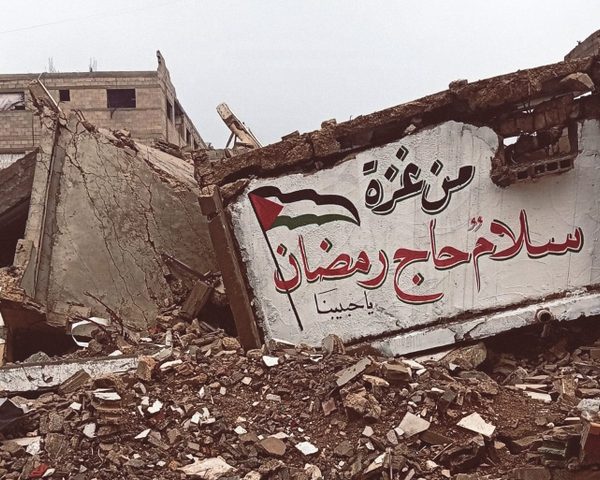
The ransacked Ramallah offices of the Union of Agricultural Work Committees after a daytime Israeli raid in December 2025.
This article first appeared in the Jewish Currents news desk newsletter. Subscribe here.
In July of 2021, Israeli forces stormed the offices of Defense for Children International-Palestine (DCI-Palestine) in the West Bank city of Al-Bireh, launching an escalating campaign of official harassment against the organization, which documented and publicized human rights abuses against Palestinian children. That campaign ended last month in DCI-Palestine’s decision to shut down its operations, under mounting pressure from the Israeli government.
Human Rights Watch’s Bill Van Esveld lamented the organization’s closure, calling DCI-Palestine “one of the most reliable messengers about life for Palestinian children under Israeli occupation.” In March, DCI-Palestine reported that half of the 351 Palestinian children in Israeli prisons as of the end of 2025 were being held without charge or trial. That report was one of the organization’s last: it closed a few weeks later. Last week, Jewish Currents spoke with Khaled Quzmar, DCI-Palestine’s general director, about what happened.
DCI-Palestine was established in 1991, during the First Intifada, to provide legal representation to Palestinian children being held in Israeli prisons. It later began offering support to children after their release. “It was difficult for the family to accept these kinds of services,” Quzmar said. “Anyone arrested by Israel is considered an adult, a hero. But in fact a child is a child. He needs special treatment during his childhood.” Quzmar says that Israel began targeting DCI-Palestine after it ramped up efforts to communicate its field workers’ findings about the abuses children were suffering in Israeli prisons with governments overseas. DCI-Palestine was one of six Palestinian civil society groups that Israel’s defense ministry designated as terror organizations in the fall of 2021. The Israeli government offered no evidence to back up the designations, which were widely condemned and dismissed by foreign governments and international experts.
This interview has been edited for length and clarity.
Josh Nathan-Kazis: Tell us about Israel’s efforts to suppress DCI-Palestine.
Khaled Quzmar: The raid of our office [in July 2021] came after DCI documented the case of a child of 15 who was raped by an Israeli interrogator. We shared the testimony with Josh Paul in the State Department in Washington. At the time, I didn’t know why they raided the offices. [Ed note: Paul, now co-founder of the lobby group A New Policy, resigned from the State Department in October 2023 over US arms transfers to Israel. In December 2023, he told CNN that while conducting human rights vetting for the State Department, DCI-Palestine had alerted him to an alleged sexual assault of a Palestinian child in an Israeli prison. Paul told CNN that the July 2021 raid of DCI-Palestine’s offices came one day after he questioned Israeli authorities about the alleged incident.]
Three months after the raid, in October 2021, the Israeli government listed DCI as a terrorist organization without sharing a single piece of evidence to support the designation. One hundred percent fake news, created just to convince themselves.
JNK: How did DCI-Palestine function after Israel designated it a terrorist organization?
KQ: We used to train [children] to be committed to the community, committed to school, and not to participate in any resistance, because children should be out of this. After they become adults, they can decide which path they would like to take, how they would like to resist. But no military actions, resistance action, before the age of 18. From our side, we understood the designation as a message to the children, to the new generation of Palestinians: International law is nothing and cannot help you; the only thing that can help you is to get out of this country.
JNK: How were you able to continue to operate?
KQ: Israeli military law designated DCI a terrorist organization. This means that all of the staff are considered terrorists, and all our beneficiaries are considered terrorists. We tried to act as usual, to go to the office. We managed to continue the work. And then, after one year of the designation, they raided our offices again. They confiscated many files, many assets, without leaving any documentation of what they confiscated. I was summoned for interrogation myself, where they threatened me not to go back to work, otherwise I will be arrested. I told them I’m doing my mission, and if you feel that I’m violating the law, you created the law yourself, I do not recognize your law. So I continued my way.
JNK: Were you able to continue to access the banking system given the terrorist designation?
KQ: Not easily. From the beginning of the designation, we started to face problems with the banks. Each statement, each transaction, required a lot of paperwork—documents, contracts, reports—to justify the amount that we are receiving. It became very, very complicated. We decided to try to understand the bank restrictions, as [the bankers] would also like to protect themselves. We had a meeting with ministers, we had a meeting with [Palestinian Authority president Mahmoud Abbas] himself, and all of them clearly said that they could not force [the banks] to work with us, because they could not protect them from Israel. In Palestine, we live in a place where no one can protect you—no government, no president. So everyone tries to take his own actions to protect himself, because he is not protected.
JNK: After all this, what spurred the decision to stop DCI-Palestine’s operations last month?
KQ: On December 1st, 2025, the Israeli army raided the offices of the Agricultural Committees during the day [another of the six Palestinian civil society groups Israel had designated as a terror organization in 2021]. This was their first time coming during the day. [They also came] accompanied by the media machine, a TV crew filming how the Israeli army arrested the staff. They put each of them in different rooms, and interrogated them while blindfolded and handcuffed. [Ed note: According to the UN Office of the High Commissioner for Human Rights, those present during the December 1st raid at the offices of the Union of Agricultural Work Committees were kept “blindfolded and handcuffed, kneeling down, or with their faces down on the floor for several hours.” Israeli forces detained eight men.]
To me, it was shocking. As director, I look at my staff—we have on staff a mother with a baby of five months. If they raid the office and arrest them, how I can help them? So I consulted the board of directors.
The board of directors cannot take on this responsibility for the staff working in the office under threat of arrest. The second issue is we couldn’t protect the children because, according to Israeli military law, those who benefited from a terrorist organization are subject to arrest and prosecution. Another issue is that Israel controls the bank system in Palestine, and any second they can close our account—that’s happened with many Palestinian NGOs before. Also, if we continued and Israel decided to close DCI, we would have lost the history of the organization because there would be no time to save our archives.
So we decided to make the decision ourselves while we are still free to do so. The decision was not to close [the organization], but to [stop its operations].
JNK: What does this mean for the children you served?
KQ: DCI did not work alone on the ground. We used to work with local NGOs and other international human rights organizations. So now they are taking care of our beneficiaries, the children that we used to work with.
JNK: What will you do now?
KQ: Since I submitted my resignation more than one month ago, I am applying for new jobs. Of course, I will stay in this field. I’m not going to change my history.

I’m Arielle Angel, editor-at-large of Jewish Currents. Before you go, there’s something I need to ask.
We’ve seen over and over how the mainstream media falters in telling stories on our beats—whether it’s antisemitism, Israel/Palestine in American politics, Jewish identity, or the American left. At Jewish Currents we’re committed to uncompromising analysis and longform reporting on these issues and more—stories you won’t find anywhere else. In a media landscape that obscures injustice and flattens discussion, we’re changing the conversation. But we need you.
If you believe in this work, please consider making a donation—or even better, a recurring one—to ensure that we are able to keep publishing stories like this one. We can’t do it without you.
Josh Nathan-Kazis is the news director at Jewish Currents. Previously, he was a senior writer at Barron’s, where he covered healthcare companies, and a staff writer at The Forward, where he investigated Jewish communal institutions.