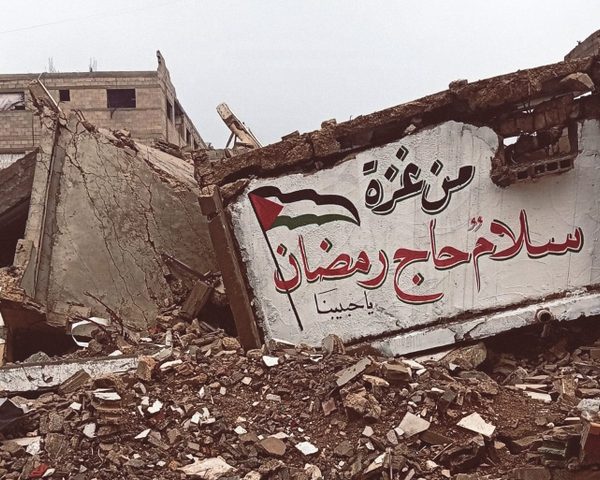
House of Words, Ibau, Where’s Your Story?
Kiryl Balbatunou/Alamy

At the turn of the 21st century, Indonesia experienced a period of profound upheaval. As economic collapse spread across Asia, mass demonstrations across the country brought an end to the 32-year reign of military dictator Suharto. It was in the context of this turbulent transformation that Afrizal Malna published his poetry collection No Dog in My Mother’s Womb (2002), in which “House of Words, Ibau, Where’s Your Story?” originally appeared. Born in Jakarta in 1957, Malna has been a prominent figure in the national arts scene since the early 1980s. Across poetry, theater, and criticism, he has documented the destructive impacts of industrialization and the militarized imposition of global capitalism, including on language.
In “House of Words, Ibau, Where’s Your Story?” Malna extends his decades-long interrogation of power’s corrosive effects on expression, hazarding a vision of redemption from the detritus of language scorched by the onrushing century. The poem opens with an intimate image of disalienation, the speaker entering a house “as if entering a story,” even as he inhabits an aftermath, an unspecified “ever since” where “there are no stories, no invitations home.” The speaker’s longing for the replenishment of the “house of words” is not the desire for a fortress enclosure, but a yearning to reanimate the manifold stories that connect past, present, and future—a home built “through the long journey of thousands of stories.” Translating the poem into English amid the naked brutality of our present, I am reminded of the necessity of rejecting calls for a return to a narrow past instrumentalized by the state to circumscribe the present and guarantee its desired future. “House of Words, Ibau, Where’s Your Story?” is a compass orienting us away from these cruel distortions and toward the possibilities of meaning made in dynamic relation, by way of careful attention to place, to people, to the way language passes between. As Malna writes: “The keeper of words has been evicted. The house of words is found only in love.”
— Daniel Owen
(English follows the Indonesian, below.)
Rumah Kata, Ibau, Mana Ceritamu?
Aku masuk ke rumahmu seperti memasuki sebuah cerita yang mengubah siapapun yang mendengarnya. Apa saja yang pernah kita ucapkan, membuat jalan pulangnya sendiri, merangkai kembali yang pernah dilupakan. Kalung di lehermu adalah kisah. Tetapi sejak kata diganti dengan sinar listrik, tombol-tombol yang bisa menanam tomat, tak ada orang bercerita, tak ada undangan untuk pulang. Halaman di belakang jadi gudang sepatu bekas. — Ibau, apa kabar? Apakah kau masih menulis? Malam mulai menyusun lagi sebuah buku dari hati yang tak pernah tidur. Aku berjanji padamu untuk merangkai sebuah cerita, membongkar makam waktu dalam sebuah dongeng. Seperti kerinduan yang meminta air matanya sendiri, seperti genggaman yang meminta tangannya sendiri. “Ibau berceritalah, seperti burung-burung pertama kali membuat hutan dari kepakan sayapnya.” Suara becak berdering, sebuah rangkaian besi dan kayu di atas aspal jalan. Waktu menjadi nyata. Pori-pori di leher kita, seperti kota-kota kecil yang menyediakan sumur untuk membasuh muka. Waktu menjadi nyata. Kecepatan, yang pernah membunuh kita di sebuah jalan, menjadi sebuah peti yang sedang tenggelam ke dasar laut. Kita jalan bersama sambil membuat malam penuh cerita. Tapi kemana kita mau pulang? Pemilik kata—telah terusir. Rumah kata hanya ada dalam cinta. Sebuah pohon jambu air tumbuh. Teh panas. Lala suara ledakan. Api. “Apakah kamu baik, Ibau?” Kota ini memiliki sejarah kucing yang lehernya tercekik, di balik panggung-panggung politik penuh pecahan kulit telur, tulang-tulang ayam, dan deretan toko berdagang es campur. Beras, gula dan minyak goreng mulai menjadi politik. Orang membuat partai-partai baru, seperti memencet tombol tv. Menciptakan seorang presiden yang memimpin api pada setiap kata. Ia yang membakar pusat-pusat akademika untuk api politik. Lalu mengirim bangkai sebuah kota, memecah alat-alat kekuasaan untuk menyelamatkan diri. Tak melihat anak-anak mulutnya tak lagi berbau susu. Aku genggam seluruh jemari di leherku, seperti usaha terakhir untuk merebut kata lewat sihir cerita. Lalu jemari-jemari waktu memasang kembali sayap-sayap malaikat setiap kata. Membiarkan ketakutan pergi dari setiap hati. Lalu kata-kata mulai membuat rumah baru lagi di situ, lewat perjalanan panjang dari ribuan cerita yang pulang mencari para pendengarnya. Membiarkan cahaya matahari membuat tanaman di halaman. Bermain bola di ruang buku, ikut membuat lapangan tempat anak-anak bernyanyi. Seperti suara yang sedang sibuk memasuki dan membuka genggaman tanganmu.
House of Words, Ibau, Where’s Your Story?
I enter your house as if entering a story that changes whoever hears it. Whatever we’ve said makes its own way home, threading back together the sequence of the forgotten. The necklace around your throat is a story. But ever since words have been replaced by rays of electric light, buttons that can plant tomatoes, there are no storytellers, no invitations home. The yard out back has become a warehouse for used shoes. — Ibau, how’s it going? Are you still writing? Night begins to recompose a book using sleepless hearts. I promise you I’ll assemble a story, exhume time from its tomb in an old tale. Like a longing that seeks its own tears, a fist that seeks its own hand. “Ibau, tell the story, speak, like the birds first building the forest from their wing flaps.” The trill of a becak’s ring, an assemblage of iron and wood atop an asphalt road. Time becomes tangible. The pores in our necks are like little cities that proffer wells for us to wash our faces. Time become tangible. Speed, which once killed us on the streets, becomes a chest sinking to the bottom of the sea. We walk together while making a night full of stories. But where can we go home? The keeper of words has been evicted. The house of words is found only in love. A water apple tree grows. Hot tea. Then the sound of an explosion. Fire. “Are you alright, Ibau?” This city has a history of strangled cats, behind political stages filled with eggshells, chicken bones, and rows of shops selling es campur. Rice, sugar, and cooking oil become politics. New parties are formed, like pressing the buttons on a tv. Create a president who leads a fire through every word. Who incinerates the centers of learning for the blaze of politics. Then ships off the city’s corpse, shatters the instruments of power to save himself. Not noticing that the children’s mouths no longer smell of milk. I hold every finger to my throat in a final effort to seize words through the spell of story. Then the fingers of time restore each word’s angel’s wings. Let fear loose from each heart. Then words begin to build a new home there, through the long journey of thousands of stories coming home to find their listeners. Let the light of the sun make a plant grow in the yard. Play ball in the space of books, make a field for children to sing. Like a voice busy entering your fist and opening each finger.

I’m Arielle Angel, editor-at-large of Jewish Currents. Before you go, there’s something I need to ask.
We’ve seen over and over how the mainstream media falters in telling stories on our beats—whether it’s antisemitism, Israel/Palestine in American politics, Jewish identity, or the American left. At Jewish Currents we’re committed to uncompromising analysis and longform reporting on these issues and more—stories you won’t find anywhere else. In a media landscape that obscures injustice and flattens discussion, we’re changing the conversation. But we need you.
If you believe in this work, please consider making a donation—or even better, a recurring one—to ensure that we are able to keep publishing stories like this one. We can’t do it without you.
Afrizal Malna is a poet from Jakarta who has recently been making performance poetry in the form of digital videos. His books in English translation include Document Shredding Museum, Morning Slanting to the Right, and Anxiety Myths.
Daniel Owen is a poet, editor, and translator between Indonesian and English. Recent publications include a revised translation of Afrizal Malna’s Document Shredding Museum.