Fugitive Sanctuaries
It has only ever been migrant movements, rather than benevolent states, that have granted true safety for the endangered.
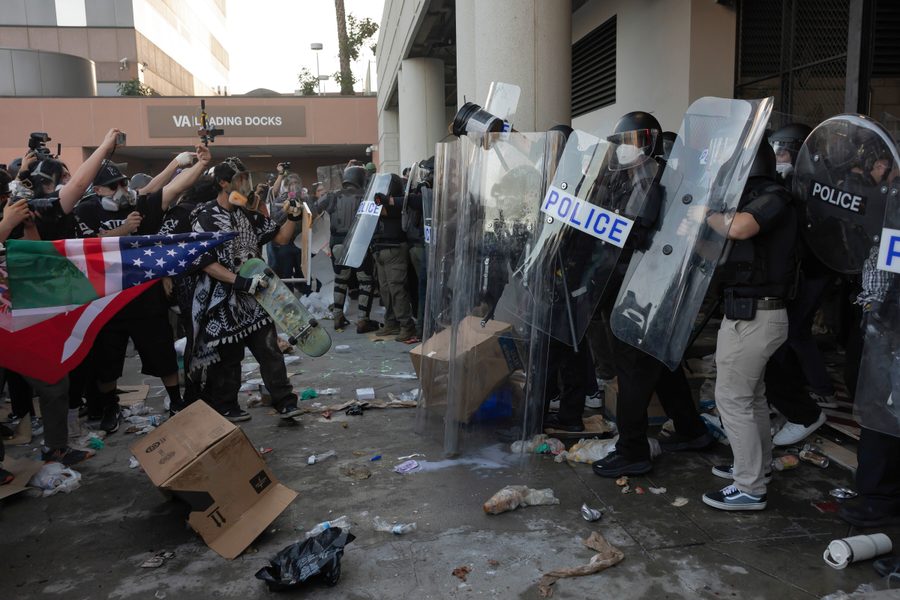
Protesters clashed with federal officers outside the Metropolitan Detention Center in Los Angeles, January 30th, 2026.
In the summer of 2025, masked federal agents carried out brutal immigration raids across Los Angeles. The city’s car washes, Home Depot parking lots, taco trucks, and public gardens all became zones of terror, not only for those consigned to undocumented status but for everyone visibly racialized as non-white. Routine administrative processes were transformed into occasions for detention, as was the case when hundreds of asylum-seekers, including children, reported to a downtown federal building for immigration hearings and regular check-ins, only to be placed in holding cells overnight without food, water, or legal counsel. Outraged, people took to the streets in protest—and immediately, President Trump claimed that a rebellion was underway and deployed the National Guard and Marines to quell it. Weeks later, the administration also sued the City of Los Angeles for its “refusal to cooperate with federal immigration authorities.” Each of these escalations was justified with reference to LA’s sanctuary policies, which constrain local law enforcement’s obligations to cooperate with federal immigration authorities. In a brief announcing the lawsuit, Attorney General Pamela Bondi called these policies “the driving cause of the violence, chaos, and attacks on law enforcement.”
Los Angeles’s long deportation summer is now the state of the nation—especially sanctuary cities. After the military assertion in LA, the federal government ordered similar deployments in Portland and Chicago, where they devastated working-class neighborhoods and wreaked terror across the populace. In recent months, the violence has only grown. In December, the Trump administration launched what it termed “the largest immigration operation ever” in and around Minneapolis. Promising consequences for the city’s “‘sanctuary’ defiance,” the administration deployed thousands of Immigration and Customs Enforcement (ICE) and Border Patrol officers to the area. The agents have since targeted local Somali and Latinx communities, fatally shot legal observers Renee Nicole Good and Alex Pretti, and arrested journalists covering anti-ICE activity.
In response, prominent liberals have defended sanctuary policies by claiming that, far from promoting lawlessness, they are in fact essential for effective law enforcement. Minneapolis Mayor Jacob Frey doubled down on this framing during a CNN town hall in late January. “We want people who are undocumented to have the confidence to call 911 without fear that they’ll get deported in doing so,” he said. “That is a safety thing. That is not an immigration strategy.” Frey’s defense of sanctuary policies resonated with that of Los Angeles Mayor Karen Bass. On the heels of the Trump administration’s lawsuit against LA, Bass emphasized to reporters that “originally, the [city’s sanctuary] law was for public safety, so the newly arrived immigrant population that was being preyed on by criminals would feel safe in reporting crimes to law enforcement.”
The Democratic politicians’ line of reasoning illuminates how, even before the current conservative assault, sanctuary policies in the US have been geared mainly towards facilitating compliance with law and order rather than defending immigrants. As a result, they have offered, at best, profoundly limited protections. In particular, sanctuary laws have long been structured by the loophole of criminality, or what the sociologist Enrique Alvear Moreno refers to as a set of “punitive exceptions.” These exceptions are as old as sanctuary itself: For instance in LA, Special Order 40—the 1979 law widely recognized as the first of the city’s sanctuary policies—carved out “criminal” immigrants from its noncooperation clauses between local police and federal immigration agents. Critically, the order specified that local police must turn over all arrest reports for any “undocumented alien booked for multiple misdemeanor offenses, a high grade misdemeanor, or a felony” to the United States Immigration and Naturalization Service.
Further, as Moreno notes in his analysis of Chicago’s sanctuary policies, such punitive exceptions are applied not only to those who have been found guilty of committing serious crimes, but also to those who are designated as “potentially criminal”—a sweeping expansion that has hollowed out sanctuary protections across the board. For example, as social scientist A. Naomi Paik has shown, people listed in gang databases—notorious tools of racial profiling that often ascribe criminality on the basis of appearance, demeanor, and dress—are subject to wholesale exclusion from sanctuary protections. In the past decades, both Democratic and Republican administrations have repeatedly used criminality as a way to undercut immigrants’ legal protections and render a growing number deportable.
For all their vaunted promise, contemporary sanctuary laws still sit within this broader history, continuing to distinguish the legitimate immigrant from the criminal one as a way to deny universal protections. In so doing, these laws follow a long-established pattern of juridical protections that only ever mitigate state harm rather than yield full safety. From the 19th-century Underground Railroad to the sanctuary movement of the 1980s, true security has always been more likely to be crafted from below rather than granted from above—a history that offers critical instruction for our own struggles for sanctuary today.
In many ways, the Fugitive Slave Acts, a pair of federal laws that sought to help recapture enslaved people fleeing bondage, and the responses they precipitated, are direct ancestors of the present-day federal round-up of immigrants and the ensuing reactions. The first Fugitive Slave Act, which Congress passed in 1793, endowed slaveholders with the authority to capture fugitives even in states where slavery was illegal. Under pressure from abolitionists, several Northern states responded to this infringement of territorial sovereignty by passing Personal Liberty Laws, which outlawed the forceful seizure of fugitives, and erected legal barriers against compelling their return. An 1842 Supreme Court ruling declared these laws unconstitutional, even as it allowed states to abstain from enforcing the Fugitive Slave Act itself. “Without the assistance of the local authorities, the 1793 Fugitive Slave Act became practically unenforceable in these states,” the legal historian James Kraehenbuehl writes.
But, while important, such legal disputes by no means formed the boundary of abolitionists’ struggle, especially amid a constant federal onslaught. In 1850, Congress passed a second Fugitive Slave Act, which attempted to ensure local compliance through a series of increasingly draconian measures—including imposing fines and imprisonment on citizens who obstructed the capture of fugitive slaves. As the historian Manisha Sinha writes, the abolitionist organizer Jermain Loguen, who was himself formerly enslaved, responded to the new law by saying: “It outlaws me, and I outlaw it.” In the wake of its ratification, Loguen joined with others to expand the Underground Railroad, a network of secret routes and safe houses that had been offering passage to people fleeing enslavement since the 1780s. The Railroad’s organizing principle was one that the sociologist W. E. B. Du Bois named in his 1935 book Black Reconstruction in America: Freedom would not be bestowed on enslaved people by good-willed states. “The North did not propose to attack property,” Du Bois wrote. “It did not propose to free slaves.” Instead, it was the “dark proletariat”—the cohorts of racialized laborers whose movements are coerced and controlled—who demanded and created their own freedom.
This focus on creating what scholars Lia Haro and Roman Coles have called “transformative sanctuary”—which centers on lived rather than promised safety—links the history of the Underground Railroad to another such attempt more than a century later. In the 1980s, US Cold War intervention in Central America fueled mass migration into the country. But once in the US, Central American refugees were systematically denied asylum. “We don’t qualify,” Alicia Rivera, one of Los Angeles’s sanctuary movement leaders frankly told Assistant Secretary of State for Human Rights, Elliott Abrams, “only because the repression and the massacres that are being carried on in El Salvador are supported by the US government.” Rendered illegal through this system of rejection, many of these migrants were detained in federal immigration facilities that sanctuary activists likened to concentration camps; others were deported to their countries of origin, where they often faced death squads. Those who managed to remain out of custody were consigned to exploitative, low-income jobs, and were denied basic rights.
At this juncture, calls for sanctuary erupted in cities across the US. Under pressure from activists, the Los Angeles City Council voted in 1985 to formally declare the city a sanctuary. The resolution reiterated the tenets set forth six years earlier in Special Order 40, and proclaimed that not only law enforcement, but all city workers would provide services to refugees who made their homes in LA. Predictably, the resolution immediately faced conservative backlash, and four days after it was announced, the City Council edited it to remove the term “sanctuary.” Michael Woo, an urban planner who led the resolution, stated that he “wasn’t willing to prolong the battle over that one word.” The shift was revealing: In the process, Woo ended up proudly explicating the intention behind the initial resolution, clarifying that it was never intended to challenge federal authority over immigration policy, only to ensure that “refugees are less afraid to contact the police.”
As local politicians leaned into a vision of sanctuary centered on law enforcement, it was once again left to a movement of grassroots activists to offer actual safety to migrants. Pushed by their members, who drew on religious traditions of refuge and harbor, churches and synagogues became key nodes in networks that provided food, shelter, and legal assistance to asylum-seekers. In one case, Roberto González, a labor organizer and political leader in El Salvador, appealed to the First Unitarian Church in Pico Union for sanctuary for himself and his family. They were then moved from one church to another every 10 days until finally they were granted asylum. My partner’s family, too, was among those who received this type of transformative sanctuary. They fled El Salvador in the 1980s, seeking asylum in the very country that had fueled the violence that had uprooted them. My partner’s mother and aunts were relegated to cleaning homes in LA, traveling each day from the working-class neighborhoods of the east to the beachside mansions of Malibu. They tell the story of la migra stopping and boarding the buses they relied on to reach their livelihoods. And they tell the story of the bus drivers who refused, who sped up their buses and drove past immigration agents—turning their vehicles, briefly, into real sanctuaries.
Ultimately, meaningful shifts in legislative framing came from this activism. For instance, in 1989, responding to grassroots pressure, San Francisco passed a City of Refuge Ordinance that, finally, framed sanctuary policies as not as a law enforcement necessity but as an act of reparation. “The people of the United States owe a particular responsibility to political refugees from El Salvador, Guatemala, and Honduras,” the ordinance stated, “because of the role that the United States military and other war related aid has played in prolonging the political conflicts in those countries.” This law, won from below, was ultimately weakened by then-mayor Gavin Newsom. Now governor of California, Newsom positions himself as a beacon of liberal resistance against Trump’s immigration enforcement, eliding his role in “eliminating sanctuary policy” in the first place.
These histories show that sanctuary has never arrived as a gift from the benevolent liberal state to immigrant peoples. Rather, true sanctuary, one that ensures protection for all seeking refuge from harm, has only ever manifested itself in the practice of migrant movements. So too today, when—even as liberal leaders dither—migrant communities are forging pockets of safety through establishing grassroots networks of monitoring and warning; rallying to keep watch at key freeway overpasses and trail the unmarked cars used by federal agents; rushing to alert street vendors to the approach of ICE agents; creating clamorous soundscapes outside of hotels in order to disrupt the rest of federal agents; documenting each kidnapping to produce a map the state conceals; raising funds to reconnect separated families; bringing food to the homes of those who cannot safely venture out to jobs or grocery stores; and more. Such embodied forms of protection prefigure a kind of sanctuary that, unlike the law, does not depend on casting people out of its purview. As such, they may be the best tools with which to chart a course that both exposes the constitutive brutality of the liberal order—and makes visible the possibility of another way.
This piece is written in memory of Benito Flores, a protagonist in Reclaiming Our Homes, a movement of unhoused people who occupied state-hoarded vacant homes in Los Angeles during the height of the Covid-19 pandemic. In his last stand against eviction, Flores sought to enact a sanctuary, building a treehouse outside of his reclaimed home with the intent of barricading himself there when the sheriff’s deputies arrived. The sanctuary turned deadly as he fell to his death from the tree. May his example light the way into a world beyond policing.

I’m Arielle Angel, editor-at-large of Jewish Currents. Before you go, there’s something I need to ask.
We’ve seen over and over how the mainstream media falters in telling stories on our beats—whether it’s antisemitism, Israel/Palestine in American politics, Jewish identity, or the American left. At Jewish Currents we’re committed to uncompromising analysis and longform reporting on these issues and more—stories you won’t find anywhere else. In a media landscape that obscures injustice and flattens discussion, we’re changing the conversation. But we need you.
If you believe in this work, please consider making a donation—or even better, a recurring one—to ensure that we are able to keep publishing stories like this one. We can’t do it without you.

Ananya Roy is co-editor of Beyond Sanctuary: The Humanism of a World in Motion and Professor at the University of California, Los Angeles, where she serves as founding director of the UCLA Luskin Institute on Inequality and Democracy.