Elaine Mokhtefi
“There was a current of confidence and warmth between all of us who were in Algiers working with liberation movements.”
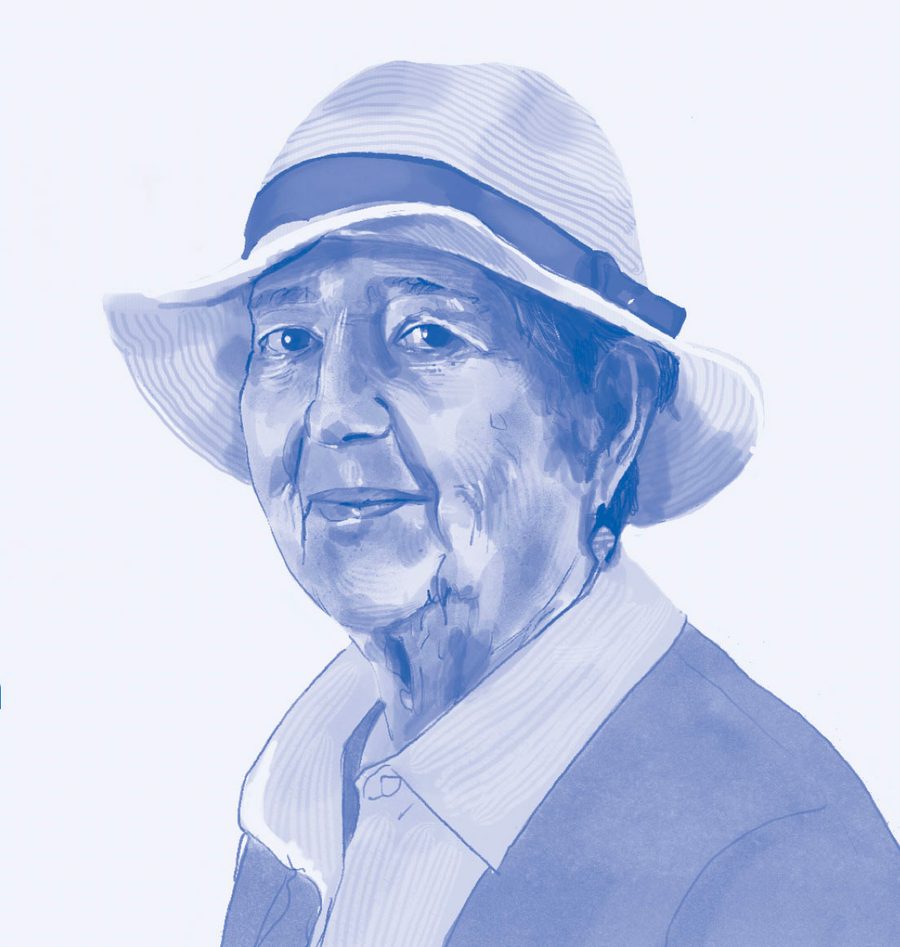

The organizer and writer Elaine Mokhtefi, who helped transform Algeria into an epicenter of anti-colonial liberation movements, was born Elaine Klein on Long Island in 1928. After a childhood spent crisscrossing the United States with her parents, struggling Jewish dry-goods merchants, she left home at 16 to attend college in Georgia; she was shocked by the virulent racism of the Jim Crow South and was soon kicked out of school. Mokhtefi returned to New York, where she threw herself into the bustling world of postwar peace-building, working as a student organizer for the United World Federalists (UWF), which sought to create a democratic world government. As anti-colonial struggles accelerated across the globe, the UWF, like this milieu more broadly, became increasingly fractured, and, in 1951, the group’s centrist leadership expelled its more radical student division. Meanwhile, as an emerging internationalist youth leader who openly criticized American racism, Mokhtefi found herself under FBI surveillance.
Like many young Americans seeking respite from the McCarthy-era US, Mokhtefi moved to Paris—but soon discovered that France was structured by its own pernicious racism. As her illusion of French cosmopolitanism evaporated, Mokhtefi glimpsed an internationalist community in the country’s shadows: a Third World liberation movement that connected the cafés of Paris’s impoverished North African quarters to on-the-ground liberation struggles from Algeria to Vietnam. She returned to internationalist organizing, working as an interpreter and coordinator in a world conference circuit that brought her to gatherings across the globe. Mokhtefi became particularly committed to the Algerian struggle, which by 1954 had hardened into a brutal war with French occupation forces. She worked closely with the Algerian independence movement in exile and eventually took a job back in New York at the movement’s US headquarters.
In 1962, Algerians defeated their colonizers, and a few months later, Mokhtefi set foot in Algiers for the first time. She immersed herself in the dizzying life of the newly independent nation through several government jobs: staffer at the tourist authority; assistant to the presidential press secretary; and, over the course of more than a decade, a series of positions for the Algerian Press Service. Her most fascinating and singular role was a kind of unofficial post: As US dissidents from Black Power activist Stokely Carmichael to psychedelics advocate Timothy Leary sought refuge on Algerian soil, Mokhtefi—the only American in the Algerian government—became their greeter, interpreter, tour guide, fixer, and handler. She developed an especially intense and often challenging relationship with Black Panther Party leader Eldridge Cleaver, who fled to Algiers in 1969 with his wife, Kathleen Cleaver, the party’s communications secretary, as well as left-wing journalist Robert Scheer; several other high-ranking Panthers followed. In the 1970s, the country took a repressive turn, and, in 1974, she was forced out after refusing to spy on a rival of President Houari Boumédiène. Along with former National Liberation Front (FLN) revolutionary Mokhtar Mokhtefi, whom she later married, Elaine returned to Paris, and finally to New York. In her 2018 memoir Algiers: Third World Capital, Mokhtefi recounts a life and times shot through with high jinks and head-spinning parallaxes at the intersection of global struggles. Her story—which we discussed in an interview at her Upper West Side apartment—helped me understand the kind of careful ingenuity that might, in a different world, be called diplomacy. This interview has been edited for length and clarity.
Ari M. Brostoff: You say in your book that you became “Algerianized” before you had ever been to Algeria. What do you mean by this?
Elaine Mokhtefi: A few months after I arrived in Paris, I went to the May Day Parade, an enormous event that takes place every year. I’d never seen anything like it; I was enthralled. Suddenly, as the parade was ending, thousands of men came running through the streets. They had no signs, no flags. Their arms were splayed. I sensed that something important was happening, but I had no idea what. Then I read an article in France Observateur, a leftist magazine at the time, which explained that these men had been excluded from the parade because they were Algerian. That was a bombshell. I saw Paris differently after that.
Other young people who had come to Paris—and who, like me, thought of Parisians as positive, friendly, amoureux—arrived at a similar realization. There was a street in the Latin Quarter where we often ate; the Tunisian and Algerian restaurants were the most prominent and cheapest, so we gathered there. We began to learn about the political situation in Algeria, and we also became aware of the large community of immigrants living on the outskirts of Paris. They lived in poverty, and their movement was restricted by the French authorities. So all of a sudden I was getting an education. It’s not as though I had been totally innocent before, but now there was specificity.
AMB: In October 1962, after more than a decade of commitment to the Algerian freedom struggle, you went to Algiers. French troops and militias had only just left the country, and independent institutions of governance were very new. Reading your account of this time, I was struck by how quickly you wound up at the center of things and how exciting—I want to say anarchic—even your more bureaucratic positions seemed to be. How did you become so embedded?
EM: I had contacts in Algiers before I arrived. I knew several members of the FLN who had come to New York during the war as part of a delegation dispatched by the Algerian government-in-exile; after independence, they became leaders in the new national government. They helped me find a lovely apartment and a terrific job as a journalist and translator at the Algeria Press Service (APS). I could bring a car from Paris; it was a very comfortable life—and it was very exciting. In the years immediately following independence, the new government encouraged liberation movements—not only in Africa but also in Asia and Latin America—to set up headquarters in Algiers. The government provided them with the means to operate and even trained their freedom fighters in the Algerian army.
And I got to be a part of it. After more than 130 years of French administration, 90% of the Algerian population was illiterate. Even people who had received formal education had little or no administrative work experience: All of those positions had been occupied by French settlers. Algerians were making lots of decisions but often didn’t have the technical skills required to put them into practice. So a lot of improvisation was required. I had only a medium education, but it was sufficient to take on a lot of responsibility.
AMB: As an American in Algiers, you supported the Algerian government in challenging US imperialism around the world, particularly the US military assault in Vietnam. What did this look like from your position?
EM: The Viet Cong had special privileges in Algiers—they were given a house and travel documents—and I became very good friends with their representative, Trân Hoài Nam. He considered me sort of the typical American, and would ask me what I thought of this or that; it was funny. At one point, together with an expatriate American jazz pianist and five or six others, I organized a committee in solidarity with the Vietnamese. We issued a communiqué attacking the United States and I put it on the APS wire so it went out all over the world.
I had a close relationship with the North Koreans, too, and even the Chinese and the Russians invited me over from time to time. It’s strange to look back at that now, but there seemed to be a current of confidence and warmth between all of us who were there working with the liberation movements.
AMB: I was fascinated by your account of these relationships—especially the one between the Panthers and the Algerian government, and how you wound up as a mediator between them. I thought your wildest story was the one about a group of American convicts on the lam who stole a million dollars, hijacked a plane, and landed it in Algiers; they hoped to deliver the stolen money to the Black Panther faction there, and thus establish themselves as political dissidents eligible to receive asylum in Algeria. The Panthers baffled President Houari Boumédiène with the incredible demand that they be allowed to keep the money. I have to say, they come off as acting pretty arrogantly toward their hosts.
EM: It was a very difficult situation. The Panthers had an unnecessarily antagonistic attitude toward the Algerians; they wrote a fiery letter to Boumédiène because he didn’t want to let them keep the money from the hijacking. I was on vacation in Paris at the time with my future husband, but I tried to help: I suggested a compromise in which the money would be given to the Palestinian Liberation Organization. Eldridge wasn’t thrilled, but he agreed. I went to a major newspaper in Paris and gave them a press release. But, of course, the Algerians couldn’t accept those terms. Put yourself in Boumédiène’s position: No company anywhere in the world would have let their pilots land on Algerian soil if the government had accepted and then distributed this stolen money. The Algerians were calm and cool throughout. Contrary to what many people have said, they did not kick the Panthers out of the country. [Ed. note: Cleaver and his comrades left gradually over the course of the following years as internal disagreements and financial strain increased among their faction.] And they authorized the air pirates to stay in the country as well.
“The Black Panther team in Algiers worked like a military organization; they wrote down everything they did. They all had roles to play and knew what their roles were.”
I feel I should emphasize more, though, how great the capacity for work was within the Black Panther team in Algiers. They worked like a military organization; they wrote down everything they did. Kathleen gave a report at the end of each day. They all had roles to play and knew what their roles were. It was amazing.
AMB: It’s almost like they were foreign service officers, highly disciplined in relation to their mission but also taking full advantage of a position of impunity. It makes me think of the story you tell about the Panthers’ bid for official recognition—can you talk about that?
EM: The Palestinians and the Vietnamese had embassies in Algiers; the Panthers and all the other liberation organizations had offices. One day, Eldridge invited me to lunch. There was an American who followed us into the restaurant—he had been hanging around, trying to get in with the Panthers. He may or may not have been a federal agent. Eldridge took the man by the neck and threw him out of the restaurant. Then he sat down and told me that he wanted the Panthers to have official status, like an embassy. He said, “Do what you can.”
I contacted Mhamed Yazid, who had been the Minister of Information of the Algerian provisional government in Tunis, and he said he would like to meet the Panthers. Mhamed was from one of the few Algerian families whose members had been well educated under the French. He spoke good English and was proud of it. He invited us to lunch at his family’s home in Blida. We sat in the garden—it was Eldridge and Kathleen and [Black Panther field marshal] Donald Cox and me. Mhamed’s grandmother made couscous with fresh vegetables, and Mhamed told all his American jokes.
We must have passed muster because after the Viet Cong got moved to Embassy Row, their house was given to
the Panthers.
AMB: You wound up in increasingly high-stakes situations, like getting passports doctored in Germany for the purposes of another proposed hijacking scheme, this time involving Eldridge and the West German anti-imperialist Baader-Meinhof Group, who wanted to hijack a plane and demand the release of American, German, and Palestinian political prisoners—
EM: —and I was just a little girl from the United States!
AMB: It seems like you were able to keep your cool even when you were in over your head. Were you scared?
EM: I was a little scared on the trip to Germany—I knew certain organizations were tracking me—but I had to go through with it. I had met so many people in Algeria who had taken such risks, and I felt that I had taken no real risks. I had never picked up a gun or gone to war. All I had to do was pick up the passports and return the passports. [Ed. note: Cleaver pulled out of the hijacking plan while the passport operation was still in progress, and the Baader-Meinhof Group did not carry out the plan under discussion.]
AMB: Where did the Palestinian struggle fit into your world in Algiers? As you’ve said, there were national liberation groups from around the world with a base there, but Palestine in particular always seemed to be in the air.
EM: I think Algerians feel closer to Palestinians than they do to anybody else. They feel that the Palestinian situation is their situation. Palestinian news has always gotten preference in Algerian media. When I worked for the APS’s French-language radio station, I would prepare a 15-minute Sunday morning radio program every week on what the press around the world was saying about Palestine. Representatives from Palestinian organizations were constantly coming through Algeria. I remember in 1967 [during the Six-Day War] you’d walk along the streets of Algiers and people would be crying. I had a boyfriend at the time who came to my house and sat on the couch and just bawled. It was as though Algeria was at war. It’s still like this—you meet any Algerian, and their heart goes out to Palestine.
AMB: Your time in Algeria ended in exile from your adopted home, but your memoir is remarkably lacking in bitterness, and you continued to do political work as a writer and activist, particularly in the Palestinian solidarity movement. Do you have any thoughts on where the inheritance of Third Worldism lives on today?
EM: That’s the kind of question I really can’t deal with. I’m a lowly worker! Sometimes with an idea.

I’m Arielle Angel, editor-at-large of Jewish Currents. Before you go, there’s something I need to ask.
We’ve seen over and over how the mainstream media falters in telling stories on our beats—whether it’s antisemitism, Israel/Palestine in American politics, Jewish identity, or the American left. At Jewish Currents we’re committed to uncompromising analysis and longform reporting on these issues and more—stories you won’t find anywhere else. In a media landscape that obscures injustice and flattens discussion, we’re changing the conversation. But we need you.
If you believe in this work, please consider making a donation—or even better, a recurring one—to ensure that we are able to keep publishing stories like this one. We can’t do it without you.