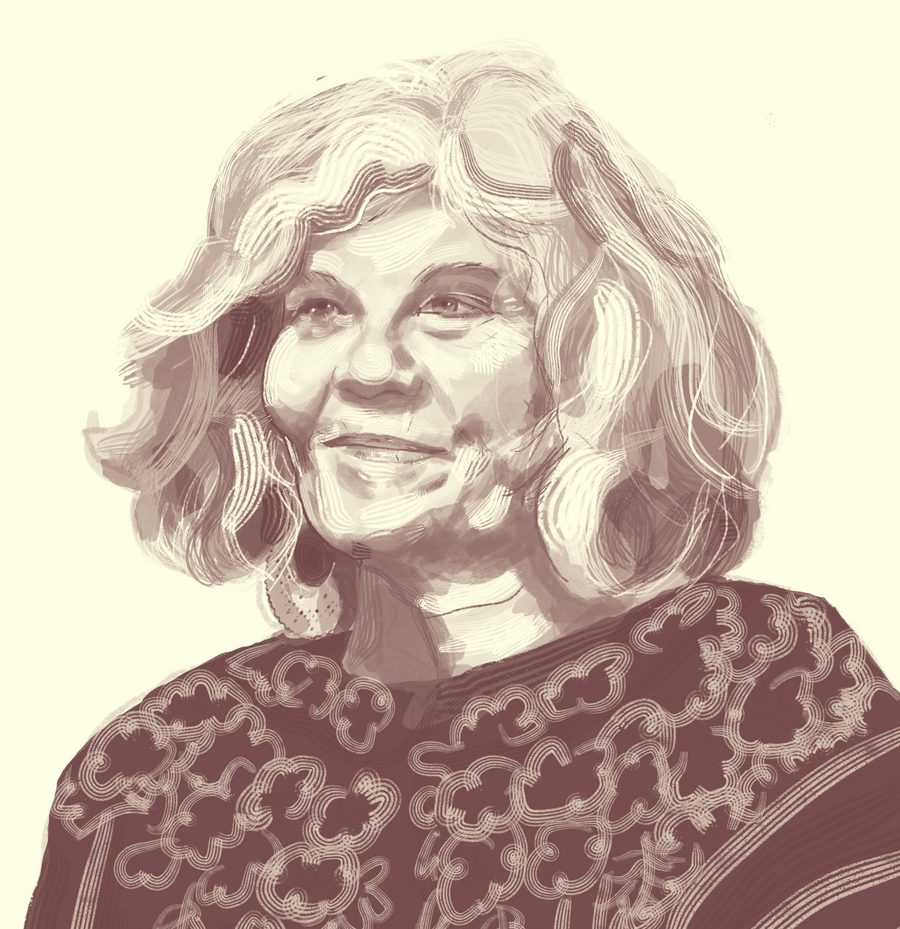
Laurie Melrood
“The people who came through the border brought the real news with them. Social change was able to happen because of this type of communication.”

I met community organizer and immigrant advocate Laurie Melrood in 2020 in Tucson, Arizona, where I was completing my doctoral work researching the US–Mexico border and Jewish social history. Laurie had spent most of the 1980s organizing for the Sanctuary Movement, helping refugees from Central America find safe transport to and shelter in the United States, and in the months before I left Tucson, Laurie invited me to help index her personal papers and other ephemera from decades of activist work. We met often, teaching each other about how to index a home archive, courting potential institutional homes for her collection, and drinking tea made with sage from her garden. In Laurie, I found a model of Jewish activism rooted in grassroots, transnational movements that seemed absent among the Jewish leaders I grew up with.
In the 1980s, civil wars across Central America catalyzed a mass migration of asylum seekers to the US’s southern border with Mexico. The Reagan administration’s support for right-wing authoritarian governments in the region contributed to the violent conditions that pushed migrants north; nevertheless, migrants from El Salvador and Guatemala encountered systemic discrimination by the US government in the process of seeking asylum, often in violation of the 1980 Refugee Act. According to federal data, the US government denied 97% of Salvadoran and 99% of Guatemalan political asylum applications between 1980 and 1990.
The Sanctuary Movement was a response to the refugee crisis, born out of liberation theology—a Christian discourse developed in Latin America in the 1960s, which used biblical teachings to ground its advocacy for the poor and oppressed. The decentralized movement mobilized under the biblical mandate to shelter the stranger known as “sanctuary” to support the needs of political refugees. In particular, it encouraged houses of worship, especially churches, to shelter immigrants in defiance of US immigration law, and raised awareness about the effects of US foreign policy in Central America.
While much has been written about the Sanctuary Movement, Laurie’s papers illuminate the subversive and little-known movement work that emerged from the Rio Grande Valley (RGV), the southernmost part of Texas, named for the river that separates the US from Mexico. The geographic isolation, poverty, and nativist political culture of South Texas necessitated a more radical and fugitive approach to sanctuary, distinct from the more public activism out of Tucson, Los Angeles, Chicago, and other movement hubs. In addition to consciousness raising and jail support for migrants, RGV organizers helped transport refugees into the country and coordinate their resettlement with a sponsoring house of worship. Taking inspiration from the strategies of Black fugitives and white abolitionists in the 19th century, the routes between churches and safe houses became known as the “New Underground Railroad.”
Between 1982 and 1987, Laurie made frequent trips between her home state of Wisconsin and the Rio Grande Valley—part of a broader organizing strategy seeking to link underground sanctuary activism at the border to safer places beyond its hyper-surveillance. She established the Madison Sanctuary Committee, helping congregations through the process of declaring themselves sanctuaries while educating faith communities about the experiences of Central American migrants and the ways US policies produced the violent conditions they fled. During those same years, she organized the Rio Grande Border Witness Program, an opportunity for people from the interior of the US to travel to the Rio Grande Valley and see for themselves the stark conditions of refugees, listen to people providing assistance, and return home with a plan to organize their communities toward further action. This practice of listening and accompaniment was a counterweight to the white saviorism she saw in the movement at the time, which manifested in American religious and social advocacy groups sidelining the overt political objectives of Central American-led solidarity and refugee organizations. “I learned that the term acompañamiento, the accompanying of people, does not mean taking over their lives, does not mean dictating their social reality or which ideology they should pursue, but just literally walking alongside them,” Laurie told curator and educator Ariel Goldberg in a 2019 interview in PROTOCOLS. Jews and other people with white privilege are “not used to those very passive roles,” she reflected. “And I’ve learned in all the work that I’ve done, with a lot of humble pie, that practice of dominating and thinking for other people doesn’t work when you are working for change with others who are more directly affected.”
In the early 1990s, after years of continual movement and unpredictable income, Laurie and her partner Blake Gentry secured more permanent work in Tucson, Arizona. Even as the momentum of the Sanctuary Movement had slowed, the border region remained the political home base from which they continued organizing on behalf of those most directly impacted by US military interventions abroad, and the so-called War on Drugs at home. For over two decades, Laurie worked with dozens of communities, locally and transnationally, as an advocate for children and their families navigating the dysfunction and bureaucratic violence of the child welfare and immigration systems.
Laurie was diagnosed with cancer in 2019. While this required a shift in how she engaged in community organizing, it also opened up space for her community to organize around her care—especially a group of young, anti-Zionist queer and trans Jews, primarily based in Tucson. By Laurie’s own account, she felt an alliance with this cohort based on shared experiences of marginalization from the mainstream Jewish community. In the final months of her life, Laurie and I began talking about recording an interview for Jewish Currents. We discussed the questions I wanted to ask and what she felt up to answering—the years of chemotherapy and medications had strained her memory—and we set a date to record. That was our final conversation; Laurie died on August 20th, 2025. Given Laurie’s passing, this column has been pulled together in an unorthodox manner, taking my intended questions, and excerpting answers from an oral history Laurie recorded with Lev Medvedev between May and June 2025.
I’ve lately been imagining Laurie’s response to the grassroots resistance against ICE’s occupation of Minneapolis. I think she’d say that “abolishing ICE” is only a starting point in the task of building alternative forms of neighborhood safety. I think she would also remind us to celebrate the small wins that moments of mass activation make possible, with more people shaken out of acquiescence and into political consciousness.
Maxwell Greenberg: You started your career working at the Jewish Federation in Madison, Wisconsin, in 1975 before pivoting to refugee hospitality and Sanctuary Movement work in South Texas in 1982. Could you speak about that transition from the liberal Jewish institutional world to a grassroots, largely Christian—and, at times, underground—social movement space?
Laurie Melrood: I was recruited right off my master’s program [in social work] to the L’Chaim senior adult program in the Madison Federation. I loved working with the older adults. I loved their whining, their sense of Yiddishkeit.
Eventually, L’Chaim started working with immigrants. I loved hearing their stories and learning about how they had adjusted in this country. I worked with Soviet Jews, I worked with Vietnamese people, I worked with Cubans. I was working with political asylum seekers from Iran, Jewish and some Zoroastrians and Bahá’ís who were seeking refuge from the Iranian government at the time. All of that gave me a sense of what happens to refugee communities when they come to this country, the lack of rights and benefits. I learned about the injustices that were an integral part of the asylum system, how politicized that system was. There was no expectation that people who really needed asylum would get it. That prepared me well for what I would find in Texas.
Near the end of my time at the Federation, I started corresponding with [Tucson-based Quaker activist] Jim Corbett from what would soon become the Sanctuary Movement. At the time, he was rescuing Salvadorans from the El Centro prison detention center in California, and had put an article in Fellowship Magazine asking people to go to Arizona’s border with Mexico to help get people out of detention and to provide hospitality to those that were on the street. Corbett eventually gave me this contact in San Antonio, Texas. I packed my bags, so to speak.
I was like 30. And I had been fairly coddled before that, not really knowing or mixing with a lot of non-Jews. It was a break in that sense. I was growing up. And once I got to Texas, my life dramatically changed.

I’m Arielle Angel, editor-at-large of Jewish Currents. Before you go, there’s something I need to ask.
We’ve seen over and over how the mainstream media falters in telling stories on our beats—whether it’s antisemitism, Israel/Palestine in American politics, Jewish identity, or the American left. At Jewish Currents we’re committed to uncompromising analysis and longform reporting on these issues and more—stories you won’t find anywhere else. In a media landscape that obscures injustice and flattens discussion, we’re changing the conversation. But we need you.
If you believe in this work, please consider making a donation—or even better, a recurring one—to ensure that we are able to keep publishing stories like this one. We can’t do it without you.
Max Greenberg is an assistant professor of American
studies at Goucher College in Baltimore, Maryland.