Claude Cahun’s Disavowals
The early 20th-century artist left a legacy of aesthetic and political autonomy in the face of fascism.
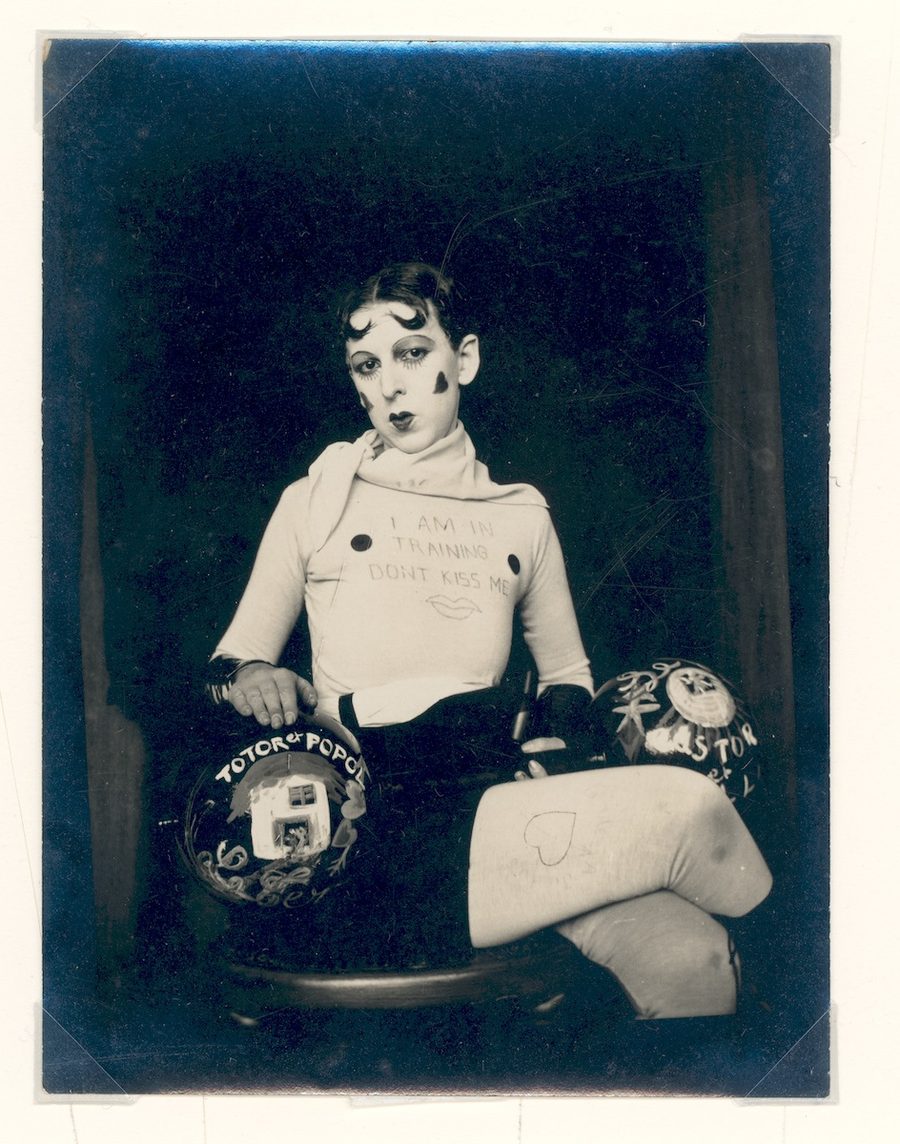
Claude Cahun: I am in training don’t kiss me, 1927, photograph, 3.5 x 4.6 in

“It’s infuriating that one can only offer what one has, what one is,” Claude Cahun bemoans in Cancelled Confessions (or Disavowals), their 1930 memoir reissued by Siglio last October in a translation by Susan de Muth. They continue: “We cover our faces with masks, then cover them again, put on makeup, then make them up again, maybe only exaggerating the resemblance to, only accentuating the imperfections of, the hidden face.” To build a façade only to tear it down, to disguise the self only to reveal its vulnerable underbelly, to falsify identity and then revert to nakedness, just to do it all again—it is an exhausting task. But, for Cahun, a necessary one.
Born Lucy Renée Mathilde Schwob to a well-off Catholic mother and Jewish father in Nantes in 1894, Claude Cahun navigated tectonic shifts, both personal and social, by way of an enduring artistic commitment to the generative possibilities of reconfiguration. Across their oeuvre—including the gender-bending studio portraits and collaborations with their longtime partner Marcel Moore (née Suzanne Alberte Malherbe) for which they are most known—Cahun developed a distinctively queer vision of modernism. (Though Cahun often used female pronouns in French, I refer here to the artist using the third-person plural that queer movements have since made available; “Neuter is the only gender that always suits me,” they write in Cancelled Confessions.) Whereas many of their contemporaries responded to the upheavals of the early 20th century with a wholesale rejection of the world as they encountered it, Cahun resisted the notion of fragmentation from an anterior whole, asserting a dynamic selfhood made and remade at the intersection of internal desire and outward presentation. Dominant strains of modernism held that we must “kill the father”; Cahun’s practice offered in response, But what if we dressed up like him instead?
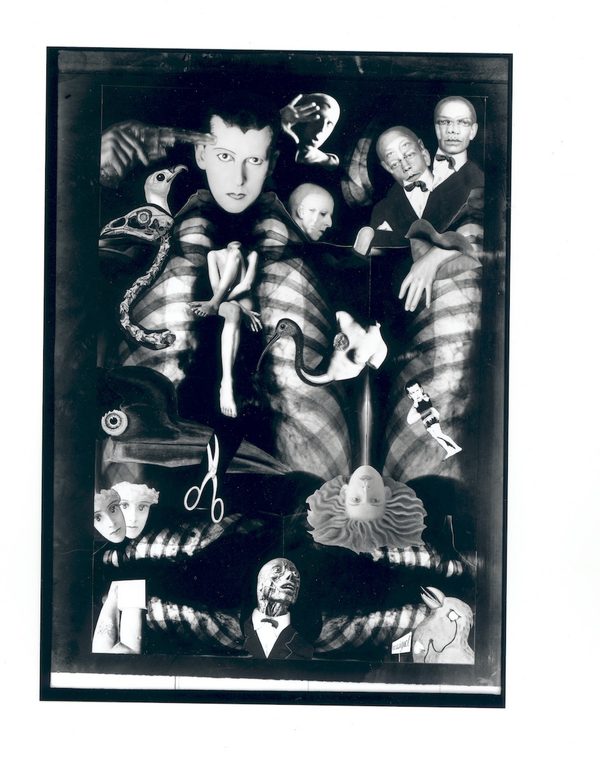
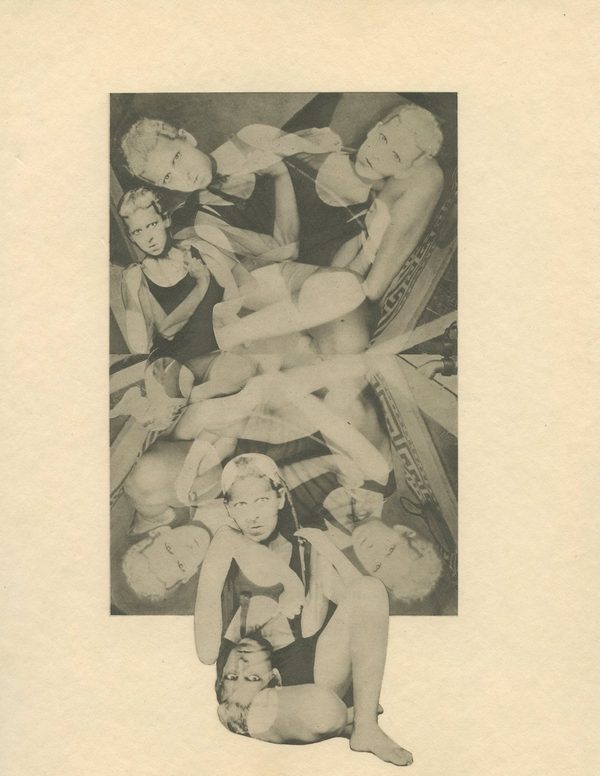
Originally published by Éditions du Carrefour as Aveux non Avenus, Cancelled Confessions (or Disavowals) is a poignant, weird, warm, and admittedly at-times exhausting book that deploys recombination both for aesthetic pleasure and as a formal strategy. In addition to letters, aphorisms, and dream sequences, the volume is studded with collages produced in collaboration with Moore. Making use of props, costumes, makeup, and other masks to create portraits that probe the bounds of the self, which they then layered with imagery sourced from newspapers, X-ray scans, playing cards, and drawings, Cahun and Moore not only reappropriated existing material, but also exposed the way that what passes for social certainty is, in fact, always up for grabs. In one such photomontage, Cahun is dressed in a bathing suit, their repeated image rotating kaleidoscopically around a central axis—the self multiple and overlapping, labile and liquid. With a pixie haircut and a striking, direct gaze toward the camera, Cahun is both present and elusive, spilling out beyond the confines of the frame. “The abstract, the absolute, the absurd, are a malleable element, a plastic material, the word one appropriates,” writes Cahun in Cancelled Confessions. “That I reclaim for myself.”
These acts of recombinant reclamation were not without risk. In 1937, as the Nazi Party continued to extend its brutal presence beyond the German borders, Cahun—who had long embraced their Jewish identity, including adopting their paternal grandmother’s recognizably Jewish surname—relocated from Paris, where they had been living with Moore for the past decade and a half, to the British isle of Jersey. When the Nazis overtook the island in 1940, Cahun and Moore, who were by that time living as eccentric “sisters,” mounted a resistance campaign that included dressing up as German officers and infiltrating gatherings of the invading troops, where they distributed misinformation. Four years later, the couple was convicted of undermining German forces and sentenced to death, and they remained incarcerated until the island was liberated the following year. Though the pair continued to make their home on Jersey until Cahun’s death in 1954, they largely retreated from public life, bitterly convinced that their fellow inhabitants had sold them out.
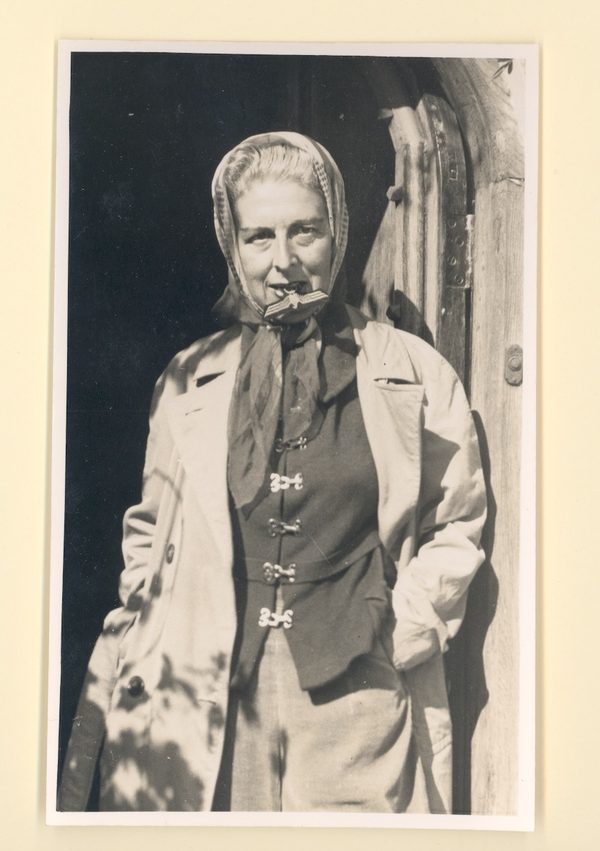
Today, as we once again confront a rising tide of global fascism, I find myself returning to a 1945 photograph of the artist, decidedly aged by the harsh conditions of their recent incarceration, in a kerchief, staring directly into the camera with a Nazi badge between their teeth: no masks, no makeup, just a knowing resolve in the strength of their antifascist commitments. Cahun has left a legacy of aesthetic and political autonomy, of incision and rearrangement. Above all, they leave to us an abiding insistence that we must leverage all of the resources of living to combat the brutal forces that threaten to constrain what we might mean for ourselves, and for each other.

I’m Arielle Angel, editor-at-large of Jewish Currents. Before you go, there’s something I need to ask.
We’ve seen over and over how the mainstream media falters in telling stories on our beats—whether it’s antisemitism, Israel/Palestine in American politics, Jewish identity, or the American left. At Jewish Currents we’re committed to uncompromising analysis and longform reporting on these issues and more—stories you won’t find anywhere else. In a media landscape that obscures injustice and flattens discussion, we’re changing the conversation. But we need you.
If you believe in this work, please consider making a donation—or even better, a recurring one—to ensure that we are able to keep publishing stories like this one. We can’t do it without you.
Tausif Noor is a critic, curator, and doctoral candidate at the University of California, Berkeley, where he studies global modern and contemporary art history. His writing has appeared in The New Yorker, The New York Times, frieze, The Poetry Project Newsletter, and many other publications.