Alphabets on the Sand
In Gaza, language is insufficient to describe the magnitude of our loss, but I write anyway.
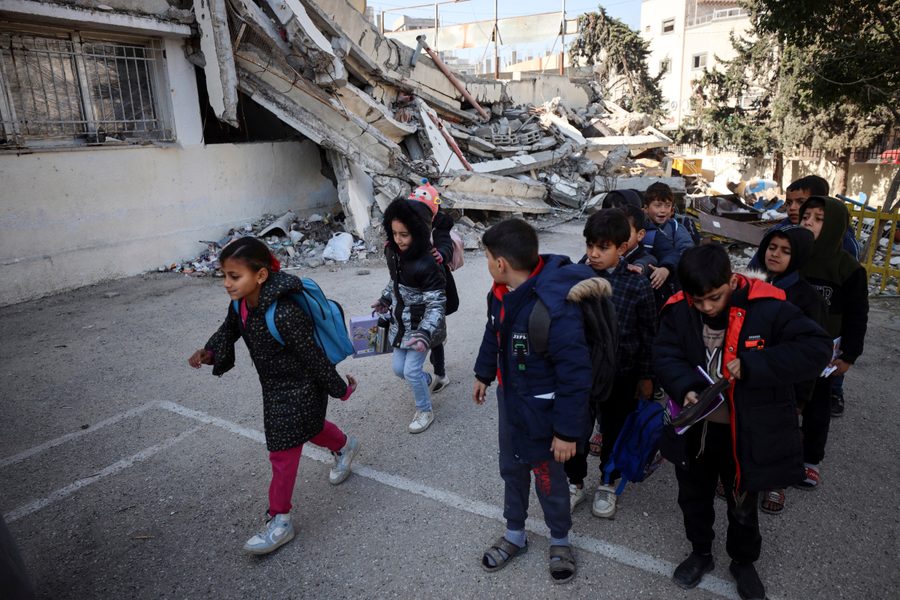
Palestinian children attend a lesson in Gaza City, February 26th, 2025.
In Gaza, books were not simply burned; they vanished. Libraries turned to dust. Schools became piles of concrete. Notebooks disintegrated in the mud, letters dissolving into the rain. Children drew alphabets on the sand, and watched as the wind erased them. They drew alphabets on the walls of their tents, then watched as dust concealed them. Children no longer read stories; they became the story.
When the war began, formal education was suspended across Gaza. Schools closed, then reopened as shelters; later, they were converted into cemeteries. Children lost their desks, their homework, their songs. Teachers no longer asked, “Did you study?” but “Did you survive?” Walls burned. Playgrounds became burial sites. The child who once memorized poems now repeats the names of the missing. Where devastation is the classroom, it often feels as though knowledge itself has become a form of mourning.
In June 2024, I was walking through Jabalia Camp when I saw an improvised graveyard beside a school. No marble headstones. Only cardboard boxes previously used by UNRWA to deliver flour, now carrying the names of the dead. The cardboard that once held supplies for survival had become markers for those who didn’t survive. I stopped in my tracks, unable to move. I wanted to copy the name of one of the martyrs into my phone, but I felt like a traitor. How can I carry a name of someone whose eye color and joys I don’t know, whose voice I’ve never heard? Will all this life evaporate like dust from an explosion—heavy, and then gone?
This past February, I went to the Shadia Abu Ghazala School in Al-Saftawi to see a friend who was staying there. The buildings that had once been brimming with chattering children were reduced to rubble, chairs that had once held eager students strewn broken throughout. In the courtyard, a man sat on a stone, holding a Quran. Ten children surrounded him, listening. No pens. No paper. No board. He was not a teacher, but a father. When teachers fell, he replaced them. When classrooms disappeared, he built one with his voice. As I stood there, ashamed of my silence, I, too, became his student, learning anew how to name loss without surrendering to it.
Now I am a high school senior. In Gaza, this final year of secondary education determines everything—our future studies, our careers, the paths of the rest of our lives. But only a few schools have reopened. From where I live in Khan Younis, it takes more than three hours to reach the nearest functioning school. On the broken roads, there are no buses, no taxis. I travel by foot. Sometimes I walk past craters deeper than I am tall. The internet comes and goes. Every day, the occupation cuts or jams the signal. When the internet returns, it crawls at 100 kilobytes per second. We wait hours to open one page, download one file, glimpse one line of a lesson we may never finish.
And still, many in Gaza refuse to stop learning. In the mornings, children walk through the ruins with plastic bags instead of backpacks. Some classes meet under trees, others in half-collapsed mosques. A child sits in the corner of a tent, reading from a half-burned notebook. A girl explains to her sister a grammatical rule she once heard. A boy searches through rubble for a torn page to keep. Education becomes resistance—not an institution, but an instinct. To learn in Gaza is to say, “I am still here.” We read not because we hope, but because each sentence feels like defiance of the ruin that surrounds us.
The ceasefire came, but the bombing never really stopped. In each moment of silence people still count the dead. In each interval of calm, I feel time slowing down—as if the world outside Gaza moves forward while we remain stuck inside the same unfinished sentence trapped between survival and meaning.
When I write, I don’t feel proud. I feel late. Words cannot keep up with what happens here. Language always follows loss. Still, I write, because forgetting is another kind of death. Writing does not save anyone; it only makes absence visible. It says, “We existed.” It says, “We tried.” And in Gaza, we have no more space to bury names.

I’m Arielle Angel, editor-at-large of Jewish Currents. Before you go, there’s something I need to ask.
We’ve seen over and over how the mainstream media falters in telling stories on our beats—whether it’s antisemitism, Israel/Palestine in American politics, Jewish identity, or the American left. At Jewish Currents we’re committed to uncompromising analysis and longform reporting on these issues and more—stories you won’t find anywhere else. In a media landscape that obscures injustice and flattens discussion, we’re changing the conversation. But we need you.
If you believe in this work, please consider making a donation—or even better, a recurring one—to ensure that we are able to keep publishing stories like this one. We can’t do it without you.
Abdullah Hany Daher is a Palestinian writer and journalist from Gaza. He documents the human stories of war, aiming to preserve voices that the rubble cannot silence.