A Time That Refuses to Pass
While the world marks two years since October 7th, 2023, those of us in Gaza have been living inside one long night.
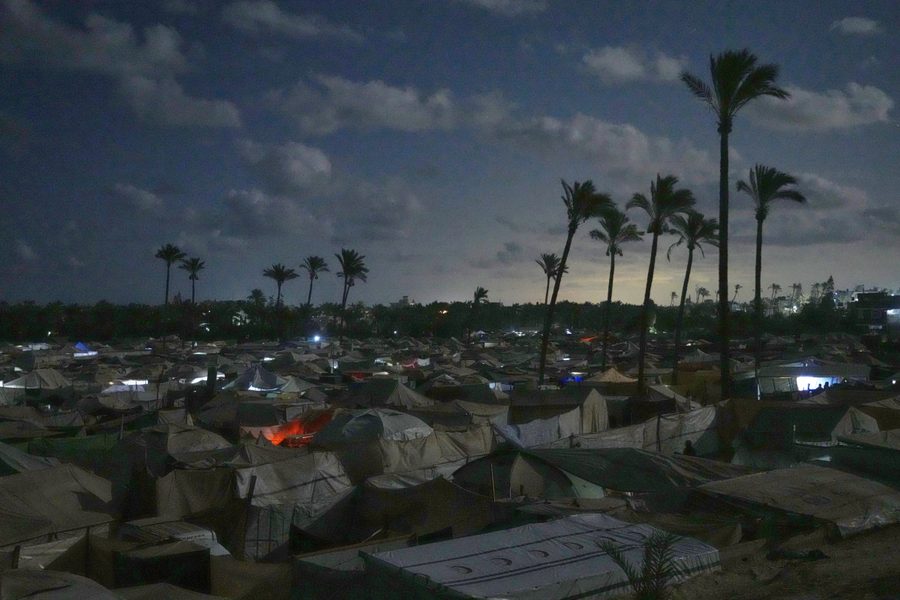
Dusk falls on a makeshift tent camp for displaced Palestinians in Deir al-Balah, in the central Gaza Strip, October, 6th, 2025.
Two years have passed since October 7th, 2023. I wrote those words in anticipation of publishing this piece on October 7th, 2025. But that turned out to be impossible. From the night of October 6th until the morning of the 8th, the bombing in Qizan Abu Rashwan, the area south of Khan Younis where my family has been staying, was relentless—so fierce that I could no longer tell the difference between the urge to publish and the urge to survive. A hand cannot tremble and write at the same time.
Yesterday, the world’s calendars turned their neat page to October 7th, yet here in Gaza the clock broke long ago. The world counts these years as complete cycles, files the date under “anniversaries”—broadcasting it in headlines and stamping it onto reports. But here, under the roar of planes, time folds in on itself; each second heavier than a year, each year only another breath of the same unending night. Life for us no longer breaks into seasons. Now survival is our singular measurement. Time: the thread that strings fragments together—days of sleeplessness, hours waiting for water or bread, minutes we believed might be our last.
This land that once held streets and homes is now a blank space dotted with tents. The only shelter as far as the eye can see: thin sheets fragile enough for a stone to pierce. Walls have been replaced with fabric, entire neighborhoods erased. Will children only remember this white city? Will they know that Gaza once had doors and windows, houses brimming with life? What will remain of all that living?
Some moments are etched indelibly in my mind—the last night the lights stayed on, the sound of my mother dissolving salt into a pot of lentils, the shape of the crack in the wall I stared at during an airstrike. Yet, entire weeks have vanished without a trace. Is this what it means to survive: to carry pieces of a life sharper than glass, and yet remain unable to recall whole stretches of time?
Here resistance lives not in slogans or weapons; now, only small acts preserve what meaning remains. My mother bakes bread over an open fire, as if in tending to a single loaf she is guarding life itself. Children draw on scraps of torn paper, trying to salvage their childhoods with each mark. We walk two kilometers with heavy jugs of water to briefly quench our families’ thirst. We wait in line for hours to receive a small pot of rice. Every morning, I make my bed, though I know it may be destroyed at any moment. I cannot control the missiles, but I can ensure this tiny gesture of order. Perhaps, I tell myself, this will be enough to remind me I am still human. These little acts are the pillars holding our lives aloft.
Everything in me testifies to two years of this ongoing night. Fear no longer arrives as a sudden tremor—it has become a thin layer stretched across all of life. A house is bombed beside me and I do not flinch, but when I try to imagine calm, I become frightened; I now know silence as that which might explode at any second. Sleep is rare, exhaustion constant.
Some evenings, we speak of “after the war.” But “after” soon dissolves into questions that answers cannot quell: If the bombing stopped tomorrow and children could return to school, would their childhoods await them? Can a person who lost half his family ever find safety in a rebuilt house? We may hope to reconstruct walls and roofs, but who will return eyes to the blind? Who will bring back the faces burned beyond recognition and restore the light to our dimmed spirits? Even time cannot bring back the dead.
Language, too, has collapsed under the weight of this present that will not pass. I write “We survived,” but the past tense feels insufficient when we don’t know what the next hour will bring. I write “we are fine,” but what can “fine” mean in a land of ruins and tents? Words cannot hold the meanings we ask them to carry. Sometimes silence feels more honest, but this mute truth is heavy—it suffocates—so I write to resist disappearance. I write to leave a trace when everything around me is being rubbed out. My words, a small dam against the current of forgetting. Even if they will not change the world, they keep me from collapsing inside.
As the world professes the passage of two years, we continue to endure this single night without end. We go on—our senses reshaped, our language weary—making the small marks that might offer our last defense against becoming nothing more than a number.

I’m Peter Beinart, editor-at-large of Jewish Currents. Before you go, I need to ask something of you.
In recent years, I’ve watched as mainstream Jewish institutions and media have chosen ethnonationalism over liberal democracy and mass slaughter over the pursuit of a just peace. Jewish Currents offers something different. It’s a magazine built on intellectual curiosity and respect for the dignity of all people.
But a project like this doesn’t sustain itself, and we can’t do it without your help. If you share my belief in the importance of this mission, please consider making a donation—or even better, a recurring one. We need you with us.
Abdullah Hany Daher is a Palestinian writer and journalist from Gaza. He documents the human stories of war, aiming to preserve voices that the rubble cannot silence.