A Map to a Place That No Longer Exists
In this city, there are thousands upon thousands of us, each carrying their own coordinates to somewhere that can no longer be found.
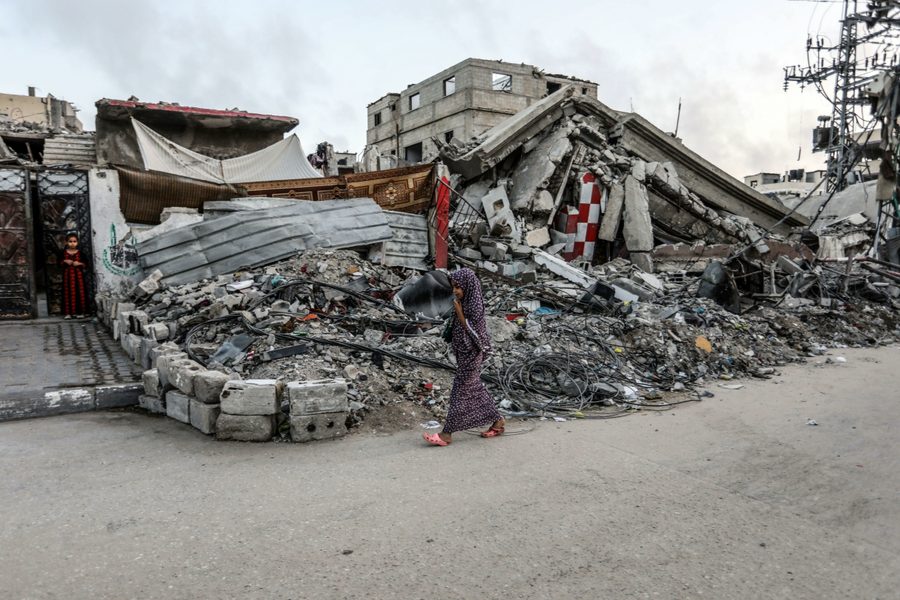
A child walks in front of a home destroyed by Israeli warplanes in the city of Khan Yunis, Gaza, June 16th, 2024.
In Gaza, the landscape changes faster than memory can keep up. Every neighborhood carries its own scars, some fresh, some already fading into dust. Places once familiar become unrecognizable overnight; streets you walked yesterday may not be there tomorrow. On this shifting ground, home is not just a structure. It is a fragile anchor to a previous version of life, one that can vanish without warning. Losing this place means losing the map inside you.
I remember the first time I saw our house after it was hit. It was May 2024. I stopped in the street, staring at the roof. A missile had torn through it, leaving a wound wide open to the sky. I stepped inside slowly. The door wouldn’t open all the way, the paint peeled off the walls in rough patches. The air was thick with dust and the smell of burnt concrete. I tried to see it as someone else’s home, but I couldn’t. This was ours, the place that had shaped me since childhood.
I cried—not in the quiet way I had learned during the war. My head tilted back, eyes locked on the hole above me, and I let it happen. I cried because the sky was now inside without permission. Because sunlight fell on broken tiles instead of on the living room floor. Because one strike could erase years of living.
In June 2025, I returned. This time there was no house. Not damaged, not wounded—gone. Scraped from the earth as if it had never stood there. I stood where the living room had been, staring at dirt and scattered stone. I thought my chest would collapse. It didn’t. In place of tears, a strange stillness. That’s when I learned what it means for grief to run dry, to be left with only emptiness. Losing a home in one sudden blow knocks you down. Watching it disappear piece by piece teaches you how to live in the ruins.
Before my house, it was my grandfather’s that was hit. It was January, cold and damp. His home had burned to the ground. No roof, no walls, just blackened remains. I had never seen him cry before. His shoulders shook, making him look smaller, as if the fire had shrunk him too. He stared at the ground where his kitchen used to be. I understood then that a house burns twice—once in the flames, and again in the eyes of the one who loved it.
In the months after my house vanished, I began noticing how the absence of buildings changes the way you move through the city. Streets lose their logic. You turn corners expecting a wall that is no longer there. You look for shade that once came from a row of homes now replaced by a flat expanse of rubble. Even sound changes—footsteps echo differently when there’s nothing for them to bounce off of. In time, you start to mistrust your own sense of direction, as if your internal map has been quietly rewritten without your consent.
Neighbors carry this disorientation, too. I have seen people stand frozen in the middle of what used to be a busy intersection, staring at nothing. Some point to the air as they speak, tracing outlines of vanished shops and doorways in the space above the dirt. Conversations about loss have grown shorter. At first, every destroyed home had a story, passed on in neighbors’ conversations and quick exchanges in the streets: the room where a wedding dress hung, the kitchen that smelled of coffee, the wall that wore the scribblings of a child. Where once people might tell you about a living room, a garden, now they just name a family and say, “They’re gone.” We talk about bombings like we talk about the weather: today here, yesterday there. The details are lost in the sheer volume of absence.
Sometimes at night I try to picture our house in all its specificity: the way afternoon light spilled through the window, the cool hallway in summer. But the picture blurs, and panic sets in. What if I forget? What if the place that no longer exists vanishes inside me too? I’ve learned that memory, like a building, can erode without care. It starts with small things—forgetting the exact sound of the front door closing, the smell of rain on the balcony—and ends with a kind of internal demolition, the slow collapse of memory, the sense that pieces of yourself are being erased.
Here, houses are more than walls and roofs. They hold footsteps, smells, echoes of conversations. They keep the map of your life. When too many are gone, the city itself begins to forget. Streets lose their shapes, people lose their usual routes and routines, the landmarks that once oriented them—the corner shop, the mosque, the old tree at the end of the street. The mind’s map slowly disappears. And when a city forgets, the people lose more than shelter—they lose themselves, the proof of their existence and belonging.
I still pass by the ground where our house once stood. Sometimes I stop, sometimes I continue on. When I do stop, I don’t cry anymore. I remember the roof with the hole, the day the sky first came in uninvited, and how that hurt more than when everything was finally gone. Back then, there was still something to lose. Now, there is only the place that no longer exists. I do not hold that place alone. In this city, there are thousands upon thousands of us, each carrying their own coordinates to somewhere that can no longer be found.

I’m Arielle Angel, editor-at-large of Jewish Currents. Before you go, there’s something I need to ask.
We’ve seen over and over how the mainstream media falters in telling stories on our beats—whether it’s antisemitism, Israel/Palestine in American politics, Jewish identity, or the American left. At Jewish Currents we’re committed to uncompromising analysis and longform reporting on these issues and more—stories you won’t find anywhere else. In a media landscape that obscures injustice and flattens discussion, we’re changing the conversation. But we need you.
If you believe in this work, please consider making a donation—or even better, a recurring one—to ensure that we are able to keep publishing stories like this one. We can’t do it without you.
Abdullah Hany Daher is a Palestinian writer and journalist from Gaza. He documents the human stories of war, aiming to preserve voices that the rubble cannot silence.