Why Hungarian Jewish Institutions Are Embracing Orbán and Netanyahu
Since October 7th, Hungary’s Jewish federation has backed away from criticism of its right-wing prime minister, prompting an increasingly vocal anti-Zionist Jewish response.

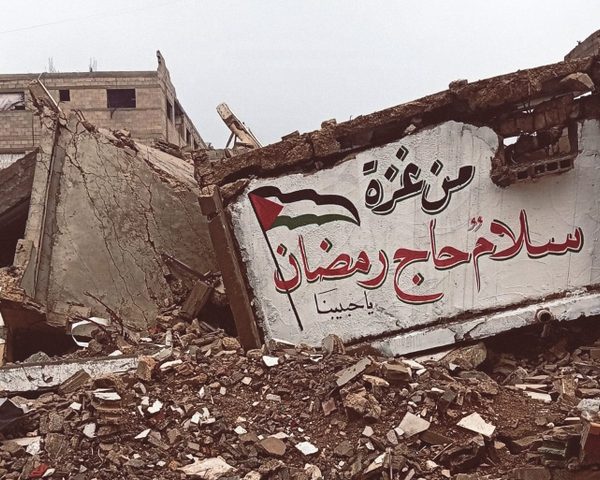
Hungarian Prime Minister Viktor Orbán welcomes Israeli Prime Minister Benjamin Netanyahu to Budapest on April 3rd.
A cikk magyar nyelvű változata itt olvasható.
The contingent of Hungarian police in front of the luxurious Four Seasons Hotel where Benjamin Netanyahu stayed in Budapest this April were not there to make an arrest. Despite the active warrant from the International Criminal Court (ICC) for the Israeli prime minister, the officers concerned themselves mostly with keeping tourists off the grassy lawn. Thanks to Hungarian Prime Minister Viktor Orbán’s decision to begin the process of withdrawing from the ICC just days before Netanyahu’s arrival, the slew of road closures across Budapest were aimed not at stopping the fugitive Israeli leader, but rather at speeding his convoy of black vans from the airport, past the Jewish Quarter, and toward the hotel on the banks of the Danube.
The fanfare marked Netanyahu’s first visit to Hungary since 2017, when he arrived at a thorny moment for the relationship between his host country’s government and its Jewish community. That previous junket came on the heels of an Orbán government billboard campaign that plastered Budapest with anti-immigration messages alongside the smiling face of Hungarian American philanthropist George Soros; many billboards were promptly graffitied with antisemitic phrases like “dirty Jew.” During Netanyahu’s visit, the president of MAZSIHISZ, the federation representing the majority of Hungary’s Jewish population, reproached Orbán for policies and rhetoric that stoked antisemitism and Netanyahu for privileging bilateral relations between the two countries over the concerns of Hungarian Jews. This criticism, which included the plea, “Prime Minister Netanyahu, I ask you respectfully to promote higher respect for the diaspora,” dominated global headlines about the visit in the following days.
But this April, there was no public critique of either leader from the federation. Across four days, MAZSIHISZ participated enthusiastically alongside the Orbán government in welcoming Netanyahu. After a joint press conference by the two prime ministers, leaders of Hungary’s Jewish communities held a roundtable with Netanyahu and accompanied both on a visit to the Holocaust memorial on the banks of the river. The statement released afterward on the MAZSIHISZ website emphasized the warm relationship with Netanyahu and the attendance of the federation’s major figures at the roundtable.
According to András Büchler, a MAZSIHISZ board member, the federation’s new approach reflects the broader community’s recent move toward the political right in its Israel politics. He framed the shift as connected to the complexities of Hungarian Jewish identity and to “the strongest pillar of that identity,” the Holocaust. In the same city where the ancestors of most Hungarian Jews survived the ghetto, he said the Hamas attacks of October 7th, 2023, have added a new “layer” to the memory of that trauma. Now, “even though traditionally most Jews are left-wing, often critical of Orbán, they feel like he is the one and only who would stand by Israel.”
Yet while the institutions of Hungarian Judaism have taken a conciliatory turn toward Netanyahu and Orbán, this view is not universal. Small protests did challenge Netanyahu’s April visit, including one group of Zionist Jewish protesters waving Israeli flags who gathered in the Jewish Quarter to denounce the visiting prime minister’s approach to the invasion of Gaza. More recently, in August, nearly 300 prominent Hungarian Jewish figures signed a petition stating that the Israeli government and Hungarian Jewish organizations “do not represent our opinion” and expressing opposition to a ban on ceasefire demonstrations in Hungary and to Orbán’s withdrawal from the ICC.
Netanyahu’s visit this year laid bare the cracks forming in the liberal consensus between Jewish institutions and the Jewish population, both of which had previously placed domestic concerns and opposition to the conservative government ahead of considerations about Israel. Now, Jewish institutions have reacted to post-October 7th fears by pulling closer to Orbán, who argues only he can guarantee Jewish safety at home and support Israel internationally—and who has sought to reinforce that argument by investing in tourism to the city’s Jewish Quarter, a project that has proved lucrative for MAZSIHISZ. At the same time, anti-Zionism is growing among certain segments of the Jewish population, who have become increasingly alienated by the traditional Jewish bodies’ embrace of the government’s narrative. “There were always critics of Israel in our community, but their voices were muted or they censored themselves,” Ráchel Surányi, a sociologist at Eötvös Loránd University in Budapest who researches the Hungarian Jewish community, told Haaretz. The critical petition, which she signed, “shows that things are changing.”
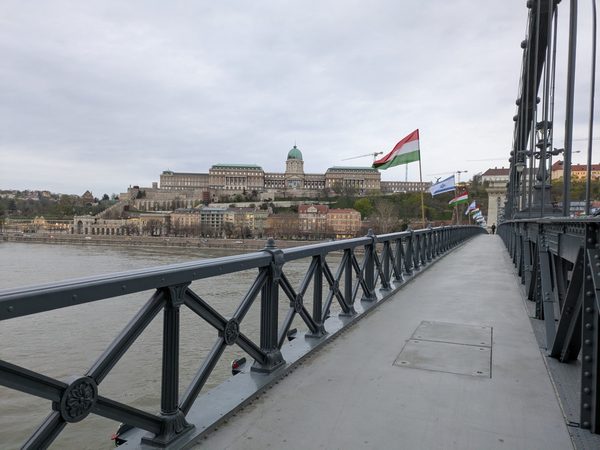
Israeli and Hungarian flags decorate Budapest’s Széchenyi Chain Bridge in advance of Netanyahu’s visit.
In 2017, when András Heisler, then-president of MAZSIHISZ (an acronym for the Federation of Jewish Communities in Hungary, pronounced “maw-zhee-hees”) and the de facto leader of Hungary’s Jewish community, reproached Orbán in front of the cameras, his organization already had a strained relationship with the prime minister’s right-wing government. That rift began in 2014, when the Orbán government distributed funds for local municipalities and civil society organizations to hold remembrance events for the 70th anniversary of the Holocaust, including $1 million directly to MAZSIHISZ. But the Jewish community began to notice “anomalies,” as Heisler put it in an interview, in the government’s politics of remembrance, symbolized most prominently by the installation of the Monument for Victims of the German Occupation in a central square in Budapest, which angered Jewish and left-wing groups by denying the role of Hungarians and the Nazi-allied Hungarian government in the Holocaust. MAZSIHISZ decided to return the $1 million to the government—a decision that Orbán’s administration viewed as “a slap in the face,” according to Heisler—and many community members avoided government-funded events throughout the year of commemoration.
Though a peace of sorts was made afterward, according to Heisler, communal attitudes toward the government remained suspicious when in 2017 news arrived that Netanyahu would visit Hungary. A survey of nearly 2,000 Hungarian Jews in that year found that only a negligible 1% supported Viktor Orbán’s ruling Fidesz Party, even as that party took nearly 49% of votes nationally and went on to secure a supermajority in the following year’s parliamentary elections. Likewise, this representative sample of Jews consistently expressed more progressive opinions than a comparative sample of educated Hungarians—for example, only 14% of Jews supported cracking down on the acceptance of refugees, whereas 66% of college-educated Hungarians did.
While Hungarian Jews, Heisler said, were initially excited about the first visit by an Israeli head of state since Hungary restored diplomatic ties with Israel in 1989, the Israeli prime minister soon also became implicated in the community’s tensions with his ally Orbán. First, Netanyahu’s initial itinerary didn’t include any meetings with the Hungarian Jewish community. Then, after the Soros billboards appeared, the Israeli foreign ministry defended them in a statement, calling Soros a legitimate target. When a public event was eventually arranged for Heisler, Netanyahu, and Orbán, the MAZSIHISZ leader saw his chance to speak out: “The intention was to give a very polite and very proper speech, but to point out the points of conflict that existed, and for which I was requesting their help,” he said.
Today, though, MAZSIHISZ leadership, under Andor Grósz, a former doctor in the Hungarian armed forces who succeeded Heisler in 2023, has taken a different approach to Orbán. The federation is now openly critical of Heisler’s rebuke. In a written response to questions from Jewish Currents, Tamás Mester, vice president of MAZSIHISZ and president of the locally affiliated BZSH (Budapest Jewish Community), termed the former leader’s statement to Netanyahu and Orbán a “diplomatic error.” According to Mester, a Hungarian Jewish leader could conceivably criticize the Israeli government publicly for politics that work against Jewish interests, but “the Netanyahu government does not and has never carried on such conduct.”
With respect to Orbán, Mester praised the prime minister’s support for Israel at the United Nations and European Union, as well as his approach to domestic Jewish concerns: “The government consistently stands with the Hungarian Jewish community. We do not have to face western European radical Islamist or far-left antisemitism.” He reiterated the government’s message that in Hungary Jews can live in safety, and said that while some observers may see “sensitive historical antisemitic tropes” in the government’s messaging, “the government consistently rejects those accusations, emphasizing that its politics are guided by national security and sovereignty, not ethnic or religious considerations.”
Heisler attributed this change in part to president Grósz’s long history serving in a hierarchy having instilled in him the belief “that there must be a peaceful relationship with the government.” But MAZSIHISZ’s new stance may correspond with changing attitudes among Hungarian Jews more broadly. According to Surányi, the sociologist, Hungarian Jews’ approach to Hungary and Israel has historically been characterized by what she and her colleague Márton Gerő call “inconsistent liberalism.” In an interview with Jewish Currents, she explained, “Many Hungarian Jews argue that they are leftist liberal when it comes to Hungary, but when it comes to Israel the political sides have different meanings, it’s not right and left.” Indeed, while displaying their progressivism on domestic policy, the 2017 study also showed that the majority of Hungarian Jews agreed generally with Israeli policy as represented by the Netanyahu government. In the years between Netanyahu’s two visits to Hungary, the community’s domestic politics may have begun to shift toward a closer alignment with their support for conservative politics in Israel.
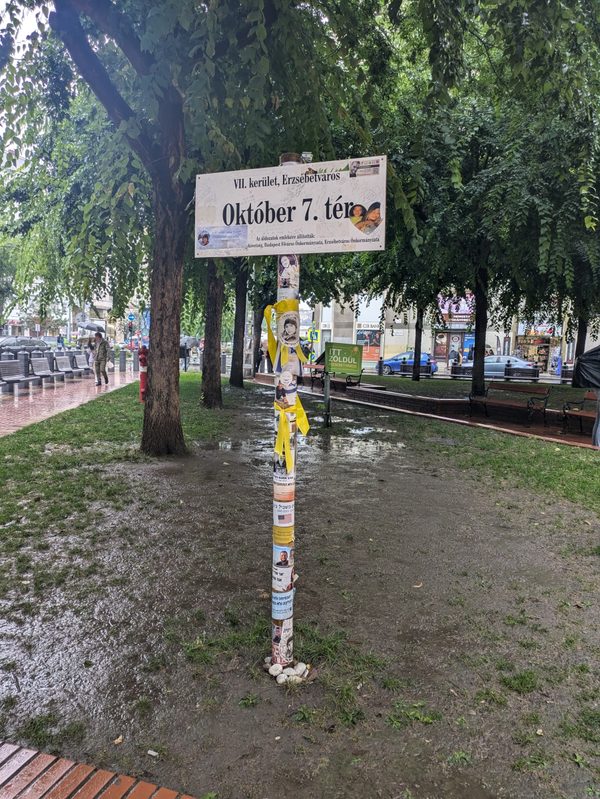
The square in Budapest’s Jewish Quarter outside the Dohány Street Synagogue, usually called Theodore Herzl Square, has been unofficially renamed “October 7th Square.
Today, although there has not been another representative survey since the 2017 study, Surányi said at least some people in the Jewish community “say that they would vote for Orbán just because he is supporting Netanyahu and Israel,” a position that was essentially unheard of in 2017. She said the origins of the shift are complex, stemming from the xenophobia and Islamophobia present across Hungarian society and coming after a decade during which “Orbán has been pressing this moral panic button” against migrants. “I think it got to the Jewish head,” she said. The new prominence of the conservative and often Fidesz-aligned Chabad movement, which has grown rapidly in Hungary, has also played a part. Ultimately, in light of the personal friendship that blossomed between Orbán and Netanyahu after the first visit, some Jews may have begun to associate support for the Hungarian leader with support for Israel. October 7th has only exacerbated such attachments: Surányi—whose own research focuses in part on the severely unbalanced discourse around Israel in Hungarian Jewish media—characterized the mainstream communal attitude as “How can you criticize Israel after it was attacked?”
Despite this apparent rightward shift, many Hungarian Jews still disagree with both the community’s support for Israel and MAZSIHISZ’s conciliatory turn toward the Hungarian government. In the August petition, signatories—including parliament member András Jámbor, Holocaust historian László Karsai, and Canadian Hungarian doctor Gábor Máté—expressed their solidarity with both “the Jewish victims of the attacks of October 7th and the innocent Palestinian victims in Gaza,” and criticized Hungarian Jewish institutions and the government for suppressing open discourse around Israel. “There is barely any platform or institution which would dare to take on these debates and nuanced conversations,” they wrote. “In fact, in recent months they have actively cancelled invitations to Jewish representatives who do not represent the point of view of the radical Israeli government.”
Anna Margit, a Berlin-based activist who grew up in the heart of Budapest’s Jewish Quarter and has returned frequently to the city in recent months to host Jewish anti-Zionist events, said she has noticed a growing anti-Zionist sentiment within the Jewish community, especially among young people. But few of these anti-Zionists, Margit said, feel represented by Jewish institutions like MAZSIHISZ. In Hungary, she said, “It feels like Zionism is the only world for Jews, the only planet. If people exit Zionism, it feels like walking off the face of the earth.” Days after the petition was released, the editor of Szombat, the largest Jewish publication in Hungary, published an article decrying the signatories for lacking self-reflection and accusing them of “not breaking the silence, but rather joining a ceaselessly and ever more aggressively howling chorus.”
There are also structural reasons why Jewish institutions may be disinclined to break with the government. Attila Novák, a historian who studies the Holocaust and Zionist movements in Hungary and East-Central Europe, explained that unlike Jewish congregations in other countries which rely on contributions or membership dues, Hungarian synagogues get most of their funding through MAZSIHISZ, which in turn receives general state funding to maintain its network of Jewish hospitals, schools, and nursing homes, as well as government compensation for religious properties illegally confiscated by the communist regime. It also makes its own income from tourism to Jewish sites. Together, nearly the entire MAZSIHISZ budget comes from those three sources, in roughly equal proportion, rendering the relationship with the government critically important. “If the state doesn’t give money, then there’s no money,” said Novák. “They can’t pay the rabbis and they can’t clean the synagogues.” While government social service funds and historical property compensation are theoretically guaranteed year over year—one reason why former president Heisler says that he didn’t see the federation as particularly dependent on the government—additional money for new projects and much-needed renovations relies on a good relationship with the state.
At the congregation level, rabbis say they face pressure from MAZSIHISZ to avoid any controversy that could endanger this funding. One rabbi was briefly expelled from the federation and fired in 2020 for Facebook posts critical of Israel. Another, who asked that his name be withheld to avoid consequences for him or his synagogue, said that funding from MAZSIHISZ makes up more than half of the budget of his congregation, which is one of Budapest’s most progressive and is split on the issue of support for Israel and Zionism. “There is dependency, and not just a small amount of dependency, on MAZSIHISZ and through them on the government too,” he said.
Even the most independent third of the MAZSIHISZ budget, tourism money, has become ever more intertwined with the state as the Hungarian government has zeroed in on international visitors to prop up a struggling economy. Budapest’s Jewish Quarter, home to a triangle of restored synagogues, is a prime attraction, one heavily promoted in government tourism materials. Once the site of the Budapest Ghetto, the neighborhood experienced decades of decay before becoming famous in the 2000s for its “ruin bars” built into run-down apartment buildings. With the emergence of Airbnb and budget airlines, millions now visit the neighborhood yearly and contribute heavily to the tourism revenues, which represent more than 13% of Hungary’s GDP. In response to the ensuing quality-of-life issues for local residents, the local government has laid out a plan to shift from party tourism to cultural tourism, especially Jewish-themed cultural tourism, which is useful both materially and symbolically to the government. Orbán uses this visibly Jewish neighborhood to bolster his claim that “Hungary is the safest country for the Jewish community,” thanks to his anti-migration policies that prevent the influence of “radical Islam.” Meanwhile, several of the restaurants and hotels in the Jewish Quarter are owned by members of Orbán’s patronage network, the NER group.
Jewish organizations stand to benefit, too. MAZSIHISZ vice president Mester specifically mentioned to Jewish Currents his appreciation for the Orbán government’s “programs and initiatives to preserve Jewish cultural heritage and support community life,” including renovations of synagogues and memorials. One of the three famous temples, the Rumbach Street Synagogue, was recently renovated by MAZSIHISZ using a grant of 3.2 billion forints (then equivalent to more than $11 million) from the government. MAZSIHISZ also manages the synagogue on Dohány Street, the largest in Europe, which, according to the director of the MAZSIHISZ tourism office, draws more than half a million international visitors a year willing to pay its steep ticket prices. Still, the investments have done little to bring back the quarter’s tight-knit Hungarian Jewish community, which mostly fled with the tourism boom. Büchler, the MAZSIHISZ governing board member, is also part-owner of a small artisan Judaica shop in the neighborhood. While the owners hope to revive some of the Hungarian Jewish life and material culture that once flourished here, he admitted that 95% of the customers are tourists and compared the situation in the neighborhood to “living in a kind of Shoah Disneyland.”
Hungary’s Jewish community, unique among its neighbors in that many educated urban Jews survived the Holocaust in Budapest, has a long history of adaptation and survival under illiberal and repressive governments. In this light, perhaps the current political shift is more a return to the norm than a new development. According to Novák, apart from Heisler’s tenure and a few clashes over antisemitism in the chaos of the post-socialist ’90s, MAZSIHISZ has never been a body that strongly criticized the government. For some, the risk of getting on Orbán’s bad side as a tiny minority community remains too great.
Another rabbi, who leads a MAZSIHISZ-affiliated congregation and also requested that his name be withheld, summed up the choices facing the Jewish institution in terms of pragmatism. “If I am Jewish, and I want to be here in Hungary for another hundred years and not leave, and the Hungarian people cannot vote out the Fidesz government for four consecutive terms, do I have to play the role of opposition instead of the Hungarian people?” he said. “Why would we play this role? Our job is to maintain our communities.” As a result, it’s been left to Hungarian Jews organizing outside institutional religious frameworks to mount an opposition both to Orbán’s rule and to Zionism. That context led Margit, the Berlin-based activist, to realize her voice was needed in the Jewish community back home: “I should be trying to do something in Hungary. Because I think there are a lot of people who are anti-Zionist Jews, but who don’t dare to say anything because they all think they are alone.”

I’m Arielle Angel, editor-at-large of Jewish Currents. Before you go, there’s something I need to ask.
We’ve seen over and over how the mainstream media falters in telling stories on our beats—whether it’s antisemitism, Israel/Palestine in American politics, Jewish identity, or the American left. At Jewish Currents we’re committed to uncompromising analysis and longform reporting on these issues and more—stories you won’t find anywhere else. In a media landscape that obscures injustice and flattens discussion, we’re changing the conversation. But we need you.
If you believe in this work, please consider making a donation—or even better, a recurring one—to ensure that we are able to keep publishing stories like this one. We can’t do it without you.

Larkin Cleland is a journalist and urban geographer. He recently completed a Fulbright Scholarship in Hungary, focusing on the history and politics of the development of Budapest’s Jewish Quarter.