Whose Jewish Dystopia?
With their dark visions of the future, two recent novels illuminate mutually incompatible forms of contemporary Jewish fear.
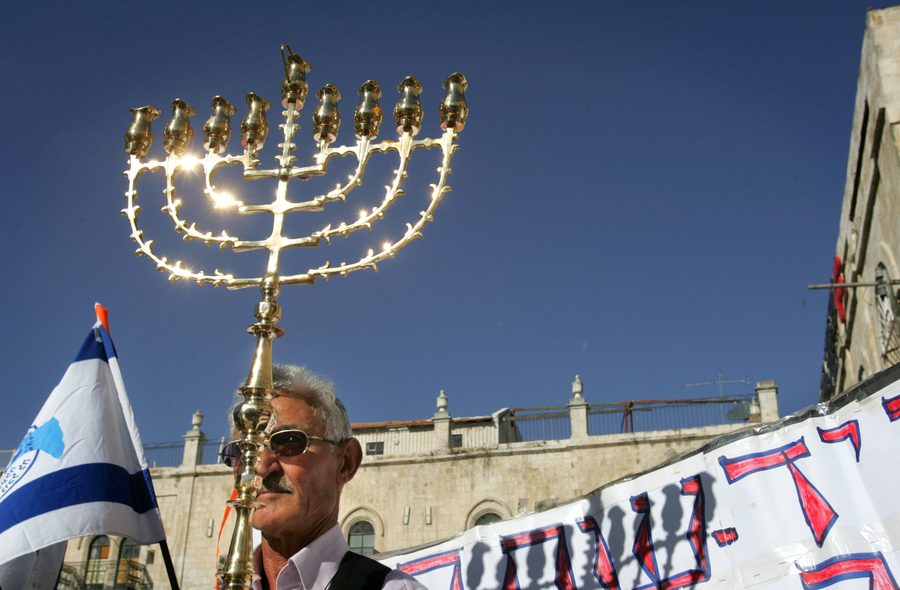
A supporter of the movement to rebuild the temple in Jerusalem passes through Jaffa Gate during a protest in the Old City, January 2nd, 2006.

Discussed in this essay: The Third Temple, by Yishai Sarid, translated by Yardenne Greenspan, Restless Books, 2024. 320 pages.
Next Stop, by Benjamin Resnick, Simon & Schuster, 2024. 320 pages.
In 1895, the journalist Theodor Herzl wrote in his diary that he had “been occupied with a work of infinite grandeur”; that is, developing his vision of Zionism. Despite his utter commitment—“for days and weeks it has possessed me beyond the limits of consciousness”—he wasn’t yet sure what would come of his “mighty dream.” But even if the “conception is not translated into reality,” he mused, “at least out of my activity can come a novel. Title: The Promised Land!” Of course, his efforts did dramatically shape the real world, but not before they produced a work of mediocre fiction. In 1902, he published a utopian tale called The Old New Land, which expounded on the political program set forth in his 1896 pamphlet The Jewish State. The novel showed readers a former “wasteland” transformed into a technologically and politically modern society where suffering Jews, liberated from both antisemitism and religion, thrived alongside Palestine’s Arab occupants, represented in the novel by one man, an engineer from Haifa who supports Jewish settlement and becomes a political leader. The Old New Land envisions Israel as a society where, as scholar Jeremy Stolow writes, “‘rationality’ and ‘liberal tolerance’ have become the supreme principles of state.” Many of Herzl’s mighty dreams came true; this one, needless to say, did not.
In that period of perilous uncertainty about Jewish life in Europe, Herzl wasn’t alone in articulating possible Jewish futures through utopian fiction. Many of his contemporaries turned to the genre to imagine what might become of them in a Europe that seemed increasingly hostile to Jews. Adolf Agai’s 1877 story “Budapest One Thousand Years Later,” which scholar Stefania Ragaù identifies as the first piece of modern Jewish utopian literature, offers a quite different vision, imagining a Hungary free of antisemitism; in his 1918 sci-fi novel In the Future City of Edenia, Kalmen Zingman did the same with his home country, Ukraine. The lapsed Zionist Nathan Birnbaum channeled his rejection of the movement into a 1907 novel in which Jews multiply enough that the world’s metropolises come to contain their own Jewish utopias. After the Holocaust and the founding of Israel, Jewish utopian literature more or less vanished—perhaps many Jews outside Israel were too scarred by the Shoah to imagine a perfect world, while Zionist true believers turned their utopian energy toward building the fledgling Jewish state. But as Israel gained and abused power, some of its writers began turning to the inverse genre: dystopian literature. (Unsurprisingly, there is a strong dystopian current in Palestinian national literature.) Amos Kenan’s best-selling and influential The Road to Ein Harod (1984), which begins with a fascist coup in Israel and ends with Armageddon, was followed by other works foretelling varyingly disastrous futures, from Yitzhak Ben-Ner’s The Angels Are Coming (1987) to Dror Burstein’s Muck (2016) and Shimon Adaf’s Shadrach (2017).
Among the most acclaimed of these Israeli dystopias is Yishai Sarid’s The Third Temple (2015), which was released in Yardenne Greenspan’s English translation last year. After a faux-scholarly preface identifying what follows as a record from a conquered kingdom, we meet the narrator, a priest named Jonathan, whom we soon see sacrificing a lamb in a temple on Jerusalem’s Mount Moriah. He does so carefully, conscientiously, determined that the animal shouldn’t suffer as it carries out its “superior destiny” of pleasing God with its aroma. Sarid lingers on the scene, writing it with deliberate beauty and collaging in a line from the binding of Isaac in Genesis and Leviticus’s injunction that “the life of a creature is in the blood, and I have given it to you to make atonement for yourselves on the altar.” This ancient act unfolds against an explicitly futuristic milieu; in order to enter the temple, Jonathan had to go through a scanner that “read from the computer chip implanted beneath the skin of my neck: ‘Jonathan son of Jehoaz, Jewish, priest, authorized to enter.’” As this suggests, the novel is set in a world in which the State of Israel has transformed into an authoritarian theocracy. Its ruler, Jonathan’s father, Jehoaz, has destroyed the Al-Aqsa Mosque and erected a new temple, replaced the Supreme Court with a rabbinic one, and instated biblical law. He’s also gone to war to annex more of historic Palestine, expelled all Palestinians, and implanted “Judaism chips” in his subjects to track their movements and ensure the kingdom’s ethnic purity. He brutally suppresses dissent, enriches his own family while his subjects starve, and keeps the country in a constant state of war that has left it a pariah nation without a single friend, besides the diaspora Jews who continue to support it and send funds.
Just a few months before Sarid’s Israeli nightmare landed in the US, American Conservative rabbi Benjamin Resnick published his debut novel, the diaspora dystopia Next Stop. This debut novel, set in an unnamed city that is unmistakably New York, it describes a near future in which the State of Israel has not degraded but disappeared entirely and mysteriously, consumed by a black hole. In the aftermath of this cataclysm, countries around the world rush to restrict Jews’ rights and movements. Soon smaller “anomalies” begin to appear in major cities across the globe, causing minor miracles and emitting a siren song that beckons Jews to descend into them; some do so, living underground and riding a “subway below the subway,” presumably searching for a permanent home. Aboveground, the anomalies inspire increasingly rampant antisemitic conspiracy theories, interpersonal violence, and state discrimination. In the city where Next Stop is set, Jews are banned from public spaces and certain lines of work, forced to live in a ghetto called “the Pale,” and subjected to brutal policing by robotic dogs.
Read alongside each other, Next Stop and The Third Temple offer dark visions of the future that illuminate two frighteningly relevant—and mutually incompatible—forms of contemporary Jewish fear. While Sarid’s dystopia is rooted in a terror of untrammeled Jewish power, Resnick’s is grounded in the notion that antisemitism is an inexplicable, ineradicable force only kept in check by the strength of the Jewish state. This deeply Zionist idea, consciously cultivated by Israel and promulgated by mainstream Jewish communal voices, has become enormously influential; in the wake of October 7th, President Joe Biden repeated variations of the remark that “were there no Israel, there wouldn’t be a Jew in the world that is safe.” Indeed, though Next Stop doesn’t explicitly address Zionism—and was written well before the Hamas-led attack on Israel and the genocide in Gaza—it’s hard not to notice the resonance between the novel’s premise and the worldview of those who see any hostility toward Israel as antisemitic. After all, Resnick imagines a world in which the fabric of time and space itself discriminates against Jews; its dystopia is essentially just the exaggerated existence of antisemitism, which Jews can escape only by reaching some mysterious homeland. Sarid’s dystopia, by contrast, hinges on the conviction that a Jewish ruler can be venal, brutal, and authoritarian enough to destroy an entire society, and that his subjects can be manipulated into such fervent Jewish chauvinism that they’ll let him do it. That is, while Next Stop rests on an old and dangerous delusion, The Third Temple has proven alarmingly prescient.
When The Third Temple came out in Israel in 2015, it was responding to political developments that sowed the seeds of the catastrophic present. Prime Minister Benjamin Netanyahu was solidifying power and welcoming far-right religious hard-liners into his coalition, including those who aspired to demolish Al-Aqsa and build a new temple where it stands. Sarid, raised in a family of committed leftists and secularists—his father, Yossi Sarid, spent decades in the Knesset, arguing for civil and human rights, a two-state solution, and a complete separation of religion and state—was appalled. He wrote The Third Temple, his fourth novel, to warn against the future he feared his government was ushering in.
The Third Temple’s narrator does not share its creator’s view. Jonathan is a naive, repressed loyalist who clings to the sense of purpose he gets from his priestly duties; even when an angel of God urges him to reconsider his commitments, he refuses. Through Jonathan’s worshipful eyes, Sarid shows us the horrors of life in a despotic, warmongering nation that is unmistakably a hyperbolized version of contemporary Israel. The dystopian features of the new “Kingdom of Judah” are all amplifications of existing Israeli policies and dynamics or manifestations of real political currents. The mandatory “Judaism chips,” for instance, are an eerie advance on the ID cards that facilitate Jews’ safe passage through Israel’s apartheid checkpoint system. Dissenters from the regime are considered “defeatists,” or worse, “inciters and sinners”; the chief of the secret police brags that he can “punish you for your thoughts.” With Palestinians expelled from the territory under its control in The Third Temple, the kingdom generates internal scapegoats. In a clear evocation of Nazi ideology, this Jewish fascism espouses racial purity, physical strength, and a “clean life of harmony with nature” and oppresses the disabled and anyone else understood as weak or imperfect. This remains a source of ongoing shame and grief for Jonathan: He was severely injured by a grenade in his childhood, and treated with great scorn as a result of the lasting damage.
The dystopian features of the new “Kingdom of Judah” are all amplifications of existing Israeli policies and dynamics or manifestations of real political currents.
Meanwhile, the kingdom’s aggression toward its neighbors—referred to collectively as “Amalek, the ancient and evil enemy of Israel”—is unmitigated, though the Jewish nation understands itself as the victim. Reflecting on the steady stream of casualties within the kingdom, Jonathan declares, “We all knew who was to blame: the Amalek and the nations of the world whose hatred for us is eternal.” (The reference to a biblical foe the ancient Israelites are enjoined to exterminate, long used by the Israeli far right to justify violence against Palestinians, was deployed by Netanyahu to announce his genocidal intentions after October 7th.) This is not the only time Sarid has explored the dangers of the narrative of eternal Jewish victimhood; his 2017 novel, The Memory Monster, which appeared in Greenspan’s English translation in 2020, satirizes Holocaust memorialization in Israel to suggest that this self-understanding has allowed Jews to become perpetrators. Discussing that novel in Haaretz just after its US release, Sarid said of his nation, “We’re no longer helpless Jews, but we still make allowances for ourselves as if we were still weak, helpless Jews.” In The Third Temple, these allowances—and the sense of impunity they foster—lead directly to endless devastation.
Next Stop springs from a variation on the very beliefs Sarid criticizes. Resnick has said that he views antisemitism as a “monster living in the closet”—a beast that may sleep, but always “wakes up . . . hungry.” With the novel, he explained, he was “trying to imagine what it will look like when the monster, inevitably, wakes up here in America.” The book opens with the meeting of its protagonists, Ethan and Ella, two Jews in their mid- to late thirties, who attempt to launch a relationship and lead normal lives, even as antisemitic animus grows and society crumbles around them. Ella, a single mother, is far more anxious about their fate than her boyfriend, who feels that their dystopian black-hole situation “would resolve itself and . . . things would be fine because they were always fine.” Whatever the narrative justification for his comparative optimism—perhaps the fact that, unlike Ella, he has no child to worry about and no family who vanished with Israel—he ultimately functions as a straw man of sorts; the novel swiftly disproves his point of view and validates Ella’s. The implication is obvious: For Jews, nothing is ever fine.
Next Stop, which is built on that belief, is so convinced of its obviousness that it makes no effort to imagine the political conditions that would actually imperil Jews. Indeed, Resnick’s decision to dump readers straight into his antisemitic dystopia implies a fundamental assumption that his audience—like his novel—is paranoid enough that he doesn’t need to establish the details of his dystopia and the antisemitism that drives it. Why is it the case that the majority of world Jewry disappearing suddenly makes all non-Jews more inclined to hate and ghettoize those who remain, rather than ignoring, pitying, or even trying to save them? How does the circulation of ambiguous antisemitic conspiracy theories trigger dramatic legislative shifts and social upheaval? And what, by the way, is the status of other religious and ethnic minorities in decaying societies that discriminate against Jews? Resnick answers none of these questions.
While Next Stop is carefully and even somewhat lyrically written—full of lovingly drawn scenes of childhood, holidays, and miraculous events—it’s marred by this rampant imprecision, which even extends to its sense of Jewishness itself. Despite occasional vague references to “registration apps” that track Jews’ movements, Resnick gives no account of how the coffee shops and bakeries that refuse to serve Jews identify them as such. They have no chip, as in The Third Temple, nor any special ID or armband; sight alone seems sufficient. (In fact, at one point a sympathetic non-Jew remarks to Ella that “everyone seems to be able to spot a Jew these days,” himself included.) This representation, combined with the anomalies’ inexplicable machinations—their “strange interior pull” manifests physically within all Jews, and according to the government, scientists suspect that Jewish mobility around the globe somehow makes them grow—makes it clear that in Next Stop, Jews are an essentially and visibly distinct race.
Next Stop tells a story of Jewish vulnerability at the very moment many American Jews have retreated into victimhood to avoid confronting Israel’s crimes.
Given the novel’s emphasis on inescapable Jewish precarity, it’s no surprise that one review, written by Megan Peck Shub for the Jewish Book Council in August 2024, declared that despite its implausibility, the narrative may seem “familiar, as if its events, in one form or another, have already happened—or are happening right now.” Next Stop tells a story of Jewish vulnerability at the very moment many American Jews have retreated into victimhood to avoid confronting Israel’s crimes. In fairness, The Third Temple could also be accused of telling certain Zionist readers what they want to hear: Its emphasis on a single corrupt leader may appeal to readers who blame Israel’s ongoing slaughter solely on Netanyahu, while its association of violence with Orthodox extremism might seem to let mainstream, secular Israeli society off the hook. Notably, in a postscript to the English edition in which he contextualizes the novel within the gradual rise of the religious far right, Sarid writes that in 1948, “reconstructing the temple was not on the agenda” because “the nation’s secular leaders were focused on building a home for their persecuted people,” declining to mention the violent dispossession wrought by those secular leaders. The novel itself is likewise not interested in interrogating the violence and dispossession involved in the building of that home.
Still, The Third Temple is a lucid and chilling examination of just how easily the belief in eternal Jewish victimhood gives rise to a terrifying politics of Jewish impunity—an urgent warning in 2015, and all the more so now. Last November, four years after insisting in Haaretz that Jews shouldn’t consider themselves weak and helpless, Sarid told the same journalist, now interviewing him about The Third Temple, that he feels we “are in a fight . . . over the image of Judaism. Will it continue to be a Judaism that includes morality, and also creativity, and free thought? Will it have tolerance for others? Or will it be a Judaism of extremism, and racist, as I describe in the book—the direction we are going in today.” For Resnick, dystopia is always just around the corner, and fear is the natural, practical response to the Jewish condition. But for Sarid, such fear, felt only for ourselves, is the sure route to a dystopian future.

I’m Peter Beinart, editor-at-large of Jewish Currents. Before you go, I need to ask something of you.
In recent years, I’ve watched as mainstream Jewish institutions and media have chosen ethnonationalism over liberal democracy and mass slaughter over the pursuit of a just peace. Jewish Currents offers something different. It’s a magazine built on intellectual curiosity and respect for the dignity of all people.
But a project like this doesn’t sustain itself, and we can’t do it without your help. If you share my belief in the importance of this mission, please consider making a donation—or even better, a recurring one. We need you with us.
Lily Meyer is a translator, a critic, and the author of the novels The End of Romance and Short War.