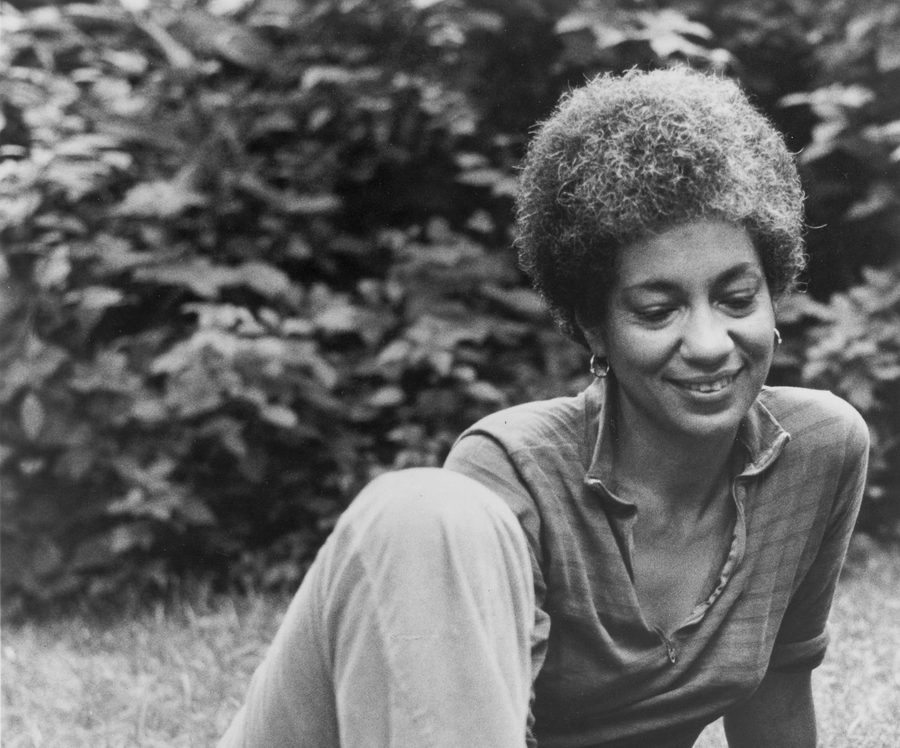
June Jordan, circa 1976
Louise BernikowWho Might We Become for Each Other?
A conversation about Black–Palestinian interconnectedness and the legacy of June Jordan

Last fall, as the 2024 United States presidential election drew near and both major parties courted the votes of Black Americans, we were confronted with a torrent of social media posts, memes, and talking heads attempting to deny the interconnectedness of Black and Palestinian communities. Black people have already done enough for collective liberation, they said; a focus on the genocide in Palestine came at the expense of Black people suffering elsewhere. “Why do Black people have to care about everyone while expecting everyone to not care about anyone but themselves?” the journalist Michael Harriot wrote in an op-ed in TheGrio, tracing the fault lines of the argument that Palestine solidarity was acting as a spoiler for Kamala Harris’s campaign. Our struggles are connected, we countered again and again, like a spell meant to vanquish those who insisted we abandon each other. Sometimes we meant that our killers work in tandem, as when members of the Atlanta Police Department—whose predecessors served slaveholders, and whose colleagues murdered Kathryn Johnston and Rayshard Brooks—share tactics with the Israeli police responsible for enforcing a regime of domination that includes systematic dispossession and the incarceration of more than 9,000 Palestinians. Sometimes we issued the pronouncement to affirm that we owe each other everything, even when we die different deaths, decreed by the passports we do or do not have, or by the color of our skin. Sometimes we said it to refute the actions of our own people who enlist in regimes fatal to the other, like last year, when at a convening of the UN Security Council, US Ambassador Linda Thomas-Greenfield voted to abstain from demanding a ceasefire in Gaza, her Black hand rising on America’s behalf.
In search of a model for cutting through these corrosive obfuscations, my comrade Zaina Alsous and I turned to the long and rich history of solidarity between Black and Palestinian people. We found ourselves pulled back to the words of Black feminist poet, educator, and activist June Jordan, who wrote with unyielding clarity about an anti-imperialist horizon with Palestine at the center. “The issue of the Palestinian people is the issue of the value of human life,” she proclaimed in 1982, and she remained firm in her conviction—even when censured by the media, the American and Israeli literary establishments, and at times, her own friends. As a Palestinian woman and a Black woman, Zaina and I had long appreciated the bridges Jordan built between our peoples. As American citizens conscripted into underwriting a genocide with our tax dollars, we have also found inspiration in Jordan’s unflinching confrontation with her own complicity. Despite her position as a queer Black woman in a country that hated her, Jordan never used her own oppression to abdicate responsibility for the imperialist violence happening in her name. In the introduction to her posthumously published essay collection Some of Us Did Not Die, Jordan writes of facing her “own absolute dirty hands”: “I am discovering my own shameful functions as part of the problem, at least. I no longer think ‘They’ are this or that, but rather, ‘We’ or ‘I’ am not doing enough, for instance, or ‘I’ have not done my homework, and so on.”
What Jordan teaches us is at once very simple and very difficult: If our claim that our struggles are connected is to be more than just cliché or consolation, we must embody it, even when privileges of class, color, and citizenship threaten to lull us into self-satisfied complacency. Jordan pushes those of us, both Black and Palestinian, living in the United States not to accept comfort instead of liberation, rest instead of resistance, or words instead of actions. It bears underscoring that while Jordan was primarily known as a poet, language was one among many things that she did with her body. She went to protests and hid in stairwells with her friends when the cops rammed through the crowd, she organized fundraisers for children in Lebanon after the 1982 Israeli invasion, she found housing for students when they were abused by partners, among countless other acts of quotidian courage. Our expressions of pain can so easily be warped into alibis for inaction, distorted into a form of redress for past or present harms—but, Jordan reminds us, when we fortify our language with action, we move closer to the justice we have been seeking.
In the spirit of Jordan’s imperative to rigorously consider the limits and possibilities of writing and organizing from within the heart of empire, Zaina and I convened a group of Black and Palestinian American poets to think alongside Jordan’s work as we discuss the roles of identity, memory, and poetry in building Black–Palestinian solidarity. In addition to Zaina—a poet and labor organizer in South Florida—the conversation below includes Aja Monet, a surrealist blues poet, musician, and cultural worker currently living in Los Angeles; George Abraham, a Palestinian poet and an editor at Mizna; and Aurielle Marie, a poet, essayist, and cultural worker living in Atlanta. There are no simple answers to the paradox of living in a country that harms us, even as we owe many of our material comforts to the violence it exacts against our own peoples across the world. Instead of offering easy certitude, this conversation offers what Jordan calls “dreams: detailed explorations of the alternatives to whatever stultifies and debases our lives.”
—Marina Magloire
Marina Magloire: In thinking about the question of solidarity through the lens of Jordan’s work, I found myself returning to her essay “Report from the Bahamas,” in which she writes about traveling to the Bahamas as a Black American woman. She draws on the experience to caution against understanding Blackness or womanhood as ready-made foundations of solidarity, recalling shopping for souvenirs from the Black Bahamian women whose livelihoods depend on selling hats and bags to the parade of tourists and reflecting that, in the context of this exchange, “we are not particularly women anymore; we are parties to a transaction designed to set us against each other.” Solidarity has to be chosen and enacted. “It is not only who you are, in other words, but what we can do for each other that will determine the connection,” she writes. We are so often presented with a marketable notion of identity—as static, extractable, something that can be bought and sold. How do we refuse this commodification and orient ourselves instead toward well-being in our relationships?
George Abraham: I teach at a college, so I often find myself taking part in conversations that are preoccupied with diversity, equity, and inclusion. Even as the right is trying to implode these initiatives to implement a more overtly fascist regime, we have to be clear that diversity, equity, and inclusion are fundamentally inadequate categories for thinking about Palestine. They may help us change what power looks like, but as Jordan warns, they traffic in the idea that identity is a fixed property of the individual—something that you have, not something whose meaning depends on what we make happen between us—and so will not fundamentally challenge regimes of domination. What we need are concepts that can help us reckon with the structures that have brought our world into being: racism, imperialism, colonialism, capitalism. And moreover, our thought has to have a material tether.
Aja Monet: I’m currently very disappointed by the ways people have neglected to work together. Clearly, our movements have not been sufficient. We’ve learned to romanticize the language of struggle, and we’ve turned that language into a series of slogans. We print them on T-shirts and posters, and we buy them to help us feel like a part of something. We mistake this image of community—which is really our shared consumption—for the possibility of actual community, which capitalism has corroded. Identity, in this framework, is just a product; its value is fixed, it occupies an unchanging position in a hierarchy. There are a couple of problems with this. First, it means the banner of an identity category can be used to conflate very different experiences. As Jordan put it in a 1987 interview, “If I, a black woman poet and writer, a professor of English at State University, if I am oppressed then we need another word to describe a woman in a refugee camp in Palestine or the mother of six in a rural village in Nicaragua or any counterpart inside South Africa.” Moreover, this rigid idea about what identity means also feeds destructive ideas about scarcity. For example, I am ashamed that as the Movement for Black Lives was trying to push our people toward a more internationalist framework, we were met with the idea that there is always some baseline anti-Black oppression that transcends context—as if taking the genocide in Palestine seriously is taking something away from Black people. It’s important to be clear that people are facing real identity-based attacks, but our solution shouldn’t be to respond on those terms. I think this is what Jordan is speaking to—the way that finding the love between us actually has the potential to move us out from identitarian groupings and toward true solidarity, which is rooted in the values that describe how we should live together. Part of what that means is addressing the grave degree of anti-Blackness that exists within our movements across the globe.
The recent uprisings in the movement for Palestinian liberation have been so transformative (in part) because we were organizing not on the basis of identity but on the basis of our shared belief that genocide should not happen. As someone who’s been a part of the Movement for Black Lives for many years, it was inspiring to see that the Palestine solidarity movement has been able to mobilize people across the world in a way that organizing from the position of Black identity politics did not allow us to do. Really, I’m just saying that I don’t know if we should be so concerned with whether or not identity is being commodified, so much as we should be concerned with whether or not we are meeting people’s material needs. If we do our work right, identity will be a way to feel connected around shared affinities and experiences, rather than a series of channels for allocating resources.
“People are facing real identity-based attacks, but our solution shouldn’t be to respond on those terms.”
Zaina Alsous: I like the entry points Aja mentioned: shame and disappointment. Without shame and disappointment, we would be immersed in self-congratulatory delusion, pretending not to see what’s happening all around us, and it is far worse to live in a state of delusion than to accept the suffering that comes with acknowledgement. That suffering is actually required to cultivate the resilience we desperately need to work with other people day-to-day—including people we don’t agree with, people who have let us down, who might be vile toward us sometimes, and blame us for the despair they’re feeling. We need to do this, as Jordan emphasizes, to ensure that our kids will have enough to eat, that people will have healthcare—basic, fundamental things.
Jordan’s work encourages us to hold onto an idea of identity that is not so individual. For me, that means that it’s not enough to think about how I am proud to be Palestinian; while it’s certainly true that I am, if I thought only about my sense of self, I wouldn’t have it in me to get up day after day amid so much unjustifiable death and grief. It’s when I remember that my people are counting on me that I have to show up.
The culture industries in the United States and Europe are exceptionally skilled at creating spokespeople on behalf of oppressed peoples, which is ultimately a way of extracting people from our communities. So when it comes to refusing the commodification of identity, presence and repetition are essential, showing up for our people day in and day out. And I think we unfortunately have the additional responsibility of being clear that visibility is not liberation—nor will we ever settle for it. Writing, or any other practice, that is devoid of a material day-to-day accountability to the community within which you live is, to me, useless.
Aurielle Marie: Certainly, some “organizers” are using identity politics to cash a check, but I do think it’s important to acknowledge that the kind of weaponization of identity that we’re talking about emerged from a wound of scarcity. It is heartbreaking and overwhelming to face the state with rocks and slingshots when they’ve got guns and prisons. And in organizing spaces, too, we find ourselves hemmed in. For example, Black people often, and for good reason, fear anti-Blackness from non-Black people of color. Sometimes, this has meant preemptively turning our backs on them, afraid they would “threaten” our success when we were already up against so much. To be vulnerable: I failed as an organizer because I wanted to “get it right” with my own people so badly that I betrayed the part of me that understood that Black folks and non-Black folks could be on the same side. I was scared of the pain of losing whatever Blackness gave me. I was trying to protect myself from losing more. This kind of rigidity was flawed and deeply human—and it is something we need to strategize around.
Marina Magloire: In her essay “Black Folks and Foreign Policy,” Jordan uses metaphors of the plantation to argue that Black Americans are house slaves who have a responsibility to use their proximity to the master to help the field slaves in Nicaragua, Vietnam, southern Africa, and Palestine. She writes: “Inside the Big House our mothers and our grandmothers worked down on their knees so that we could stand up. They kept their eyes on a house ahead of them, a house full of family come to freedom. Now we sleep inside that Big House. Will we let ourselves and our family in the field just grovel down and die, domesticated by de Massa? Or will we join our cousins in the field—and clean it up?” Jordan doesn’t usually write much about the past—in fact, she wrote to Alice Walker in 1981 that “we differ because I am emphatically oriented towards the present and the future reality and I am interested in the past only as it may be helpful now, or tomorrow.” However, in this essay, she links her solidarity to the memory of her ancestors’ struggle, calling up the history of refusing to accept the table scraps of US imperialism. How do you understand the role of memory in our movements?
Zaina Alsous: Memory is a pedagogy. It can be instrumentalized to reify systems of extraordinary violence. It is also a tool that can tether our people to one another. So memory is essential, and it comes with a great deal of responsibility: What memories do we invoke, and how do we invoke them toward that end of, as Aja said, finding the love between us?
To succeed, we need to be in coalition not just in our organizing but also in our habits of communication and memory. As a Palestinian born in the US South, instead of being fixated on the historic levels of atrocity waged against my own people in a way that turns me away from where I am, I have to get clear that those atrocities cannot be fully understood without holding onto the memory of the land I’m on, which includes the memory of the generations descended from enslaved people—because all of those things lead to the brutality of the present. As Jordan reminds us, it is not productive to be self-obsessed. The reality is that Palestine will not be free without mobilizing millions of people across the world toward a common purpose, and this requires creating resilient forms of connection across disparate contexts. In 2020, the Palestinian artist Taqi Spateen painted a mural of George Floyd on part of the separation wall in the occupied West Bank. In an interview, Spateen explained that he did not sign his name because “it’s not about me”—and he further clarified his intention in depicting a man who had been murdered by a police officer: “I want the people in America who see this mural to know that we in Palestine are standing with them, because we know what it’s like to be strangled every day.” These are the kinds of memory practices that I am committed to: ones that create forms of recognition among oppressed peoples, that establish a lexicon of common cause.
Throughout her life, Jordan sought ways to see ourselves in one another, studying liberation movements across the globe. I love her 1984 essay “Nicaragua: Why I Had to Go There.” She writes: “Here in the United States you do get weary, after a while; you could spend your best energies forever writing letters to the New York Times. But you know, in your gut, that writing back is not the same as fighting back.” She continues: “[The Sandinistas] have given to me and to all of us an amazing example of self-love. With their bodies and their blood they have shown us the bravery that self-love requires.” Is it possible, then, that in this moment of deep despair we could call upon an overwhelming self-love for our people to instruct us in study and strategies of communication that never focus only on our own people?
I find such a powerful example of this in Jordan’s 1996 essay “Eyewitness in Lebanon,” which she wrote in the context of the Israeli occupation of Southern Lebanon that began in the early 1980s. Of course, this resonates now because of the recent Israeli bombing campaign; my family’s home was bombed. My parents were born as Palestinian refugees in Lebanon, and as a child I didn’t encounter much public discussion about this period of occupation. Jordan writes, “But I went there, to Lebanon. And I’m back. And I’m real. And Lebanon is real. And this poisonous pretense to the contrary seems to me insolent and ominous, at best.” And later: “My life requires perpetual revolt against a double standard that puts me on the Easily Invisible side of the ledger, the Don’t Matter and No Count side of things, the Be Good/Keep Quiet/Say ‘Thank you’ side of the equation. And Lebanon is on the wrong side, just like me. Lebanon is not white.” Jordan is not saying that identity doesn’t matter. She’s employing a strategy. She’s asking: How do I communicate about this atrocity that is so far away from my own people in a way that makes them feel a sense of connection?
“Memory is essential, and it comes with a great deal of responsibility: What memories do we invoke, and how do we invoke them toward the end of finding the love between us?”
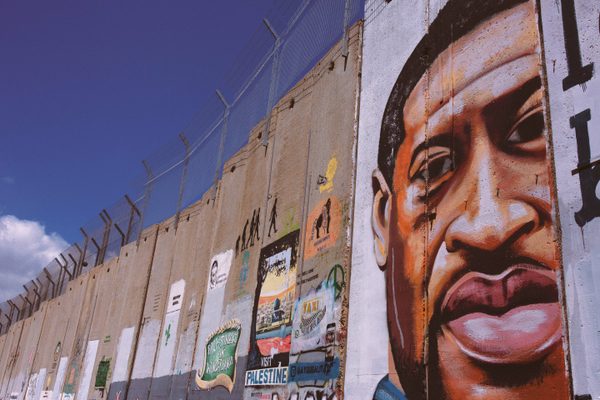
A mural depicting George Floyd on the Israeli separation barrier in the West Bank town of Bethlehem.
Marina Magloire: In the introduction to Poetry for the People, a pedagogical primer born from her poetry workshops at University of California, Berkeley, in the 1990s, Jordan writes: “Poetry is a political action undertaken for the sake of information, the faith, the exorcism, and the lyrical invention, that telling the truth makes possible. Poetry means taking control of the language of your life. Good poems can interdict a suicide, rescue a love affair, and build a revolution in which speaking and listening to somebody becomes the first and last purpose to every social encounter.” How do you understand the role of poetry in addressing the ongoing violence against our peoples?
George Abraham: I recently taught a Palestinian Resistance Literature class at a liberal arts college. At the end of the semester, the students, most of whom were people of color, designed an exhibit made up of texts and personal reflections articulating material connections between their own lives and the struggle for Palestinian liberation. We know how this story goes: The administration prohibited the display. During this disheartening ordeal, a comrade returned me to Jordan’s essay “Nobody Mean More to Me Than You And the Future Life of Willie Jordan,” in which she recounts designing a class on Black English at the State University of New York at Stony Brook. Jordan explains that the class came about as a kind of corrective to the corrosive institutional distortions Black people face in the US: “As children, most of the thirty-five million Afro-Americans living here depend on this language for our discovery of the world . . . [But] we begin to grow up in a house . . . meant to shelter a family that is alien and hostile to us. As we learn our way around this environment, either we hide our original word habits, or we completely surrender our own voice.” In her course, Jordan built a different kind of home, one where her students were free to study and imagine in a grammar that affirmed “the presence of life”—the lives of the students and their communities, the lives denied by the dominant formula that “White English, in America, is Standard English.” When Reggie Jordan, the brother of one of the students, was murdered by the Brooklyn police, the class got to work. They composed notes of condolence to the family, as well as statements to both the police, who routinely murdered Black folks, and the press, who had neglected to cover the event. The group knew their language of study would be unlikely to “communicate with those who, evidently, did not give a damn about us/Reggie/police violence,” and still they chose to do all of their writing in Black English. After all: “If we sought to express ourselves by abandoning our language wouldn’t that mean our suicide on top of Reggie’s murder?” Jordan’s essay reoriented me toward the critical questions: What is the language that our truth demands? Who might we become for each other as we learn to tell it?
Jordan said, “Poetry is a political act because it involves telling the truth”—so these are poetic questions. After all, poetry is where we intimately and carefully attend to language. And they are questions that I find particularly urgent here in the US, where many of the best-resourced poets cannot bring themselves to call a genocide a genocide—let alone to meaningfully confront the truth of our complicity or offer material support in solidarity with Palestinians. They are questions that rhyme with the tradition of Palestinian poetry that is rooted in the insurgent collective—a tradition that, as Palestinian writer and revolutionary Ghassan Kanafani put it, is grounded in a “dialectical relationship [between] artistic work and the movement . . . at work in society.”
Aurielle Marie: Part of my grief and fear is that I did, at one point, feel like we had arrived at the place Jordan names: the edge of rhetoric and the beginning of action. In 2014 and 2015, I thought we were going somewhere together—Black and brown and Indigenous folks who were organizing in opposition to state violence. There was a palpable momentum. There were folks who were willing to die. I was one of them. Then, it just stopped. And the idea that you could arrive at the place of revolutionary action, and then just revert . . . I don’t think I’ve recovered from it. That’s when I turned to writing as my way through.
Aja Monet: In the Movement for Black Lives, infiltration, commodification, and individualism became detrimental. We lost sight of the fact that organizing is fundamentally rooted in relationships, not in quotas or donor expectations. The movement began to fail when the poetry of organizing—the day-to-day, door-to-door blues of it—fell away.
When we were organizing in South Florida, we facilitated poetry workshops for organizers to help us deal with the interpersonal discord among us and to direct critical discussions about our purpose and our future. Some people didn’t want to face the reflections that the workshops revealed. Others didn’t want to participate at all because they felt it was not radical enough. If we look to Indigenous knowledge, then we know that the stories we tell ourselves about ourselves are integral to our liberation movements; they inform how we come to know who we are, who we want to be, and what we’re capable of.
Capitalism is vicious, and it captures what is normal. It is normal for people to want the material conditions of their lives to shift. I think our role as poets and as organizers is to facilitate the creation of language for that desire that also helps people understand where that desire comes from, and how it is exploited. Poems instruct us to go inward to help the individual find language for what they’re experiencing as part of the collective. Poems have helped me transform freedom from an abstract idea into a fully fleshed sensory experience that I can share with others.
“Slowness is not comfortable. It’s a way of insulating our work by refusing the state the ability to dictate what our center should be.”
Marina Magloire: Without the kinds of deep work that you’re talking about, people don’t trust each other. I saw this in the Palestine solidarity encampments here in Atlanta: People were trying to organize direct actions, but couldn’t even agree on methods. Many of us were not actually in community with each other outside of these crisis situations, so we hadn’t built the trust necessary to make collective decisions in incredibly stressful situations. In her essay “Notes Toward a Model of Resistance,” Jordan highlights community as the mechanism that gives us the courage to face the threat of individual harm. With compassion, she describes attending a protest with a woman who retreats in tears when the police arrive: “Not blessed by a visible, known, tested, and building community on which she could rely, she felt, and therefore, she was isolated. She could not do herself, or anyone else, any good.” In light of escalating violence, what does moving toward community look like for you at this moment?
Aurielle Marie: My initial impulse is to home in on the idea of escalation: Here it comes—more of it. And then I begin to wonder, What do we mean by escalation? The state is driven by extraction and expansion. It has one single, horrible project, with endless variations. Attuning ourselves to the proliferation of forms of brutality can wear us down, decimating our capacity.
I was talking with [the poet and musician] Saul Williams for Scalawag magazine, and he invoked something awful: The State of Israel has deployed bombs so powerful that they are vaporizing Palestinians. When Saul said that, his tone was incredulous. And I assumed that disbelief: How can they just disappear people that way? I was stuck, the question running on a loop in my mind. Then, the next week, I heard myself think it—How could they disappear people that way?—and I felt convicted by that way, as if it was the specificity of the method and not the fact of disappearing people at all that horrified me. At once, I felt shame: How dare I fall for this sleight of hand? This somatic impact of a new tactic had pushed from my mind the thousands and thousands of people who have been disappeared by the state in other ways. I had forgotten the women who stepped through the Door of No Return, the people detained in Guantanamo, the children ripped apart when the police bombed row houses in Philadelphia seeking to kill MOVE activists, the mother and son in Gaza burned in a tent; I had forgotten even my own experience as an activist kidnapped by the police. A new technology had made me forget that this is what they do. If they package their violence in a better PR kit, should I be less alarmed? To be disappeared is to be disappeared is to be disappeared.
In light of the incapacitation that the framework of escalation encourages, my personal assignment is to refuse that imposed acceleration. Urgency is deeply important, but we have to be attuned to multiple modalities. When we would respond to the state essentially every time they killed another unarmed Black person, it meant that we were locked into such a relentless pace of reaction that we could not build protracted movements. It burnt us out and left us vulnerable to infiltration. Slowness is not comfortable. It’s a way of insulating our work by refusing the state the ability to dictate what our center should be. It’s like the song we’ve sung time and time again, marching in the streets: “We shall not be moved.” The state can outpace us—and if they tire us, they will outlast us. Now, I invite folks who are doing their work in the streets over into my home, and they know when they cross that threshold that they are here to eat, drink water, write poems, decompress. I see how folks are preserved by that slowness; it’s allowing for a continuity that I hadn’t witnessed before. Here in Atlanta, there is distrust in the marrow of our relationships—the state did that. We need a space where we can alchemize that into something different, or we’ll stay trapped in the same cycles.

I’m Arielle Angel, editor-at-large of Jewish Currents. Before you go, there’s something I need to ask.
We’ve seen over and over how the mainstream media falters in telling stories on our beats—whether it’s antisemitism, Israel/Palestine in American politics, Jewish identity, or the American left. At Jewish Currents we’re committed to uncompromising analysis and longform reporting on these issues and more—stories you won’t find anywhere else. In a media landscape that obscures injustice and flattens discussion, we’re changing the conversation. But we need you.
If you believe in this work, please consider making a donation—or even better, a recurring one—to ensure that we are able to keep publishing stories like this one. We can’t do it without you.
Marina Magloire is an Atlanta-based scholar and the author of We Pursue Our Magic: A Spiritual History of Black Feminism.

Zaina Alsous works in the labor movement in South Florida and is the author of the poetry collection A Theory of Birds.

Aurielle Marie is an acclaimed poet, essayist, and storyteller. They’re the author of Gumbo Ya Ya, which won the 2020 Cave Canem Poetry Prize and the 2022 Lambda Literary Award for Bisexual Poetry. Aurielle was the 2022 Georgia Author of the Year in poetry and a 2023 Finalist for the Kate Tufts Discovery Award. Marie lives in Atlanta, Georgia, on unceded Muskogee land.

aja monet is a Surrealist Blues Poet and cultural worker, who follows in the long legacy and tradition of poets participating and assembling in social movements. She is the author of the poetry collections my mother was a freedom fighter and florida water, both from Haymarket Books; the creator of the Grammy-nominated poetry album, when the poems do what they do; and the Artistic Creative Director for V-Day.