The Genocides The New York Times Forgot
The paper’s Gaza coverage continues its pattern of downplaying US-backed atrocities in Bangladesh, East Timor, and Guatemala.
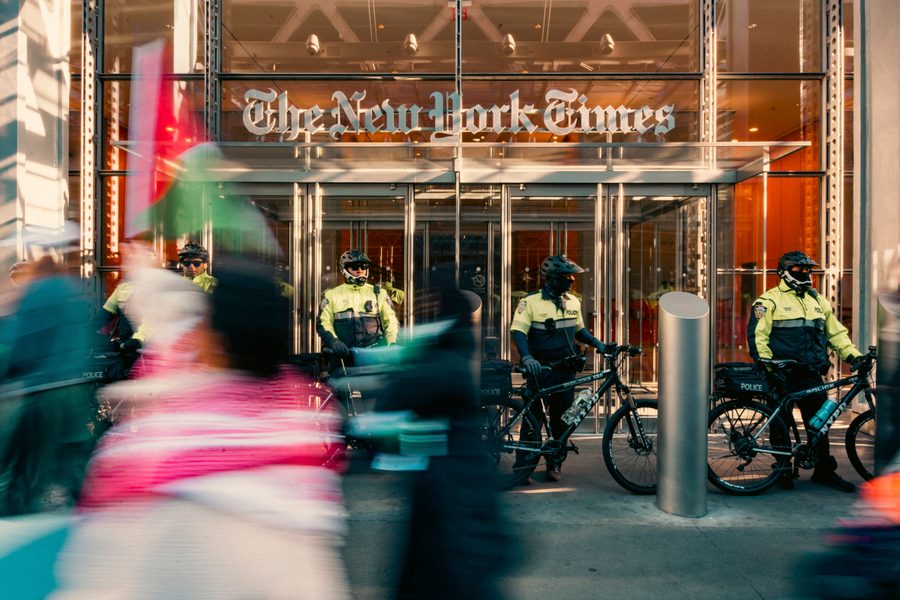
Police barricade The New York Times building during a protest calling for a Gaza ceasefire, New York, February 4th, 2024.
In the winter of 1981, six years into Indonesia’s occupation of the island nation East Timor, The New York Times Magazine published a report about the island that may as well have been written about Gaza any time since October 7th, 2023. Referring to the relatively small groups in the United States protesting their government’s role in the occupation, correspondent Henry Kamm wrote, “There is substance to these protests, even if, at their most extreme, they degenerate into hyperbole—accusations of ‘genocide’ rather than mass deaths from cruel warfare and the starvation that accompanied it on this historically food-short island, of American complicity rather than acquiescence.”
By the end of the occupation in 1999, about a quarter of the population of East Timor had died. A generation of scholars has since concluded that Indonesia’s systematic campaign of murder, starvation, and displacement indeed amounted to genocide. And the US was undeniably complicit, providing weapons and diplomatic support to the Suharto regime while publicly denying Indonesia’s atrocities. (In the Times article, Kamm acknowledged that the US had “furnished most of the weapons that Indonesia used for its invasion” but assured the reader that “the United States intended that these weapons be used only for Indonesia’s self-defense.”)
Likewise, this September the United Nations Human Rights Council concluded that, using more than $20 billion in US military aid, Israel committed genocide in its Gaza war, now nominally ended under a tenuous US-brokered “peace” deal. A small chorus of US politicians have since adopted the label, albeit reluctantly. But as with its coverage of Timor, the New York Times has equivocated on the cause of famine in Gaza and frequently downplayed the appropriateness of the genocide designation. In April 2024, The Intercept reported that an internal Times memo had cautioned staff to “set a high bar” for allowing sources to use the term genocide “as an accusation” in its Gaza coverage, even in quotations—even as the paper encouraged the routine use of the term “terrorism,” without quotes, to describe the October 7th attacks on Israel.
The Times’ obfuscation of these two US-backed genocides is part of a broader pattern. In newly published research, my co-author Tianhong Yin and I delved into the paper’s archive to look at how it covered post-World War II atrocities that are now understood by experts as genocides. We compared the Times’ treatment of genocides in Rwanda, Cambodia, and Bosnia—cases in which the US was either not directly involved, or, as in Bosnia, ostensibly engaged in “genocide prevention”—to genocides that, like Gaza, featured active American assistance to the aggressors. Specifically, we looked at the number of Times articles that referenced each country from the start of the genocide period up to 2020, as well as the number that included contested language like “genocide,” “massacre,” “slaughter,” and “atrocity.”
Our results were clear: The historical events that the New York Times has most clearly remembered as genocides, as crimes that demand outrage and accountability, are those where American complicity was not part of the story. But in cases where the US facilitated mass violence, the Times is much more apt to omit the genocide label or avoid mentioning the situation entirely. Such is the case with East Pakistan, now Bangladesh. The US oversaw the transfer of weaponry to its ally West Pakistan, which in 1971 conducted a campaign of mass murder and rape against the largely Bengali inhabitants of East Pakistan. So too in Guatemala, where throughout the latter half of the 20th century, the US installed, armed, and trained a string of military dictatorships that prosecuted a brutal, decades-long counterinsurgency, including the mass rape and murder of the indigenous Maya in what is now known as a “silent holocaust.” Each of these wars claimed hundreds of thousands of lives, but in the pages of the Times they have quickly receded into obscurity.
Ultimately, these omissions are part of an American “culture of impunity,” one that cannot be laid at the feet of any single media organization. But as the “paper of record” self-consciously publishing what is often referred to as the “first draft of history,” the Times nevertheless holds a particularly powerful position in representing—as well as influencing—the liberal mainstream. As such, it can be argued that the Times’ silences have helped sustain what genocide studies scholar Jeff Bachman calls the US’s “near-continuous stream of violence and atrocities” well into the present. After all, an American public steeped in the responsibility it bears for the atrocities of Timor, Bangladesh, and Guatemala, among others, would have been more likely to recognize how history was repeating itself in Gaza. By failing to foster such an awareness, the Times has contributed to a collective amnesia that has stymied accountability, most recently for US participation in Israel’s genocide.
Bangladesh was the most widely reported of the genocides we studied in which the US can be said to bear some direct responsibility. At first, in 1971, war in what was then called East Pakistan was considered worthy of some attention by the Times. This corresponded with a time when there was controversy in the State Department regarding American support for West Pakistan, and when some diplomats were recognizing the genocidal potential of US complicity. But after that internal dissent failed to change US policy, one would have to squint to find any reference to the fact that a genocide was committed in the world’s eighth most populous country, let alone that the US provided much of the weaponry for it. From the December 1971 conclusion of the war to 2020—a span of about 48 years, or well over 17,000 daily editions of the New York Times—just 176 articles included the term “genocide” when mentioning Bangladesh. For comparison, by 2020 Cambodia—which itself was the least mentioned of the three genocides we studied that were not US-backed—had been mentioned along with “genocide” in 808 articles in the 41 years since the ouster of the Khmer Rouge in 1979.
East Timor is another illustrative case, especially because it demonstrates how US grand strategy shapes the way mass violence is understood by the country’s ostensibly independent domestic media. At the start of the Indonesian occupation in 1975, the US had an interest in maintaining close ties with Indonesia and keeping it outside of the USSR’s sphere of influence. But this posture shifted after the fall of the Soviet Union in 1991 and the accompanying change in the geopolitical landscape. By 1999, the US had distanced itself from Suharto’s Indonesia and held Timorese independence as a foreign policy goal. Not coincidentally, it was around this time, long after the worst phase of the genocide had ended, that the Times finally deemed Timor a minor but newsworthy story, reporting on the Timorese independence referendum and the subsequent Indonesian repression. The change was noticeable: From 1975 to 1991, the term “genocide” had accompanied mentions of Timor in only 1.5% of Times articles. Then, from the end of the Cold War in 1991 to Timorese independence in 1999, when Timorese victimhood became less of an impediment to US foreign policy, far more reporting was published on the conflict and more than 5% of articles included the term “genocide.” Overall, Timor remained a marginal story and has all but vanished from the news over the decades, but the paper’s sudden openness to covering it after the reversal in US policy is nevertheless revealing.
The Guatemalan genocide has been similarly marginalized. Despite the country’s proximity to the US and extensive American interference in its politics, decades of mass violence amounted to no more than a minor Times story. The paper published just over one mention of Guatemala per day during the 1981–1983 period known as the “silent holocaust.” Compare this with the more than three articles per day published about Rwanda during that country’s genocide, in which the US had no active role. Fewer than 2% of articles mentioning Guatemala from 1981 to 2020 include the term “genocide.” This stands in contrast to inclusion of “genocide” in articles mentioning Rwanda (32%), Bosnia (8%), and Cambodia (6%).
The US role in these genocides is generally shrouded in obscurity even when they are discussed in the Times today. An August 2025 New York Times Magazine piece that offered one of the all-too-rare accounts of the Guatemalan genocide serves as a case in point. In this moving photographic portrait of Mayan survivors of sexual violence who have recently taken their assailants to trial, only one sentence provided the Times’ American readers any sense of their government’s responsibility for this horror. It stated that the crimes took place when “then-dictator, Efraín Ríos Montt, ordered his US-supported military to eradicate guerilla opposition” The line is perfectly accurate, but it is also a characteristically vague understatement. The US “supported” the Guatemalan dictatorship the same way Germany “supported” Vichy France: In 1954, the CIA, in part at the behest of the United Fruit Company, overthrew Guatemala’s elected government and set up a military dictatorship, trained and reorganized its army, and set it loose on the civilian population to protect American business interests and keep the land in the hands of friendly oligarchs.
This is not to say that American culpability has been entirely written out of the Times. When a Guatemalan tribunal found Montt guilty of genocide and crimes against humanity in 2013, the issue of US responsibility was treated as a legitimate controversy in the paper. The opinion section featured a debate (“What Guilt Does the US Bear in Guatemala?”), and a news article on Montt’s trial centered around the glaring omission of US culpability from the proceedings. Likewise, a search through the paper’s archives will unearth the occasional op-ed calling for accountability for atrocities in Timor. Still, these US-sponsored genocides remain on the margins of popular discourse, in a remote corner of American collective memory as recorded by the Times.
Meanwhile, one does not need to diligently comb through the Times’ archives to find coverage of those cases of genocide where the US is not implicated. Cambodia and Rwanda, for instance, are often mentioned in those terms. When US officials sought to represent their mid-1990s military intervention against Serbia as a humanitarian mission to protect Bosnian Muslims, the Times frequently included language like “genocide,” “atrocity,” and “slaughter” in its coverage of Serb aggression. And unlike Timor, Bangladesh, and Guatemala, these cases have been given sustained attention over time, their legacies inscribed into the institutional memory of the paper. Hundreds of articles referenced the occurrence of genocide in the years after the conclusion of mass violence in Rwanda, Bosnia, and Cambodia.
The result of such lopsided coverage is that American complicity in some of the worst atrocities since the Holocaust has, in effect, been written off as an unfortunate byproduct of well-intentioned Cold War campaigns. Such narratives reinforce a dominant interpretation of American foreign policy as benevolent and motivated by humanitarian principles, with mass violence and war crimes considered the exceptions rather than the rule. This has left the American public ill-equipped to understand the logic of its government’s contemporary brutalities, most notably US participation in the destruction of Gaza. It has also hampered our ability to understand the proper context for the naked—but far from novel—lawlessness of the Trump administration’s military policy. When, for example, Times chief Washington correspondent David Sanger considered the upheaval at Trump’s Pentagon, he wrote that “what has made the American military notable in the past 75 years is abiding by international law, its refusal to kill civilians.” “This didn’t always work perfectly,” he added for good measure, “but at least it was a core belief.” (The Times editorial board has also continued to lament the dissolution of the old foreign policy consensus that wrought the aforementioned carnage.)
This mythology appears to have informed the Times’ credulous reporting on Gaza. It is not that the Times has altogether ignored the bloodshed in Gaza; rather, the paper has framed it in a way that tends to suggest Israel’s ethnic cleansing campaign is not fundamentally criminal. Israeli actions are usually depicted as possibly heavy-handed or controversial but essentially legitimate operations to “root out” Hamas. When Israel bombs a Gazan refugee camp, the Times duly provides the Israeli justification and informs its audience that “Israel is trying to eliminate Hamas, which led the attack [of October 7th].” Human rights organizations and independent news outlets have long since concluded that Israel systematically and intentionally targets civilians and civilian infrastructure “as a goal in itself.” But this has done little to change the ubiquitous Times story that Israel has carried out a (possibly reckless) “search-and-destroy” mission against Hamas.
In keeping with the paper’s prior coverage, this telling ultimately serves to sanitize not only Israel but, crucially, the US, which is cast in the role of bystander and mediator rather than participant and accomplice. American officials repeatedly appear in Times stories as apparently motivated by humanitarian concern for the Palestinians but (at least during the Biden years) unable to restrain their Israeli counterparts and blundering in their efforts to aid Palestinians. As Israel starved the population of Gaza with indispensable US backing, Nicholas Kristof, among the Times’ most liberal regular columnists, emphasized in an illustrative piece that Biden was “upset over the humanitarian toll” in Gaza but that he “blew it” by, in this case, defunding the United Nations Relief and Works Agency for Palestine Refugees in a “misguided effort to impose accountability.” All this belies the basic fact that in Gaza, as in Timor, Bangladesh, and Guatemala, the US was no bumbling humanitarian but a hegemon ready to pursue its interests through brutality, and willing to support its clients’ and allies’ mass killings until doing so becomes impolitic. To avoid yet another US-backed genocide will require a reckoning with this reality—from both the government that underwrote the wars and the media that forgot them.

I’m Peter Beinart, editor-at-large of Jewish Currents. Before you go, I need to ask something of you.
In recent years, I’ve watched as mainstream Jewish institutions and media have chosen ethnonationalism over liberal democracy and mass slaughter over the pursuit of a just peace. Jewish Currents offers something different. It’s a magazine built on intellectual curiosity and respect for the dignity of all people.
But a project like this doesn’t sustain itself, and we can’t do it without your help. If you share my belief in the importance of this mission, please consider making a donation—or even better, a recurring one. We need you with us.
Zachary Jablow is a PhD candidate in political science at the University of Illinois and a visiting lecturer at Bryn Mawr College.