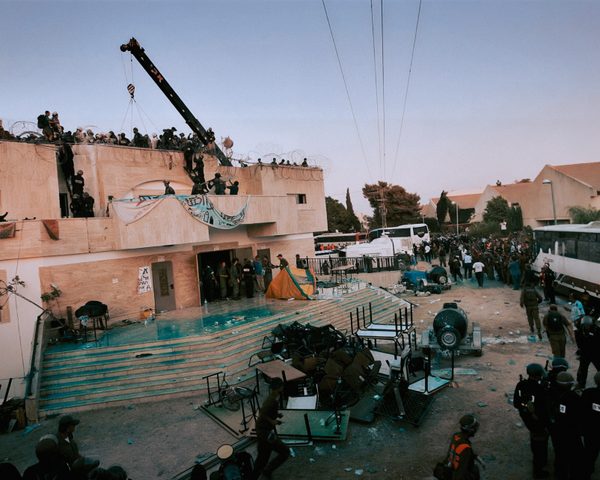
Gaza City, 2014.
ZUMA PressThe Rhythm of Revolution
A new edition of a landmark anthology of Palestinian poetry testifies to both a steadfast lineage of anti-colonial resistance and an increasingly under-resourced leftist internationalism.

Discussed in this essay: Enemy of the Sun: Poetry of Palestinian Resistance, ed. Naseer Aruri and Edmund Ghareeb, Seven Stories Press, 2025. 272 pages.
On August 7th, 1970, Jonathan Jackson entered the Marin County courthouse, armed. He was there to secure the freedom of Fleeta Drumgo, John Clutchette, and his brother, George Jackson, three Black political prisoners known as the Soledad Brothers. He burst into a courtroom, where three other prisoners attending a hearing joined him in taking hostages. “We are revolutionaries. We want the Soledad Brothers freed by 12:30 pm,” Jonathan declared before leaving. Hours later, after an intense standoff in the parking lot, police fire split his body open, and the 17-year-old became a beloved martyr of the Black radical tradition, or a warning about violent extremism, depending on who you ask.
For his son, Jonathan Jackson Jr., Jonathan and his brother George—who would be murdered the following year by a prison guard—were something else: bearers of an intimate yet expansive inheritance. More than 20 years later, in the foreword to Soledad Brother, a collection of George’s letters, Jackson Jr. explained his involvement in the project as a mode of “responsibility to [his] legacy,” writing, “My charge is an accepted and cherished piece of my existence.” Jackson Jr., who was born eight months after his father’s death and four months before his uncle’s, does not call his inheritance grief; he does not call it punishment. He calls it a charge, framing the cruel truncation of his guiding kinships as a kind of map and propulsion for which he is, astonishingly, grateful. Sometimes lives become doorways. Sometimes people die to make way for us to walk through.
As Jackson Jr. describes in the foreword, his uncle was firmly committed to resisting the many enduring violences of US empire, from the mass criminalization of Black people to the bombs dropped on Vietnam. George longed to study Arabic, Swahili, and Chinese so he could more rigorously engage with anti-imperial struggles across the Global South, and deeply valued the creative work of oppressed peoples forging alternatives to their own domination—including the 1970 anthology of Palestinian resistance poetry Enemy of the Sun, edited by the Palestinian American scholar and activist Naseer Aruri and the Lebanese scholar Edmund Ghareeb, who also translated many of the works in the collection. After George was assassinated, the anthology’s titular poem was found in his cell in the maximum security prison San Quentin. It was reprinted in the Black Panther Party newspaper, where—perhaps, as the scholar Greg Thomas speculates, because the poem was written in the Black revolutionary’s own hand—it was attributed not to its author, the Palestinian poet Sameeh al-Qassem, but to “Comrade George.”
As is the case with fate, and the overlapping genealogies of resistance that stitch together people brutalized by the insatiable colossus of imperial expansion, this accidental attribution is why I too know of al-Qassem’s poem and this collection, the first anthology of Palestinian poetry printed in English in the United States. I first learned of Enemy of the Sun while striving to move through George’s doorway, to learn from his pedagogy of defiance and interlocking solidarities. Like so many people across the world, in the 2010s, I joined mass mobilizations against the racist extrajudicial murders of Black people. In attempting to understand the longer history of that time, I came upon George’s work. His galvanizing call resonated across decades: “Settle your quarrels, come together, . . . understand that fascism is already here, that people are already dying who could be saved, that generations more will die or live poor butchered half-lives if you fail to act,” he wrote in Blood in My Eye. So in 2018, when I encountered a text about Greg Thomas’s exhibition “George Jackson in the Sun of Palestine,” I read it eagerly, moved to see George’s connections to my own people. This is how I first learned about Enemy of the Sun—which features a dozen Arab poets, most of them Palestinian—and I promptly ordered a copy online.
I was raised in a Palestinian family, but I learned what it meant to align with the hope of a liberated Palestine from Black leftists and trade unionists in the US South and the Caribbean. I witnessed so many hold Palestine close as they fought against the orders of racialized extraction that dispossessed their own communities. In North Carolina, I saw Black Workers for Justice and UE Local 150 push for the United Electrical, Radio and Machine Workers of America to become the first national union in the US to endorse the Palestinian-led Boycott, Divestment, and Sanctions Movement. In Camagüey, Cuba, when Rebecca, a widowed teacher, learned I was Palestinian, she hugged me and showed me a poster featuring Palestinian children and the words “They Will Not Pass” that had hung in her home since the 1980s. The struggle for a free Palestine has, for me, therefore always been a global question, a commitment to rearranging the world.
The struggle for a free Palestine has, for me, always been a global question, a commitment to rearranging the world.
So when I encountered that battered copy of Enemy of the Sun, with poems uplifting the Palestinian cause alongside anti-imperial and anti-colonial struggles from Vietnam to Cuba to the Congo to that of Indigenous peoples in the so-called United States, it didn’t feel simply like a collection of texts. It felt like a catalog of inheritance—and it felt like a charge. “It is the return of the sun, / Of my exiled ones / And for her sake, and his / . . . I shall not compromise,” al-Qassem writes in the titular poem. “I shall resist, / Resist—and resist.” By way of the symbol of the sun—featured in revolutionary posters across the Global South during the 1960s, ’70s, and ’80s—the poet beckons a past future foreclosed by the current colonial order. The restored harmony of the land and its people is the sole compass, a measure that cannot be contained by the life of any single individual. What is at stake, these poems clarify, is the dynamic and ongoing practice of realizing one’s political commitments in the context of a collective.
Last September, after Enemy of the Sun had been out of print for more than 50 years, Seven Stories Press reissued the anthology, with work by an additional 14 Palestinian poets translated by Ghareeb and others, and a new preface by Thomas. To encounter the new edition at this moment, as Israel’s genocide in Gaza continues with no end in sight, while American imperialists draw up innovative plans for the immiseration of Palestine, and attempt to starve post-revolutionary states in the Global South into absolute surrender, is to experience the ongoing urgency of the charge issued by the text. But it is also to register a profound despair: to acutely feel the diminishment of the robust network of entangled liberatory state projects across the Global South that animated the original 1970 collection—and upon which the horizon of Palestinian liberation may ultimately depend.
Most of the poems in the original anthology were written as revolutionary possibility was thrumming across the world. In 1959, the Cuban revolution culminated in overthrowing dictator Fulgencio Batista. In 1960, the Democratic Republic of the Congo won independence from Belgium; two years later, Algeria declared its independence from France—to name just a few of the more than 30 countries across the Global South that threw off colonial powers over the decade. It was from and into this world of radical possibility that Enemy of the Sun was born.
In fact, the book’s very existence is indebted to the connections forged through these struggles. After receiving rejections from 13 publishers, Aruri and Ghareeb finally found a home for their manuscript at Drum and Spear Press. Founded in the wake of the 1968 murder of Martin Luther King Jr. by organizers with the Student Nonviolent Coordinating Committee (SNCC), the major youth wing of the civil rights Movement, Drum and Spear began as a radical Black bookstore in Washington, DC. The press, which soon followed, aimed to amplify the narratives of Black revolutionary thought from Africa and throughout the diaspora. This commitment to Pan-Africanism inspired a catalog that connected readers to thinkers and texts that wouldn’t otherwise be readily accessible in the US.
The decision to publish an anthology of Palestinian emerged from Black radicals’ embrace of the struggle for a free Palestine. Many Black people in the US had initially celebrated the establishment of the State of Israel as a kind of redemption for the Jewish people in the wake of the Holocaust, but by the early 1960s, as Black American literary scholar Samuel W. Allen writes in the original preface, the tides were turning. He explains that many people, especially younger Black radical activists, were “troubl[ed]” as they became “more and more sharply aware of the hundreds of thousands of century-old occupants of the seized land who were wrenched from their homes.” In 1969, Charles Cobb Jr. and Courtland Cox, two of the founders of Drum and Spear, attended the Pan-African Cultural Festival in Algeria, which featured a speech by a member of the Palestinian National Liberation Movement. Around the same time, Black Panther co-founder Huey P. Newton encouraged an anti-Zionist position within the party. In 1970, Newton expressed the organization’s position in no uncertain terms: “We support the Palestinians’ just struggle for liberation one hundred percent. We will go on doing this, and we would like for all of the progressive people of the world to join in our ranks in order to make a world in which all people can live.” (The Panthers reaffirmed anti-Zionist positions in subsequent 1974 and 1980 statements.)
If this anthology draws from the resource of entangled decolonial struggles, it also sounds a cautionary note against the allure of idealizing struggles from afar.
Crediting managing editor Anne Forester with the idea to publish Enemy of the Sun, Cox explained in a 2015 interview that “the book was one of several things that we were doing . . . around our support for the Palestinians and other people who we felt were oppressed.” Indeed, the publication aligned with a broader anti-imperial common sense: “This [pro-Palestinian stance],” he said, “was not a big deal. We saw that the Palestinian struggle was part of our struggle against what was characterized as an imperialist nature of the United States and other countries.”
The poems in the anthology’s original edition are similarly guided by an internationalist consciousness that turns them toward a broader shared horizon, a collective duty to forge a path forward. This orientation is underlined by the presentation: They appear without bylines, the work of various authors interspersed so that the reader experiences them as one continuous, modulating voice, swaying between macro political junctures and familial and personal longing. As Aruri and Ghareeb note in their introduction, these poems do not dwell on individual sorrow and romantic pining; rather, “the poet’s consciousness of his people’s struggle causes him to look around him and to feel that there are other peoples in the world who have waged and are waging a similar struggle for freedom and dignity and leads him to express his feeling of solidarity with them.” For example, in his poem “Patrice Lumumba,” al-Qassem—who was born in 1939 to a Druze family from the Upper Galilee, and who came to serve in leadership roles in the Israeli Communist Party—effusively praises the independence leader, who served as the first prime minister of the country now called the Democratic Republic of the Congo, ending nearly 80 years of Belgian colonial rule:
O you eagle repelled by existence In a humiliated, shackled valley. As you twisted in the cesspool of mud and thorns Fired by a yearning for light
Though he was taken early—assassinated at the age of 35 at the orders of the leader of Katanga, a breakaway state, in what was likely a joint plan with Belgian officials—Lumumba had lived to see what the Palestinian people continue to dream of: a self-determined state forged in the image of its people. Like his poem “Enemy of the Sun,” al-Qassem’s ode is a battle cry, a call to subordinate individualist attachments to the greater good of the people.
But if this anthology draws from the resource of entangled decolonial struggles, it also sounds a cautionary note against the allure of idealizing struggles from afar. In my favorite piece in the collection, an adamantly materialist poem with the simple but durable title that holds the weight of our longing, Mahmoud Darwish warns against such romanticization. From “On Hope”:
Do not tell me: I wish to be a baker in Algeria In order to sing with the revolutionaries Do not tell me: I wish to be a shepherd in the Yemen To sing for the uprising of the age . . . The Congo and Jordan Rivers Will not serve the Euphrates Each river has its own Our land is not barren Each land has its own rebirth Each dawn has a date with revolution.
Here Darwish reminds us that all struggles are contingent on their specific social formations—and that it is critical not to neglect one’s own particularities. The poem’s inclusion highlights Enemy of the Sun’s guiding charge: to attend to the whole of the world without losing sight of one’s own ground.
“What time is it on the clock of the world?” activists Grace Lee Boggs and James Boggs famously asked in their 1974 book Revolution and Evolution in the Twentieth Century. Their question comes back to me now, more than five decades after the anthology’s original publication. What does it mean to read these poems amid the renewal and expansion of the Nakba and the eliminationist project of Zionism? Hundreds of thousands of martyrs later? Amid Gaza in rubble? In a moment of revolutionary retreat and the entrenchment of reactionary power, what is the purpose of revolutionary poetry?
When I first opened the new edition and encountered Greg Thomas’s foreword, “The Weapon of Poetry”—which riffs on a phrase by the French writer Jean Genet, who, in his introduction to the first edition of Soledad Brother, characterizes the text as “both a weapon of liberation and a love poem”—I bristled at its title, reminded of the occasional self-righteousness of those who think angry words alone are enough. But the struggle for Palestinian liberation shows that language does in fact have material stakes: Dareen Tatour, a poet and photographer from the Galilee, was imprisoned for sharing poetry that Israeli forces deemed an “incitement to terrorism.” She is far from alone; clearly, the language of those who refuse to surrender to imperial orders is recognized as a threat, deemed contraband, and made grounds for punishment.
When it comes to Palestine, speech and struggle cannot be easily disentangled.
This is in part because, when it comes to Palestine, speech and struggle cannot be easily disentangled. Several of the poems in the updated edition speak powerfully to the way that revolutionary theory emerges from revolutionary struggle, and not the other way around. In “They Taught Me,” for instance, Laila Al Jammal—an activist, writer, and cultural worker born in Akka in 1942—distinguishes between her formal schooling and the political education she has lived amid the occupation, her words both emerging from and sustaining the work of resistance:
Wow! What I’ve learned. I learned afterwards . . . And the religious leaders and the kings and the presidents Seek blessing in silence Their hands are tied The children shout: “Victory is coming, cowards.”
At the same time, the newly included poems reckon with the toll struggle takes on the people committed to it. In “To My Mother,” Kamal Nasser—an activist and professor who founded the weekly al-Jil al-Jadid (The New Generation), was the head editor of the Arab Socialist Baath Party’s newspaper, and served in various leadership positions in the Palestine Liberation Organization—recognizes that the pursuit of liberation could cost him his life and directs his mother to swallow her personal pain: “do not block the desires that are in my eyes. / Your tears are a blasphemy / . . . / For our rights call me to battle.” This piece is immediately followed by one by its addressee, Wadi’a Nasser. She responds in a poem speaking to her son, who was assassinated in 1973 by undercover Israeli commandos while he was living in Beirut, affirming and assuming the expansiveness of her son’s call:
I shall continue to hear your voice see you in every youth And I shall continue to hear your voice In the mountain passes Shouting: “We shall remain in spite of the enemy In death, we shall be resurrected anew And we shall raise our banner proudly.
Even as these additions maintain the original selections’ political resolve, reading this new edition at this moment, I am struck by the loss of mass, rooted working-class organization that animated the original. The significant shifts in world order that have fed the consolidation of US and Israeli power—including the collapse of the Soviet Union, the dissipation of the Non-Aligned Movement, and the NGO-ization of Palestinian institutions in the wake of the Oslo Accords—have diminished the resources Palestinians can draw from in their ongoing fight for self-determination. They have also made it significantly more difficult and costly for Palestinians to engage in the armed resistance that Nizar Qabbani summons in “the case”:
in Bethlehem—where once you were free pour out like rain and multiply like grass and flowers advance—advance— the story of peace is only a play
Most of the new edition’s more contemporary poets have institutional affiliations, but are not political leaders; it seems no coincidence, then, that their poems are somewhat more restrained—perhaps their authors are more aware of being closely monitored and surveilled in the current context of the eradication of any semblance of political, legal, or military limits placed on the US or Israel. Enemy of the Sun now ends not with Qabbani’s call to arms, but with the clarion simplicity of Ahmed Mansour’s “Gaza Will Rise”: “Gaza will rise, proud and free, / A testament to humanity’s plea.” And yet, what these two conclusions share is the firmness of their refusal to accept the terms of the world as given—and a steadfast devotion to future freedom. Decades of occupation later, and in spite of wide-ranging punishment backed by the most powerful militaries in the history of humanity, misinformation, media complicity, mass firings, and criminal penalties, since the beginning of the genocide in Gaza, widespread demonstrations have erupted across the world. The global working class still refuses to turn away from the Sun of Palestine.
Years ago, I brought my copy of Enemy of the Sun to a party in Miami. I kept it tucked in my bag, waiting to find a private moment with the person I was falling in love with so I could show him the poem “Cuba” by Tawfiq Zayyad, a politician and member of the Israeli Communist Party who, in 1976, led a nationwide strike in protest of Israeli theft of Palestinian lands:
The people in my land love the truly heroic. My friends who have filled the world with the fragrance of struggle Keep up the pressure on the imperialists They have cut my wings. . . . A people yearning for their usurped lands Press on—
I wanted to show my love, by way of words written by a Palestinian decades earlier, the tenderness I felt for this villainized island and for its people’s refusal to settle for anything less than a society of their own making. I wanted to show him that even though I had never, at that point, even set foot in the land of my own people, I had gratefully accepted their charge to carry on. In every demonstration against prisons, in every meeting to defend the rights of workers, in every picket against evictions, my people are there with me. We are here. I’m not sure I would call this understanding a “weapon,” but it emboldens me nonetheless. It steadies me, revealing this particular form of obligation as the most enduring fabric of love.
Finding resolve against despair in today’s historic chapter is difficult; finding utility in poetry perhaps even more so, a medium of the metaphysical and the incomplete. If poetry must hold the weight of catalyzing historic transformation, it is destined to come up short. Revolution, after all, has to do with who commands the guns, who owns the land, who holds the petroleum and the mines. But every break in the order of things might also return us to the long unbroken line of those who carried the flame when they too felt unsure of the path forward—a way to find and be found within an ever-emerging shared language. “I waited for you—but, you were not born yet!” writes Rashed Hussein in his poem “Letter to a Woman”:
And you are not yet born, And the train wants to start I’m sorry, I have to board! But I’m leaving this letter

I’m Arielle Angel, editor-at-large of Jewish Currents. Before you go, there’s something I need to ask.
We’ve seen over and over how the mainstream media falters in telling stories on our beats—whether it’s antisemitism, Israel/Palestine in American politics, Jewish identity, or the American left. At Jewish Currents we’re committed to uncompromising analysis and longform reporting on these issues and more—stories you won’t find anywhere else. In a media landscape that obscures injustice and flattens discussion, we’re changing the conversation. But we need you.
If you believe in this work, please consider making a donation—or even better, a recurring one—to ensure that we are able to keep publishing stories like this one. We can’t do it without you.
Zaina Alsous works in the labor movement in South Florida and is the author of the poetry collection A Theory of Birds.