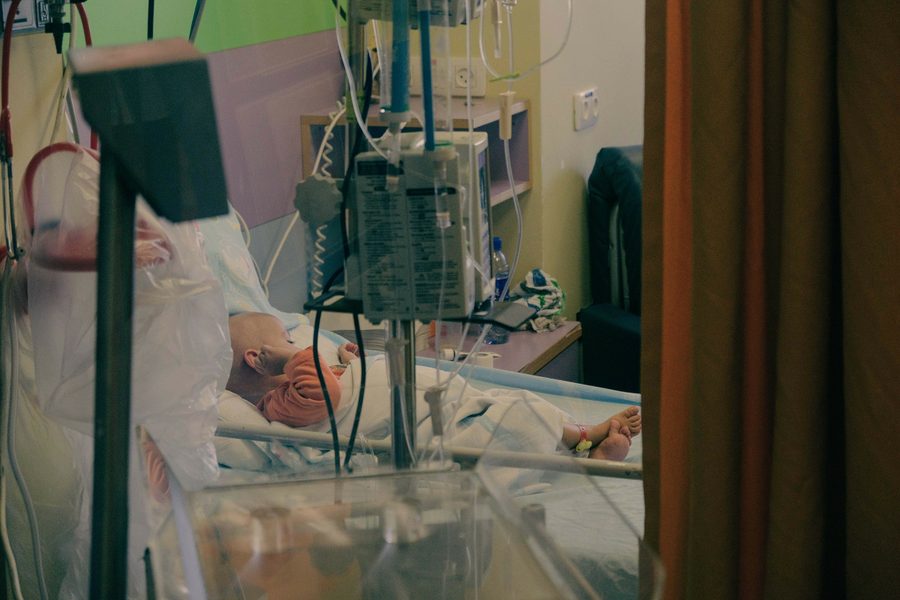
A Palestinian child from Gaza being treated in the Sheba Medical Center’s Pediatric Hemato-Oncology Institute during Israel’s 2014 assault on the Gaza Strip.
Nir Alon/ZUMA WireThe Gazans Trapped in Sheba Hospital
By showcasing its treatment of a few Palestinian patients, Israel masks its destruction of Gaza’s healthcare system—and its obligations under international law.
When I visited Khadija,[1] an elderly woman from northern Gaza, at Sheba Medical Center in the Tel Aviv suburb of Ramat Gan in late April, she told me her cancer treatment had been working. Going forward, she would only need a checkup every two months. But her improvement offered little solace. “Inshallah, after the next checkup, we will go home. To where? I don’t know,” she muttered as she scrolled through WhatsApp photos of flattened buildings and rubble sent by family and friends. Sitting on the opposite bed, her sister Naila flipped her phone screen toward me: The image was of a few sad-looking onions with numbers sharpied on them: 56, 39, 62—the astronomical cost, in shekels, for a single one.
Khadija and Naila live in a faded row of white British Mandate-era barracks that, for the last 21 months, have housed around 20 Gazan patients and select accompanying family members as the patients undergo treatment for chronic illnesses and rare forms of cancer. For Khadija, like for many other Gazan patients, Sheba was her last option: After being diagnosed with stage-three leukemia in May 2023, she went through a grueling process to obtain a medical permit to receive treatment at a hospital in the West Bank city of Nablus, where she traveled with her sister, the sole escort allowed by her permit. But her cancer was aggressive, and the hospital ran out of treatment options for her. She was directed to Sheba, where she arrived in August 2023 and where she has been stuck ever since. The sisters cannot go back to Gaza, nor can they leave the 200-acre hospital complex. Doing so—to grab a bite to eat, to visit a park, to sit at the sea a few miles away—would violate the strict terms of their permit. As is standard for medical permits granted to Gazans, their documents only cover the grounds of the hospital. Unable to return home, the patients and their families are now essentially imprisoned within the confines of Sheba.
Inside the hospital, the rhythms of life have taken on a strange normalcy—with critical limits. There are some activities that happen throughout the day, but participation has dwindled over time. Khadija once joined weekly workshops—yoga, drawing, handicrafts—led by Israeli and Palestinian volunteers. Now, she mostly stays in the courtyard, sitting in a lawn chair outside her door and quietly altering old clothes with a needle and thread. As for the ten or so Gazan children being treated at Sheba, aside from a few hours of English class each week, they have had no formal schooling since their hospitalization. They find ways to entertain themselves, always within the confines of the hospital. The children I met could effortlessly navigate to the hospital’s playground and small shopping center. But when I told them it was time for me to leave and asked them to point me toward the exit, they simply shrugged. One asked if I spoke Hebrew and suggested I ask a staff member.
Meals tend to be shared in the courtyard that adjoins the tiny apartments, but the hospital doesn’t provide food to the patients’ families. While some food donations come from Shefa ‘Amr, Tamra, and other Palestinian towns in northern Israel, most of the families’ provisions come from an elderly Jewish Israeli man named Buma Inbar, who has taken it upon himself to deliver fruit, vegetables, and pantry staples to the families. Inbar got involved in arranging medical care for Palestinians in Israel in 1995, after his son Yotam was killed in action in Lebanon and he connected to a group of bereaved Israeli and Palestinian families. “These meetings with bereaved Palestinian mothers really broke me . . . All of the sudden, I encountered the pain that was so familiar from home somewhere completely different,” Inbar told me.
Inbar’s act of charity, set against a backdrop of neglect, dramatizes the ethos guiding Israel’s treatment of Palestinian patients, in which altruism replaces obligation. This speaks to a much darker reality—one that complicates the story Israel tells about its humanitarian treatment of Palestinian patients. In late February 2024, a group of Israeli and Jewish physicians responded to South Africa’s International Court of Justice case accusing Israel of genocide by emphasizing that “thousands of Palestinians from [the West Bank and Gaza] receive care in publicly funded Israeli public hospitals.” But this narrative of benevolence falters in the face of a violent reality: For the Gazan patients at Sheba, medical care exists in the shadow of Israel’s systematic denial of Palestinian health rights and its utter devastation of Gaza’s healthcare infrastructure. The Sheba administration and Israel’s medical establishment have remained largely silent as Israel’s ongoing assault on Gaza has continued over the past 21 months. In some cases, they have gone further—calling on the Israeli military to bomb Palestinian hospitals, as “the residents of Gaza saw fit to turn hospitals into terrorist nests to take advantage of western morality,” in the words of a November 2023 open letter to military and political officials signed by dozens of Jewish Israeli doctors.
Focusing on the care provided to Palestinian patients helps sustain the illusion that Israeli institutions are graciously extending aid to a neighboring population. But as global health expert Yara Asi told me, this framing ignores the deeper power imbalance: “Israel and Palestine are not neighboring countries that need to help each other,” she said. “Often, Palestinians benefiting from medical treatment in Israel have no other option.” Moreover, Israel is required to provide medical care to the occupied Palestinian population under international law. By framing this treatment as a generous gesture, Israel repackages a legal obligation as an act of charity—and takes credit for addressing a crisis of its own making. “We take a few Palestinians, put them in [Israeli] hospitals, and then deny another 12,000 seriously injured the ability to leave, while destroying their entire medical system,” Neve Gordon, an Israeli professor of international human rights and humanitarian law at Queen Mary University in London, told me. “The fact that a few patients receive treatment in Israel then becomes a display of our supposed moral superiority.”
By framing treatment of Palestinians as generosity, Israel repackages a legal obligation as an act of charity—and takes credit for addressing a crisis of its own making.
Israel and its supporters have long pointed to the medical treatment of Palestinians from the West Bank and Gaza—as well as Syrians, Iraqis, and Lebanese—in its world-class hospitals as evidence of the state’s magnanimity. According to the World Health Organization and the medical NGO Project Rozana, prior to October 7th, Israel treated around 70 patients a day from Gaza, with a total of some 100,000 Palestinians from both Gaza and the West Bank receiving specialized treatment in Israeli and East Jerusalem hospitals every year. Sheba regularly treats Palestinians and other patients from countries with which Israel does not have diplomatic relations, promoting their work under the motto “hospitalization without borders.” The Edmond and Lily Safra Children’s Hospital at Sheba is particularly known for providing pediatric oncology and cardiac surgical treatment to Palestinian children—who, as of 2010 (the last year for which data was available), often made up one third of the patients being treated.
After October 7th, when Israel began arresting and deporting thousands of stranded Gazan workers, the fate of Gazan medical patients began to look similarly grim. In early November 2023, Israeli police arrested and expelled several patients from Gaza who were receiving care at the Makassed Hospital in East Jerusalem. Then, in March 2024, Israel’s security establishment ordered some 20 cancer patients, including children, who were undergoing treatment at Sheba to pack up within 24 hours to be bussed back to Gaza, claiming that their treatment had ended. Physicians for Human Rights–Israel (PHRI) quickly intervened, securing an injunction from the High Court to prevent the evacuation of Gazans being treated at Israeli hospitals.
The episode at Sheba underscored the tension between state officials and the Israeli doctors who have been treating Gazan patients, many of whom demonstrated in the lobby of Safra Children’s Hospital against the scheduled deportation. “Compassion over everything,” read the Hebrew sign held by protesters. As one doctor, who explained that his patient had indeed finished treatment but needed close monitoring, told Ynet: “We are here because we are treating [these patients] and cannot send them to their deaths . . . This is not our war, and the war is not with them.”
But beyond the callousness of sending sick children into a war zone, the doctors also mentioned something else: Israel was fumbling an opportunity to demonstrate its humanity to the world. “We all understand the immediate implications of [the patients’] return [to Gaza],” an anonymous source familiar with the details of the case told Ynet. “Their lives are at stake, but it’s also . . . a serious blow to Israeli hasbara,” the Hebrew term for state propaganda efforts. Noting that Gazan children at Sheba received permission to be there from the Ministry of Defense, the doctors argued that “if anything, this is the time for the State of Israel to seize an opportunity to be humane in the midst of a war situation.”
After being named a top ten hospital in the world by Newsweek in 2024—an accolade it again received in 2025, as Israel’s war on Gaza raged on—Sheba doubled down on its self-styled image of inclusivity and benevolence. The hospital’s Director General, Yitshak Kreiss, reiterated its “mission to provide healthcare without boundaries,” and championed the diversity of both the staff and patients: “Jewish and Arab personnel are working side by side 24/7 to save the lives of civilians and soldiers—Jews, Muslims, and Christians alike.” Commenting on a transplant performed on a young boy from Gaza following October 7th, he added: “Sheba is a hospital of peace and a symbol of coexistence where medical treatment is provided to everyone. We treat Palestinians, we cooperate with Palestinians, and we host Palestinians. We share the same fate.”
The involvement of Israeli doctors in treating Palestinians and the diverse makeup of Israeli hospital staff have often been used to whitewash the realities of military occupation. This practice, sometimes called “medical hasbara,” functions as a form of soft power that, as anthropologist Avram Bornstein has shown, aims to perpetuate Palestinian subordination. In the first decades of Israeli control over the West Bank and Gaza, those leading medical hasbara efforts framed the occupation as a force for modernization which introduced medical technologies, training programs, and immunization campaigns to Palestinian communities in the occupied territories. In more recent years, medical hasbara has shifted to counter claims of Israeli human rights abuses by spotlighting the permits Israel grants to Palestinians to travel to Israeli hospitals. “Israeli media, and especially COGAT [an Israeli military body that manages civilian control in the West Bank and Gaza], use the treatment of a very limited number of Palestinians, especially children, as a propaganda tool,” explained Aseel Abu Rass, the director of the occupied Palestinian territories department at PHRI. “Israel’s Foreign Ministry highlights these cases in meetings with UN and EU officials to say, ‘Look at the humanitarian gestures we’re making.’” This practice has continued into the current war, with the Israeli military boasting of its role in facilitating the medical evacuations of Palestinians who need treatment outside of Gaza, even as it spreads death, injury, and starvation in the Strip.
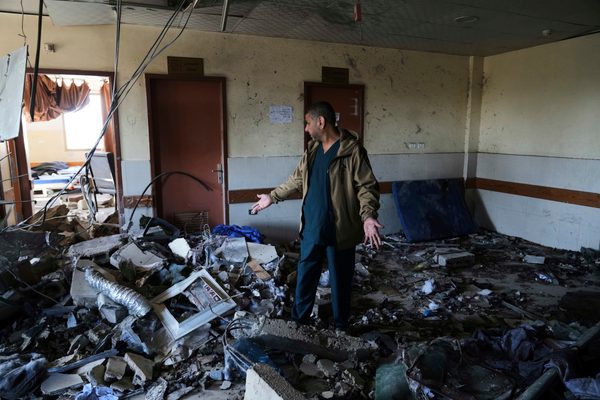
Dr. Marwan al-Hams, director of the Field Hospitals Department in Gaza, surveys the destruction inside the surgical building of Nasser Hospital, a day after it was struck by an Israeli airstrike in Khan Younis, Gaza Strip, March 24th, 2025.
It is precisely this contradiction that has overshadowed hasbarists’ best efforts. The scope of Israel’s destruction is particularly stark when considering attacks on hospitals, medical personnel, and patients: Between October 7th, 2023, and May 7th, 2025, Israeli forces struck 122 health facilities and 180 ambulances in Gaza in 686 separate attacks. Seven mass graves have been found inside medical complexes. More than 1,400 medical workers have been killed. Earlier this month, Israeli forces killed Marwan Al-Sultan, the director of the Indonesian Hospital in northern Gaza, along with his family, making him the 70th healthcare worker to be murdered in a span of 50 days. Hundreds of other Palestinian healthcare workers have been detained and tortured, some to death, in Israeli prisons and detention camps. Hussam Abu Safiya, head of pediatrics at Kamal Adwan Hospital, for example, has been held without charge for more than six months. His lawyer told +972 Magazine that Abu Safiya was “attacked brutally and savagely” by prison guards last month and appears to have lost close to 90 pounds; his colleagues say they fear for his life. Doctors in Gaza who have not yet been killed or kidnapped must provide medical care without gloves, hand soap, running water, and sometimes even anesthetics or electricity. They have had patients killed in their hospital beds by Israeli blasts and have treated countless young children with high velocity bullets in their heads or chests. As Mimi Sayed, an emergency medicine physician who deployed to Gaza twice over the past year, testified at the recent Sarajevo Gaza Tribunal: “I have seen more brain matter out of the skulls of small children due to shrapnel injuries than I ever thought possible in my lifetime.”
As Israel’s military continues to inflict untold damage on Gaza’s health infrastructure, its medical establishment has spoken out only tepidly and indirectly. In May 2025—a month after Israeli forces executed 15 medics in Rafah, and with the official Palestinian death toll surpassing 53,000—the Israel Medical Association (IMA), which represents 95% of physicians in Israel, issued a terse statement calling for the safe passage of humanitarian aid to “innocent civilians.” (Notably, the word “Gaza” does not appear once in the statement.) But even this mild appeal was couched in language echoing Israeli military claims that Hamas operates out of health facilities. On June 19th, after an Iranian ballistic missile struck Soroka Hospital in Be’er Sheva, the IMA reiterated these claims. “Unlike many hospitals in Gaza which have tragically been conscripted by Hamas, the strike on Soroka is an entirely unjustified attack on civilians,” Zion Hagay, president of the association, wrote in a request to the World Medical Association to condemn the strike. Later, in response to a PHRI newsletter that both criticized the missile strike on Soroka Hospital while also stressing the need to protect medical facilities in Gaza, Hagay wrote a sharply-worded letter to PHRI director Guy Shalev, a copy of which PHRI provided to Jewish Currents. Hagay explained that while he agreed that “every life is precious,” it was also a fact that “a hospital is not always a hospital.”
The reticence of Israeli medical leadership is underscored by how openly the country’s hospitals have embraced their role in supporting the war. Sheba’s website and social media pages post regular updates on how the hospital has stepped up its activities during “Operation Iron Swords,” the Israeli military’s name for the war on Gaza. The hospital touts the frontline role of Sheba’s trauma unit in treating injured Israeli soldiers, the importance of whole blood transfusions in reducing battlefield fatalities, and its work providing simulation-based training to military medics and doctors on army bases at the Gaza border before they enter the Strip. (This wartime posture is not new: Before Sheba was repurposed for civilian use in 1953, it was Israel’s “Military Hospital Number 5.”)
“Sheba is integrated with the Israel Defense Forces,” its American philanthropic counterpart explains. “Supporting the IDF” is one of the nonprofit’s six core principles, among others that include “humanitarian missions” and “fostering coexistence.”

The cover of a July 2024 issue of the Rambam hospital magazine.
Sheba’s messaging is not limited to treating the injured. The hospital “support[s] our doctors who have been called up or volunteered to join the forces,” according to the caption of a YouTube video released in early 2024. Its American philanthropic counterpart, founded in the early 1970s, is decidedly less subtle: “Sheba is integrated with the Israel Defense Forces,” it explains, noting that the hospital houses Israel’s National Center for the Rehabilitation of Injured Soldiers. “Supporting the IDF” is one of the nonprofit’s six core principles, among others that include “humanitarian missions” and “fostering coexistence.” Two hours north of Sheba, at Rambam Hospital, Haifa’s largest medical center, the patriotic sentiment is no less strong. The 2024 issue of the hospital’s magazine declares that since October 7th, the hospital’s management and staff have demonstrated a “united front and commitment to the national cause.” In a section titled “From Military Uniform to Hospital Scrubs,” the publication features a few of the hundreds of physicians who transitioned back and forth between their roles as civilian doctors and soldiers. “Rambam’s medical ‘superheroes’ fight on two fronts,” it boasts. As Abu Rass explained, “The army is intertwined in all aspects of Israeli life. Many senior Israeli doctors, including those who hold high positions in the IMA, are reserve officers or military doctors.” Because of this, she was unsurprised by the Israeli medical establishment’s silence. “They’ve always used the language and logic of the Israeli military,” she said, recalling a case from August 2022, when an unusually high number of parents were denied permits to accompany their children to medical treatment outside of Gaza. “We sent a letter to the IMA, asking them to condemn the policy. But instead of addressing the children’s inability to leave [the Strip without their parents], they echoed the military’s line—blaming Hamas for using the children as human shields.”
When I spoke with Raz Somech, an Israeli physician at Sheba who has treated hundreds of Palestinian children with genetic diseases, he expressed not just a continued commitment to his Palestinian patients but also a deep sense of pride. Over decades of work, Somech has built enduring relationships with Palestinian families and doctors across Gaza and the West Bank. Toward the end of our conversation, he handed me a printed copy of an article he published in April 2024 in the Journal of Clinical Immunology, titled “Was It All for Nothing?,” in which he describes a recent collaboration with Palestinian colleagues to implement a newborn screening program for certain genetic conditions. “It was clear to us that helping our Palestinian neighbors in Gaza is what we should do—for patients, for us, for decent values as human beings, and as doctors,” he wrote. The October 7th attacks, however, shook him. “I am deeply saddened by the fact that this violence and bloodshed has made me question the bridges we have built. Was it all a farce? Was it all for nothing?” His answer is no. “I still believe that, on both sides, we, as doctors and colleagues, should promise to continue treating everyone,” he writes.
And yet, within Somech’s anguished question—“Was it all for nothing?”—is the suggestion that medical professionals who treat Palestinian patients and nurture professional relationships with their doctors are “going the extra mile” in an act that may exceed their professional duties. In the context of increasing Israeli racism and repeated cases of Israeli practitioners refusing to provide medical care to Palestinian prisoners, the continued commitment of Somech and others like him to treating Palestinians can appear brave or morally commendable in contrast. But, in reality, withholding care or severing cooperation would be a serious violation of Israel’s obligation under international law to provide for the health and welfare of Palestinians living in the territory it occupies. As then-UN Special Rapporteur Michael Lynk reminded the UN General Assembly in October 2020, following reports from health officials in Gaza about shortages of lab equipment, medications, and supplies to treat COVID-19, “Israel as the occupying power has the primary responsibility to ensure respect, protection, and fulfillment of the right to health of Palestinians in Gaza,” in accordance with Article 56 of the Fourth Geneva Convention. That is, when Sheba uses the slogan “hospitalization without borders” it is taking an Israeli legal obligation and recasting it as a humanitarian favor. As Abu Rass pointed out to me, the fact that the Palestinian Authority (PA) foots the bill when Palestinians are treated in Israel is a further dereliction of Israel’s duty. “As an occupied population, all Palestinians should receive medical treatment as a matter of right, not be charged as if they were foreign patients,” she said.
Israel’s failure to uphold Palestinians’ right to health goes back decades. Following the occupation of the West Bank and Gaza in 1967, Israel revealingly placed Palestinian healthcare under the Israeli Ministry of Defense, rather than the Ministry of Health. As the founder of PHRI, Ruchama Marton, has observed, Israel intentionally created a reality of Palestinian dependency on Israeli health services through the use of severe budget restrictions, referrals to Israeli hospitals for specialized care, and restrictions on licenses for new medical projects, ensuring that Palestinian healthcare remained stunted and underdeveloped. In the decades that followed, Palestinians living under occupation, especially children, suffered from high levels of infectious diseases and malnutrition disorders, and many died from treatable health maladies.
Then in the mid-1990s, as part of the processes surrounding the signing of the Oslo Accords, the Palestinian Ministry of Health (MoH) was established, offering new hope for the development of Palestinian healthcare. Between 1994 and 1998, donors committed $353 million to rebuild the ailing sector, disbursing about half that amount to build new hospitals and primary care clinics across the West Bank and Gaza. The plan was for the new MoH, in tandem with other nascent Palestinian institutions, to assume more and more responsibilities over the following five years as part of the process of establishing a Palestinian state. But part of the problem, explained Gordon, who worked closely with Palestinian negotiators, was that the Palestinian delegation, under pressure from Israel and eager to prove their own sovereignty, “accepted taking on the medical system without any conditions.” After decades of Israeli control, the system they inherited was severely deficient—yet there were no Israeli commitments to help rebuild the sector it had destroyed over the previous years or to ensure the freedom of movement for medical professionals and patients that would be necessary going forward.
Since the failure of Oslo, Israel has maintained effective control of the occupied Palestinian territories, including over its external borders and thus over all international trade, while local Palestinian authorities—currently the PA in the West Bank and Hamas in Gaza—exercise limited sovereignty. Thus, Israel formally washed its hands of responsibility for Palestinians’ healthcare by handing it over to Palestinians, but retained ultimate control over the movement of patients, medical personnel, and supplies. In the case of Gaza, the stringent air, land, and sea blockade that Israel has imposed on the enclave since 2006 has severely limited Gaza’s ability to import medical technology, especially tools for advanced imaging like PET and CAT scanners. Asi noted the restrictions include some raw materials——concrete, wires, and pipes—needed to even construct a hospital building. All of this, Asi explained, “created an artificial health deficit in Gaza that could only be filled by applying for Israeli permits to train or get care in Israel.”
The process of obtaining a medical permit is opaque and cumbersome: For a patient from Gaza, for instance, local physicians must refer patients to an Israeli military body that files the request with the Israeli authorities for an entry permit. Some applicants are then summoned for interrogation at Erez Crossing by the Shin Bet, Israel’s national security agency. At any point in the application process, the patient may be refused without explanation. Their family members, including the parents of sick children, may also be denied a permit to accompany them. (Because of this, the medical permit system has historically been a key way that Israel recruits collaborators, as the Shin Bet pressures people to provide intelligence in exchange for access to life-saving treatment for their loved ones.) According to the World Health Organization, between 2008 and 2022, over 70,000 permit applications—around 30%—from Gaza were denied. Even more patient companion applications—nearly 115,000, representing 44% of requests—were delayed or denied in the same period. This has deadly consequences: Cancer patients from Gaza whose permits for chemotherapy or radiation were initially delayed or denied between 2015 and 2017 were 1.5 times less likely to survive. “There are hundreds of people every month who don’t get access to life-saving care—surgeries, cancer treatments,” said Abu Rass. “Not letting them out is basically a death sentence.”
Once the Oslo Accords transferred formal responsibility for healthcare from Israel to the PA, targeting medical infrastructure no longer carried the same political or legal weight. This ethos laid the groundwork for the current decimation of Gaza.
In addition to codifying the permit regime, the Oslo Accords marked a turning point in the Israeli military’s approach to Palestinian medical infrastructure. Prior to Oslo, Israel had largely avoided bombing hospitals and clinics—not out of goodwill, but because it was directly responsible for the institutions providing health services to Palestinians. “Even if the infrastructure was minimal or underdeveloped, it was the mechanism through which Israel fulfilled obligations set forth in international law,” Gordon explained. “Destroying it would have meant dismantling Israel’s own tool of governance.” But once Oslo transferred formal responsibility for healthcare to the PA, that impediment dissolved. What followed was a shift in practice and mindset: Targeting medical infrastructure no longer carried the same political or legal weight. This new ethos laid the groundwork for the current decimation of Gaza, in which the destruction of the healthcare system is not collateral damage, but a deliberate, punitive strategy.
If it was mostly advanced care that was nonexistent in Gaza before October 7th, Israel’s continued assault on the Strip has rendered Gaza’s medical system largely nonfunctional. Between October 7th, 2023, and mid-April 2024, more than 7,200 Palestinians were medically evacuated from Gaza to other countries, including Egypt, Qatar, Algeria, Turkey, and several EU states. The majority of these patients are being treated for trauma injuries, while hundreds of others are suffering from cancer, as well as cardiovascular and blood diseases. Twelve thousand Palestinians, many of whom are severely wounded, ill, and malnourished, are currently awaiting treatment they cannot get inside Gaza. But the line between those in urgent need of medical evacuation and the rest of Gaza’s population is quickly fading. Hunger is widespread, and illness is rampant. People are now collapsing on the streets—and dying—from starvation. According to Gaza’s Ministry of Health, in a single 24-hour period this week, 18 people died from famine.
Only a few dozen miles separate that reality from the daily rhythms at Sheba, where life carries on, even through sorrow. Gazan mothers and their children sit and chat in the courtyard, sipping orange soda, playing endless rounds of Connect Four, and chasing each other in “al-ghumayda” (hide-and-seek). One afternoon, a Palestinian restaurant owner from Jaffa stopped by, delivering a bundle of fresh fish to the Gazan families. I watched as the mothers prepared the whole denise fish in a traditional Gazan spice blend, serving it with dagga, a fiery sauce of crushed green chiles, garlic, and lemon—a visceral reminder of an unreachable home.
There is no question that Sheba’s walls are safer than anywhere in Gaza. But physical safety doesn’t ameliorate the pain of having been cut off from family for almost two years. Many of the Gazans at Sheba have lost relatives, and contact with other loved ones has been reduced to evening phone calls. Often, when Naila handed me the phone to introduce a relative in Gaza, I’d find them sitting in the dark, without any electricity. But despite the horrors happening back home that they witness through their screens, many of the patients I spoke to expressed a fervent desire to return. “I cannot put into words what our families in Gaza are going through,” said Iman, who accompanied a grandchild receiving cancer treatment at Sheba. “Still, we ask God every day to let us go back home. My granddaughter wants to go back to her house, to sit on her bed.”
One evening visit, my conversation with Naila, Khadija, and a few others was cut short by the wail of an air raid siren—an incoming projectile, likely launched from Yemen. In a quiet panic, I scanned their faces for direction, assuming we would all hurriedly shuffle over to the nearest shelter. “Where do you all go?” I squeaked. Naila smiled gently, almost sheepishly. “We don’t go anywhere,” she said. Sensing my unease, she motioned toward a mobile safe room. I booked it and stood inside with a few Jewish Israelis. When I returned to the picnic table a few minutes later, the women were sitting exactly as I’d left them.
If most of the Gazan patients were able to ignore the missiles launched intermittently from Yemen, the same could not be said for the ballistic missiles from Iran in June—a number of which landed in various neighborhoods of Ramat Gan, near the hospital. “This time we always went to the shelters. We were genuinely scared, especially for the children,” said Rama, whose ten-year-old daughter is being treated for cancer. Some children were so frightened by the escalation that they had vomited. “The young children were quite traumatized by the sirens, perhaps more than the booms of the interceptions or the missiles themselves,” she told me. “We don’t have such sirens in Gaza.”
Pseudonyms are being used for all Palestinian patients to protect their safety.

I’m Arielle Angel, editor-at-large of Jewish Currents. Before you go, there’s something I need to ask.
We’ve seen over and over how the mainstream media falters in telling stories on our beats—whether it’s antisemitism, Israel/Palestine in American politics, Jewish identity, or the American left. At Jewish Currents we’re committed to uncompromising analysis and longform reporting on these issues and more—stories you won’t find anywhere else. In a media landscape that obscures injustice and flattens discussion, we’re changing the conversation. But we need you.
If you believe in this work, please consider making a donation—or even better, a recurring one—to ensure that we are able to keep publishing stories like this one. We can’t do it without you.

Dikla Taylor-Sheinman is an editor and writer at +972 Magazine based in Jerusalem.